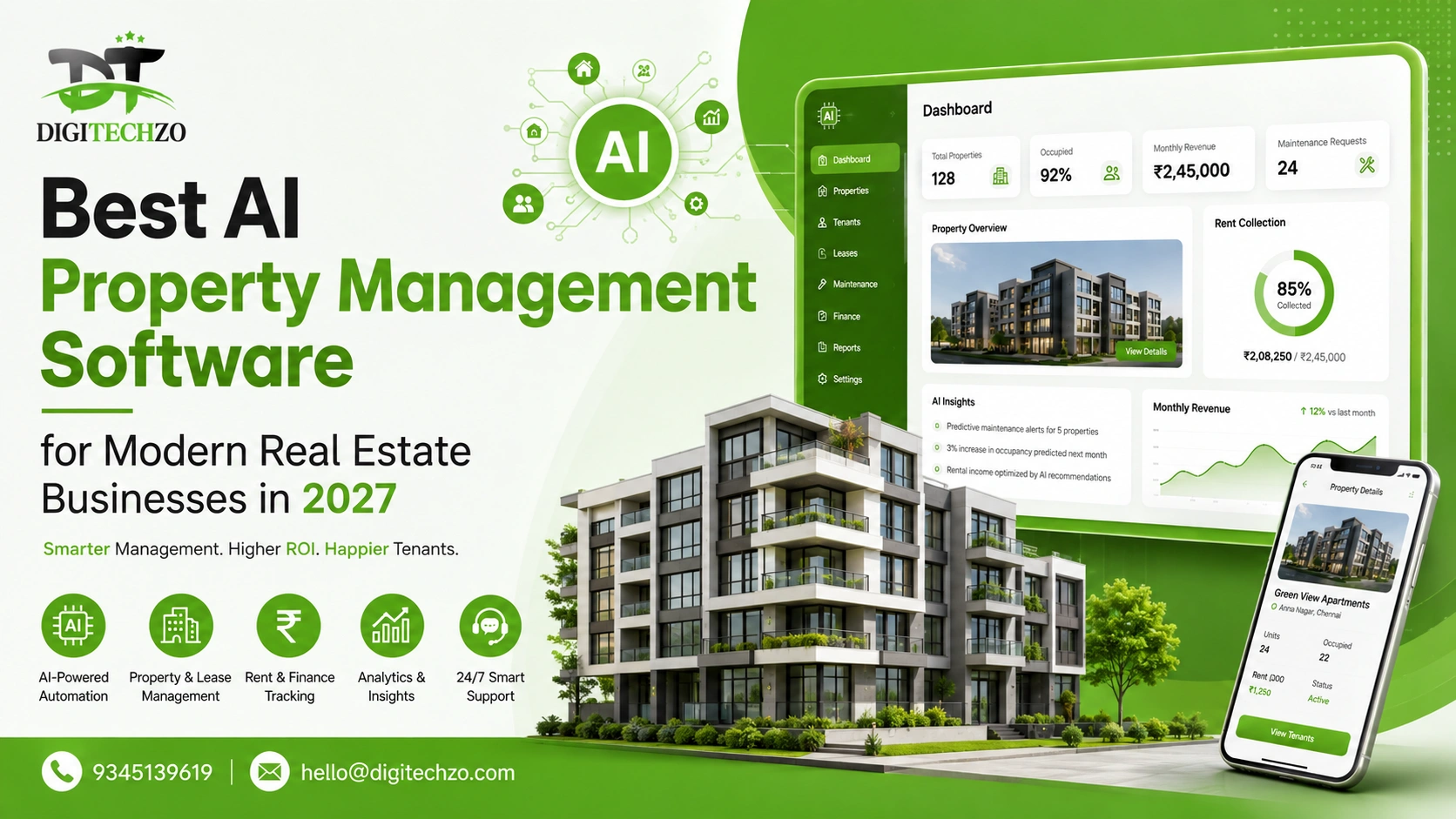
Every property manager knows the 2 a.m. maintenance call, the spreadsheet that doesn't reconcile, and the tenant screening that takes three days too long. If you're still running a growing rental portfolio on manual workflows, you're not just losing time — you're losing money and tenants to competitors who moved faster. That's exactly why AI Property Management Software has gone from "nice to have" to the operational backbone of every serious real estate business heading into 2027.
At Digitechzo, we've spent years helping property management companies and real estate operators evaluate, implement, and get real ROI from software — not just install it and hope for the best. This guide distills that hands-on experience into a no-fluff buying framework, so you choose the right platform the first time.
The best AI Property Management Software in 2027 combines automated rent collection, AI-driven tenant screening, predictive maintenance, and smart communication tools in one platform. Top picks vary by portfolio size, but the winning formula is always the same: less manual work, faster decisions, and fewer vacancies. Below, we rank the leading options, break down real costs, and show you exactly how to evaluate any tool against your business.
What Is AI Property Management Software?
AI Property Management Software is a category of real estate technology that uses artificial intelligence — machine learning, natural language processing, and predictive analytics — to automate the day-to-day operations of managing rental properties. This includes tenant screening, rent collection, lease management, maintenance coordination, and financial reporting.
Unlike traditional property management systems that simply digitize paperwork, AI Property Management Software actively makes decisions and predictions. It flags a tenant likely to default before the first missed payment. It schedules a maintenance technician before a small leak becomes a $10,000 repair. It answers a prospective tenant's inquiry at 11 p.m. without a human ever touching the keyboard.
In short: traditional software stores your data. AI Property Management Software acts on it.
Why 2027 Is a Turning Point for Property Management Technology
Three forces are converging right now, and they explain why property managers who delay adoption are falling behind:
- Labor costs keep climbing while tenant expectations for instant response keep rising — AI is the only way to close that gap without ballooning headcount.
- Portfolios are getting more distributed. Managers overseeing units across multiple cities or states can no longer rely on local knowledge and manual spreadsheets to catch problems early.
- Tenants now expect a "digital-first" experience — self-service portals, instant maintenance requests, and AI chat support — the same way they expect it from banking or retail apps.
From our work advising real estate operators at Digitechzo, the pattern is consistent: companies that adopted AI Property Management Software early reduced vacancy days, cut down on late payments, and freed up staff to focus on retention and growth instead of firefighting.
Core Features to Look For
Not all tools branded as "AI Property Management Software" actually use AI meaningfully. Some just slap the label on a rules-based automation engine. Here's what genuinely intelligent software should offer:
AI-Powered Tenant Screening
Goes beyond a credit score pull — analyzes rental history patterns, income verification signals, and behavioral risk indicators to predict reliability.
Predictive Maintenance
Uses historical repair data and, where integrated, IoT sensor data to flag issues (HVAC failure, plumbing wear) before tenants even file a request.
Automated Rent Collection & Late-Payment Prediction
Identifies tenants at risk of late payment based on patterns and proactively sends reminders or offers flexible payment plans — reducing collection costs.
AI Chatbots and Virtual Leasing Assistants
Handle prospect inquiries, schedule tours, and answer FAQs 24/7, dramatically shortening lead response time — a metric directly tied to lease conversion.
Dynamic Pricing and Market Analysis
Continuously scans comparable listings and demand signals to recommend optimal rent pricing, similar to revenue management tools used in hospitality.
Financial Reporting and Forecasting
Automatically reconciles books, flags anomalies, and forecasts cash flow — reducing reliance on manual bookkeeping.
Integration Ecosystem
The best AI Property Management Software connects with accounting tools, listing syndication platforms, smart locks, and payment processors without custom development.
Top AI Property Management Software Options Compared
| Category Fit | Best For | Standout AI Capability | Pricing Model |
|---|---|---|---|
| Enterprise Portfolios | 200+ units, multi-market | Predictive maintenance + portfolio-wide analytics | Per-unit, custom enterprise pricing |
| Mid-Size Property Managers | 20–200 units | AI screening + automated leasing workflows | Per-unit monthly subscription |
| Small Landlords / Growing Portfolios | 1–20 units | AI rent collection + chatbot leasing assistant | Flat monthly fee or free tier + add-ons |
| Commercial Real Estate | Office, retail, mixed-use | AI lease abstraction + tenant risk scoring | Custom quote based on square footage |
How to read this table: Don't chase the "best-rated" tool overall — chase the one built for your portfolio size. A tool designed for enterprise REITs will overwhelm a 10-unit landlord with unnecessary complexity and cost, while a lightweight small-landlord tool will buckle under a 300-unit portfolio's reporting demands.
Pros and Cons of AI Property Management Software
Pros
- Cuts manual admin work by automating screening, communication, and rent collection
- Reduces vacancy periods through faster leasing response and dynamic pricing
- Lowers maintenance costs via predictive alerts instead of reactive repairs
- Improves tenant retention with faster, more consistent communication
- Scales without proportional headcount growth
Cons
- Upfront learning curve for staff used to manual processes
- AI screening models need regular auditing to avoid bias in decision-making
- Integration with legacy systems can require IT support
- Subscription costs add up across large, multi-tool tech stacks
- Over-reliance on automation without human oversight can lead to tenant relationship gaps
How to Choose the Right Platform for Your Portfolio
Step 1: Audit Your Current Pain Points
Before you even look at a demo, list your top three operational bottlenecks — is it late rent, slow leasing, or maintenance chaos? The right AI Property Management Software should directly solve your biggest pain point first, not the vendor's flashiest feature.
Step 2: Match Software to Portfolio Size
A 15-unit landlord and a 500-unit REIT have almost nothing in common operationally. Choosing enterprise-grade AI Property Management Software for a small portfolio wastes budget; choosing a lightweight tool for a large one creates data bottlenecks.
Step 3: Test the AI, Not Just the UI
Ask vendors specific questions: How does the screening model handle thin-file applicants? How far in advance does predictive maintenance flag issues? A polished interface means nothing if the AI underneath is shallow.
Step 4: Check Integration Depth
Confirm the software connects natively with your accounting system, listing sites, and payment processor — not through clunky third-party workarounds.
Step 5: Calculate True ROI, Not Just Sticker Price
Factor in reduced vacancy days, lower eviction/legal costs from better screening, and staff hours saved — not just the monthly subscription fee.
Real-World Use Cases and Scenarios
Scenario 1: The Multi-City Portfolio Manager A property manager overseeing 180 units across three states was spending hours weekly reconciling maintenance requests submitted by phone, text, and email. After adopting AI-driven maintenance triage, requests were auto-categorized by urgency and routed to the nearest available vendor — cutting average resolution time significantly and reducing tenant complaint volume.
Scenario 2: The Small Landlord Scaling Up A landlord growing from 6 to 25 units hit a wall managing screening and rent collection manually. AI-powered screening cut applicant review time from days to hours, while automated late-payment prediction let them proactively offer payment plans — reducing evictions and preserving tenant relationships.
Scenario 3: The Commercial Real Estate Firm A commercial operator used AI lease abstraction to extract key terms (renewal dates, escalation clauses) from hundreds of legacy PDF leases in a fraction of the time manual review would take, eliminating missed renewal deadlines that had previously cost thousands in lost negotiating leverage.
Common Mistakes to Avoid
- Choosing software based on brand recognition alone, without testing it against your actual workflows
- Ignoring data migration complexity — moving years of tenant and lease history into a new system is often underestimated
- Skipping staff training, which leads to underused features and wasted investment
- Failing to audit AI screening for compliance, especially around fair housing regulations
- Overbuying features you won't use for 12+ months, inflating cost without added value
- Not setting a clear rollout timeline, causing indefinite "we'll switch eventually" delays that cost real money
Expert Tips for a Smooth Rollout
- Run a pilot on a subset of units first. Test the AI Property Management Software on 10–15% of your portfolio before a full migration.
- Keep a human-in-the-loop on AI screening decisions, at least initially, to catch edge cases the model misses.
- Set measurable KPIs before rollout — average days vacant, maintenance resolution time, late-payment rate — so you can prove ROI with data, not opinion.
- Negotiate a trial period with real data, not a sandbox demo, so the AI's predictions reflect your actual portfolio behavior.
- Revisit your tech stack every 12 months. AI Property Management Software evolves fast — a tool that led the market two years ago may now lag behind.
Frequently Asked Questions
Is AI Property Management Software worth it for small landlords?
Yes, for landlords with even 5–10 units, AI Property Management Software pays for itself through faster tenant screening, automated rent reminders, and reduced vacancy time, often outweighing the subscription cost within a few months.
How does AI Property Management Software improve tenant screening?
It analyzes broader risk signals — payment history patterns, income verification consistency, and behavioral data — rather than relying solely on a credit score, resulting in more accurate approve/deny decisions.
Can AI Property Management Software replace a property manager entirely?
No. It automates repetitive tasks like screening, rent reminders, and maintenance triage, but strategic decisions, tenant relationships, and legal judgment calls still require human oversight.
What's the average cost of AI Property Management Software?
Pricing typically scales per unit per month, ranging from a few dollars per unit for small landlords to custom enterprise pricing for large portfolios — always weigh cost against time and vacancy savings, not sticker price alone.
Is AI-based tenant screening legally compliant?
It can be, but only if the platform is regularly audited for fair housing compliance. Always ask vendors how their AI model is tested for bias before adopting it.
Why Choose Digitechzo for AI Property Management Software in 2027?
Choosing the right AI property management software is no longer just about features — it’s about building an operational system that can handle growth without adding complexity. As portfolios expand, the gap between having software and having the *right* system becomes increasingly visible in missed opportunities, delayed responses, and inefficient workflows.
Digitechzo approaches this challenge as both a technology and business problem. As an AI Development Company, the focus is on helping real estate businesses evaluate platforms based on real operational needs, then enhancing them with AI-driven automation, integrations, and custom workflows where standard solutions fall short. This ensures your system reflects how your team actually works, not how software vendors assume you should.
The outcome is a leaner, more responsive operation — where lead handling is consistent, tenant communication is proactive, and decision-making is supported by real-time data instead of guesswork.
Digitechzo works as a practical implementation partner, helping you move from comparison to a system that’s built to scale with your business in 2027 and beyond.