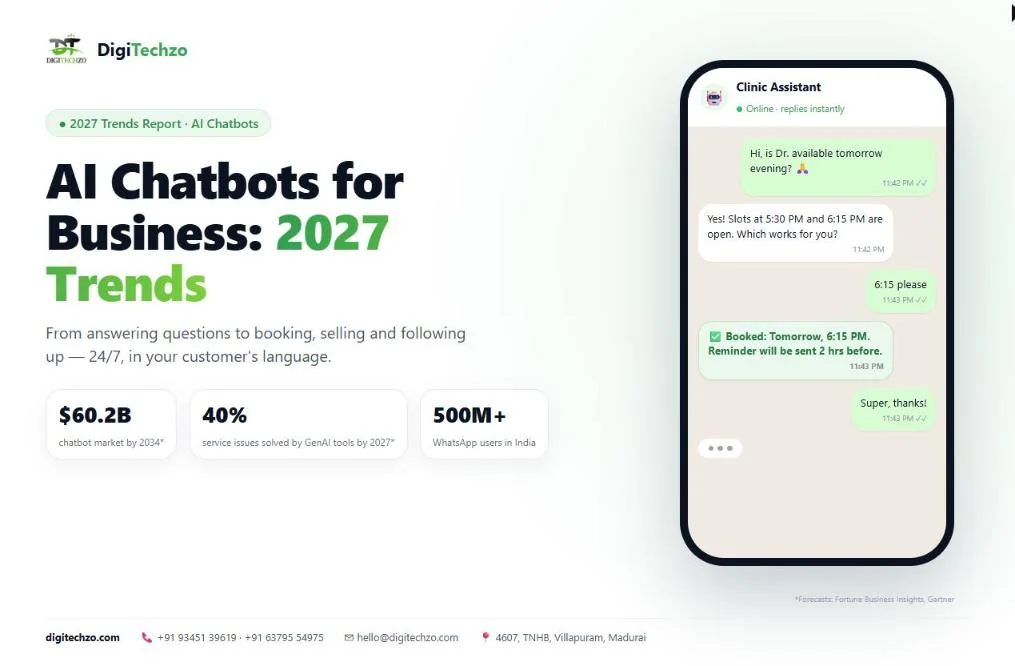
A few years ago, a "chatbot" meant a clunky pop-up that answered three questions and then said "Sorry, I didn't understand that." Heading into 2027, that picture has changed completely. Modern AI chatbots understand natural language, answer from a company's own documents, book appointments, qualify leads and hand over to a human when they should.
This guide looks at where AI chatbots for business actually stand today, what the research firms expect for 2027, where they deliver real value, and what to watch out for before you build one.
What Is an AI Chatbot?
A chatbot is software that holds a conversation with a person through text or voice. Older chatbots were rule-based: they followed fixed decision trees and keyword matches. Today's AI chatbots are built on large language models (LLMs), which let them understand intent, handle follow-up questions and reply in natural language.
The real shift for businesses came from connecting these models to company data. A technique called retrieval-augmented generation (RAG) lets a chatbot look up answers in your own product catalogue, policies or knowledge base instead of guessing. (If you want a plain-English explanation, our article RAG Explained for Business Leaders walks through it.)
Rule-based vs AI chatbots at a glance
| Rule-based chatbot | AI chatbot | |
|---|---|---|
| How it answers | Fixed scripts and buttons | Understands free-text questions |
| Knowledge | Only what was scripted | Your documents, catalogue, FAQs (via RAG) |
| Handles follow-ups | Poorly | Yes, keeps context |
| Languages | One script per language | Many languages from one setup |
| Can take actions | Limited | Book, update CRM, create tickets (with integrations) |
AI Chatbot Market: The Numbers Heading Into 2027
Market estimates vary between research firms because they define "chatbot" differently, but the direction is consistent: strong, sustained growth.
- Market size: Fortune Business Insights values the global chatbot market at USD 8.37 billion in 2025, rising to USD 10.42 billion in 2026, and projects it to reach USD 60.21 billion by 2034 at a CAGR of about 24.5% (source). That puts 2027 squarely in the steep part of the curve.
- Customers are already using AI elsewhere: Gartner predicts that by 2027, 40% of all customer service issues will be fully resolved by "unofficial" third-party GenAI tools such as ChatGPT and Google AI Overviews (Gartner). In other words, if your business doesn't give customers a good AI answer, a general-purpose AI will try to answer for you.
- Chat overtakes traditional channels: A Gartner survey of 265 customer service leaders found that self-service and live chat are expected to surpass traditional channels as the top customer service technologies by 2027 (Gartner).
- Humans aren't going away: Gartner also predicts that by 2027, half of the organisations that planned big service headcount cuts because of AI will drop those plans, and that by 2028 none of the Fortune 500 will have fully eliminated human customer service (Gartner).
Note: figures for 2027 and beyond are forecasts from the named firms, not measured results.
Why India is a special case
For Indian businesses, the chatbot conversation is really a WhatsApp conversation. India is WhatsApp's largest market by far, with well over 500 million users (Statista), and Meta's India leadership has publicly called business messaging and WhatsApp its "next engine of growth" in the country. Customers here already expect to message a business, not fill in a form.
Enterprise adoption is moving too. The EY–CII report The AIdea of India: Outlook 2026 found that 47% of Indian enterprises already have multiple GenAI use cases live in production (EY). Customer-facing chat is one of the most common starting points because the return is easy to measure.
Seven AI Chatbot Trends to Watch in 2027
1. From answering to acting
The biggest change is that chatbots are becoming AI agents: instead of only answering "what are your timings?", they book the slot, update the CRM and send the confirmation. Udhaya Prakash, Founder at Digitechzo, wrote about why many of these projects stall and how to make one actually work in AI Agents for Small Businesses in India. For a broader overview, see AI Agents for Business: What They Actually Do.
2. One conversational channel instead of many
Gartner predicts that by 2028, 30% of Fortune 500 companies will offer service only through a single AI-enabled channel that handles text, images and voice (Gartner). Expect 2027 to be the year many companies start consolidating scattered email, phone and chat queues into one smart front door.
3. Multimodal chat
Customers will increasingly send a photo of a damaged product, a screenshot of an error or a voice note, and expect the bot to understand it. Models that read images and audio make this practical for ordinary businesses, not just large enterprises.
4. Voice comes back
AI voice agents that sound natural are bringing chatbots onto the phone line, which matters in markets where many customers still prefer to call. The same knowledge base can power both chat and voice.
5. Regional languages by default
LLM-based chatbots can reply in Tamil, Hindi, Telugu and other languages from a single setup. For Indian businesses selling beyond metros, this removes one of the biggest barriers to automation.
6. Being visible to other AIs
Since customers increasingly ask ChatGPT, Gemini or Google AI Overviews first, businesses will need accurate, structured information on their own websites so those assistants describe them correctly. Your own chatbot and your public content should tell the same story.
7. Trust, privacy and clear hand-off
India's Digital Personal Data Protection Act, 2023 raises the bar on how customer data is collected and stored. Good chatbots in 2027 will be explicit about what they store, avoid guessing, and pass the conversation to a human when a question is sensitive or the customer asks.
Real Use Cases of AI Chatbots for Business
| Industry | What the chatbot does | Typical result to track |
|---|---|---|
| E-commerce / D2C | Product questions, order tracking, return requests, cart recovery on WhatsApp | Fewer support tickets, recovered carts |
| Clinics and hospitals | Appointment booking, reminders, pre-visit instructions, follow-ups | Fewer no-shows, less front-desk load |
| Real estate | Answer project details 24/7, qualify budget and location, schedule site visits | More qualified site visits |
| Education and coaching | Course enquiries, fee details, batch timings, admission follow-ups | Faster enquiry-to-admission |
| Restaurants | Menu questions, table bookings, order status | More direct bookings |
| B2B services | Lead qualification on the website, meeting booking, FAQ handling | Response time, meetings booked |
If you are thinking about WhatsApp specifically, our guide to WhatsApp Business API automation, setup and pricing covers the practical side.
How an AI Chatbot Works (Step by Step)
- Channel: The customer writes on your website, WhatsApp, Instagram or app.
- Understanding: The language model works out what the customer actually wants, even if the message is informal or mixed-language.
- Knowledge lookup: The bot searches your approved content (catalogue, policies, FAQs) using RAG, so answers stay grounded in your data.
- Action: Through integrations, it can check order status, book a slot or create a lead in your CRM.
- Guardrails: Rules stop it from inventing prices or promises and decide when to escalate.
- Human hand-off: Complex or sensitive conversations move to your team with the full chat history.
- Learning loop: Unanswered questions are reviewed and added to the knowledge base every week.
What Does an AI Chatbot Cost?
Cost depends far more on scope than on the AI model itself: how many channels, how many integrations, how much data needs cleaning and how many languages. A simple FAQ bot and a WhatsApp agent that books appointments and updates a CRM are very different projects. We break down the real cost drivers in AI Chatbot Development Cost: What Actually Drives the Price.
Common Mistakes to Avoid
- Launching without clean content. A chatbot is only as good as the information behind it.
- No human escape route. Customers get frustrated fast if they can't reach a person.
- Automating everything at once. Start with the two or three questions that make up most of your volume. Our list of business workflows to automate first is a good starting point.
- Not measuring. Track resolution rate, hand-off rate, response time and leads or bookings created.
- Ignoring data protection. Decide upfront what you store, for how long, and who can see it.
How to Get Started
- List your 20 most common customer questions and where customers ask them.
- Pick one channel (usually WhatsApp in India) and one goal: fewer tickets, more bookings or faster lead response.
- Gather and clean the source content.
- Build a pilot with clear hand-off rules and test it with real conversations.
- Review weekly, then add integrations and channels once the basics work.
Frequently Asked Questions
What Is an AI Chatbot?
A chatbot is software that holds a conversation with a person through text or voice. Older chatbots were rule-based: they followed fixed decision trees and keyword matches. Today's AI chatbots are built on large language models (LLMs), which let them understand intent, handle follow-up questions and reply in natural language.
What Does an AI Chatbot Cost?
Cost depends far more on scope than on the AI model itself: how many channels, how many integrations, how much data needs cleaning and how many languages. A simple FAQ bot and a WhatsApp agent that books appointments and updates a CRM are very different projects. We break down the real cost drivers in AI Chatbot Development Cost: What Actually Drives the Price.
How are trust, user privacy, and compliance handled in AI Chatbots for Business?
India's Digital Personal Data Protection Act, 2023 raises the bar on how customer data is collected and stored. Good chatbots in 2027 will be explicit about what they store, avoid guessing, and pass the conversation to a human when a question is sensitive or the customer asks.
What common mistakes should founders avoid when launching AI Chatbots for Business?
Launching without clean content. A chatbot is only as good as the information behind it. No human escape route.
What should businesses consider regarding AI Chatbot Market: The Numbers Heading Into 2027?
Market estimates vary between research firms because they define "chatbot" differently, but the direction is consistent: strong, sustained growth. Market size: Fortune Business Insights values the global chatbot market at USD 8.37 billion in 2025, rising to USD 10.42 billion in 2026, and projects it to reach USD 60.21 billion by 2034 at a CAGR of about 24.5% (source).
Explore DigiTechzo's Enterprise AI Engineering Practice
Accelerate operational intelligence with autonomous multi-agent workflows, custom LLM fine-tuning, and predictive analytics on our AI Development Company page.