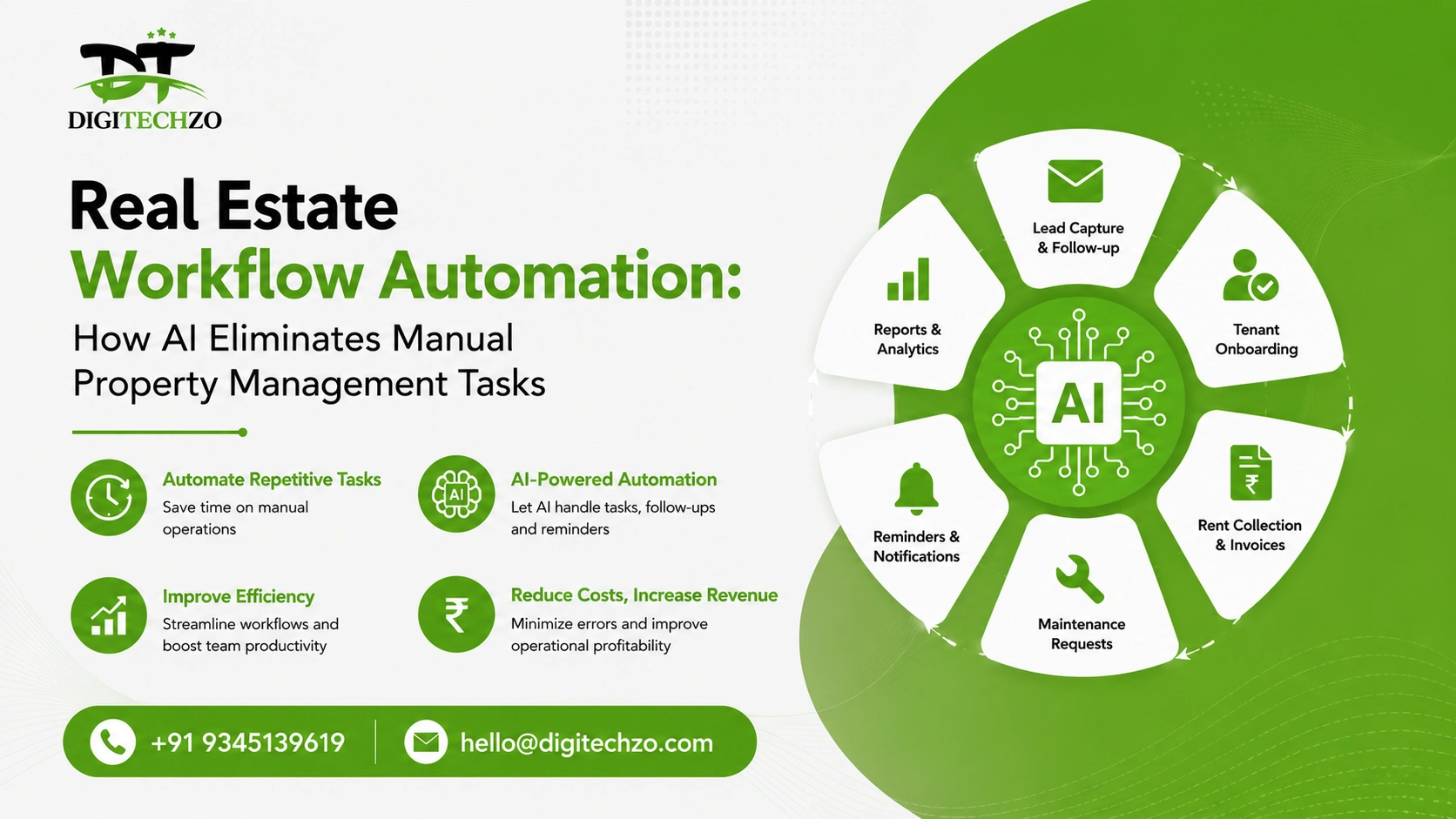
If you manage properties or run a real estate brokerage, you already know the feeling: fifteen browser tabs open, a spreadsheet that hasn't been updated since Tuesday, three tenants waiting on a maintenance response, and a lead that went cold because nobody followed up in time. This isn't a staffing problem. It's a systems problem — and it's exactly what real estate workflow automation software was built to solve.
At digitechzo, we've spent years building automation systems for property managers, brokerages, and real estate investment teams who were drowning in repetitive admin work. What we consistently see is this: teams don't need more people, they need fewer manual touchpoints. This guide breaks down exactly how real estate workflow automation software works, where it delivers the fastest ROI, and how to avoid the mistakes that sink most automation rollouts.
Real estate workflow automation software uses AI and rule-based triggers to handle repetitive property management tasks — lead follow-ups, lease renewals, maintenance dispatch, rent reminders, and document processing — without manual intervention. Teams that adopt it typically cut administrative hours by 30–50% and respond to leads and tenant requests in minutes instead of days, directly improving conversion rates and tenant retention.
What Is Real Estate Workflow Automation Software?
Real estate workflow automation software is a category of tools that connects your CRM, listing platforms, communication channels, and back-office systems so that repetitive, rule-based tasks happen automatically instead of manually. Instead of a human triggering every step — sending an email, updating a spreadsheet, assigning a maintenance ticket — the software watches for a trigger event (a new lead form, a lease approaching expiration, a maintenance request) and executes a predefined or AI-driven action.
The distinction that matters most in 2026 is the shift from basic automation (if-this-then-that rules) to AI-powered automation, which can read unstructured input — an email, a text message, a scanned document — understand intent, and decide the next best action on its own.
In practice, real estate workflow automation software touches almost every department:
- Sales and leasing (lead capture, qualification, follow-up)
- Property management (maintenance, rent collection, renewals)
- Back office (document processing, compliance tracking, reporting)
- Tenant and owner communication
Why Manual Property Management Doesn't Scale
Here's the uncomfortable truth most agencies don't say out loud: manual workflows don't fail because people are lazy. They fail because human attention doesn't scale linearly with portfolio size.
A property manager handling 50 units can keep most things in their head. At 200 units, that same manager is triaging fires all day, and quality drops across the board — slower lead response, missed renewal dates, inconsistent maintenance follow-up. This is precisely the gap that real estate workflow automation software is designed to close.
Consider a common scenario we see with mid-sized property management firms:
A leasing agent gets 40 inbound leads a week from three different listing portals. Each lead needs to be logged, qualified, and followed up with within an hour to have a realistic chance of conversion. Manually, this takes roughly 15–20 minutes per lead across data entry, first response, and scheduling. That's 10+ hours a week just on lead intake — before a single showing happens.
With real estate workflow automation software in place, that same intake process runs in the background: leads are captured automatically from every source, scored by intent, and routed to the right agent with a pre-drafted, personalized first response sent within minutes.
Core Tasks Real Estate Workflow Automation Software Eliminates
This is where the real value shows up. Below are the highest-impact areas where real estate workflow automation software replaces manual work almost entirely.
Lead Capture and Qualification
Instead of manually pulling leads from Zillow, Facebook, or your website contact form, automation software ingests them all into a single pipeline, deduplicates them, and scores them based on behavior (pages visited, budget indicated, urgency signals) — so agents spend time only on leads worth pursuing.
Tenant Communication and Rent Reminders
Automated sequences handle rent due-date reminders, late payment notices, and lease renewal prompts across SMS, email, and app notifications — with no manual sending required.
Maintenance Request Routing
AI-based triage reads incoming maintenance requests, classifies urgency (a leaking pipe vs. a squeaky door), and automatically assigns the correct vendor or technician, cutting response time from days to hours.
Document Processing and Compliance
Lease agreements, inspection reports, and compliance documents get auto-extracted, categorized, and stored — flagging missing signatures or expiring certifications before they become liabilities.
Showing Scheduling
Instead of back-and-forth emails, automation software syncs calendars and lets prospects self-book showings, sending confirmations and reminders automatically.
Reporting and Owner Updates
Owner performance reports — occupancy rates, maintenance costs, rent collection — generate automatically on a schedule instead of being manually compiled each month.
How AI Actually Works Inside Real Estate Workflow Automation Software
Most vendors talk about "AI" vaguely. Here's what's actually happening under the hood in modern real estate workflow automation software:
Natural Language Processing (NLP)
NLP models read incoming tenant messages, emails, or maintenance requests and extract intent — is this a complaint, a payment question, or an emergency? This lets the system route or respond appropriately without a human reading every message first.
Predictive Scoring
Machine learning models analyze historical lead and tenant data to predict outcomes — which leads are likely to convert, which tenants are at risk of not renewing — so teams can act proactively instead of reactively.
Trigger-Based Orchestration
This is the backbone layer: rules that say "when X happens, do Y." A lease hitting 60 days to expiration triggers a renewal sequence. A maintenance ticket tagged "urgent" triggers an immediate vendor notification.
Document Intelligence (OCR + AI)
Optical character recognition combined with AI models allows the software to read scanned leases or inspection PDFs, extract key fields (dates, names, clauses), and populate your system automatically — no manual data entry.
Manual vs. Automated Workflow: A Side-by-Side Comparison
| Task | Manual Process | With Real Estate Workflow Automation Software |
|---|---|---|
| Lead response time | Hours to days | Under 5 minutes |
| Rent reminders | Manually sent per tenant | Auto-scheduled sequences |
| Maintenance triage | Manager reads and assigns each ticket | AI classifies and routes instantly |
| Lease renewal tracking | Spreadsheet monitoring | Automated alerts at 90/60/30 days |
| Owner reporting | Manually compiled monthly | Auto-generated, always current |
| Document filing | Manual upload and naming | Auto-extracted and categorized |
Choosing the Right Real Estate Workflow Automation Software
Not all platforms are built the same, and picking the wrong one creates more manual work, not less. Here's what actually matters when evaluating real estate workflow automation software:
Integration Depth
The software needs to plug directly into your existing CRM, listing syndication tools, and accounting system. If it requires manual CSV exports to "integrate," it's not real automation.
AI Maturity, Not Just Marketing
Ask vendors specifically what their AI does — is it genuinely reading and interpreting messages, or is it just templated auto-replies dressed up as AI?
Scalability
A good system should work the same whether you manage 30 units or 3,000 — the workflows shouldn't need to be rebuilt as you grow.
Customization Without Developers
You should be able to adjust trigger rules and sequences yourself, without submitting a support ticket every time your process changes.
Pros and Cons of Real Estate Workflow Automation Software
Pros:
- Cuts administrative hours significantly, freeing staff for high-value work
- Faster lead response directly improves conversion rates
- Reduces human error in compliance-sensitive documentation
- Improves tenant satisfaction through faster maintenance response
- Scales without proportional headcount growth
Cons:
- Upfront setup and integration takes real time and planning
- Poorly configured automation can feel impersonal to clients if overused
- Requires ongoing monitoring — automation isn't "set and forget"
- Data quality issues in legacy systems can undermine AI accuracy at first
Common Mistakes When Automating Real Estate Workflows
- Automating a broken process. If your lead qualification process is inconsistent manually, automating it just scales the inconsistency faster.
- Over-automating tenant communication. Sending every message via bot, including sensitive conversations (disputes, hardship requests), damages trust. Keep a human handoff point.
- Ignoring data cleanup before implementation. Real estate workflow automation software is only as good as the data feeding it. Duplicate contacts and outdated property records lead to broken workflows.
- Treating automation as a one-time project. Teams set it up once and never revisit trigger rules as the business evolves, causing drift and irrelevant automations.
- Skipping staff training. Even the best real estate workflow automation software fails if the team doesn't understand what's automated versus what still needs manual review.
Expert Tips to Get the Most Out of Automation
- Start with your highest-volume, lowest-complexity task. Rent reminders and lead intake are usually the fastest wins — automate those first before tackling nuanced workflows like renewal negotiations.
- Keep a "human escalation" rule in every sequence. Any automated workflow should have a clear point where it hands off to a real person if the situation gets complex.
- Audit your automation quarterly. Trigger rules that made sense at 100 units may not make sense at 500. Revisit them regularly.
- Combine automation with a single source of truth. Automation works best when your CRM, accounting, and maintenance systems are unified — not when automation is patched on top of siloed tools.
- Measure response time and conversion before/after. Don't just assume automation is working — track the numbers so you can prove and improve ROI.
FAQs
What is real estate workflow automation software used for?
Real estate workflow automation software is used to automate repetitive property management and leasing tasks — including lead follow-up, rent reminders, maintenance dispatch, lease renewal tracking, and reporting — reducing manual admin work and speeding up response times.
Is real estate workflow automation software only for large property management companies?
No. Small and mid-sized teams often see the fastest relative ROI, since automation directly replaces hours that would otherwise require hiring additional admin staff.
Does real estate workflow automation software replace property managers or agents?
No — it removes repetitive administrative tasks so managers and agents can focus on relationship-building, negotiations, and decisions that require judgment, which automation cannot replace.
How long does it take to implement real estate workflow automation software?
Basic workflows (lead routing, rent reminders) can often go live within one to two weeks. Full-scale implementation across maintenance, compliance, and reporting typically takes four to eight weeks depending on integration complexity.
What's the difference between basic automation and AI-powered real estate workflow automation software?
Basic automation follows fixed if-this-then-that rules. AI-powered software can interpret unstructured input — like a tenant's message or a scanned lease — and make context-aware decisions, not just follow static triggers.
Final Thoughts
Manual property management doesn't fail because teams aren't working hard enough — it fails because human effort can't scale at the same rate as a growing portfolio. Real estate workflow automation software closes that gap by handling the repetitive, time-sensitive tasks that eat up hours every week: lead follow-up, rent reminders, maintenance routing, renewals, and reporting.
The teams that win in the next few years won't be the ones with the most staff — they'll be the ones with the smartest systems. If you're ready to see what real estate workflow automation software could look like for your specific portfolio, Digitechzo builds custom automation systems for property managers and brokerages who are done doing repetitive work by hand. Reach out for a workflow audit and we'll show you exactly where automation could save you the most hours.