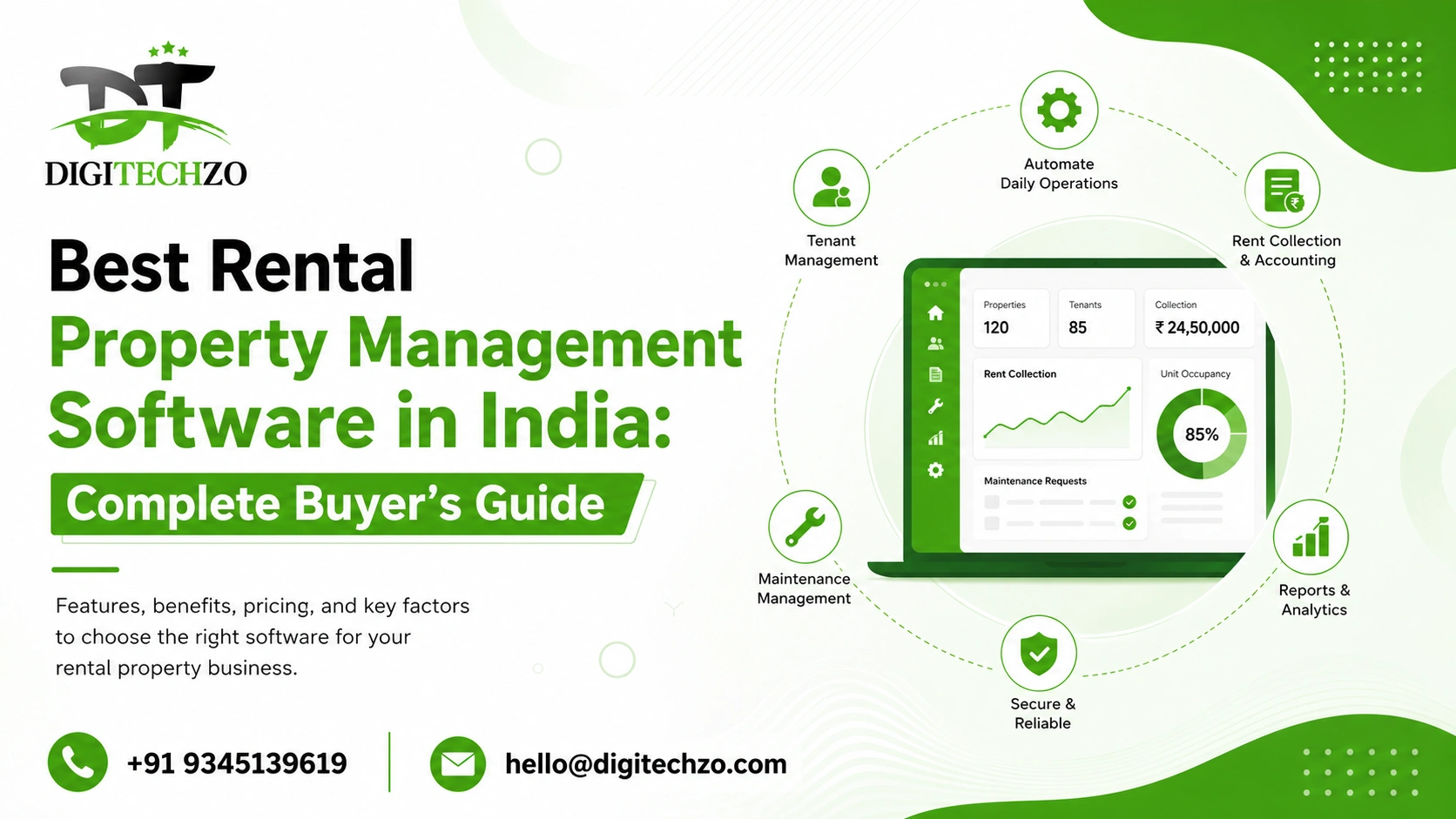
If you manage even three or four rental units in India, you already know the real headache isn't finding tenants — it's everything that happens after. Rent reminders that go unanswered on WhatsApp. Maintenance requests scribbled on paper. A spreadsheet with three different versions floating around your inbox. And at the end of the year, a tax filing scramble because nobody can find last April's receipts.
This is exactly why rental property management software has moved from "nice to have" to "non-negotiable" for landlords, housing societies, and property managers across India. At Digitechzo, we've spent years helping property owners and real estate businesses digitize exactly this kind of operational mess — so this guide isn't theory. It's built from what actually works when software meets the reality of Indian rental portfolios: multiple owners, GST considerations, tenant KYC norms, and rent cycles that don't always follow the calendar month.
By the end of this guide, you'll know exactly what rental property management software does, which features actually matter versus which are marketing fluff, how to compare the top platforms available in India, and how to pick the right one without overpaying for capabilities you'll never use.
The best rental property management software in India automates rent collection, tenant communication, maintenance tracking, and financial reporting in one dashboard. For 1–10 units, cloud-based tools with mobile apps and UPI-integrated rent collection offer the best value. For larger portfolios (10+ units or multiple properties), look for software with owner statements, GST-ready invoicing, and multi-user access. Pricing in India typically ranges from free (basic tiers) to ₹500–₹5,000+ per month depending on unit count and features.
Types of Rental Property Management Software
Not every landlord needs the same tool. Broadly, rental property management software falls into four categories:
H3: Basic Rent Collection Apps
Lightweight tools focused almost entirely on collecting rent digitally and generating receipts. Good for individual landlords with 1–3 units who don't need maintenance tracking or owner reporting.
H3: Full-Suite Property Management Platforms
End-to-end systems covering rent, leases, maintenance, communication, and reporting. Best for landlords with 4+ units or anyone managing property for others.
H3: Society/Association Management Software
Built for RWAs and housing societies rather than individual rental units — includes maintenance billing, visitor management, and amenity booking alongside rent tracking. Only relevant if you're managing a building, not just tenants.
H3: Enterprise Property Management Systems
Used by large real estate firms and property management companies handling hundreds of units, often with custom integrations to accounting software (like Tally or Zoho Books) and CRM systems.
The mistake most people make: buying enterprise-grade software for a 2-unit portfolio, or the reverse — trying to scale a basic rent-collection app to manage 50 units across multiple owners. Match the software tier to your actual portfolio size, not your five-year plan.
How to Choose the Right Software: A Practical Framework
Here's the framework we walk clients through at Digitechzo when they're evaluating rental property management software:
Step 1: Count Your Actual Units and Complexity
A single-owner, 2-unit setup has completely different needs than a manager overseeing 15 units for 5 different owners. Be honest about scale — it determines whether you need a free basic tool or a paid full-suite platform.
Step 2: List Your Top 3 Pain Points
Is it late rent? Lost documents? No visibility into maintenance costs? Rank your actual problems before you start comparing feature lists — this stops you from being swayed by features you'll never use.
Step 3: Check Payment Integration Depth
Not all "digital payment" claims are equal. Confirm UPI autopay/recurring mandate support specifically — one-time UPI links still require the tenant to remember to pay each month, which defeats much of the automation benefit.
Step 4: Test the Mobile Experience Before You Commit
Download the app (most offer free trials) and actually try recording a payment and raising a maintenance ticket. If it feels clunky in 10 minutes, it'll feel worse during a real tenant dispute.
Step 5: Confirm Data Export and Ownership
Ask directly: can you export your tenant data, payment history, and documents if you switch platforms later? Software that locks your data in is a long-term risk, regardless of how good the interface looks today.
Step 6: Match Pricing to Unit Count, Not Just Features
Many platforms price per unit per month. Calculate your actual monthly cost at your current unit count — a plan that looks cheap at the "starting from" price can get expensive fast as you scale.
Pros and Cons of Using Rental Property Management Software
| Pros | Cons |
|---|---|
| Saves hours per month on rent follow-ups and record-keeping | Learning curve for landlords unfamiliar with apps |
| Reduces disputes with digital receipts and payment trails | Monthly/annual subscription cost |
| Improves tenant experience, aiding retention | Requires tenant buy-in to use payment/maintenance features |
| Centralizes documents (leases, IDs, receipts) securely | Some platforms have limited customer support in India |
| Enables data-backed decisions (which unit is profitable, which tenant is consistently late) | Switching platforms later can be time-consuming if data export is poor |
Rental Property Management Software vs. Traditional Methods
| Factor | Spreadsheet/Manual | Rental Property Management Software |
|---|---|---|
| Rent reminders | Manual calls/texts | Automated, scheduled |
| Receipt generation | Manual, often delayed | Instant, auto-generated |
| Document storage | Scattered (email, drive, paper) | Centralized, searchable |
| Maintenance tracking | Ad hoc, easy to forget | Logged with status and history |
| Financial reporting | Manual compilation, error-prone | Auto-generated reports |
| Scalability | Breaks down beyond 3–4 units | Scales to hundreds of units |
| Tenant experience | Inconsistent, manual | Self-service portal/app |
The pattern is consistent: manual methods work until they don't. Most landlords we've spoken with at Digitechzo didn't switch to rental property management software preemptively — they switched after a missed rent payment, a lost lease document, or a tenant dispute that could have been avoided with a digital paper trail.
Common Mistakes When Choosing Rental Property Management Software
- Choosing based on price alone. The cheapest plan often strips out UPI autopay or maintenance tracking — the exact features that save the most time. Compare total value, not just the monthly number.
- Ignoring tenant-side usability. Software only works if tenants actually use it. If the tenant app is confusing, they'll go back to bank transfers and WhatsApp messages, and you lose the automation benefit entirely.
- Not checking for GST and TDS support. If you rent commercial property or manage rent above the TDS threshold, software without proper invoicing and tax documentation will create extra manual work at filing time — the opposite of why you bought the tool.
- Overbuying for current needs. Enterprise features like multi-owner reporting and vendor management add cost and complexity that a 2–3 unit landlord doesn't need yet.
- Skipping the trial period. Nearly every platform offers a free trial or freemium tier. Skipping this and committing to an annual plan upfront is the single most common regret we hear about
- Forgetting about data portability. Landlords rarely think about switching platforms until they're stuck with one that no longer fits — by which point migrating years of payment history becomes a real project.
Expert Tips for Getting the Most Out of Your Software
- Digitize your existing leases first. Before switching to any rental property management software, scan and upload your current lease agreements and tenant ID proofs. This single step gives you the fastest payoff — instant document retrieval — even before you use any other feature.
- Set up autopay mandates during onboarding, not later. Tenants are far more likely to authorize a UPI autopay mandate when you introduce it as "how rent works now" rather than asking them to change an existing habit six months in.
- Use the maintenance log as a negotiation tool. When a tenant disputes a charge or a unit needs a rent revision, a documented maintenance history (what was fixed, when, at what cost) is far more persuasive than memory.
- Review your financial reports monthly, not annually. Most owners only look at reports at tax time. Checking monthly catches late payments and unusual expense patterns early, when they're still easy to fix.
- Standardize your process before adding more units. If you're planning to scale from 2 units to 10, get your rent collection and documentation process fully digital first — retrofitting good habits onto 10 units is much harder than starting with them.
Frequently Asked Questions
What is the best rental property management software for a single landlord in India?
For a landlord with 1–3 units, a lightweight rent collection app with UPI payment support and digital receipts is usually enough — you don't need full owner-reporting or vendor management features until your portfolio grows.
Is rental property management software worth it for just 2–3 properties?
Yes, if late rent, lost receipts, or tenant communication is already a recurring hassle. The time saved on reminders and documentation alone often justifies the cost, even at a small scale.
How much does rental property management software cost in India?
Pricing varies widely — from free basic tiers to ₹500–₹5,000+ per month depending on the number of units, payment processing fees, and whether you need advanced features like owner statements or GST invoicing.
Can rental property management software handle GST and TDS compliance?
Full-suite platforms typically support GST-compliant invoicing for commercial rentals and help track TDS thresholds on rent, but basic rent-collection apps usually don't — check this specifically if compliance is a priority.
Do tenants need to install anything to use rental property management software?
Most platforms offer a tenant-facing app or web portal for payments and maintenance requests, but many also allow payment via a simple link (UPI/payment gateway) without requiring an app download, which improves adoption.
Why Choose Digitechzo for Rental Property Management Software in India?
Choosing the right rental property management software isn’t just about features — it’s about finding a system that actually fits your portfolio, tenant mix, and day-to-day operations. Many landlords and property managers end up with tools that look good on paper but create friction in real workflows.
Digitechzo approaches this as a practical implementation challenge. As an AI Development Company, we help evaluate, customize, and integrate rental property management systems tailored to Indian market needs — including tenant communication, rent tracking, maintenance workflows, and financial reporting. Instead of pushing a one-size-fits-all platform, the focus is on aligning the software with how you currently operate and where you want to scale.
This results in fewer manual errors, clearer financial visibility, and smoother tenant interactions. Whether you manage a small portfolio or multiple units, the right setup reduces administrative load and supports smarter decision-making over time.
If you want to avoid costly migrations and choose the right system from the start, Digitechzo provides a structured, business-first approach to making that decision with confidence.