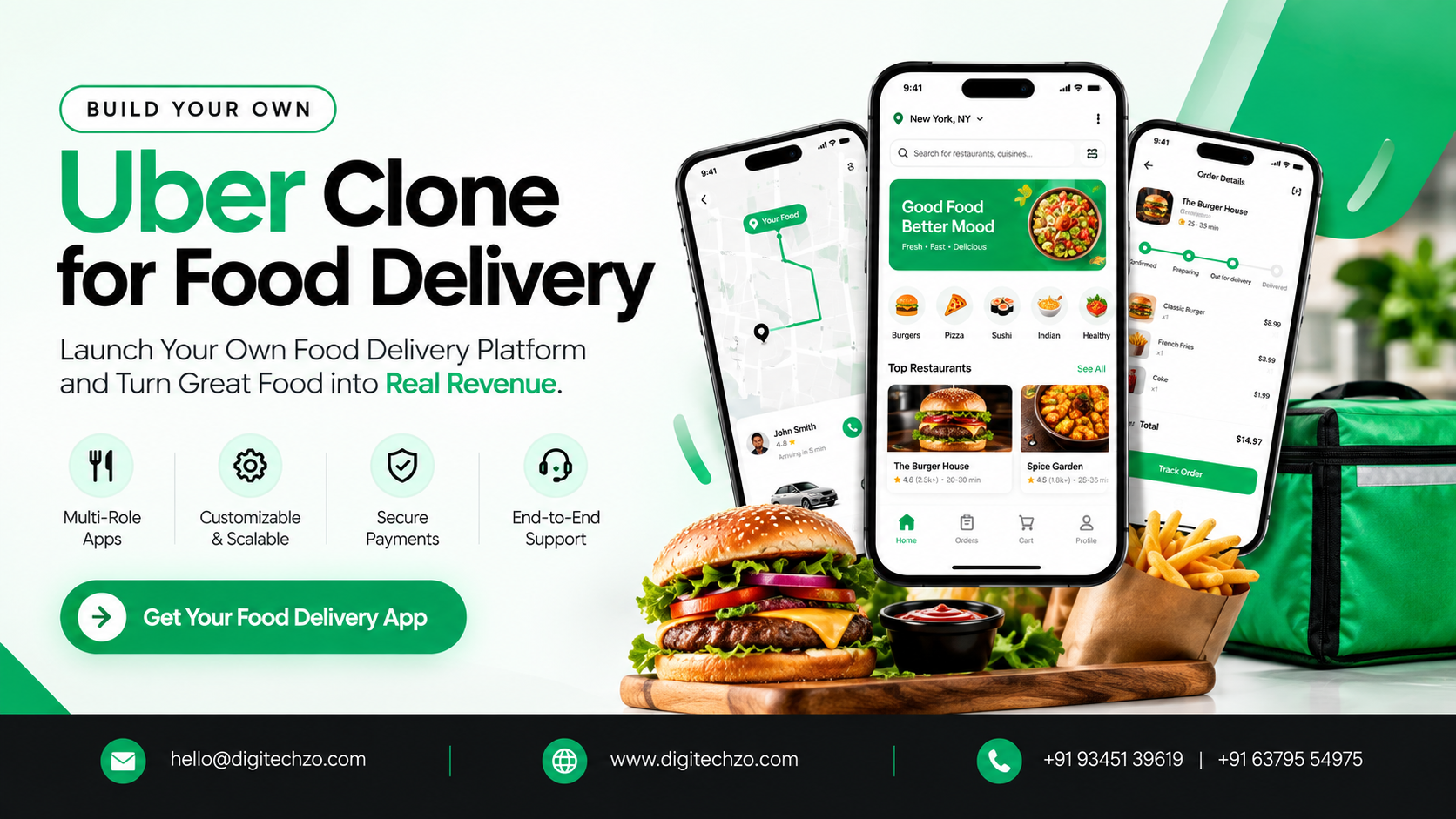
You want your own food delivery platform. Maybe you know the restaurants in your city, run a restaurant group tired of paying marketplace commissions, or see a niche the big platforms ignore, like late-night food, regional cuisines or office lunches. The problem is that a food delivery business isn't a single app. It connects customers, restaurants and delivery partners, and each side needs its own tools.
That is why an Uber Eats clone is a popular starting point. But the app is only part of the picture. This guide covers how the model works, which decisions to make first, which features matter for each role, and what to verify before choosing a development partner.
An Uber Eats clone is a ready-to-customize food delivery platform foundation, typically a customer app, a restaurant app or dashboard, a delivery partner app and an admin dashboard, that you brand and adapt as your own business. To build a successful one, decide your delivery model first, prioritize the features each role needs at launch, choose a revenue model, and pick a partner who is clear about customization, ownership and support. It should be an independently branded platform, not a copy of Uber Eats.
What an Uber Eats Clone Is (and Is Not)
"Uber Eats clone" refers to a platform that follows the food delivery marketplace model that Uber Eats popularized: customers browse restaurants, place an order, a delivery partner brings it, and the platform earns from the transaction. Providers commonly describe these products as white-label food delivery apps.
A responsible project is:
A business-model-inspired platform with its own name, logo, interface, policies and partners
A customized marketplace solution adapted to your city, cuisines, payments and operating rules
Operated independently, with no suggestion of affiliation with Uber or Uber Eats
It shouldn't copy Uber Eats' trademarks, branding, interface designs or proprietary code. For legal questions, speak to a qualified lawyer. This article is business and technical guidance, not legal advice.
How a Food Delivery Marketplace Works
Food delivery is a three-sided marketplace. Every order involves the customer, a restaurant and a delivery partner, plus your admin team coordinating them.
Customer App
Customers browse nearby restaurants, search by cuisine or dish, view menus, build a cart, pay, track the order and rate the experience.
Restaurant App or Dashboard
Restaurants manage menus and prices, mark items unavailable, accept or reject orders, set preparation times, update opening hours and view order history and payouts. If this side is clumsy, restaurants stop using the platform, so it deserves as much design effort as the customer side.
Delivery Partner App
Delivery partners go online, receive and accept delivery requests, get pickup and drop-off directions, update order status and see earnings.
Admin Dashboard
You manage restaurants, delivery partners, customers, orders, delivery zones, fees, commissions, promotions, refunds and reports. For most operators, this is where the business is actually run.
A typical order flows like this: the customer places an order, the restaurant accepts it, the system assigns a delivery partner, the partner picks it up and delivers it, then payment is settled and ratings are collected.
Choose Your Delivery Model First
This decision shapes your app, costs and operations, yet many guides skip it.
Whichever you choose, make sure the product you pick supports it. A clone built only for one model may need significant rework for another.
Features That Matter for Each Role
Rather than copy a long feature list, consider what each side needs to get through an order smoothly.
Customers
Registration and login (phone or email, with OTP)
Restaurant search and filters (cuisine, rating, delivery time, price)
Menu browsing with customization options (size, add-ons, notes)
Cart, promo codes and multiple payment methods
Live order tracking and notifications
Order history, reordering and ratings
Restaurants
Menu, price and availability management
Order acceptance with preparation-time setting
Working hours and temporary closure controls
Order history, earnings and payout reports
Notifications that cannot be missed in a busy kitchen
Delivery partners
Onboarding with document verification
Availability toggle, order requests and navigation
Earnings, incentives and payout history
Support access for order issues
Admin
Onboarding approvals for restaurants and couriers
Zone, fee and commission configuration
Live order monitoring and manual reassignment
Refund, dispute and cancellation handling
Promotions, banners and notifications
Analytics on orders, delivery times, cancellations and revenue
Add advanced features, such as scheduled orders, loyalty programs, subscriptions, group ordering, in-app chat and multi-language support, after the core flow works reliably.
Business Models and Revenue Streams
Food delivery platforms can generate revenue in several ways. None guarantees profitability, which depends on order volume, delivery costs, competition and execution.
Restaurant commission: a percentage of each order
Delivery fees charged to customers
Service fees or small-order fees
Subscription programs for customers or restaurants
Promoted listings or featured placement for restaurants
Advertising and local brand partnerships
Peak-time pricing adjustments, where your market and regulations allow
Delivery cost is often the hardest part to balance. Fees set too low may not cover courier payouts, and fees set too high may reduce orders. Test with real data in a small area before scaling.
Launching Without the Chicken-and-Egg Problem
Customers want restaurants, restaurants want customers and couriers want orders. A practical approach is:
Start in one zone where you already have relationships or demand
Onboard a focused set of restaurants rather than every restaurant in the city
Match courier supply to expected order volume, whether your own staff, partners or a logistics integration
Offer something specific: a cuisine, a pricing model, faster support, lower commission for partner restaurants
Measure and fix delivery times, cancellations and order accuracy before expanding
Existing restaurant businesses and local operators often have an advantage here because their supply side already exists.
Ready-to-Customize Foundation vs Custom Development
Be cautious about claims such as "launch in days" or "half the cost." These depend on what's included, how much you customize and what integrations you need.
Technology and Integrations to Plan For
Maps and location services: for address search, routing, ETAs and live tracking
Payment gateways: cards, wallets and local methods, plus restaurant and courier payouts
Push notifications, SMS and OTP: for order updates and verification
Dispatch logic: how orders are assigned to couriers (nearest, load-based, manual override)
POS or menu integrations, if restaurants use existing point-of-sale systems
Cloud hosting, monitoring and backups
Analytics and reporting
Security: protecting customer data, payment flows and admin access
Third-party services usually have their own usage costs, which add to your running budget.
What the App Does Not Solve
Restaurant partnerships: you need to sign up and keep restaurants
Courier supply and quality: reliable delivery decides repeat orders
Food safety and local regulation: rules for food businesses, delivery and data differ by region
Customer support: missing items, late orders and refunds need people and processes
Marketing: customer acquisition is a continuous effort
Budget for these alongside development.
What to Look for in a Clone Development Partner
Role-by-role demo: can you see customer, restaurant, courier and admin experiences working together?
Delivery-model support: does it support the model you chose, and can it change later?
Customization scope: what can be changed (branding, fees, zones, workflows) and what cannot?
Restaurant-side usability: is the restaurant tool simple enough for busy kitchens?
Integrations: which payment, maps and messaging providers are supported?
Ownership: do you receive the source code, under what licence, and who owns your customizations?
Security and testing: how are payments, personal data and access controlled, and how is the product tested before release?
Scalability: how does it handle more restaurants, orders and zones?
Support and updates: what is included after launch, and for how long?
Candor: does the provider explain limits, or only benefits?
Common Mistakes to Avoid
Treating it as an app project, not an operations project
Skipping the delivery-model decision
Neglecting the restaurant experience
Launching citywide on day one
Copying Uber Eats' branding or interface
Setting fees without modelling delivery costs
Not clarifying source-code and ownership terms
Ignoring third-party service costs
Why Choose DigiTechzo for Food Delivery Platform Development?
A food delivery platform involves several apps, integrations and continuing changes, so your development partner matters as much as the product foundation.
DigiTechzo describes itself as a business growth technology company, with services across AI development, websites, mobile apps, blockchain, software and growth marketing. For a food delivery project, that means you can discuss customer, restaurant and delivery partner apps, the admin dashboard and integrations with a team that works across product development and business growth, and shape the platform around your own brand, markets and operating model.
FAQs
What is an Uber Eats clone?
It is a ready-to-customize food delivery platform, usually with customer, restaurant and delivery partner apps and an admin dashboard, that follows the familiar food delivery marketplace model under your own brand.
How does an Uber Eats clone work?
A customer orders from a restaurant, the restaurant accepts it, a delivery partner is assigned to collect and deliver it, and payment is settled between the parties according to your fee rules.
What features does a food delivery app need at launch?
Customer ordering and tracking, restaurant menu and order management, delivery partner dispatch and navigation, payments, notifications and an admin dashboard with fee, zone and refund controls.
Do I need my own delivery riders?
Not necessarily. You can use independent couriers on your platform, restaurant-managed delivery, a hybrid model, or a third-party logistics integration, depending on your market.
How do food delivery platforms make money?
Common models include restaurant commissions, customer delivery and service fees, subscriptions, promoted listings and advertising. Profitability is not guaranteed.