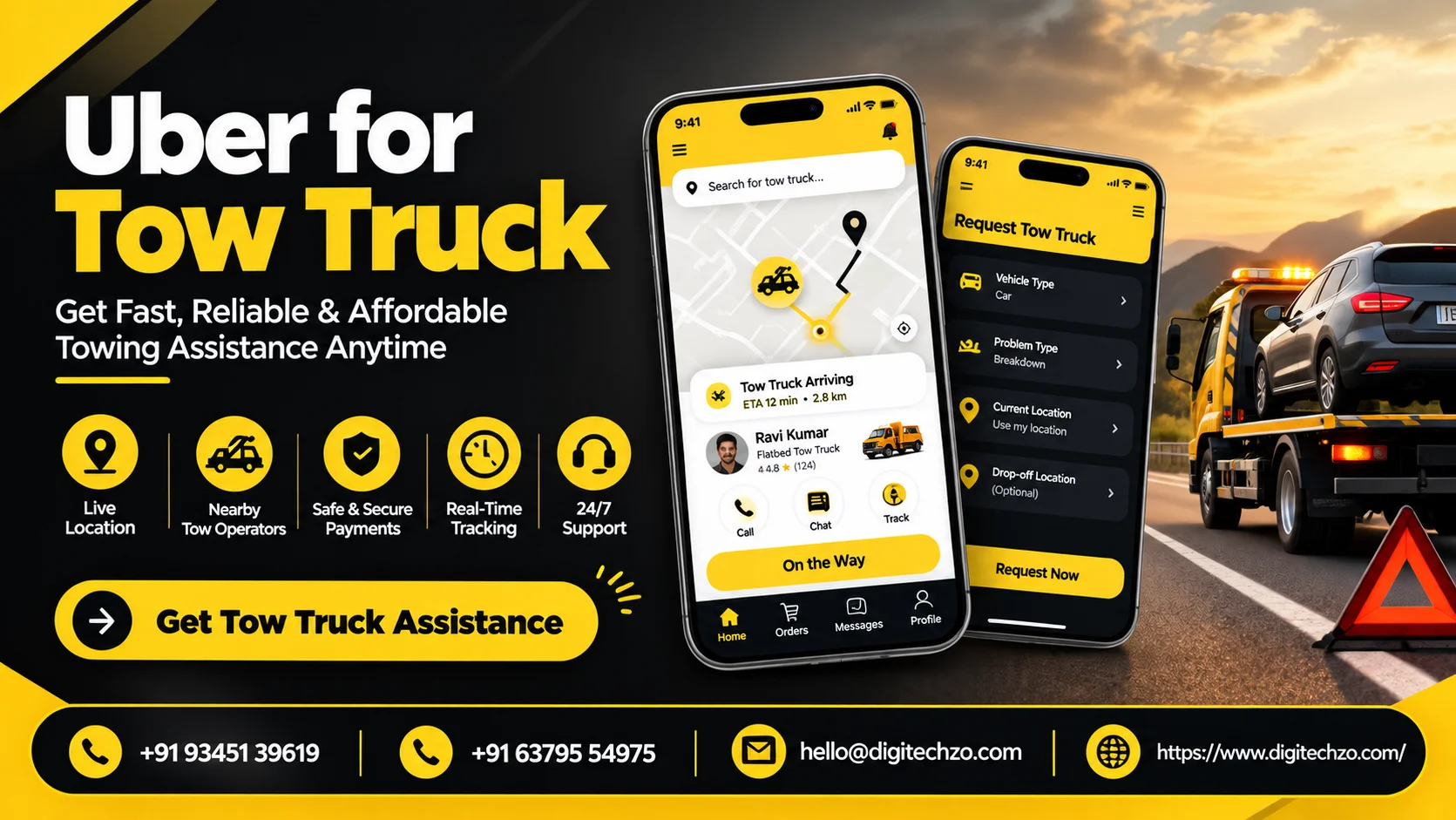
A driver is stranded on a highway shoulder, calling number after number to find a tow operator who can come soon and quote a fair price. A few kilometers away, a tow operator is missing jobs because the phone rang while the truck was out. An Uber for Tow Truck app tries to fix both sides: the motorist sees available help, price and arrival time, and the operator gets organized job requests. If you are thinking of launching that kind of platform, the real question is not whether the idea works, but what a towing business actually needs from it.
This guide explains how the model works, where it differs from ride-hailing, what features and integrations matter, and what to verify before choosing a development partner.
An Uber for Tow Truck app is an on-demand platform that connects motorists with nearby tow and roadside operators through a customer app, an operator app and an admin dashboard. It adapts the ride-hailing pattern of location-based matching, live tracking and in-app payment to emergency vehicle services. Towing needs extra logic for vehicle type, quotes, damage documentation, safety and, often, business clients such as insurers. You can start from a ready-to-customize foundation or build custom, but the final platform needs its own brand, pricing rules and operating processes.
What Is an Uber for Tow Truck App?
It is a two-sided marketplace, and often a three-sided one. Motorists request help for a breakdown, accident or lockout, and tow operators or fleets accept jobs, travel to the location and complete the service. The platform handles matching, communication, payment and ratings.
The "Uber" label describes the interaction pattern, not a company's code or brand.
Business-model-inspired, not copied
A sound approach is a business-model-inspired platform built on a ready-to-customize foundation, then independently branded and configured. Do not copy another company's name, logo, interface, content or proprietary code, and do not imply affiliation. If you have intellectual property questions, consult a qualified lawyer. This article is technical and business guidance, not legal advice.
Towing vs "Uber for trucks" freight
Search results for similar phrases often cover freight platforms, which connect carriers and shippers to move goods (matching truck drivers or carriers with shippers). A towing platform is different: it serves emergency or vehicle-transport needs, with a motorist on the roadside and a tow operator responding. The workflows, safety needs and customers differ.
How an On-Demand Towing Order Works
- Request. The motorist shares their location, the vehicle details, the problem (breakdown, flat tire, flat battery, out of fuel, lockout, accident) and the drop-off point if a tow is needed.
- Quote. The platform shows an estimated or fixed price, or the operator sends a quote that the motorist accepts or declines, a pattern reported in at least one real-world service (an immediate quote that users can accept or decline).
- Dispatch. The job goes to eligible operators based on proximity, truck type, availability and rating, or an admin assigns it.
- Acceptance and ETA. An operator accepts, and the motorist sees the profile, truck and live ETA.
- Arrival and condition record. The driver documents the vehicle's condition with photos before moving it.
- Service. The tow or roadside fix is completed, with status updates.
- Payment. The final price is confirmed and paid in-app (or by methods your market allows), then split between operator and platform.
- Rating and records. Both sides rate the job, and the platform stores job records and photos.
Where the Ride-Hailing Model Breaks Down
| Factor | Ride-hailing | On-demand towing |
|---|---|---|
| Urgency | Convenience | Often an emergency |
| Vehicle matching | Any available car | Right equipment for the vehicle (flatbed, wheel-lift, heavy-duty) |
| Pricing | Fare estimate from distance and time | Hookup fee, distance, vehicle type, wait time, extra work |
| Customer location | Usually safe pickup point | Often roadside, highway or parking structure |
| Job complexity | A to B | Diagnosis, recovery, winching, multi-service |
| Evidence needs | Minimal | Vehicle condition photos to handle damage disputes |
| Business customers | Few | Insurers, fleet managers, dealers, roadside clubs |
| Supplier structure | Individual drivers | Individual operators and multi-truck companies |
| Connectivity | Mostly urban | May include weak signal areas |
Treating a towing app as a taxi app with a truck icon leaves out the logic that makes dispatch work.
Who Uses the Platform: Roles and Components
- Motorist (customer app). Requests help, shares location, receives a quote, tracks the operator, pays and rates.
- Tow operator or driver (operator app). Receives job offers, navigates to the scene, documents the vehicle, updates status, collects payment details and views earnings.
- Fleet owner or towing company. Manages multiple trucks and drivers, assigns jobs and sees company-level reporting. Often overlooked, and essential if you want established operators on your platform.
- Admin dashboard. Onboards and verifies operators, manages service types and pricing, monitors live jobs, handles disputes, manages commissions and payouts, and reports.
- Business client portal (optional). Insurers, fleet managers or roadside clubs submit jobs, track them and receive invoices, sometimes via API.
Essential Features: MVP vs Later
| Area | MVP (launch) | Later phases |
|---|---|---|
| Accounts | Phone or email login, vehicle profiles | Saved vehicles, membership plans |
| Request | Location, vehicle details, service type, photos of the issue | Voice or chat-assisted requests |
| Matching | Distance, truck type, availability | Smart dispatch ranking, auto-reassignment |
| Pricing | Fixed pricing by service and distance, or quote-and-accept | Dynamic pricing, surcharges, contracts |
| Tracking | Status updates, live ETA | Live map with share-link |
| Documentation | Pre-service photos, job notes | Digital condition report, e-signature |
| Payments | Online payments, final price confirmation, commission split | Tips, invoicing, corporate billing |
| Operator tools | Job offers, navigation, earnings | Fleet management, shift scheduling |
| Communication | Push, SMS fallback, in-app chat or masked calling | Multilingual support |
| Trust and safety | Operator verification, ratings, emergency contact | Document expiry alerts, incident workflow |
| Admin | Operators, jobs, pricing, disputes, payouts | Analytics, fraud signals, multi-city rules |
| Business clients | Manual job entry | Portal and API integration |
Prioritize reliable dispatch, accurate ETAs, clear pricing and good documentation. Cosmetic features can wait.
Pricing and Quoting
| Model | How it works | Best for | Watch out for |
|---|---|---|---|
| Fixed price per service | Set prices for jump start, tire change, short tow | Common, predictable jobs | Underpricing complex cases |
| Base fee plus distance | Hookup fee and per-distance charge, adjusted by vehicle type | Standard towing | Customers disputing distance |
| Quote and accept | Operator or system proposes a price before dispatch | Variable jobs | Slower response times |
| Contracted rates | Pre-agreed rates for business clients | Insurers and fleets | Reconciliation and invoicing |
Transparent pricing matters, because customers in an emergency are especially sensitive to surprise charges. Whatever the model, the platform should show what is included, what could change and how extra work is approved.
How a Towing Platform Makes Money
Possible models include a commission per completed job, a service or booking fee for the motorist, subscriptions or membership plans for roadside coverage, operator subscriptions for access to jobs, lead or referral fees, and contracted fees from business clients.
Consumer vs business channels
Consumer requests can be unpredictable and expensive to acquire. Business clients such as insurers, roadside clubs and fleet managers can provide steadier volume, but they typically need contracts, invoicing, reporting and integrations. Many platforms combine both, and the choice should shape your MVP. These are possible models, not profit guarantees. Results depend on your market, operator supply, pricing, acquisition cost and operations.
Safety, Trust and Compliance
- Operator verification. Collect and review licenses, insurance and vehicle details where your market requires them, and track expiry dates.
- Motorist safety. Show clear instructions for waiting safely, share location securely and offer an emergency contact option.
- Transparent pricing. Predatory-towing concerns make price clarity a trust feature, not a nice-to-have.
- Evidence. Photos and timestamps help resolve damage and billing disputes.
- Data privacy. Location and vehicle data are personal data, so align with applicable laws such as GDPR or India's DPDP Act.
- Local towing rules. Regulations on rates, private-property towing and operator licensing vary widely by country and region. Get qualified local advice.
Technical guidance is not legal advice, and requirements depend on where you operate.
Technology and Integrations
- Apps and panels: customer app, operator app, admin web dashboard, optional business portal.
- Location services: GPS, geocoding, routing and ETA from a maps provider. Background location in the operator app needs careful battery and permission handling.
- Dispatch engine: logic for proximity, vehicle-type eligibility, timeouts and reassignment.
- Payments: a gateway that supports marketplace splits, authorization and final-amount capture. Availability varies by country.
- Notifications: push plus SMS fallback for weak data coverage.
- Communication: in-app chat and masked calling so numbers stay private.
- Media and documents: photo capture, storage, PDF invoices and condition reports.
- Business integrations: APIs or portals for insurers and fleet clients.
- Security and scalability: encrypted data, role-based access, audit logs, and an architecture that adds cities and service types without rebuilds.
Ready Foundation vs Fully Custom Development
| Factor | Ready-to-customize foundation | Fully custom build |
|---|---|---|
| Starting point | Existing booking, tracking and admin modules | Requirements and architecture from zero |
| Fit for towing logic | Needs adaptation for vehicle types, quotes and documentation | Designed around towing |
| Time to first version | Can be shorter, depending on changes | Usually longer |
| Business-client features | Often additional work | Planned from the start |
| Differentiation | Must be added deliberately | Built in |
| Ownership | Must be defined by contract | Usually clearer, still contractual |
| Maintenance | Depends on code quality and documentation | Depends on your team or partner |
| Best for | Validating the model in one region | Complex dispatch, B2B integrations or multi-region plans |
Neither is automatically cheaper or faster. A foundation built for ride-hailing needs real adaptation for towing, so ask which modules are reused and which are rebuilt.
Launch Roadmap
- Pick a region and services. Start with one city or corridor and a clear service list.
- Recruit operators first. Onboard local tow companies and independent drivers before marketing to motorists.
- Set pricing and commission. Model what motorists pay, what operators earn and what the platform keeps.
- Define policies. Cancellations, wait time, no-shows, damage claims, disputes and refunds.
- Decide your channels. Consumer-first, business-first or mixed.
- Build the MVP. Focus on request, dispatch, documentation and payment.
- Pilot and measure. Track acceptance rate, ETA accuracy, completion rate, disputes and operator retention.
- Expand. Add areas, services and business integrations based on data.
What to Look for in a Development Partner
- Marketplace and location experience: ask about dispatch and tracking systems they have built.
- Customization capability: can they model vehicle types, quotes and documentation, and what limits exist?
- Integrations: maps, payments, SMS, and APIs for business clients.
- Reliability under poor connectivity: how the apps behave with weak signal.
- Security and privacy: handling of location, vehicle and payment data.
- Ownership terms: source code, data, accounts and licenses in writing.
- Documentation and testing: QA process, release process and technical documentation.
- Deployment and support: hosting, monitoring, maintenance and response times.
- Scalability and roadmap: adding cities, services and clients.
- Business understanding: do they ask about your operators, pricing and customers?
- Transparent scope: milestones, change requests and itemized estimates.
Be cautious of promises of guaranteed profit, launch in days, or "identical" copies of another app.
Common Mistakes to Avoid
- Copying the taxi model without adapting it. Vehicle matching, quotes and documentation need their own design.
- Launching without operators. A motorist who sees no available help will not return.
- Ignoring fleet owners. Many established operators work as companies, not individuals.
- Opaque pricing. In emergencies, unclear charges destroy trust.
- No documentation workflow. Disputes become expensive without photos and records.
- Overlooking weak-signal areas. Plan SMS fallback and resilient app behavior.
- Skipping local regulations. Licensing and rate rules vary.
- Overbuilding the MVP. Prove dispatch quality first.
Why Choose DigiTechzo for Uber for Tow Truck App Development?
Provider selection matters because a towing platform combines location services, dispatch logic, payments and operational workflows for several user types. A partner who builds only screens leaves the hardest parts to you.
According to its website, DigiTechzo provides AI development, websites, mobile apps, blockchain, software and growth marketing. That mix is relevant to a platform that needs customer and operator mobile apps, back-end software and a plan for reaching users after launch.the place to explore how a towing platform could be scoped around your operating model.
Whichever provider you consider, ask for a written scope, integration plan, ownership terms and support model, and verify relevant experience directly.
FAQs
What is an Uber for Tow Truck app?
It is an on-demand platform that connects motorists with nearby tow and roadside operators for requests, dispatch, tracking and payment.
How does an on-demand towing app work?
The motorist requests help and gets a price, a nearby operator accepts, the driver documents the vehicle and completes the service, and payment and ratings follow.
What features does a tow truck booking app need first?
Location-based requests, vehicle details, dispatch by truck type, pricing or quotes, live tracking, photo documentation, in-app payments, operator verification and an admin dashboard.
How do towing apps handle pricing?
Common approaches are fixed prices by service, a base fee plus distance, quote-and-accept, or contracted rates for business clients.
How does a towing platform make money?
Typical options are commission per job, service fees, memberships, operator subscriptions and business contracts. Profitability depends on your market and operations.
Is it the same as an "Uber for trucks" app?
No. Freight platforms match carriers with shippers moving goods, while towing platforms serve motorists who need vehicle assistance.
Should I use a ready foundation or build custom?
A foundation can help you test a model, but towing logic needs adaptation. Compare customization limits, ownership terms and maintenance, not speed claims.
Do I need a portal for insurers or fleet clients?
Not at launch, but if business clients are central to your plan, design for a portal or API early.
What regulations apply to towing platforms?
Rules on licensing, insurance, rates and private-property towing vary by region. Consult qualified local advisers.