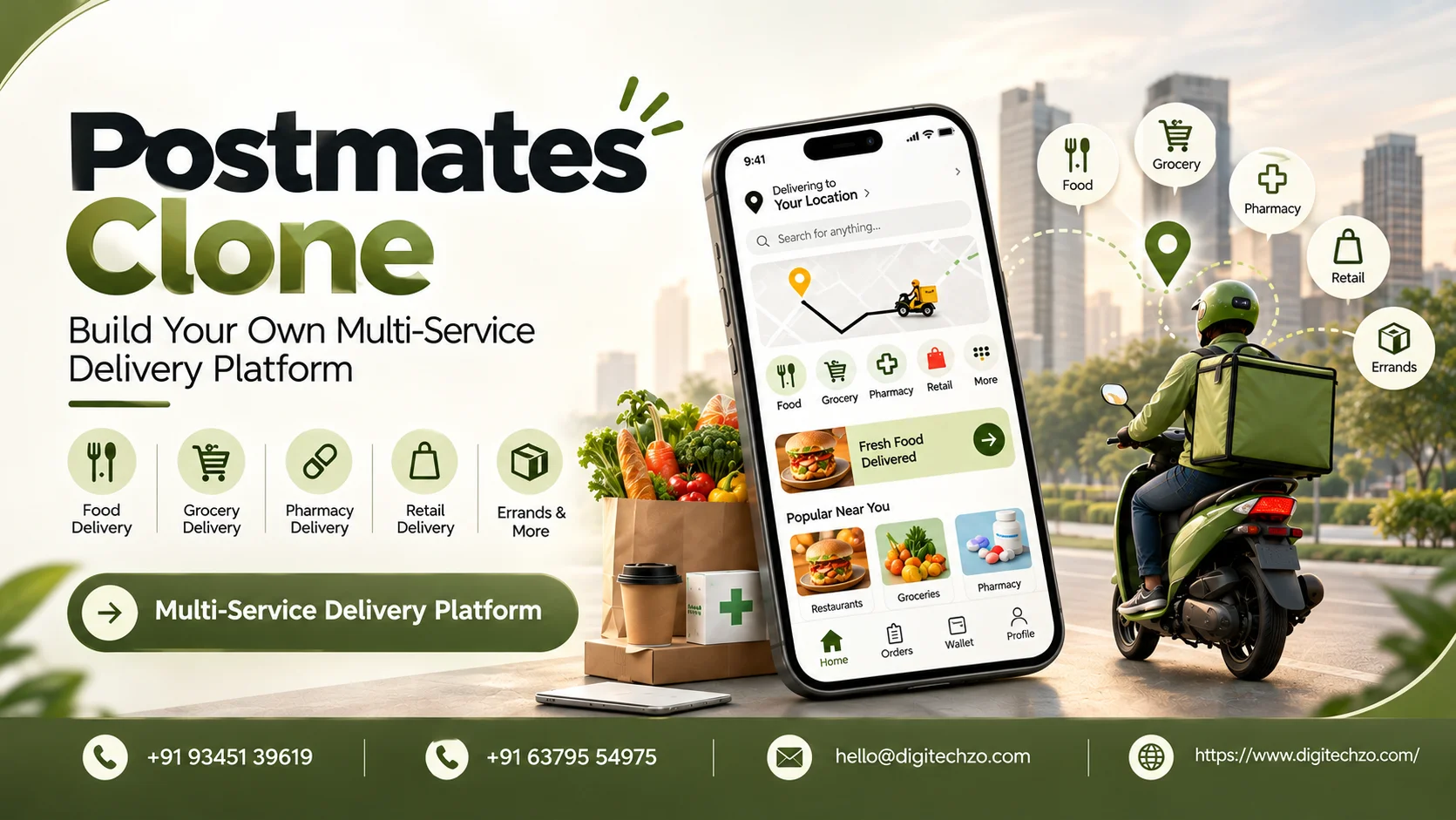
You want to run a local delivery service that carries more than restaurant meals: groceries, pharmacy items, retail goods, forgotten keys, parcels across town. Customers should tap once, and a courier should show up. You have seen "Postmates clone" listed by app vendors, and you are not sure what it means, what it includes, or whether it is still a sensible model. This guide answers those questions and covers the decisions that matter before you spend on development.
A Postmates clone is a business-model-inspired, multi-service delivery platform where customers order from local merchants or request errands and pickups, and couriers fulfil the jobs through an app. It normally includes a customer app, a merchant panel, a courier app and an admin dashboard, built on a ready-to-customize foundation and independently branded. The central decisions are which order types you support, how you dispatch and pay couriers, and what niche you serve. Costs and timelines depend on scope, so get estimates against a written feature list.
What Is a Postmates Clone?
A Postmates clone refers to a delivery marketplace modeled on the "get almost anything delivered locally" idea: one platform, many categories, and a courier network that moves goods between merchants and customers.
What happened to Postmates
Postmates is no longer an independent company. Uber agreed to acquire Postmates in 2020 in an all-stock deal reported at about $2.65 billion. The acquisition was completed on December 1, 2020, and the Postmates Fleet courier app went offline in 2021. Many vendor pages still describe it as if it were a standalone competitor. The phrase "Postmates clone" now works as shorthand for a multi-category on-demand delivery model, not for copying a current product.
Business-model-inspired, not copied
A sound approach is a ready-to-customize foundation that becomes an independently branded platform with its own name, design, business rules and operations. Do not use Postmates' or any other company's name, logo, interface, content or proprietary code, and do not imply affiliation. If you have intellectual property questions, consult a qualified lawyer. This article is technical and business guidance, not legal advice.
Three Order Types Your Platform Can Support
This is the decision that shapes your product most, and many guides skip it.
| Order type | How it works | Platform requirements | Challenge |
|---|---|---|---|
| Merchant order | Customer orders from a listed store or restaurant, and the merchant accepts and prepares the order | Merchant panel, catalog or menu, order acceptance, prep-time handling | Merchant onboarding and catalog accuracy |
| Errand or "buy it for me" | Customer asks a courier to buy items from a store that is not integrated | Free-text item list, courier purchasing flow, payment method for the courier, receipt capture | Price uncertainty, courier cash handling, fraud controls |
| Pickup and drop | Courier collects a package or item and delivers it | Pickup and drop-off details, package size, handover confirmation | Item restrictions, vehicle fit, liability |
You can support all three, but starting with one or two keeps the first version manageable. A merchant-order focus resembles food or grocery delivery. Adding errands and pickup-and-drop is what makes a platform multi-service.
Roles on the Platform
- Customer. Browses merchants or describes an errand, pays, tracks the courier and rates the service.
- Merchant. Receives orders, confirms availability, manages menu or catalog, and hands over the order.
- Courier. Accepts jobs, buys or collects items, delivers, confirms handover and views earnings.
- Admin and operations team. Onboards merchants and couriers, sets fees and zones, monitors live orders, handles disputes, refunds and payouts.
- Business accounts (optional). Local retailers or companies that send recurring deliveries.
How a Delivery Order Flows
- Request. The customer picks a merchant order, an errand or a pickup-and-drop, with address and details.
- Price and fees. The platform shows item prices (or an estimate for errands), delivery fee, service fee and tip option.
- Merchant or courier acceptance. Merchants accept orders, and couriers accept deliveries or errands.
- Dispatch. The system offers the job to nearby couriers by distance, availability, vehicle type and rating, or an admin assigns it.
- Fulfilment. The courier collects the order, or shops for the items and captures a receipt.
- Delivery and handover. The courier delivers with live tracking, and the customer confirms receipt, using a PIN, photo or signature where needed.
- Settlement. Payment is finalized, and money is split between merchant, courier and platform.
- Feedback. Ratings and issue reports feed quality control.
How It Differs From Restaurant and Grocery Delivery Clones
| Factor | Restaurant delivery | Grocery delivery | Multi-service (Postmates-style) |
|---|---|---|---|
| Typical merchants | Restaurants | Supermarkets | Mixed: restaurants, retailers, pharmacies, any local store |
| Catalog | Menus | Large SKU catalog | Mix of integrated catalogs and free-text errands |
| Main complexity | Prep time, hot food | Picking and substitutions | Variety of order types and item types |
| Courier role | Delivery | Picker or delivery | Delivery, shopping and package handling |
| Pricing certainty | High | Medium | Lower for errands |
| Risk | Food quality | Missing items | Restricted items, cash handling, price disputes |
Because of this variety, a multi-service platform needs stronger configuration: category rules, item restrictions, fee rules by order type and clear courier workflows.
Essential Features: MVP vs Later
| Area | MVP (launch) | Later phases |
|---|---|---|
| Accounts | Phone or email login, saved addresses | Business accounts, team ordering |
| Discovery | Categories, merchant list, search | Personalized recommendations |
| Orders | Merchant orders plus one of errand or pickup-and-drop | All three types, scheduled and recurring orders |
| Merchant tools | Order acceptance, menu or catalog upload, availability toggle | Inventory sync, analytics, merchant promotions |
| Courier app | Job offers, navigation, status updates, earnings | Batching, shifts, performance dashboards |
| Dispatch | Distance, availability, vehicle type | Auto-batching, smarter ETA, rebalancing |
| Payments | Online payment, tips, refunds, commission and payout splits | Wallet, subscriptions, courier instant payouts |
| Tracking | Status updates, live ETA | Live map, shareable link |
| Handover | Photo or PIN confirmation | Age verification, signature |
| Communication | Push, in-app chat, masked calling | SMS fallback, multilingual support |
| Admin | Zones, fees, merchants, couriers, disputes | Analytics, fraud signals, multi-city rules |
| Support | Issue reporting and refunds | Ticketing and service-level tracking |
Courier Dispatch and Operations
Courier operations decide whether the service feels reliable.
- Dispatch logic. Match by distance, availability, vehicle type (bike, scooter, car) and item size, and set timeouts and reassignment rules.
- Courier onboarding. Collect identity documents and required licenses, and run checks permitted in your market.
- Payments for errands. Decide how couriers pay stores, for example by reimbursement or another method, and design controls for receipts and price limits.
- Earnings and payouts. Define how couriers are paid, how tips are passed on and how often payouts occur.
- Quality control. Track acceptance rate, delivery time, cancellations and customer ratings.
- Worker classification. Whether couriers are treated as independent contractors or employees varies by jurisdiction and has been contested in several markets. Get qualified legal advice before designing this part of the model.
Delivery Fees and Revenue Models
Possible revenue sources include:
- Delivery fees: a base fee plus distance, or tiered by zone.
- Service or small-order fees: charged to customers on top of item prices.
- Merchant commission: a share of sales from listed merchants.
- Subscriptions: customers pay a membership for reduced fees.
- Advertising or promoted listings: merchants pay for visibility, clearly labeled.
- Business delivery contracts: recurring deliveries for local companies.
These are possible models, not profit guarantees. Delivery margins can be tight, and results depend on order density, courier cost, merchant terms, customer acquisition cost and local competition. Model the unit economics for your own city before building.
Trust, Safety and Compliance
- Restricted items. Define what couriers may and may not carry, especially for pickup-and-drop. Prohibited and age-restricted goods need clear rules.
- Age-restricted deliveries. Items such as alcohol or tobacco, where legal, need licensing and age verification at handover.
- Food safety and handling. Requirements vary by region for prepared and perishable items.
- Courier verification and safety. Verification steps, emergency options and incident reporting.
- Proof of delivery. Photos, PINs or signatures help resolve disputes.
- Data privacy. Addresses and order history are personal data, so align with laws such as GDPR or India's DPDP Act where applicable.
- Local licensing and taxes. Rules for delivery operators and marketplaces differ by region.
Technical guidance is not legal advice. Check requirements with qualified local advisers.
Technology and Integrations
- Apps and panels: customer app (iOS, Android, web), merchant panel, courier app and admin dashboard. Cross-platform frameworks such as Flutter or React Native are common choices, alongside native development.
- Backend: an API layer, a relational database for orders and payments, and cloud hosting that scales at peak times.
- Maps and routing: geocoding, delivery zones, route and ETA from a maps provider.
- Dispatch engine: rules for matching, timeouts, batching and reassignment.
- Payments: a gateway that supports marketplace splits, authorization and final-amount capture, plus payouts to couriers and merchants. Availability varies by country.
- Notifications and communication: push, SMS, in-app chat and masked calling.
- Merchant integrations: menu or catalog upload and, where available, POS or inventory APIs.
- Security and scalability: encrypted data, role-based access, audit logs, and architecture that supports new zones and categories.
Ready Foundation vs Fully Custom Development
| Factor | Ready-to-customize foundation | Fully custom build |
|---|---|---|
| Starting point | Existing modules for orders, couriers and admin | Requirements and architecture from zero |
| Fit for multi-service orders | Depends on how well the foundation handles errands and pickup | Designed around your order types |
| Time to first version | Can be shorter, depending on changes | Usually longer |
| Differentiation | Must be added deliberately | Built in |
| Dispatch flexibility | May be limited | Fully tailored |
| Ownership | Must be defined by contract | Usually clearer, still contractual |
| Maintenance | Depends on code quality and documentation | Depends on your team or partner |
| Best for | Testing a model in one city | Complex dispatch, multi-city or unusual order types |
Neither route is automatically cheaper or faster. Published cost figures for delivery apps vary enormously, so ask any partner for an itemized estimate tied to your scope.
Launch Roadmap: Pick a Niche First
Delivery is a competitive space with large established players, so a broad launch is risky. A focused start is usually safer.
- Choose a niche and area. For example, a specific town, a type of merchant, or a service like pharmacy-adjacent items or local retail, where regulations allow.
- Pick order types. Start with one or two.
- Secure supply. Sign merchants and recruit couriers before marketing to customers.
- Model economics. Work out delivery cost, fees, commission and break-even order volume.
- Define policies. Restricted items, cancellations, refunds, courier payment and disputes.
- Build the MVP and pilot. Test with a limited group and measure delivery time, failed orders and complaints.
- Expand deliberately. Add zones, categories and features based on data.
What to Look for in a Development Partner
- Marketplace and logistics experience: ask about dispatch, tracking and multi-role platforms they have built.
- Architecture and customization: which modules are reusable, and where are the limits?
- Configurability: category rules, fee rules, restricted items and zones.
- Integrations: maps, payments, notifications and merchant systems.
- Security and privacy: handling of location, payment and personal data.
- Ownership terms: source code, data, accounts and licensing in writing.
- Documentation and testing: QA process, release process and technical documentation.
- Deployment and support: hosting, monitoring, maintenance and response times.
- Scalability and roadmap: adding cities, categories and order types.
- Business understanding: do they ask about your niche, couriers and economics?
- Transparent scope: milestones, change requests and itemized estimates.
Be cautious of promises such as "risk-free" development, guaranteed profits, or steep cost reductions without a stated scope.
Common Mistakes to Avoid
- Treating Postmates as a live benchmark. It has been absorbed into a larger company, so build on the model, not the brand.
- Launching everywhere at once. Delivery depends on local density.
- Supporting every order type at launch. Errands and pickups add risk, so prove the core flow first.
- Ignoring courier cash handling. Errands need clear purchasing and receipt controls.
- Weak restricted-item rules. Define them before the first delivery.
- Underpricing delivery. Fees must reflect courier cost and distance.
- Skipping worker and licensing questions. Get legal advice early.
- Overbuilding the MVP. Delay features that do not affect the first deliveries.
Why Choose DigiTechzo for Delivery Marketplace Development?
Provider selection matters because a delivery marketplace joins several apps, a dispatch engine, payments and operations. A partner who builds only the screens leaves you to solve the difficult parts.
According to its website, DigiTechzo provides AI development, websites, mobile apps, blockchain, software and growth marketing. That range is relevant to a platform that needs customer, merchant and courier apps, supporting back-end software and a plan for reaching customers after launch.the place to explore how a delivery marketplace could be scoped around your order types and niche.
Whichever provider you consider, ask for a written scope, integration plan, ownership terms and support model, and verify relevant experience directly.
FAQs
What is a Postmates clone?
It is a multi-service on-demand delivery platform modeled on the idea of delivering goods from local merchants and handling errands through couriers, independently branded and not copying any company's proprietary assets.
Does Postmates still exist?
Postmates was acquired by Uber, with the deal completed in December 2020, and its courier app was folded into Uber Eats in 2021. Check current sources for the status of its consumer app.
How is it different from an Uber Eats clone or Instacart clone?
Uber Eats-style platforms focus on restaurants, and Instacart-style platforms on grocery picking. A multi-service platform adds mixed merchants and optionally errands and pickup-and-drop.
What features does a delivery marketplace need first?
Merchant and category discovery, order placement, a merchant panel, a courier app with dispatch, payments, live tracking, handover confirmation and an admin dashboard.
How do couriers pay for errand purchases?
That is a design choice, such as reimbursement or another controlled method, with receipt capture and price limits. Choose it with legal and financial advice.
How does a delivery marketplace make money?
Typical sources are delivery and service fees, merchant commissions, subscriptions, advertising and business contracts. Profitability depends on density and costs.
Should I use a ready foundation or build custom?
A foundation can help you test a model in one city, but check how well it handles your order types. Compare customization limits, ownership terms and maintenance rather than speed claims.
How much does it cost to build a delivery app like this?
Published figures vary widely because scope differs. Ask for an itemized estimate based on your order types, integrations and platforms.
Do I need legal advice before launching?
Yes, especially on courier classification, restricted goods, licensing and data privacy, which vary by region.