It's 2 AM. A tenant's water heater bursts. Your phone rings — again. You're scrolling through spreadsheets trying to find the vendor's number, checking a lease you printed six months ago to confirm who's responsible for the repair, and mentally calculating how this is going to eat into tomorrow's schedule.
If you manage more than a handful of units, this scene is painfully familiar. Rent collection delays, missed lease renewals, scattered maintenance requests, and manual bookkeeping don't just cost time — they cost real money and tenant trust. This is exactly the gap that property management automation software was built to close.
At Digitechzo, we've spent years helping real estate operators and property management companies digitize their workflows, and one pattern shows up again and again: the businesses that scale fastest are the ones that stop managing properties manually and start managing them systemically. This guide breaks down exactly how property management automation software works, what it actually saves you, how to choose the right one, and the mistakes that quietly sabotage most implementations.
Property management automation software is a digital platform that automates rent collection, maintenance requests, tenant communication, lease tracking, and accounting — cutting manual admin work by up to 70% and reducing per-unit operating costs. The right platform pays for itself within 3–6 months through reduced late payments, fewer vacancies, and lower staffing overhead.
What Is Property Management Automation Software?
Property management automation software is a centralized digital system that replaces manual, repetitive property management tasks with automated workflows. Instead of chasing rent payments by phone or manually logging maintenance tickets in a notebook, the software handles these processes automatically, based on rules and triggers you set once.
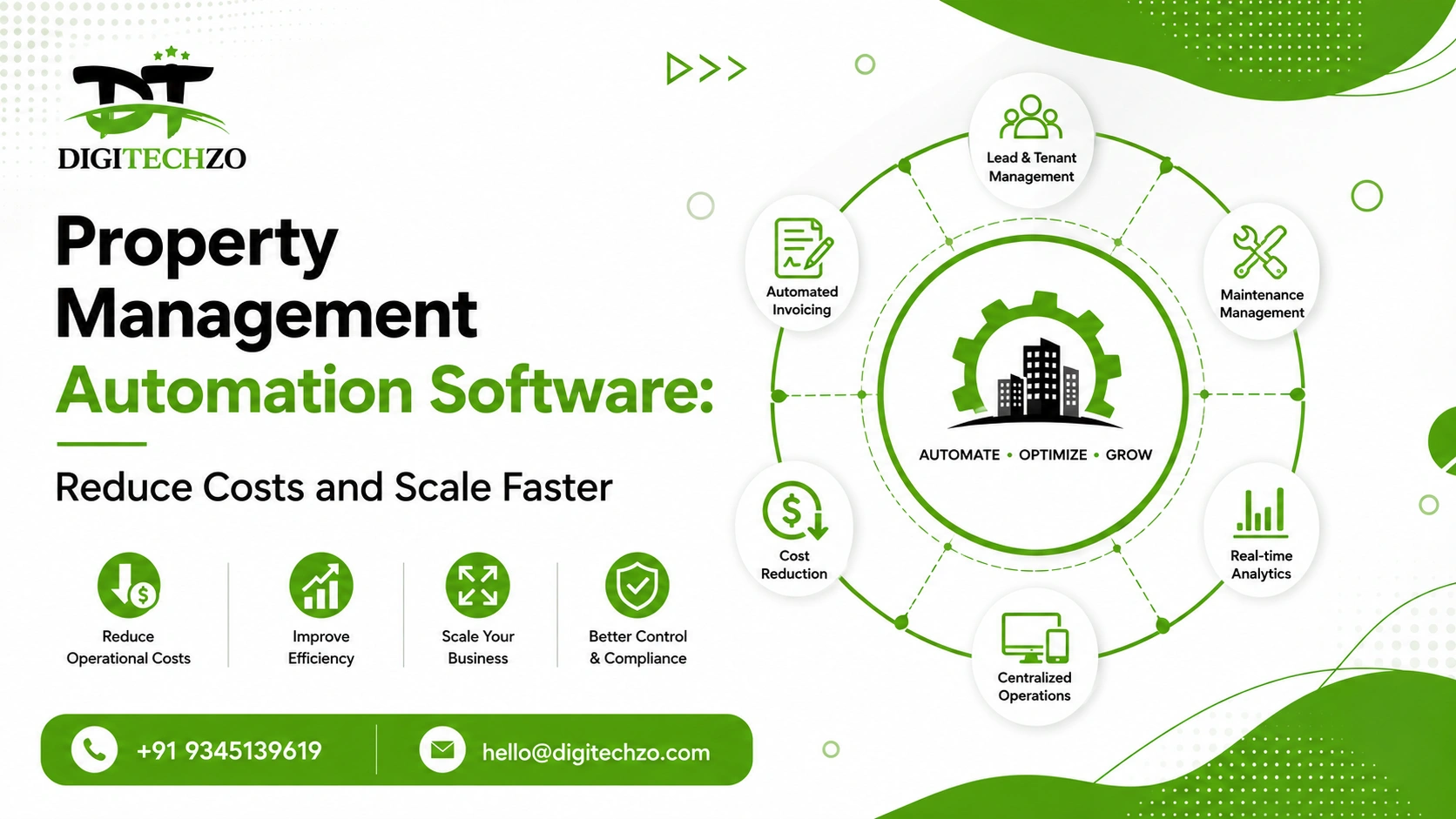
At its core, property management automation software typically automates:
- Rent invoicing, reminders, and online collection
- Maintenance request routing and vendor assignment
- Lease renewal alerts and document generation
- Tenant screening and onboarding
- Financial reporting and accounting reconciliation
- Tenant and owner communication
Think of it as the operating system for your rental portfolio — one dashboard instead of five spreadsheets, three inboxes, and a filing cabinet.
How It's Different From Traditional Property Management Software
Traditional property management software digitizes records. Automation-focused platforms go a step further — they act. A traditional tool stores your lease data; an automation tool sends the renewal notice, generates the new lease, and reminds the tenant to sign it, without you lifting a finger.
Why Manual Property Management Is Costing You More Than You Think
Most operators underestimate the hidden cost of manual processes because it's spread across many small inefficiencies rather than one big expense.
Here's what typically drains time and money without automation:
- Late rent payments: Manual reminders are inconsistent, and inconsistency directly correlates with higher delinquency rates.
- Maintenance delays: A ticket sitting in an email inbox for two days can turn a $150 fix into a $1,500 problem.
- Tenant turnover: Poor communication and slow response times are consistently cited as top reasons tenants don't renew.
- Administrative overtime: Staff spend hours on data entry that automated systems complete in seconds.
- Compliance risk: Missed inspection dates or expired certifications can lead to fines that a scheduled automated alert would have prevented.
Multiply any of these across 50, 200, or 1,000 units, and the case for property management automation software stops being about convenience — it becomes a financial necessity.
Core Features to Look For
Not all platforms are built the same. Here's what genuinely matters when evaluating property management automation software, based on what actually moves the needle operationally.
Automated Rent Collection
Recurring invoicing, multiple payment methods, auto-reminders, and late fee application without manual intervention.
Maintenance Workflow Automation
Tenants submit requests through a portal or app; the system auto-assigns vendors based on category, location, and availability, then tracks the job to completion.
Lease Lifecycle Automation
Auto-generated lease documents, e-signatures, renewal reminders sent 60–90 days out, and automatic rent escalation calculations.
Tenant Screening Integration
Automated background checks, credit checks, and income verification connected directly to your applicant pipeline.
Accounting and Reporting Automation
Auto-reconciled bank feeds, owner statements generated on a schedule, and tax-ready reports without manual spreadsheet building.
Communication Automation
Bulk announcements, automated tenant onboarding sequences, and AI-assisted responses for common questions.
Vacancy and Marketing Automation
Auto-syndication of vacant listings across rental platforms the moment a unit is marked available.
How Property Management Automation Software Reduces Costs
This is where property management automation software proves its ROI, and it's worth breaking down by category rather than making a vague claim.
| Cost Area | Manual Process Cost | With Automation |
|---|---|---|
| Rent collection admin | 5–8 hrs/week per 100 units | Under 1 hr/week |
| Maintenance coordination | 10–15 hrs/week | 2–3 hrs/week |
| Late payments | 8–12% of tenants | Reduced by 30–50% |
| Staffing per units managed | 1 manager per 100–150 units | 1 manager per 250–400 units |
| Tenant turnover admin | 6–10 hrs per turnover | 2–3 hrs per turnover |
Example scenario: A regional operator managing 400 units across three cities was running everything through spreadsheets and a shared inbox. After implementing property management automation software, they reduced their back-office team from four full-time staff to two, cut average rent collection time by 11 days per cycle, and reduced maintenance resolution time from 5.2 days to 1.8 days. That's not a hypothetical — it's the kind of result we consistently see reported across mid-sized portfolios once workflows are automated end to end.
How It Helps You Scale Faster
Cost reduction is one half of the equation. The other half — often more valuable long-term — is scalability.
Manual processes have a hard ceiling. A property manager can realistically handle a fixed number of units before service quality drops. Property management automation software removes that ceiling by decoupling growth from headcount.
- Onboard new units without onboarding new staff — automated workflows apply instantly to new properties added to the system.
- Standardize operations across locations — every property follows the same automated rent, maintenance, and communication rules, eliminating inconsistency between managers.
- Make data-driven expansion decisions — automated reporting gives you real-time occupancy, delinquency, and maintenance-cost data across your entire portfolio, not just the properties you happen to check that week.
- Support remote and hybrid teams — cloud-based automation means your team doesn't need to be physically present to manage operations effectively.
This is the core reason property management automation software has become non-negotiable for operators aiming to move from dozens of units to hundreds.
Top Use Cases and Real-World Scenarios
Scenario 1: The Growing Portfolio
A landlord scaling from 20 to 150 units within two years can't manage rent reminders and maintenance manually at that pace. Property management automation software lets them absorb that growth without hiring proportionally.
Scenario 2: The Multi-City Operator
Managing properties across time zones makes real-time communication difficult. Automated tenant portals and AI-assisted responses close that gap 24/7.
Scenario 3: The Owner-Investor With a Day Job
Part-time landlords benefit enormously from automated rent collection and maintenance routing since they don't have bandwidth for daily manual oversight.
Scenario 4: The HOA or Community Manager
Automated dues collection, violation tracking, and resident communication reduce board workload and improve compliance record-keeping.
Property Management Automation Software: Pros and Cons
Pros
- Significant reduction in administrative hours
- Faster maintenance turnaround and higher tenant satisfaction
- Reduced late payments through consistent automated follow-up
- Scalable operations without linear staffing growth
- Centralized, audit-ready financial and compliance data
Cons
- Upfront setup and data migration takes time
- Requires tenant adoption (some tenants resist digital portals initially)
- Subscription costs can add up for very small portfolios
- Over-automation without human oversight can feel impersonal to tenants during sensitive issues
The honest takeaway: property management automation software delivers strong ROI for portfolios above roughly 20–30 units, while very small landlords should weigh cost against manageable manual workload.
How to Choose the Right Platform
Step 1: Map Your Current Workflow Gaps
Identify where you're losing the most hours — rent chasing, maintenance coordination, or reporting — and prioritize software strength in that area.
Step 2: Check Integration Compatibility
Your property management automation software should integrate with your accounting system, payment processors, and listing syndication platforms.
Step 3: Evaluate Automation Depth, Not Just Features
Many platforms list "automation" as a checkbox feature but only automate notifications, not actual workflows. Ask vendors specifically what triggers automatically versus what still requires manual action.
Step 4: Test Tenant-Facing Experience
Request a demo tenant portal. If it's confusing, your tenants won't use it, and adoption failure undermines the entire system.
Step 5: Confirm Scalability of Pricing
Per-unit pricing should remain sustainable as you scale from 50 to 500 units — some platforms become disproportionately expensive at scale.
Common Mistakes to Avoid
- Automating a broken process — If your maintenance workflow is disorganized manually, automating it just makes disorganization happen faster. Fix the process logic first.
- Skipping tenant onboarding and training — Rolling out a portal without explaining it to tenants leads to low adoption and continued manual work.
- Ignoring data migration accuracy — Importing outdated or incomplete lease data creates automated errors (wrong rent amounts, missed renewal dates) that are worse than manual mistakes.
- Choosing based on price alone — The cheapest platform often lacks true workflow automation and ends up costing more in lost efficiency.
- Failing to review automated reports — Automation reduces manual work, not oversight. Skipping regular report reviews can let errors compound unnoticed.
- Not setting escalation rules — Fully automated systems still need human escalation paths for emergencies or disputes.
Expert Tips for a Smooth Rollout
- Start with one workflow at a time. Automate rent collection first, prove the ROI, then expand to maintenance and leasing — trying to automate everything simultaneously overwhelms staff and tenants alike.
- Set clear escalation thresholds. Define exactly when an automated process should hand off to a human (e.g., disputes, emergency repairs, hardship requests).
- Audit automation rules quarterly. Late fee rules, renewal timelines, and vendor assignment logic should be reviewed as your portfolio and local regulations evolve.
- Use automated data for pricing decisions. Real-time occupancy and delinquency data from your property management automation software can directly inform rent pricing strategy, not just operations.
- Pair automation with a communication policy. Tenants should always know how to reach a human when needed — automation should reduce friction, not eliminate accessibility.
FAQs
What does property management automation software actually automate?
It automates rent collection and reminders, maintenance request routing, lease renewals, tenant communication, and financial reporting — replacing manual, repetitive tasks with rule-based workflows.
Is property management automation software worth it for small landlords?
For portfolios under 10–15 units, the ROI is smaller but still valuable for rent collection and maintenance tracking. It becomes essential once a portfolio exceeds roughly 20–30 units.
How much does property management automation software typically cost?
Most platforms charge per unit per month, generally ranging from $1 to $5 per unit, with enterprise portfolios negotiating custom pricing based on volume.
Does automation replace property managers?
No. It removes repetitive administrative work so managers can focus on tenant relationships, vendor negotiation, and strategic decisions — not replace human judgment on complex issues.
How long does it take to implement property management automation software?
Basic setup typically takes 2–4 weeks, including data migration and tenant onboarding, though larger portfolios with complex integrations may take 6–8 weeks for full rollout.
Why Choose Digitechzo for Property Management Automation Software?
Property management automation is no longer just about reducing manual work—it’s about removing the operational limits that slow down portfolio growth. Many businesses adopt generic tools but still struggle with fragmented workflows, delayed processes, and limited visibility across operations.
Digitechzo works as an AI Development Company that builds automation systems tailored to how property management teams actually operate. Instead of one-size-fits-all software, the approach focuses on mapping your workflows—rent collection, maintenance tracking, tenant communication, and reporting—and transforming them into integrated, automated processes. AI-driven insights and real-time data are embedded into the system to improve decision-making and operational control.
This results in faster processes, fewer manual errors, improved cash flow through timely payments, and the ability to scale without increasing administrative overhead. Teams can shift their focus from repetitive tasks to portfolio expansion and tenant experience.
For property managers aiming to scale efficiently with automation built around their business, Digitechzo provides a practical, results-driven path to achieving that growth.