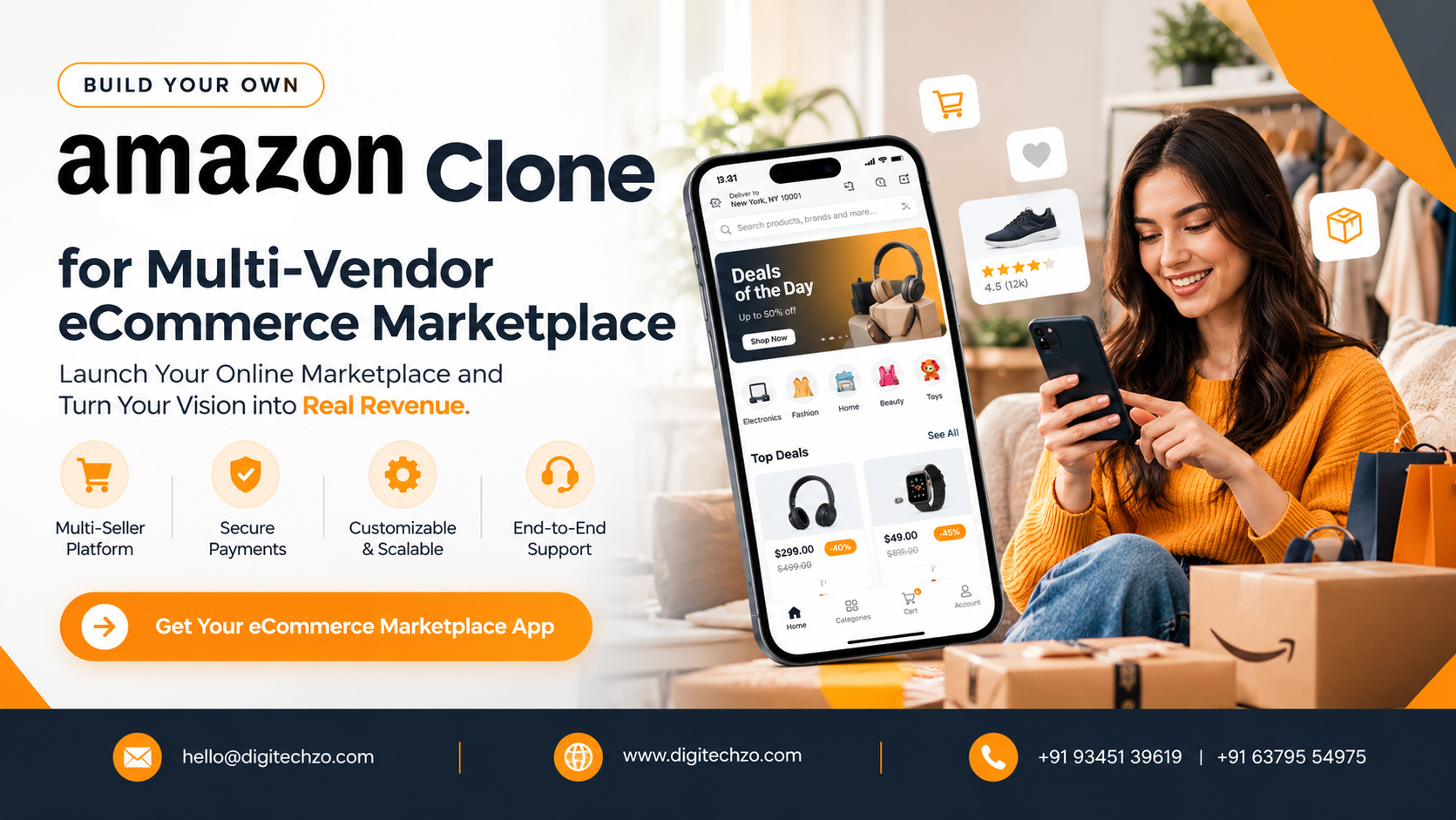
You may already sell products online and want to let other sellers list beside you. Or you may have a niche in mind, such as handmade goods, industrial supplies or regional products, where no marketplace serves buyers and sellers well. Either way, you don't want to design catalogs, seller dashboards, multi-seller checkout and payouts from zero.
That's why an Amazon clone is a common starting point. But a marketplace is more than a store with extra logins. This guide explains how the multi-vendor model works, which decisions to make first, and what to verify before choosing a development partner.
An Amazon clone is a ready-to-customize multi-vendor eCommerce marketplace foundation, typically with a buyer storefront, a seller dashboard and an admin dashboard, that you brand and adapt as your own platform. To build a successful one, choose your niche and fulfillment model, make sure the platform handles multi-seller orders, commissions and payouts correctly, and select a partner who is clear about customization, ownership and support. It should be an independently branded marketplace, not a copy of Amazon.
What an Amazon Clone Is (and Is Not)
"Amazon clone" describes a platform that follows the multi-vendor marketplace model Amazon popularized: third-party sellers list products, buyers browse and purchase, and the platform earns from the transactions. Providers sell this as a white-label script, a marketplace builder or a custom solution.
A responsible project is:
A business-model-inspired platform with its own brand, design, policies and positioning
A customized marketplace solution adapted to your product categories, region, currencies and rules
Independently operated, with no suggestion of affiliation with Amazon
It shouldn't copy Amazon's trademarks, branding, interface designs, product content or proprietary code. For legal questions, consult a qualified lawyer. This article is business and technical guidance, not legal advice.
How a Multi-Vendor Marketplace Works
Buyers
Buyers search or browse categories, compare products, read reviews, add items to a cart, pay, track orders and request returns.
Sellers
Sellers register, get approved, list products, manage inventory and pricing, process orders, handle shipping and returns, and view sales and payouts in a seller dashboard.
Admin
You approve sellers and listings, manage categories, set commissions and fees, monitor orders and payments, handle disputes, run promotions and review analytics.
The basic flow: a seller lists a product, a buyer purchases it, the platform collects payment, the seller fulfills the order, and the seller is paid after your commission and fees under your payout rules.
Is a Multi-Vendor Marketplace Right for You?
It suits you if:
You have access to sellers, such as suppliers, local merchants or an existing seller community
You can bring buyers, through an existing audience, niche or region
You want control over fees, branding and customer relationships
Consider alternatives if you only sell your own products. A single-vendor online store is simpler, and marketplace complexity (seller onboarding, order splitting, payouts, disputes) only pays off when you want third-party sellers.
Features That Matter Most
Buyers
Registration, login and profile management
Fast search with filters (category, price, brand, rating, availability)
Product pages with images, specifications, seller information and reviews
Cart, checkout, multiple payment methods and saved addresses
Order tracking, returns and refunds
Wishlists and notifications
Sellers
Registration and verification
Product listing with bulk upload or import
Inventory and price management
Order management and shipping updates
Returns handling and buyer messaging
Sales reports, earnings and payout history
Admin
Seller and listing approval and moderation
Category, attribute and brand management
Commission, fee and tax configuration
Order, dispute and refund management
Payout management
Promotions, banners and content
Analytics on sales, sellers and customer behaviour
Advanced additions, such as sponsored listings, loyalty programs, multi-language and multi-currency support, recommendation engines and seller subscription tiers, can follow once the core flow is stable.
What Happens When One Cart Has Several Sellers
This is where marketplaces differ from ordinary online stores, and where many guides stay silent.
When a buyer's cart contains items from three sellers, the platform typically needs to:
Take one payment from the buyer
Split the order into separate seller orders, each with its own status, shipping and tracking
Calculate shipping per seller (or per shipment), which may affect the total the buyer sees
Apply commission to each seller's portion
Hold funds until the order is delivered or the return window passes, if your policy requires it
Pay sellers according to your payout schedule
Handle partial outcomes, where one seller cancels or one item is returned while the rest are delivered
Ask any provider to demonstrate this flow, including a partial refund. If a platform can't handle it clearly, your support team will end up handling it manually.
Choose Your Fulfillment Model
Choose a model first, then confirm that the platform supports it, including shipping rules and carrier or logistics integrations.
Business Models and Revenue Streams
Common models include:
Commission per sale, percentage-based or fixed
Seller subscriptions or membership plans
Listing fees for products or premium placement
Featured or sponsored listings
Advertising
Fees for added services, such as fulfillment or payment handling
None guarantees profitability. Revenue depends on seller and buyer volume, competition, payment costs, support and marketing. Set commission carefully: too high and sellers leave, too low and the business struggles to cover costs.
Why Niche Beats "Everything Store"
Competing with the largest marketplaces on everything is rarely realistic. A focused marketplace gives buyers and sellers a clear reason to join:
A product niche: handmade, organic, industrial, medical supplies, regional products
A region or language underserved by global platforms
A seller community you already work with
A service advantage: curated sellers, faster local delivery, better seller support, lower fees
Start narrow, build trust and reviews, then expand categories.
Ready-to-Customize Foundation vs Custom Development
Treat claims like "launch in days" or "half the cost" cautiously. They depend on what's included, how much you customize and which integrations you need.
Technology and Integrations to Plan For
Payment gateways with marketplace support: split payments, seller payouts and refunds. Not every gateway supports these in every country, so check early.
Shipping and logistics: carrier rate and tracking integrations
Search infrastructure: fast filtering over large, varied catalogs
Catalog tools: bulk upload, import and export
Tax handling: configurable to your region
Notifications: email, SMS and push
Cloud hosting, caching, monitoring and backups
Security: payment data protection, access controls and seller data separation
Analytics and reporting
Web and mobile apps, depending on your audience
Third-party services usually come with usage fees that add to your running costs.
What the Platform Does Not Solve
Sellers and buyers: supply and demand still need to be built
Seller quality control: counterfeit, misleading or low-quality listings damage trust
Fulfillment performance: late shipping and poor packaging reflect on your brand
Customer support and disputes: someone has to resolve them
Regulation and tax: consumer protection, product restrictions, data protection and tax rules vary by country and category
Marketing and SEO: attracting buyers is an ongoing effort
What to Look for in a Clone Development Partner
Working demo of buyer, seller and admin flows, including multi-seller checkout and partial refunds
Payout and commission logic: flexible rules per seller or category, and clear reporting
Catalog and search performance at scale
Customization scope: what can be changed (branding, fields, workflows, fees) and what cannot
Integrations: supported payment, shipping and tax tools, and how others can be added
Ownership: do you receive source code, under what licence, and who owns your customizations?
Security and testing: how payments and data are protected, and how the product is tested before release
Scalability: how it handles more sellers, products and traffic
Support and updates: what is included after launch, and for how long
Candor: does the provider explain limits, or only benefits?
Common Mistakes to Avoid
- Trying to be a general store from day one
- Ignoring seller supply until after launch
- Skipping payout and order-splitting details
- Weak seller vetting and listing moderation
- Copying Amazon's branding, design or product content
- Not deciding the fulfillment model early
- Not clarifying source-code and ownership terms
- Underestimating support, returns and dispute workload
Why Choose DigiTechzo for Marketplace Development?
A multi-vendor marketplace combines storefronts, seller tools, payments and admin systems, and the way they fit together affects day-to-day operations and growth. Your development partner matters as much as the foundation you start from.
DigiTechzo describes itself as a business growth technology company, with services across AI development, websites, mobile apps, blockchain, software and growth marketing. For a marketplace project, that means you can discuss the buyer storefront, seller and admin tools, mobile apps and integrations with a team that works across product development and business growth, and shape the platform around your own brand, niche and operating model.
FAQs
What is an Amazon clone?
It is a ready-to-customize multi-vendor eCommerce marketplace, usually with a buyer storefront, seller dashboard and admin dashboard, following the familiar third-party marketplace model under your own brand.
How does a multi-vendor marketplace work?
Sellers list products, buyers purchase them, the platform collects payment and applies commission, sellers fulfill orders, and payouts are released under your rules.
What features does a multi-vendor marketplace need at launch?
Seller onboarding, product catalog, search and filters, cart and checkout, order management, payments with commission and payouts, returns handling and an admin dashboard.
How do multi-vendor platforms make money?
Common models include commission per sale, seller subscriptions, listing fees, sponsored listings and advertising. Profitability is not guaranteed.
Who handles shipping on a marketplace?
That depends on your fulfillment model: sellers ship their own orders, the marketplace fulfills, sellers dropship, or a hybrid of these.
How are payments split between sellers?
The platform collects one payment, then divides it into seller shares after commission and fees. This needs a payment setup that supports marketplace payouts in your region.