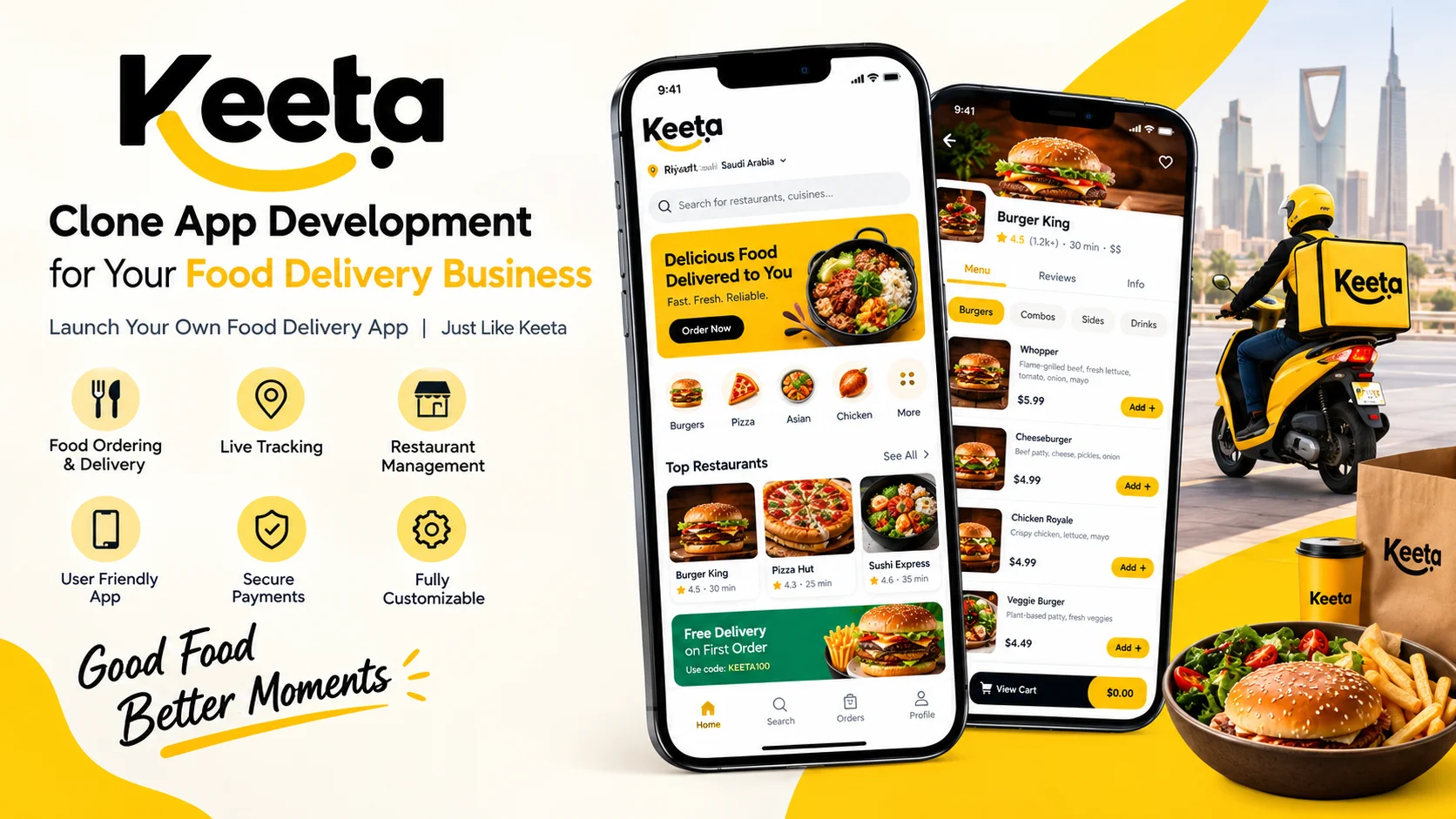
The modern food delivery industry is experiencing a rapid architectural evolution driven by high-frequency hyperlocal demand, automated dispatching, and micro-fulfillment models. As global platforms set new standards for speed and efficiency, enterprise operators are seeking agile software solutions to deploy competitive food delivery marketplaces under their own brand. At DigiTechzo, we specialize in high-concurrency mobile and cloud architectures tailored for modern quick-commerce and delivery ecosystems.
Developing a custom food delivery engine requires balancing multi-tenant restaurant management, real-time courier tracking, AI-driven dispatching, and secure payment processing. By leveraging a high-performance script architecture, businesses can accelerate launch timelines while maintaining total ownership over source code, user data, and brand identity.
Quick Takeaway / Direct Answer: A Keeta clone app provides an enterprise-ready, customizable software foundation that replicates the high-speed order matching, automated dispatch, and multi-tier management of leading food delivery platforms. It enables business owners to quickly launch scalable multi-vendor delivery marketplaces with full source code control and custom integrations.
What Is a Keeta Clone App?
A Keeta clone app is a white-label, highly customizable food delivery software solution built to replicate the core workflows, real-time dispatch mechanisms, and user interfaces of high-volume delivery platforms like Keeta. It provides pre-engineered mobile apps for consumers and delivery drivers, along with comprehensive administration portals for restaurants and platform owners.
How a Keeta-Like Food Delivery Platform Works
The platform coordinates a synchronized four-way interaction between customers, restaurant merchants, delivery couriers, and central platform administrators. Orders placed through the mobile app trigger real-time kitchen display workflows, while automated spatial algorithms dynamically assign nearby couriers for optimized pickup and rapid doorstep delivery.
Keeta Clone vs. White-Label vs. Custom Development
A ready-made clone script balances deployment velocity with deep architectural flexibility. Unlike closed SaaS white-label subscriptions that restrict backend modifications, a customized clone solution provides full source code ownership, allowing engineering teams to build custom integrations while avoiding the extreme timeline and expense of starting from scratch.
Food Delivery Business Models and Use Cases
Modern food delivery engines support diverse monetization strategies and operational operational structures tailored to regional demand. Whether powering a local aggregator or an enterprise restaurant network, flexible digital architecture accommodates evolving commercial requirements and expansion plans.
Multi-Vendor Food Delivery Marketplace
This flagship marketplace model enables hundreds of independent restaurants to list menus, manage orders, and tap into a shared fleet of delivery partners. The platform monetizes through commission fees per order, merchant onboarding packages, and sponsored search listings for premium restaurant visibility.
Restaurant Chains and Cloud Kitchens
Enterprise restaurant franchises and virtual cloud kitchen hubs utilize dedicated delivery software to manage direct-to-consumer digital channels. Centralized menu publishing, multi-brand order aggregation, and direct courier dispatch streamline virtual kitchen operations while eliminating third-party marketplace commissions.
Hyperlocal Food Delivery Business
Hyperlocal delivery architectures focus on high-density urban areas, optimizing dispatch radii within specific zip codes. By limiting delivery zones to short distances, operators achieve ultra-fast fulfillment cycles while reducing driver idle time and fuel expenses.
Multi-City Food Delivery Operations
Multi-city systems leverage distributed cloud infrastructures to support localized menus, regional tax rules, multi-currency processing, and municipal delivery parameters. Central administrative teams monitor performance metrics across disparate geographic markets through a unified management console.
Keeta Clone App Features
A complete food delivery ecosystem relies on interconnected mobile applications and web management dashboards. Each module provides specialized user interfaces engineered for speed, operational clarity, and high-concurrency data exchange.
Customer App Features
The customer mobile app features intuitive menu browsing, real-time GPS courier tracking, dynamic ETA estimation, multi-channel payment processing, in-app messaging, push notifications, and customizable loyalty rewards designed to maximize user retention and lifetime customer value.
Restaurant Management Panel Features
Merchants access a specialized order management panel to accept incoming orders, update item availability, configure prep times, manage digital menus, analyze daily revenue, and interface directly with assigned delivery couriers.
Delivery Partner App Features
Couriers utilize a streamlined mobile app equipped with real-time order requests, optimized turn-by-turn navigation, route batching, dynamic earnings calculators, active status toggles, and digital proof-of-delivery confirmation features.
Admin Dashboard Features
The central administration portal grants platform operators complete governance over vendor approvals, commission structures, dynamic delivery fee rules, dispute resolution, financial payouts, and system-wide business intelligence analytics.
Benefits of Keeta Clone App Development
Deploying a mature delivery script offers clear economic and technical advantages for ambitious market entrants. It combines rapid commercial rollout with enterprise resilience and unlimited feature expansion capabilities.
Streamlined Restaurant and Delivery Operations
Automated workflow triggers minimize manual intervention between order placement and fulfillment. Automated kitchen acceptance and dynamic courier dispatch reduce merchant prep delays and eliminate idle driver wait times at pickup points.
Improved Customer Experience and Retention
Seamless UI/UX design, instant order confirmation, accurate live tracking, and flexible payment options foster strong consumer trust, resulting in higher repeat order rates and stronger brand affinity in competitive markets.
Centralized Order and Business Management
Platform administrators gain total operational visibility into live orders, courier densities, payment gateway settlements, and merchant sales metrics through unified telemetry dashboards that simplify multi-market governance.
Food Delivery Marketplace Revenue Models
Marketplace software unlocks multiple monetization revenue streams, including merchant transaction commissions, customer delivery and service fees, featured restaurant placement fees, ad space monetization, and premium consumer subscription plans.
Food Delivery Order Management and Dispatch
Efficient dispatching serves as the core computational engine of any logistics platform. Reliable order routing minimizes delivery latency, optimizes courier efficiency, and guarantees high consumer satisfaction levels.
Order Placement to Delivery Workflow
When a user submits an order, the system validates payment, broadcasts the ticket to the restaurant panel, estimates preparation duration, and places the job into an intelligent queue for optimal courier assignment upon kitchen completion.
Delivery Partner Assignment and Tracking
Spatial algorithms match pending pickups with couriers based on distance, traffic conditions, current load, and historical delivery speed. Continuous WebSockets telemetry streams accurate real-time GPS locations to all active parties.
Delivery Zone and Fee Management
Operators define precise geofenced delivery zones using interactive polygon mapping tools. Variable delivery pricing engine rules dynamically calculate fees based on mileage, weather conditions, time of day, and peak demand spikes.
Order Status Notifications and Updates
Automated push notifications, SMS alerts, and transactional emails keep users informed through every delivery milestone, including order acceptance, food preparation, courier pickup, en-route progress, and final doorstep arrival.
Keeta Clone App Customization and Integrations
Extensibility ensures your software adapts to specialized commercial operations and localized technical ecosystems. Seamless API integrations connect the platform with global services and custom infrastructure tools.
Branding and UI/UX Customization
Tailor every visual element, color palette, logo mark, and design component to reflect your corporate identity. Intuitive customer interface flows enhance accessibility and optimize conversion rates across native iOS and Android platforms.
Payment Gateway Integration
Incorporate leading financial rails such as Stripe, PayPal, Razorpay, Apple Pay, and Google Pay alongside localized payment instruments and digital wallet mechanisms. Integrating secure solutions via fintech app development services guarantees PCI-DSS compliant payment processing.
Maps, Notifications, and Third-Party Integrations
Integrate Google Maps Platform or Mapbox APIs for geospatial routing alongside Twilio and Firebase for reliable real-time communication. Connecting POS systems and CRM workflows streamlines inventory sync and enterprise data pipelines.
Multi-Language and Multi-Currency Support
Expand into international delivery markets using built-in localization frameworks. The platform supports dynamic translation keys, RTL text orientation, and automated currency conversion rates for global commercial flexibility.
Security, Scalability, and Technical Architecture
Architected on cloud-native microservices, containerized Docker deployments, and high-performance relational databases, the platform implements OWASP security standards, end-to-end data encryption, and auto-scaling capabilities to absorb peak order bursts effortlessly.
Keeta Clone App Development Process
Building a robust enterprise delivery platform requires a structured engineering lifecycle. A disciplined agile roadmap ensures risk mitigation, high software quality, and predictable project milestones from kickoff through maintenance.
Business Requirements and Planning
The process begins by defining strategic business goals, targeted delivery regions, merchant commission mechanics, ecosystem workflows, and technical system specifications tailored to your commercial vision and operational constraints.
Feature Selection and UI/UX Design
Solution architects map core user journeys and assemble high-fidelity wireframes. Prototyping customer ordering, merchant management, and courier dispatch workflows ensures frictionless usability prior to writing production code.
App Development and Integration
Engineers build native or cross-platform mobile apps using Flutter or React Native, backed by robust backend APIs. Advanced intelligence features can be incorporated through custom AI development services to optimize route prediction engines.
Testing and Quality Assurance
Rigorous functional, load, penetration, and cross-device testing routines validate system stability under heavy traffic scenarios, ensuring data security, seamless payment processing, and uninterrupted real-time tracking performance.
Deployment and Ongoing Maintenance
Following successful staging validation, production environments deploy to scalable cloud infrastructure like AWS or Google Cloud. Continuous monitoring, patch deployments, and feature enhancements guarantee long-term system health.
Keeta Clone App Development Cost
Financial investment requirements depend on platform complexity, customization extent, regional development rates, and integration needs. Understanding software cost breakdown factors ensures efficient capital allocation and clear budget planning.
Ready-Made Keeta Clone App Pricing Factors
Pre-built script packages reduce upfront software costs, typically ranging from $5,000 to $15,000 for standard base codebases. Pricing fluctuates based on included modules, native application source code access, and base platform features.
White-Label Food Delivery App Costs
White-label deployment contracts combining brand customization, regional gateway setup, and cloud server provisioning generally cost between $15,000 and $35,000 depending on platform scale, localization, and technical scope.
Custom Food Delivery App Development Costs
Fully bespoke delivery ecosystems engineered from scratch with specialized AI dispatch modules, complex POS integrations, and multi-cloud infrastructure range from $40,000 to over $100,000 based on development scope and timeline constraints.
Hosting, Maintenance, and Additional Expenses
Ongoing expenses include cloud hosting infrastructure, map provider API costs, SMS notification gateways, app store publisher license fees, and routine technical maintenance services to support long-term software performance.
Source Code Ownership and Licensing
Securing complete, unencumbered source code IP rights eliminates recurring per-transaction software royalties, giving platform owners complete freedom to modify, host, white-label, or sell their custom solution indefinitely.
See How the Keeta Clone App Works
Visualizing end-to-end platform interaction demonstrates how separate software components merge into a unified delivery pipeline. Live workflows show real-time data flow between customer actions, merchant prep, and driver dispatch.
Customer Ordering Experience
Consumers open the mobile app, browse localized restaurant storefronts, customize dish options, apply discount promo codes, select preferred delivery addresses, and securely authorize payment through digital checkout workflows.
Restaurant and Delivery Partner Workflows
Merchants receive immediate auditory and visual alerts for incoming orders, confirm prep schedules, and stage completed packages. Nearby drivers receive automated route push alerts, navigate to stores, and complete verified package handoffs.
Admin Dashboard and Reporting
Platform executives monitor high-level ecosystem health metrics, view live dispatch heatmaps, audit automated transaction splits, export compliance tax reports, and configure global platform security configuration settings.
Product Demo and Technical Capabilities
Comprehensive software demonstrations showcase high-throughput API response rates, resilient offline state caching, dynamic map rendering speeds, and smooth WebSocket connection handshakes during high-volume simulated order spikes.
Keeta Clone App vs. Custom Food Delivery App
Choosing between an adapted clone script foundation and a ground-up custom engineering project requires evaluating immediate operational requirements against long-term capital resources and strategic time-to-market priorities.
Features and Customization
Clone scripts come pre-configured with essential food delivery feature sets that cover 80% to 90% of standard industry requirements. Custom development allows 100% tailored system architecture, specialized database schemas, and unique workflow engines.
Development Time and Investment
Script-based delivery platforms launch within 4 to 8 weeks at significantly lower capital expenditure. Custom platforms built from scratch typically require 6 to 12 months of dedicated engineering and substantial capital commitment.
Scalability and Long-Term Maintenance
Modern high-quality clone engines built on modular microservices scale seamlessly to support hundreds of thousands of concurrent users when paired with cloud auto-scaling infrastructure and disciplined DevOps engineering practices.
Choosing the Right Development Approach
Startups and regional operators benefit from the cost-efficiency and fast deployment of customized clone scripts, whereas large global enterprise entities with complex existing systems often prefer tailored custom software engineering.
Architectural Comparison Matrix
The following comparison table highlights key operational and technical trade-offs across different food delivery platform development approaches:
| Evaluation Parameter | Ready-Made Keeta Clone | White-Label Subscription | Custom App Development |
|---|---|---|---|
| Time-to-Market | 4 – 8 Weeks | 1 – 2 Weeks | 6 – 12 Months |
| Source Code Ownership | Full Ownership Included | No Code Ownership (SaaS) | Full Ownership Included |
| Upfront Capital Cost | Moderate ($5k - $25k) | Low Initial Cost ($1k - $3k) | High ($40k - $100k+) |
| Recurring Monthly Fees | None (Hosting Only) | High Monthly / Per-Order Fees | None (Hosting Only) |
| Customization Level | High (Extensible Architecture) | Limited Configuration Options | Unlimited Technical Freedom |
Why Choose DigiTechzo for Keeta Clone Script Development for Your Food Delivery Business?
At DigiTechzo, we engineer high-concurrency, enterprise-grade digital platforms tailored to complex logistics and delivery challenges. With over 160 successful digital solutions delivered globally, our engineering teams bring deep technical expertise in microservices design, real-time spatial dispatching, and secure cloud operations. We don't just deliver code; we partner with enterprise leaders to architect scalable platforms built for long-term commercial performance.
Our forward-deployed engineering teams leverage modern frameworks, containerized microservices, and robust OWASP-aligned security protocols to ensure your food delivery app withstands massive traffic spikes during peak dining hours. Whether you need custom payment gateways, POS system synchronization, or dynamic AI route optimization, our technical architects provide full lifecycle guidance from initial planning to global market rollout. Discover our capabilities and schedule a technical roadmap session with our technical team via DigiTechzo's technical consultation portal.
Ready to Build Your Custom Food Delivery Engine?
Consult with DigiTechzo's solution architects to design a scalable, high-performance Keeta clone app tailored to your operational requirements and commercial launch timeline.
Schedule a Technical Consultation →Frequently Asked Questions
What Is a Keeta Clone App?
A Keeta clone app is a ready-to-deploy food delivery software script replicating the functionality, user workflows, dynamic dispatching, and vendor tools of leading platforms like Keeta. It allows businesses to launch a custom-branded delivery platform with full source code ownership.
How Much Does Keeta Clone App Development Cost?
The cost typically ranges from $5,000 to $25,000 for standard white-label script implementations, while complex enterprise systems with custom AI features and deep POS integrations range between $30,000 and $75,000+ based on development scope.
How Long Does It Take to Develop a Keeta Clone App?
A pre-engineered clone solution can be customized and deployed within 4 to 8 weeks. Fully bespoke platforms engineered entirely from scratch usually require 6 to 12 months depending on technical complexity and functional requirements.
Can I Launch a Keeta Clone App Under My Own Brand?
Yes, the solution is fully white-labeled, meaning all mobile apps, web panels, admin consoles, and user communications feature your company logo, color scheme, domain name, and exclusive corporate branding.
Can I Get the Complete Source Code?
Yes, purchasing a licensed clone development package from an enterprise engineering firm like DigiTechzo includes 100% full source code ownership without ongoing per-order royalty fees.
Can I Customize Payment Gateways and Delivery Zones?
Yes, platform administrators can integrate localized payment gateways, set up regional currency rules, and configure precise geofenced delivery zones with dynamic fee structures via the central administration portal.
Can the Platform Support Multiple Cities?
Yes, the underlying microservices architecture is engineered to support multi-city operations with city-specific merchant networks, dynamic pricing rules, localization settings, and regional administrative permissions.
Does the Keeta Clone App Include AI-Powered Delivery Dispatch?
Advanced clone packages incorporate AI algorithms to optimize real-time courier matching, estimate preparation and transit times accurately, and execute multi-order route batching for maximum logistics efficiency.
What Are the Ongoing Costs of a Food Delivery App?
Ongoing costs include cloud server hosting infrastructure, third-party map API fees (e.g., Google Maps), SMS/push notification gateway charges, app store developer accounts, and periodic software maintenance or technical support.
Plan Your Food Delivery App Launch
Launching a successful delivery platform requires structured strategic execution. Aligning your operational strategy with reliable technical architecture ensures smooth market expansion and long-term business viability.
Define Your Business Model and Target Market
Analyze regional competition, identify target merchant demographics, determine revenue split percentages, and outline service boundaries to establish a clear commercial market positioning strategy before starting software development.
Select Essential Features and Integrations
Prioritize key launch features including real-time order tracking, regional payment gateways, automated courier dispatching, and merchant dashboards to establish an effective minimum viable product (MVP) delivery engine.
Estimate Your Budget and Launch Timeline
Calculate capital expenditure requirements for software acquisition, cloud infrastructure setup, third-party API service tiers, merchant onboarding incentives, and driver recruitment campaigns to ensure financial sustainability through market launch.
Build Your Keeta-Inspired Food Delivery Platform With Digitechzo
Partnering with an experienced enterprise technology company accelerates your digital journey. DigiTechzo provides full-stack engineering expertise to help you build, customize, and scale a competitive food delivery marketplace platform.
Customized Food Delivery Software Solutions
We tailor modular delivery scripts into robust custom platforms engineered to solve unique business challenges. Our architects ensure seamless integration between mobile frontends, POS platforms, cloud backends, and spatial dispatch services.
Plan Your Platform Features and Development Scope
Our engineering team collaborates with your product managers to map out functional requirements, technical API integrations, UI/UX designs, and cloud infrastructure architecture for a predictable, high-quality development timeline.
Discuss Your Keeta Clone App Project With Digitechzo
Transform your food delivery vision into a market-ready, enterprise-grade mobile solution. Contact DigiTechzo today to schedule an introductory technical roadmap discussion with our lead engineers.
Explore DigiTechzo's Enterprise AI Engineering Practice
Accelerate operational intelligence with autonomous multi-agent workflows, custom LLM fine-tuning, and predictive analytics on our AI Development Company page.