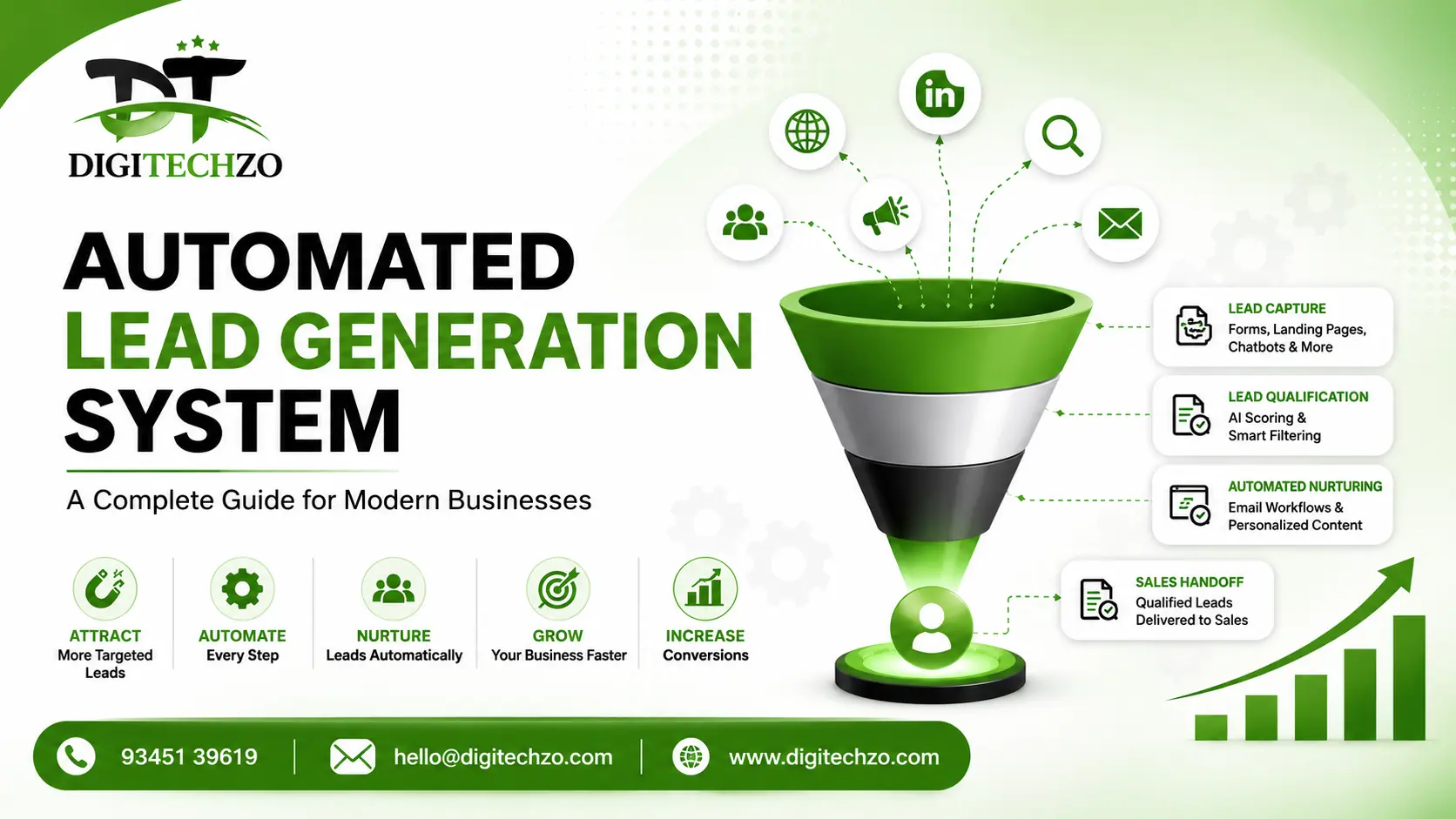
Most sales teams don't have a lead problem. They have a leaking bucket problem.
Marketing spends the budget, forms get filled, a spreadsheet fills up — and then leads sit untouched for hours or days while reps are buried in manual follow-ups, data entry, and guesswork about who's actually ready to buy. By the time someone calls, the prospect has already booked a demo with a competitor who replied in five minutes.
This is the exact gap an automated lead generation system is built to close. At DigiTechzo, we've spent years helping businesses fix this leaking bucket — rebuilding their lead capture, scoring, and nurturing into a system that runs itself instead of running on hope. This guide breaks down exactly how that works, what to avoid, and how to build one that actually converts.
An automated lead generation system uses software — forms, chatbots, email sequences, CRM workflows, and AI scoring — to capture, qualify, and nurture prospects with minimal manual effort. Done right, it cuts cost-per-lead, speeds up follow-up time from days to minutes, and lets sales focus only on leads that are actually ready to buy.
What Is an Automated Lead Generation System?
An automated lead generation system is a connected set of tools and workflows that finds, captures, qualifies, and nurtures potential customers with little to no manual intervention. Instead of a salesperson manually emailing every website visitor, the system does the repetitive work — while humans step in only at the moments that require judgment: a discovery call, a negotiation, a closing conversation.
A true system typically includes:
- Capture layer – forms, landing pages, chatbots, pop-ups
- Enrichment layer – tools that add firmographic and behavioral data to a raw lead
- Scoring layer – rules or AI models that rank leads by intent and fit
- Nurture layer – automated email/SMS sequences that move leads toward sales-readiness
- Routing layer – logic that hands off hot leads to the right rep instantly
This isn't the same as "lead gen software." A tool is one piece; a system is the wiring that connects all the pieces so a lead moves from stranger to sales-qualified without anyone manually pushing it along.
Why Manual Lead Generation Is Failing Businesses in 2027
Three forces have made manual lead generation unsustainable:
1. Buyer expectations have shifted. Most B2B buyers now do the majority of their research online before ever speaking to a rep, which means by the time they fill out a form, they expect a fast, relevant response — not a three-day wait.
2. Cost per lead keeps climbing. Median cost-per-lead across industries has moved into the $200+ range in many sectors, and the gap between top-performing and bottom-performing programs is widening — well-run automated systems now cost several times less per lead than programs that rely on manual volume tactics.
3. Follow-up speed decides deals. The majority of conversions come from consistent follow-up rather than the first outreach attempt, yet a large share of reps still never follow up a second time. That's not a talent problem — it's a systems problem.
Put simply: the businesses winning right now aren't generating more leads. They're capturing the same leads faster, qualifying them better, and following up more consistently — and they're using automation to do all three at once.
Core Components of an Automated Lead Generation System
1. Smart Capture (Forms, Chatbots & Landing Pages)
Modern capture isn't a static contact form. It's adaptive — chat-based capture on landing pages that asks progressive questions instead of a 10-field form. Businesses that swap static forms for conversational capture typically see a meaningful lift in qualified meeting bookings on the same traffic, simply because friction drops and qualification starts immediately.
2. Lead Scoring & Qualification
Lead scoring assigns a numeric or tiered value to each lead based on:
- Fit – company size, industry, job title, budget signals
- Intent – pages visited, time on site, content downloaded, email opens
- Engagement velocity – how quickly and how often a lead interacts
Companies that implement systematic lead scoring commonly report a significant jump in lead quality once sales starts working only the leads that clear the threshold, rather than everything that lands in the CRM.
3. Automated Nurturing (Email & SMS Sequences)
Not every lead is ready to buy today. Nurture sequences keep warm leads engaged with relevant content until they are. Businesses with strong nurturing programs generate substantially more sales-ready leads at a lower cost than those without one — and nurtured leads consistently place larger orders than leads that skip nurturing entirely.
4. AI Chatbots & Conversational Capture
AI-driven chat now handles the "first conversation" that used to require a human — answering FAQs, qualifying budget and timeline, and booking meetings directly onto a rep's calendar. Chatbot-driven interactions cost a fraction of a live support conversation, which is why the majority of marketing and sales leaders have already deployed, or plan to deploy, one.
5. CRM Integration & Lead Routing
None of the above matters if a qualified lead sits in an inbox. Automated routing pushes hot leads to the right rep — by territory, deal size, or product line — within seconds of qualification, instead of waiting for someone to check a shared inbox.
6. Analytics & Attribution
A system without measurement is a black box. Attribution tracking shows which channel, campaign, and piece of content actually produced revenue — not just form fills — so budget moves toward what works.
How an Automated Lead Generation System Actually Works (Step by Step)
- A visitor lands on your site via search, social, or a paid campaign.
- A capture mechanism engages them — a chatbot, a gated resource, or a smart form — collecting contact details and initial intent signals.
- The lead is enriched automatically, pulling in company size, role, and other firmographic data from third-party sources.
- A scoring model ranks the lead based on fit and behavior, sorting it into hot, warm, or cold.
- Hot leads are routed instantly to a sales rep with full context; warm leads enter a nurture sequence; cold leads get added to a long-term list.
- The nurture sequence adapts based on further engagement — opening a pricing email, for instance, can automatically bump a lead's score and trigger a rep alert.
- Everything is tracked back to source, so the team can see exactly which channel and content produced the deal.
This entire loop can run in the background 24/7 — including outside business hours, when a large share of form submissions actually happen.
Manual vs. Automated Lead Generation: A Side-by-Side Comparison
| Factor | Manual Process | Automated System |
|---|---|---|
| Response time | Hours to days | Seconds to minutes |
| Lead qualification | Rep judgment, inconsistent | Rule/AI-based, consistent |
| Follow-up consistency | Drops off after 1–2 attempts | Runs on a fixed cadence automatically |
| Scalability | Limited by headcount | Scales without added headcount |
| Cost per lead | Typically higher | Typically lower with SEO/automation mix |
| Data & attribution | Fragmented, manual reporting | Centralized dashboards |
| Best for | Very small, high-touch pipelines | Growing or high-volume pipelines |
Pros of automation: faster response, lower cost per lead over time, consistent follow-up, better data. Cons of automation: upfront setup time, risk of feeling impersonal if poorly configured, requires ongoing tuning.
Best Automated Lead Generation Tools by Category
- Capture & Chat: Drift-style conversational tools, Intercom, HubSpot forms
- Enrichment: Clearbit-style enrichment APIs, ZoomInfo
- Scoring & CRM: HubSpot, Salesforce, Pipedrive
- Email/SMS Nurture: ActiveCampaign, Klaviyo, HubSpot Workflows
- AI Prospecting/Outreach: AI-assisted SDR platforms that combine intent data with automated sequencing
Choose based on team size and complexity — a 5-person startup rarely needs the same stack as a 200-person enterprise sales org. Start with capture + CRM + one nurture channel, then layer in scoring and AI chat as volume grows.
How to Build an Automated Lead Generation System (Framework)
Here's the framework we use with clients at DigiTechzo — call it C.A.S.R.:
Capture
Map every entry point (SEO content, paid ads, social, referrals) and standardize how each one collects data.
Assess
Build a scoring model with 5–8 factors, weighted by what actually predicts a closed deal in your business — not generic industry defaults.
Sequence
Design nurture paths for each score tier. Hot leads get a call within minutes; warm leads get a 5–7 email sequence over 2–3 weeks; cold leads get long-term content nurture.
Route
Set clear rules for who gets what lead, and instrument the whole thing with attribution so you can see what's actually working.
Review the system monthly. Automation isn't "set and forget" — scoring thresholds and sequences need retuning as your audience and offer evolve.
Common Mistakes Businesses Make
- Automating before defining what a "qualified lead" means. Without a clear definition, the system optimizes for the wrong signal.
- Over-automating the first human touchpoint. A bot that never hands off to a real person frustrates high-intent buyers.
- Ignoring lead scoring decay. Scores based on stale data (a visit from six months ago) misrepresent current intent.
- Treating nurture emails as generic newsletters. Sequences need to map to where the lead actually is in their journey.
- Skipping attribution setup. Teams end up optimizing channels based on gut feeling instead of real revenue data.
- No feedback loop between sales and marketing. If sales doesn't report back on lead quality, the scoring model never improves.
Expert Tips for Higher Conversion Rates
- Respond inside 5 minutes wherever possible. Speed-to-lead is one of the single biggest levers on conversion rate, and automation is the only reliable way to hit it consistently.
- Personalize past the first name. Dynamic content based on industry or role outperforms generic blasts by a wide margin.
- Let AI handle qualification, not the close. Use chatbots and automation to filter and route — keep humans on the persuasion-heavy parts of the funnel.
- Re-score, don't just re-send. When a cold lead re-engages, update their score in real time instead of waiting for a scheduled review.
- Pair automation with SEO content. Organic, intent-driven traffic tends to convert at a lower cost than paid channels, and it feeds your automated system with warmer leads from the start.
Why Choose DigiTechzo for Automated Lead Generation Systems?
An automated lead generation system needs more than forms and email workflows; it requires intelligent automation that can capture, qualify, score, and nurture prospects with minimal manual intervention. AI can make these workflows more responsive by helping businesses process data, identify buying signals, and prioritize leads efficiently.
Digitechzo’s relevant AI capabilities include machine learning, AI automation, AI agents, LLM integrations, AI-powered applications, data-driven solutions, and scalable AI architecture. These capabilities provide a strong technical foundation for developing intelligent lead-generation workflows that can support evolving business requirements.
For businesses looking to integrate AI into their lead generation processes, exploring an AI DEVELOPMENT COMPANY can help identify the right technical approach for building smarter, more scalable automation.
FAQs
What is an automated lead generation system?
It's a connected set of tools — capture forms, chatbots, scoring models, CRM workflows, and nurture sequences — that finds, qualifies, and nurtures prospects with minimal manual work, so sales teams only spend time on leads that are ready to buy.
Is automated lead generation better than manual outreach?
For most growing businesses, yes — it responds faster, follows up more consistently, and scales without adding headcount. Very small, high-touch pipelines can still benefit from manual outreach layered on top of automation.
How much does an automated lead generation system cost?
Costs vary widely by stack and scale — from a few hundred dollars a month for a small business using a CRM plus email automation, to several thousand for enterprise setups with AI scoring, enrichment, and multi-channel routing.
Can small businesses use automated lead generation?
Yes. A small business can start with just a CRM, one nurture sequence, and a smart contact form, then add scoring and chatbots as lead volume grows.
Does automation make lead generation feel impersonal?
It doesn't have to — the key is using automation for qualification and timing, while keeping the actual sales conversation human. Poorly configured systems feel robotic; well-designed ones feel fast and relevant.