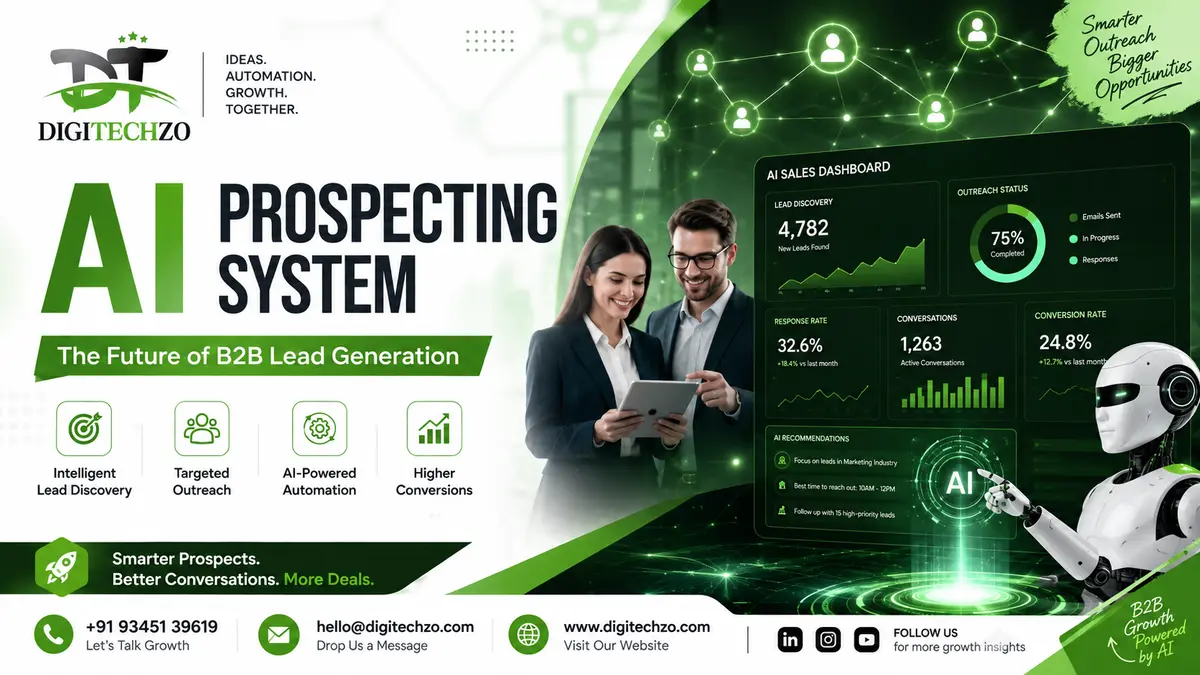
Sales teams are drowning in tools and starving for qualified pipeline. If you've spent a Monday morning scrolling through 300 stale leads from a list you bought six months ago, you already know the problem: volume without intent is just noise. This is exactly the gap an AI prospecting system is built to close — replacing manual list-building and cold guesswork with continuous, signal-based targeting that finds buyers while they're actually in-market.
At DigiTechzo, we've spent the last several years inside B2B revenue teams, watching the same pattern repeat: reps spend 60-70% of their week on research and outreach prep instead of actual selling. An AI prospecting system flips that ratio. This guide breaks down exactly what these systems are, how they work, what to look for, and how to avoid the mistakes that sink most implementations.
An AI prospecting system uses machine learning and intent data to automatically identify, score, and engage the B2B buyers most likely to convert — replacing manual research with real-time signals like job changes, funding events, tech-stack shifts, and content engagement. Done right, it cuts prospecting time by more than half and lifts reply rates significantly because outreach is timed and personalized around actual buying intent rather than a static list.
What Is an AI Prospecting System?
An AI prospecting system is software that combines machine learning models, firmographic and intent data, and automation to continuously identify and prioritize the accounts and contacts most likely to buy — then triggers or assists outreach at the right moment.
It's different from a simple lead list or a basic sales automation tool in three ways:
- It's continuous, not static. A purchased list is a snapshot. An AI system re-scores your total addressable market daily or weekly as new signals appear.
- It's predictive, not just descriptive. Instead of just telling you "this company has 200 employees," it tells you "this company is 3x more likely to buy in the next 30 days based on hiring patterns and web activity."
- It closes the loop. The best systems don't stop at identification — they feed scored leads directly into sequences, CRM records, and rep task queues.
AI Prospecting System vs. Lead Generation Software
These terms get used interchangeably, but they're not the same thing. Lead generation software (forms, landing pages, chatbots) captures leads who raise their hand. An AI prospecting system goes further upstream — it finds and prioritizes leads before they've ever filled out a form, based on behavioral and firmographic signals.
How AI Prospecting Systems Actually Work
Most platforms follow a similar pipeline, even if the underlying models differ:
- Data ingestion — The system pulls firmographic data (industry, size, revenue), technographic data (what tools a company uses), and intent data (content consumption, search behavior, job postings) from dozens of sources.
- Ideal Customer Profile (ICP) matching — Machine learning models compare incoming accounts against your historical closed-won deals to find pattern matches.
- Intent scoring — Accounts are ranked by a composite score that weighs recency and strength of buying signals — think "VP of Ops just posted about scaling problems" scoring higher than a generic firmographic match.
- Trigger-based routing — High-scoring accounts get pushed into rep queues or automated sequences, often with AI-drafted, context-aware first-touch messaging.
- Feedback loop — Win/loss data flows back into the model, so scoring accuracy improves over time.
The Role of Buying Signals
Buying signals are the fuel of any AI prospecting system. The strongest ones typically include:
- Leadership or role changes (a new VP often re-evaluates existing vendor relationships within their first 90 days)
- Funding announcements or headcount growth in a relevant department
- Technology adoption or removal (detected via tech-stack tracking)
- Spikes in content consumption around a specific problem category
- Competitor mentions or review-site activity
Why Traditional Prospecting Is Breaking Down
Cold outbound response rates have been sliding for years as inboxes get noisier and buyers get better at filtering out generic pitches. Three structural problems make manual prospecting increasingly inefficient:
- Research time eats selling time. A rep manually qualifying an account — checking LinkedIn, the company site, recent news — can easily burn 15-20 minutes per account before writing a single line of outreach.
- Static lists decay fast. Contact and firmographic data degrades continuously as people change roles and companies restructure, so a list built in January is materially stale by March.
- Generic messaging gets ignored. Buyers can spot a templated, non-contextual email instantly, and it damages sender reputation for future outreach.
None of this means human judgment is obsolete — it means human judgment needs to be pointed at the 5% of accounts actually showing intent, not spread evenly across a list where 95% aren't ready.
Core Components of an AI Prospecting System
A genuinely useful system needs these building blocks working together, not in isolation:
Data Layer
Firmographic, technographic, and intent data, ideally from multiple providers to reduce blind spots.
Scoring & Prediction Engine
The ML model that ranks accounts and contacts against your specific ICP — this should be trainable on your own closed-won/closed-lost history, not just a generic industry benchmark.
Enrichment & Personalization
Automatic pulling of contextual detail (recent news, role tenure, tech stack) that feeds into outreach copy so messaging references something real, not a mail-merge field.
Orchestration & Sequencing
The layer that decides channel, cadence, and timing — email, LinkedIn, phone — based on account score and past engagement.
CRM & Attribution Integration
Everything needs to sync back to your CRM cleanly, or reps will simply distrust and ignore the tool within a few weeks.
Key Benefits, Backed by Data
- Time reclaimed for selling. Teams using intent-based prioritization consistently report cutting manual research time by half or more, redirecting that time into calls and follow-up.
- Higher reply and conversion rates. Outreach timed to an active buying signal — like a recent funding round or a relevant new hire — routinely outperforms cold, untimed sends because the message arrives when the problem is already top of mind.
- Shorter sales cycles. When you're talking to an account already evaluating the problem space, you skip much of the early education stage of the funnel.
- Better rep morale and retention. Reps who spend their day on qualified conversations instead of research and rejection tend to stay engaged longer — a quieter but real ROI of these systems.
AI Prospecting vs. Traditional Prospecting
| Factor | Traditional Prospecting | AI Prospecting System |
|---|---|---|
| Data freshness | Static list, decays over weeks | Continuously updated signals |
| Targeting basis | Firmographics only | Firmographics + real-time intent |
| Rep time per qualified lead | High (manual research) | Low (pre-qualified and scored) |
| Personalization | Manual, inconsistent | Automated, context-aware |
| Scalability | Limited by headcount | Scales with data, not headcount |
| Feedback loop | Rare, manual | Built-in, continuous model improvement |
Pros of AI prospecting systems: faster qualification, better timing, more consistent personalization, scalable coverage of a large TAM.
Cons to weigh: upfront setup and data integration effort, dependency on data quality, and a real risk of over-automation that makes outreach feel robotic if messaging isn't reviewed by humans.
Real-World Use Cases
- A SaaS company targeting mid-market finance teams used hiring-signal tracking (new controller or CFO hires) to time outreach within the first two weeks of a leadership change, when new leaders are most open to evaluating tools.
- A cybersecurity vendor layered technographic data (detecting when a prospect removed a competing tool from their stack) on top of firmographic fit to trigger immediate rep alerts — catching prospects in an active buying window rather than a cold state.
- A B2B agency (like the workflows digitechzo builds for clients) combined intent scoring with content engagement data, routing only accounts that had visited pricing or comparison pages multiple times into a high-priority sequence — dramatically improving lead-to-meeting conversion versus blanket outreach.
A Framework for Choosing or Building Your System
Use this checklist before committing budget:
- Define your ICP with real closed-won data, not assumptions — the model is only as good as what it's trained against.
- Audit your existing data sources for overlap and gaps before adding a new tool on top.
- Prioritize integration depth over feature count — a system that syncs cleanly with your CRM and sequencing tool beats one with more bells and whistles but poor integration.
- Start with one segment, prove lift in reply/conversion rate, then expand.
- Keep a human review step on AI-drafted first-touch messaging until you trust the output quality.
Common Mistakes to Avoid
- Treating AI scoring as infallible. Scores are directional, not gospel — sales judgment still matters, especially for strategic accounts.
- Skipping ICP calibration. Feeding the model a poorly defined or outdated ICP produces confidently wrong prioritization.
- Automating the entire outreach chain. Fully automated, unreviewed messaging at scale tends to erode reply rates and brand trust over time.
- Ignoring data hygiene. Duplicate or malformed CRM records compound errors in scoring and routing.
- Measuring activity instead of outcomes. More emails sent isn't the goal — more qualified meetings booked is.
Expert Tips
- Layer at least two independent intent signal types (e.g., technographic + content engagement) rather than relying on one — single-signal scoring produces more false positives.
- Re-train or recalibrate your scoring model on a quarterly cadence as your ICP and market shift.
- Give reps visibility into why an account scored high — a transparent score builds trust in the system far faster than a black-box number.
- Pilot on a defined segment (e.g., one vertical or region) for 60-90 days before a full rollout, so you have a clean before/after comparison.
Why Choose DigiTechzo to Develop Your AI Prospecting System?
Building an effective AI prospecting system requires more than automating lead research. It needs machine learning, intent-driven data processing, AI automation, and intelligent workflows that can identify high-value prospects and support timely engagement.
Digitechzo brings relevant AI capabilities across machine learning, AI automation, AI agents, LLM integrations, AI-powered applications, and scalable AI architecture. These capabilities can support prospecting systems designed around real-time buyer signals, intelligent lead qualification, and personalized engagement rather than static prospect lists.
For businesses planning to build or enhance an AI-driven prospecting platform, partnering with an AI development company can provide the technical foundation needed to turn prospecting requirements into practical AI-powered workflows.
What is an AI prospecting system in simple terms?
It's software that uses AI and real-time buying signals — like funding events, hiring changes, and content engagement — to automatically find and prioritize the B2B accounts most likely to buy, instead of relying on static, manually built lists.
Is an AI prospecting system the same as a CRM?
No. A CRM stores and manages customer relationship data after contact is made. An AI prospecting system operates earlier in the funnel, identifying and scoring which accounts to pursue in the first place, and typically integrates with your CRM rather than replacing it.
How long does it take to see results from an AI prospecting system?
Most teams see measurable improvement in reply and meeting-booked rates within 60-90 days, once the ICP model has enough closed-won/closed-lost data to calibrate scoring accurately.
Can small B2B teams use AI prospecting systems, or is this only for enterprise?
Small teams often see the biggest relative time savings, since they have less headcount to absorb manual research work — the key is starting with a narrow, well-defined segment rather than trying to cover the entire market at once.
Does an AI prospecting system replace sales reps?
No. It removes the manual research and list-building burden so reps can spend more time on conversations, relationship-building, and closing — the judgment and rapport-building parts of selling stay human.