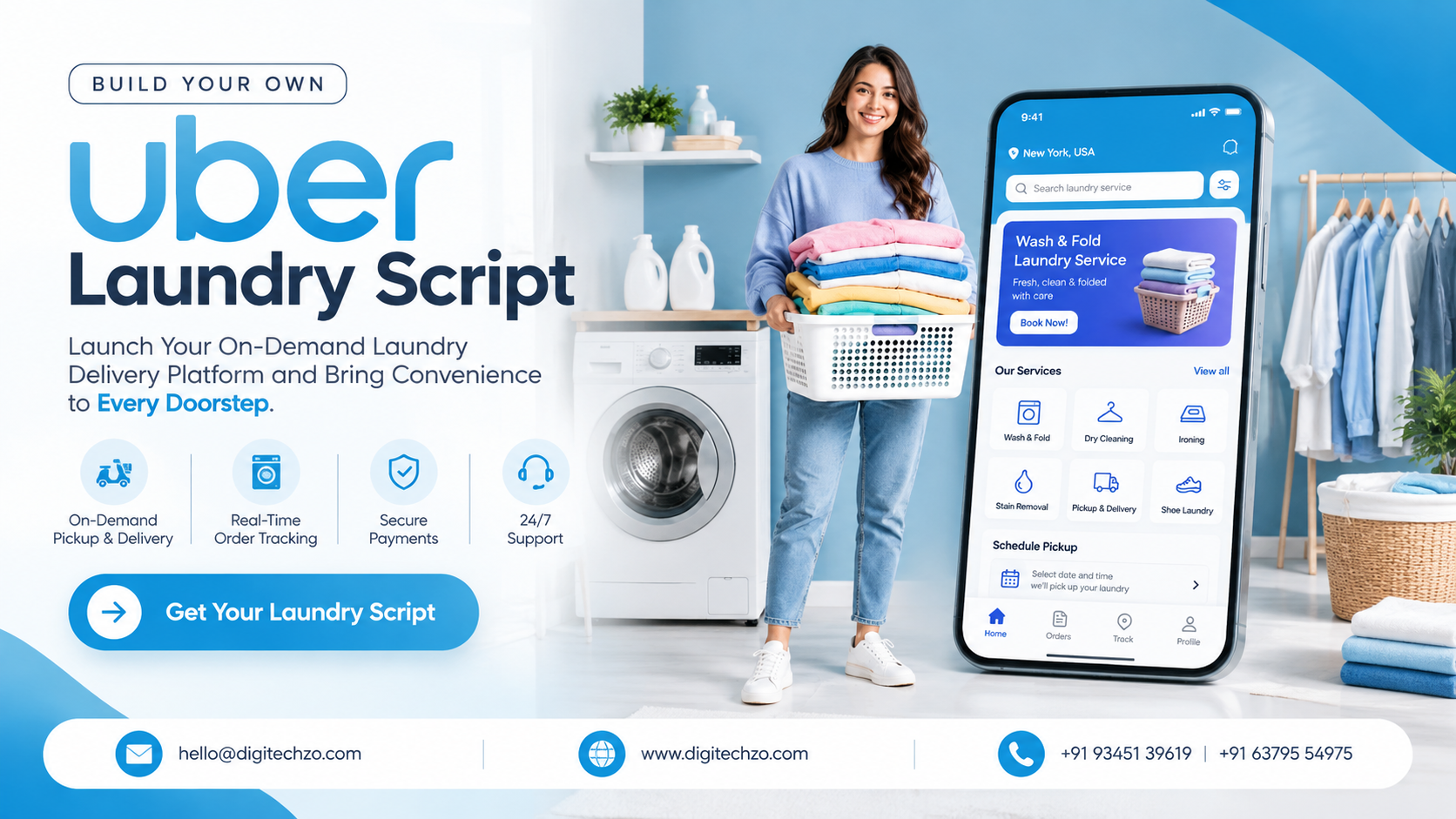
You run a laundry or dry-cleaning shop, or you want to start a service where customers never visit one. Right now, orders arrive by phone and messages, pickups are scheduled on paper, and nobody can say where a customer's bag is at 4 p.m. You want customers to book in a few taps, track pickups and deliveries, and pay online, without designing every workflow from scratch.
That is the idea behind an Uber for Laundry app. But the app is only the visible layer. The business runs on pickup logistics, garment handling and consistent quality. This guide explains how the model works, which operating model to choose, what the order workflow must cover, and what to verify before choosing a development partner.
An Uber for Laundry app is a ready-to-customize on-demand laundry platform that lets customers book pickup and delivery, while your laundry operation or partner laundries process the orders. To start a laundry delivery business with one, first choose your operating model (your own laundry, partner laundries, or a hybrid), then make sure the platform handles scheduling, pricing, order tracking and delivery workflows reliably. Check customization scope, ownership terms and support before you commit.
What an Uber for Laundry App Is (and Is Not)
"Uber for Laundry" describes an on-demand laundry platform inspired by the ride-hailing business model: a customer requests a service in the app, a delivery agent collects the laundry, it is cleaned, and it is delivered back. Providers often sell it as a white-label or clone-based foundation.
A responsible project is:
A business-model-inspired platform with its own brand, interface, services and policies
A customized on-demand service solution adapted to your city, service types and pricing
Independently operated, with no suggestion of affiliation with Uber
It shouldn't copy Uber's trademarks, branding, interface designs or proprietary code. For legal questions, consult a qualified lawyer. This article is business and technical guidance, not legal advice.
Choose Your Operating Model First
Many guides jump to features. This decision shapes your app, costs and operations.
Confirm that the platform supports your chosen model. An app built for one model may need rework for another.
How the Platform Works
Customer App
Customers register, choose services (wash and fold, dry cleaning, ironing, specialty items), select a pickup slot, confirm the order, pay, track pickup and delivery, and rate the service.
Laundry Partner or Operations Panel
Your facility team or partner laundries receive orders, confirm items on arrival, update the status through each processing stage, handle special instructions and mark orders ready for delivery.
Delivery Agent App
Agents see assigned pickups and deliveries, navigate to addresses, confirm collection and handover, and track earnings if they are partners rather than staff.
Admin Dashboard
Admins manage customers, services, prices, delivery zones, time slots, partner laundries, agents, payments, refunds, promotions and reports.
If you run a single laundry with your own drivers, the partner and agent roles may be internal tools rather than separate partner apps. Match the architecture to your model.
The Order Lifecycle: What Happens Between Pickup and Delivery
Most guides stop at "pickup and delivery." The middle is where quality is won or lost.
Booking: the customer chooses services, address and a pickup slot
Pickup: the agent collects the bag, confirms the count or description and updates the status
Intake at the laundry: items are counted, weighed if needed, checked for stains or damage and tagged
Quote adjustment: the final price is confirmed if it depends on weight or item count
Processing: washing, dry cleaning, ironing and folding, with status updates
Quality check and packing
Delivery scheduling and dispatch: an agent is assigned and the customer is notified
Handover and payment: delivery confirmation, with payment collected if it wasn't taken online
Feedback and issue handling: ratings, complaints, re-cleans or claims
Ask any provider to demonstrate intake, quote adjustment and issue handling, not just booking and tracking.
Features That Matter Most
Customers
Registration, saved addresses and order history
Service and item selection with clear pricing
Pickup and delivery slot booking, including recurring orders
Live order status and agent tracking
Multiple payment options and receipts
Notifications and in-app support
Ratings and re-order
Laundry partners or operations team
Incoming order management and status updates
Item intake and tagging records
Special instructions and notes
Capacity or availability settings
Earnings and payout reports (in marketplace models)
Delivery agents
Pickup and delivery tasks with navigation
Proof of collection and delivery
Availability toggle and earnings view
Admin
Service catalogue, pricing and zone configuration
Time-slot and capacity control
Partner and agent onboarding and management
Order monitoring and manual reassignment
Refund, complaint and claim handling
Promotions, subscriptions and reports
Advanced additions, such as route batching, subscription plans, loyalty points, garment-level tracking and multi-language support, can follow once the core flow works.
Pricing Models for Laundry Orders
Pricing logic shapes both the customer experience and your margins.
Where the price depends on weighing or counting, make sure the platform supports an estimate at booking and a confirmed amount after intake, with customer notification.
Business Models and Revenue Streams
Service revenue from your own laundry
Commission on orders processed by partner laundries
Delivery or express fees
Subscriptions for regular households
B2B contracts with hotels, gyms, offices and short-term rentals
Add-on services, such as stain treatment, ironing, shoe or bedding cleaning
Promotions and featured partners, in marketplace models
None guarantees profitability. Results depend on order density, pickup efficiency, processing costs, quality and competition.
Ready-to-Customize Foundation vs Custom Development
Be careful with claims like "launch quickly" or "lower cost." They depend on what's included, how much you customize and which integrations you need.
Technology and Integrations to Plan For
Maps and location services: address search, geofenced service areas, routing and live tracking
Payment gateways: cards, wallets, cash on delivery and, for marketplaces, partner payouts
Scheduling logic: time slots, capacity limits and recurring pickups
Push, SMS and email notifications: for status changes and reminders
Barcode or QR tagging, if you track garments individually
Route optimization, if volume justifies it
Cloud hosting, monitoring, backups and security
Analytics and reporting
Native or cross-platform mobile apps for customers and agents
Third-party services usually carry usage fees on top of development.
What the App Does Not Solve
Laundry quality: equipment, staff training and consistency still decide repeat orders
Pickup density: profitable routes need enough orders in close areas
Lost or damaged items: you need clear policies, evidence steps and a claims process
Delivery agents: hiring, scheduling and reliability
Regulation and safety: business licences, labour rules, chemical handling and data protection vary by region
Customer support
Marketing and local trust
What to Look for in a Clone Development Partner
Working demo covering booking, pickup, intake, processing, delivery and admin
Operating-model fit: own-laundry, marketplace, hybrid or subscription, and how easily the platform adapts
Order workflow flexibility: custom statuses, quote adjustment after weighing and issue handling
Scheduling and capacity logic: time slots, zones and recurring orders
Customization scope: what can be changed (services, pricing, workflows, branding) and what cannot
Integrations: supported payment, maps and notification services, and how others can be added
Ownership: do you receive the source code, under what licence, and who owns your customizations?
Security and testing: how payments and personal data are protected, and how releases are tested
Scalability: how it handles more orders, zones and partners
Support and updates: what is included after launch, and for how long
Candor: does the provider explain limits, or only benefits?
Common Mistakes to Avoid
- Treating it as an app project instead of an operations project
- Not choosing an operating model before development
- Ignoring the intake and quality-check steps
- Launching across a whole city at once instead of dense zones
- Complicated pricing the customer can't understand
- No claims policy for damaged or lost items
- Copying Uber's branding or interface
- Not clarifying source-code and ownership terms
Why Choose DigiTechzo for Laundry App Development?
A laundry delivery platform connects customer, partner, delivery and admin experiences, and the way they fit together shapes daily operations. Your development partner matters as much as the foundation you start from.
DigiTechzo describes itself as a business growth technology company, with services across AI development, websites, mobile apps, blockchain, software and growth marketing. For a laundry delivery project, that means you can discuss customer and agent apps, the admin and operations tools, and integrations with a team that works across product development and business growth, and shape the platform around your own brand, services and operating model.
FAQs
What is an Uber for Laundry app?
It is an on-demand laundry platform where customers book pickup and delivery in an app, and a laundry operation or partner laundries clean the items. It is built as your own independently branded service, not a copy of Uber.
How does a laundry delivery app work?
The customer books a pickup, an agent collects the laundry, it is processed at a laundry facility, and an agent delivers it back, with status updates and payment handled in the app.
What features does a laundry app need at launch?
Customer booking and tracking, slot scheduling, service and price management, a laundry-side order panel, a delivery agent app, payments, notifications and an admin dashboard.
Should I run my own laundry or use partner laundries?
Run your own if you have a facility and want quality control. Use partners if you want to scale without equipment, accepting the extra work of partner management and quality control. A hybrid is also common.
How is pricing handled?
Common methods are per item, per kilogram, service bundles or a hybrid. Where the final price depends on weighing, the platform should show an estimate and confirm the amount after intake.
How do laundry delivery businesses make money?
Through service revenue, delivery fees, partner commissions, subscriptions, B2B contracts and add-on services. Profitability is not guaranteed.