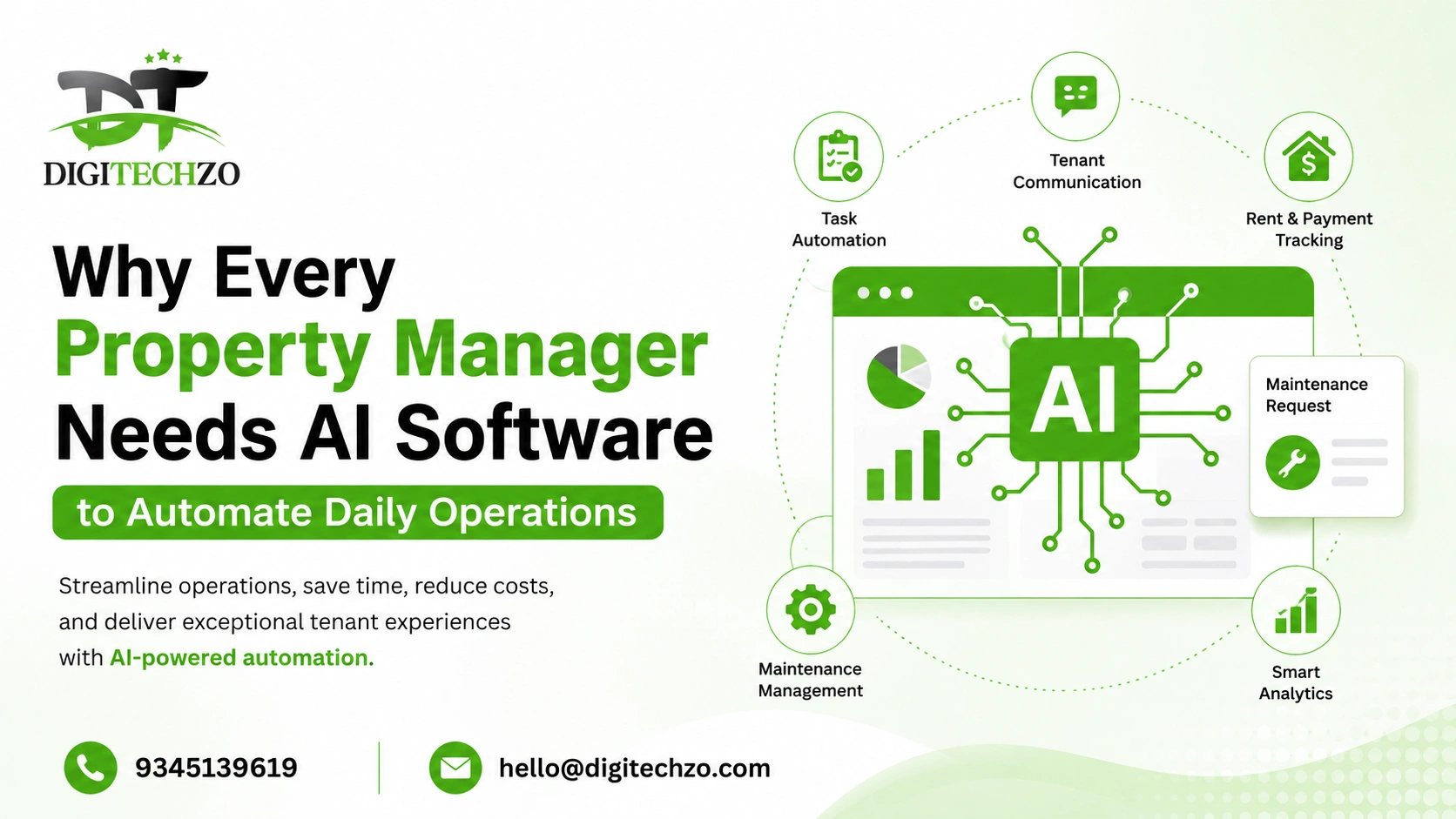
If you manage more than a handful of units, you already know the real job isn't "managing properties." It's managing hundreds of tiny fires at once — a late-night maintenance call, a lease that needs renewing, a tenant asking the same question for the third time, a vacancy that's bleeding cash every day it sits empty. Most property managers aren't drowning because they're bad at their jobs. They're drowning because they're doing 2010-era work with 2026-era portfolios. This is exactly the gap that property management AI software was built to close.
At digitechzo, we've spent years building automation and AI-driven systems for real estate and operations-heavy businesses, and one pattern shows up in almost every audit we run: property managers lose 15–20 hours a week to tasks that software can now do in seconds. That's not a productivity tip. That's a business model problem.
This guide breaks down exactly why property management AI software has moved from "nice to have" to "how you stay in business," what it actually automates, how to evaluate tools, and the mistakes that quietly sink most implementations.
Property management AI software automates repetitive, high-volume tasks — tenant screening, maintenance triage, rent collection, lease renewals, and communication — freeing property managers to focus on growth and tenant retention instead of admin work. The best tools cut operating costs by 20–30%, reduce vacancy periods, and catch maintenance issues before they become expensive emergencies. If you're managing 15+ units without AI-assisted automation, you're likely leaving money and hours on the table every single week.
What Is Property Management AI Software?
Property management AI software is a category of tools that uses machine learning, natural language processing, and predictive analytics to handle the operational workload of managing rental properties — without a human manually touching every task.
Unlike traditional property management systems (which are essentially digital filing cabinets — you input data, they store it), property management AI software actively works. It reads maintenance requests and routes them. It screens tenant applications against risk models. It predicts which units are likely to see late payments. It answers tenant questions at 2 a.m. without waking anyone up.
Think of the difference this way: traditional software tells you what happened. Property management AI software tells you what's about to happen — and often handles it before you even see the alert.
Key Capabilities That Define This Category
- Predictive maintenance scheduling based on equipment age, usage patterns, and historical repair data
- AI-powered tenant screening using credit, rental history, and behavioral risk scoring
- Automated rent collection and reminders with dynamic follow-up sequences
- Conversational AI chatbots for 24/7 tenant and prospect communication
- Dynamic pricing engines that adjust rent based on market conditions
- Document and lease automation with AI-assisted review and e-signatures
Why Manual Property Management Doesn't Scale
Here's an uncomfortable truth: most property managers didn't choose to be inefficient. They just started small, and the manual processes that worked for 10 units quietly became unsustainable at 50.
A property manager operating without automation typically deals with:
- Answering the same 5–7 tenant questions dozens of times a week
- Manually cross-checking maintenance vendor availability and pricing
- Chasing late rent payments one phone call at a time
- Re-entering the same tenant data across three or four disconnected systems
- Missing early warning signs of tenant turnover risk because there's no time to analyze patterns
None of this is a skills gap. It's a bandwidth gap. And bandwidth gaps compound — one missed maintenance signal today becomes a $4,000 HVAC replacement in six months. This is precisely where property management AI software earns its cost back multiple times over.
Core Ways Property Management AI Software Automates Daily Operations
This is the heart of the matter — and where most competitor content stays surface-level. Let's go deeper.
Maintenance Request Triage and Vendor Matching
Instead of a tenant submitting a ticket that sits in an inbox for two days, property management AI software reads the request, classifies urgency (a leaking pipe vs. a squeaky cabinet), and automatically routes it to the right vendor based on availability, cost history, and past performance ratings.
Real impact: Portfolios using AI-based maintenance triage typically report 30–40% faster resolution times, because the system removes the human bottleneck of manual dispatching.
AI Tenant Screening and Risk Scoring
Traditional screening checks a credit score and calls it done. Property management AI software builds a fuller risk profile — payment behavior patterns, rental history consistency, and even communication responsiveness during the application process — to flag applicants who look fine on paper but carry higher default risk.
Rent Collection and Predictive Delinquency Alerts
AI models can flag tenants likely to pay late before the due date, based on past payment timing patterns. This lets property managers send a gentle reminder or offer a payment plan proactively — instead of chasing a delinquent account after the fact.
24/7 Conversational AI for Tenant and Prospect Communication
A chatbot trained on your specific property data can handle:
- Leasing inquiries and virtual tour scheduling
- Maintenance status updates
- Move-in/move-out logistics questions
- Basic policy questions (pet policy, parking, guest rules)
This alone eliminates a huge share of routine inbound messages that otherwise interrupt a property manager's day.
Dynamic Rent Pricing
Property management AI software continuously analyzes local market data, comparable listings, seasonality, and occupancy trends to recommend optimal rent pricing — helping avoid both under-pricing (lost revenue) and over-pricing (extended vacancy).
Lease Renewal and Document Automation
AI tools can identify which leases are approaching renewal, predict renewal likelihood based on tenant behavior, and trigger personalized renewal offers automatically — with e-signature workflows built in.
Financial Reporting and Anomaly Detection
Rather than manually reconciling books, AI systems flag unusual expenses, duplicate charges, or budget variances in real time, giving property managers an early warning system instead of a monthly surprise.
Real-World Use Cases and Scenarios
Scenario 1: The Mid-Size Portfolio Manager A manager overseeing 80 units across three buildings was spending nearly 12 hours a week on maintenance coordination alone. After implementing property management AI software with automated triage and vendor routing, that dropped to roughly 3 hours a week — time redirected into lease renewals and tenant retention calls that directly protected revenue.
Scenario 2: The Leasing Bottleneck A leasing team was losing prospective tenants because inquiries submitted after business hours went unanswered until the next morning — by which point many had already toured a competing property. A conversational AI layer answering inquiries instantly increased tour bookings by capturing leads at the exact moment of interest.
Scenario 3: The Delinquency Spiral A property manager noticed rent delinquencies climbing but couldn't identify a pattern manually. Predictive analytics within their property management AI software flagged a cluster of units where payment timing had been steadily drifting later for three consecutive months — allowing early intervention before it became a collections issue.
Property Management AI Software vs. Traditional Property Management Tools
| Factor | Traditional Property Management Software | Property Management AI Software |
|---|---|---|
| Core function | Stores and organizes data | Analyzes data and takes action |
| Maintenance handling | Manual ticket logging | Automated triage and vendor matching |
| Tenant communication | Manual email/phone replies | 24/7 AI chatbot handling |
| Rent pricing | Manual market research | Real-time dynamic pricing |
| Risk detection | Reactive (after the fact) | Predictive (before it happens) |
| Time investment | High, ongoing manual work | Low, exception-based oversight |
Pros and Cons of Property Management AI Software
Pros
- Significant time savings on repetitive administrative tasks
- Faster maintenance response and lower emergency repair costs
- Improved tenant experience through instant communication
- Data-backed pricing and leasing decisions
- Early detection of financial and operational risks
- Scales portfolio management without proportionally scaling headcount
Cons
- Upfront learning curve for teams used to manual processes
- Initial setup and data migration takes time to do properly
- Requires clean, structured data to perform well
- Not a full replacement for human judgment on sensitive tenant issues
- Subscription costs can add up across multiple tool categories if not consolidated
How to Choose the Right Property Management AI Software
Not all tools in this category are built the same. When evaluating property management AI software, prioritize:
- Integration depth — Does it connect with your existing accounting, leasing, and maintenance systems, or does it create another data silo?
- Transparency of AI decisions — Can you see why the system flagged a tenant as high-risk or recommended a rent change? Black-box scoring is a red flag.
- Scalability — Will it still work smoothly at 3x your current unit count?
- Support for human override — The best tools augment your judgment; they don't remove your ability to make the final call.
- Track record and case studies — Ask for real performance data, not just feature lists.
Common Mistakes Property Managers Make with AI Automation
- Automating everything at once. Rolling out AI across maintenance, screening, and communication simultaneously overwhelms teams and makes it impossible to identify what's actually working.
- Ignoring data quality first. Property management AI software is only as good as the data it learns from. Feeding it inconsistent, outdated records guarantees poor recommendations.
- Treating AI as "set and forget." These systems need periodic review — market conditions change, and pricing or screening models need recalibration.
- Removing the human layer entirely. Tenants still need a real person for sensitive situations like hardship requests or disputes. Full automation without empathy damages retention.
- Choosing tools based on hype instead of fit. The flashiest AI feature isn't always the one your portfolio actually needs.
Expert Tips for Getting the Most Out of Property Management AI Software
- Start with the single biggest time-drain in your operation (usually maintenance or communication) and automate that first before expanding.
- Set a monthly review cadence to check AI-generated pricing and risk recommendations against real outcomes.
- Keep a documented escalation path so tenants can always reach a human when needed.
- Use AI-generated reports to have data-backed conversations with owners and stakeholders, not just internal efficiency gains.
- Pair automation rollout with brief tenant communication explaining new AI touchpoints — transparency reduces confusion and complaints.
FAQs
Is property management AI software worth it for small portfolios?
Yes, even portfolios under 20 units benefit — primarily from automated tenant communication and maintenance triage, which save disproportionate time relative to portfolio size when managed by a small team.
Does property management AI software replace property managers?
No. It removes repetitive administrative work so property managers can focus on tenant relationships, strategic decisions, and issues that genuinely require human judgment.
How much does property management AI software typically cost?
Pricing varies widely by feature set and portfolio size, often ranging from per-unit monthly fees to tiered subscription plans. Most tools scale cost with the number of units managed.
Can property management AI software integrate with my existing accounting system?
Most modern platforms are built with integration in mind, but the depth of integration varies significantly — this should be a top evaluation criterion before purchase.
Is tenant data safe with AI-powered property management tools?
Reputable providers follow data encryption and compliance standards, but property managers should always verify a vendor's data security practices before onboarding.
Why Choose Digitechzo for Property Management AI Software?
As property portfolios grow, manual processes like tenant communication, maintenance coordination, and rent tracking become bottlenecks that limit scalability. Adopting AI software isn’t just about automation — it’s about building systems that can handle increasing complexity without adding operational strain.
Digitechzo approaches this with a workflow-first mindset. As an AI Development Company, we identify where your team is losing time and design automation systems that integrate directly into your operations — from intelligent lead handling and tenant communication to maintenance routing and reporting. Instead of generic tools, the focus is on building solutions that reflect how your portfolio actually runs.
This leads to faster response times, fewer missed tasks, and more consistent operations across properties. Your team spends less time on repetitive work and more time on decisions that improve occupancy, retention, and revenue.
If you're looking to turn daily operations into a scalable, AI-driven system, Digitechzo offers a practical path to implementing automation that delivers measurable impact.