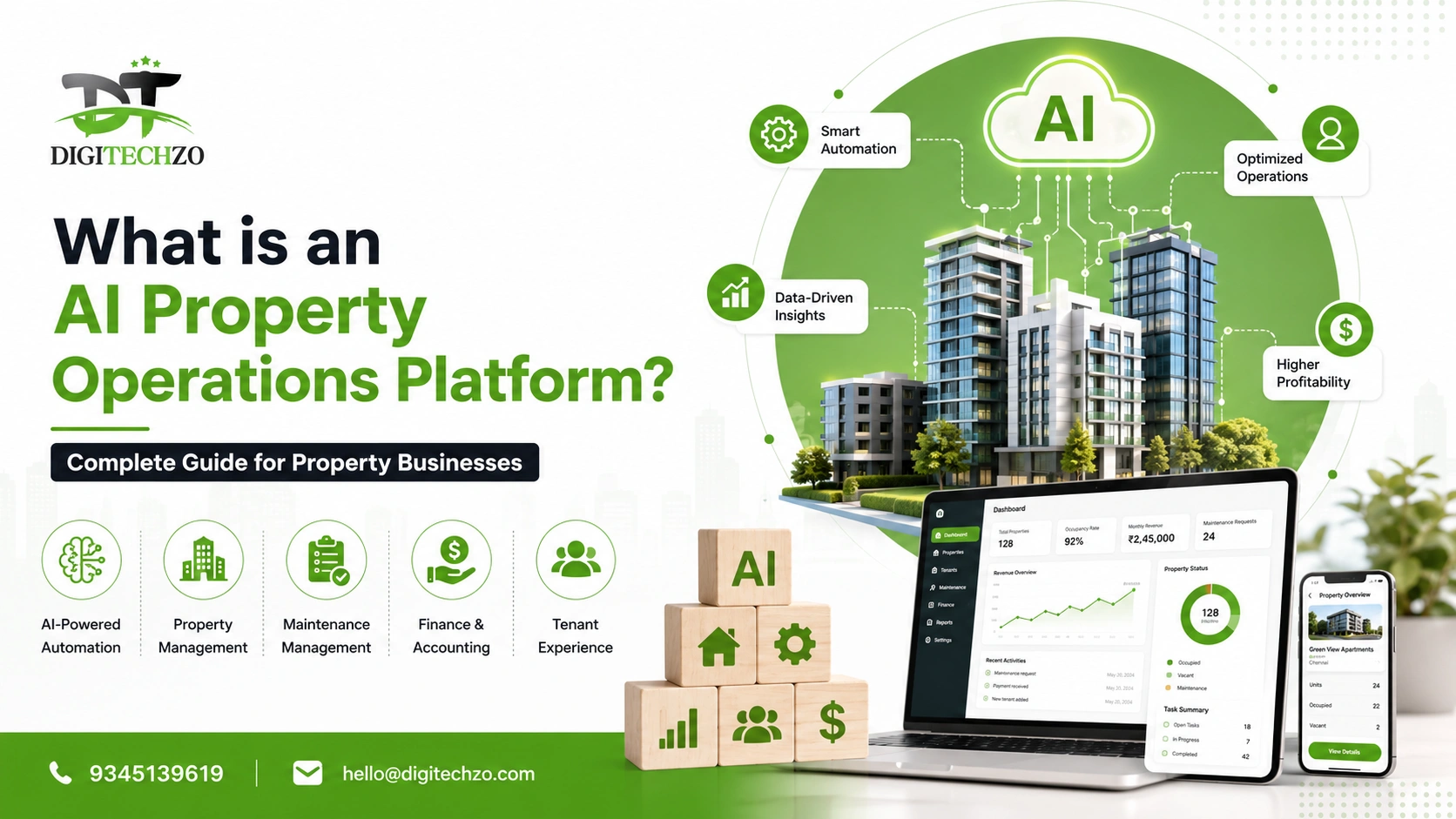
If you manage more than a handful of properties, you already know the real problem isn't finding tenants or collecting rent — it's the hundred small operational tasks that eat your week: maintenance tickets stuck in email threads, vendors who never confirm a time, staff following three different versions of the "same" process, and owners asking for reports you have to build by hand at 11 PM. This is exactly the gap an AI property operations platform is built to close.
At Digitechzo, we work with property management companies, facility teams, and real estate operators who are drowning in fragmented tools — a CRM here, a spreadsheet there, a maintenance app that doesn't talk to anything else. What we've seen, again and again, is that the businesses that scale without burning out their teams are the ones that centralize operations around a single intelligent system. That's the promise of an AI property operations platform, and in this guide, we'll break down exactly what it is, how it works, what it costs to get wrong, and how to choose one that actually fits your business.
An AI property operations platform is software that uses artificial intelligence to automate and centralize the day-to-day running of properties — maintenance, tenant communication, vendor coordination, compliance, and reporting — instead of managing these tasks manually across disconnected tools. Unlike traditional property management software, it actively predicts issues, automates workflows, and generates decisions rather than just storing data.
What is an AI Property Operations Platform?
An AI property operations platform is a centralized software system that applies artificial intelligence — machine learning, natural language processing, and predictive analytics — to run the operational side of property management. This includes maintenance scheduling, tenant and vendor communication, compliance tracking, staff task management, and performance reporting.
The word "operations" is the key differentiator here. Most legacy property software was built around record-keeping: leases, rent rolls, ledgers. An AI property operations platform is built around doing work — it doesn't just store the fact that a maintenance request came in, it triages the request, assigns the right vendor, predicts the likely cost, and flags it if it's part of a recurring pattern (like a unit with repeated plumbing issues).
In simple terms: traditional software tells you what happened. An AI property operations platform helps you decide what to do next — and increasingly, does it for you.
Why This Category Emerged Now
Three things converged to make AI property operations platforms viable:
- Data volume: Property businesses generate huge amounts of unstructured data (emails, texts, inspection photos, invoices) that AI is now good at parsing.
- Labor cost pressure: Property operations teams are chronically understaffed relative to the number of units and tasks they handle.
- Maturity of AI tooling: Natural language processing and predictive models have become affordable enough to embed into everyday software, not just enterprise-grade systems.
How an AI Property Operations Platform Actually Works
Understanding the mechanics helps you evaluate vendors instead of buying on buzzwords. Most AI property operations platform tools operate in four layers:
Data Ingestion Layer
The platform pulls in data from every operational touchpoint — tenant messages, maintenance requests, vendor invoices, inspection reports, IoT sensors (for smart buildings), and financial systems. This is the raw material AI needs to function.
Intelligence Layer
This is where machine learning models process the data to:
- Classify and prioritize maintenance requests automatically
- Predict which assets are likely to fail next (predictive maintenance)
- Detect anomalies in spending, occupancy, or tenant behavior
- Summarize long email or chat threads into actionable next steps
Automation / Workflow Layer
Based on what the intelligence layer decides, the platform triggers actions: assigning a vendor, sending a tenant update, escalating an unresolved ticket, or generating a compliance alert — without a human manually initiating each step.
Reporting & Decision Layer
Finally, the platform converts all of this activity into dashboards and reports that owners, managers, and investors can actually use — occupancy trends, maintenance cost per unit, vendor performance scores, and operational bottlenecks.
Featured snippet answer: An AI property operations platform works by ingesting operational data, using AI models to prioritize and predict issues, automating the resulting workflows, and reporting outcomes in real time — replacing manual coordination with intelligent automation.
Core Features to Look For
Not every tool marketed as an "AI property operations platform" actually uses AI meaningfully. Here's what genuinely useful platforms typically include:
- Automated maintenance triage — AI reads the request, categorizes urgency, and routes it
- Predictive maintenance alerts — flags equipment likely to fail based on historical patterns
- AI-powered tenant communication — chatbots or auto-responders that resolve common queries instantly
- Vendor performance scoring — ranks vendors by response time, cost, and quality
- Smart compliance tracking — automatically flags upcoming inspections, license renewals, or regulatory deadlines
- Unified dashboard — a single operational view across all properties, not siloed by tool
- Natural language reporting — ask the system a question ("Which properties had the highest maintenance cost last quarter?") and get an instant answer
H3: Table — Feature Comparison at a Glance
| Feature | Traditional PM Software | AI Property Operations Platform |
|---|---|---|
| Maintenance handling | Manual ticket logging | Auto-triaged and routed |
| Reporting | Manual report building | Real-time, AI-generated insights |
| Vendor management | Spreadsheet-based | AI-scored performance tracking |
| Tenant communication | Manual replies | AI-assisted or automated responses |
| Issue prevention | Reactive | Predictive |
AI Property Operations Platform vs. Traditional Property Management Software
This is the single most common point of confusion, so let's be precise.
Traditional property management software (like a basic PMS) is primarily a system of record. It manages leases, rent collection, and tenant records. It's essential — but it's passive. It waits for a human to input data and take action.
An AI property operations platform sits on top of, or alongside, that system of record and acts as a system of action. It doesn't just track that a lease renewal is due in 30 days — it drafts the renewal notice, flags the tenant's payment history for risk, and schedules the follow-up automatically.
Think of it this way: your PMS is the filing cabinet. Your AI property operations platform is the operations manager who never sleeps, never forgets a follow-up, and gets faster the more data it sees.
Real-World Use Cases
Scenario 1: The Multi-Site Property Manager
A property manager overseeing 40 units across five buildings used to spend Monday mornings manually sorting weekend maintenance requests by urgency. With an AI property operations platform, requests are auto-classified the moment they arrive — a burst pipe gets flagged as emergency and routed to an on-call vendor within minutes, while a squeaky door gets queued for routine service. The manual triage step disappears entirely.
Scenario 2: The Facilities Team Managing Compliance
A commercial facilities team responsible for fire safety inspections, elevator certifications, and HVAC servicing across a portfolio used to track deadlines in a shared spreadsheet — and missed one, resulting in a fine. An AI property operations platform cross-references inspection history and regulatory calendars to auto-generate alerts weeks before deadlines, not days.
Scenario 3: The Owner Who Wants Visibility Without Micromanaging
Investors and owners often want performance visibility without calling their property manager weekly. An AI property operations platform generates a plain-language summary — "Occupancy is up 4% this quarter; maintenance costs at Building C are 22% above portfolio average, driven mainly by HVAC repairs" — instead of a raw spreadsheet dump.
Pros and Cons
Pros:
- Cuts manual coordination time significantly, freeing staff for higher-value work
- Reduces missed deadlines and compliance risk through predictive alerts
- Improves tenant satisfaction with faster response times
- Gives owners real-time, understandable performance data
- Scales operations without proportionally scaling headcount
Cons:
- Requires clean, consistent data to perform well — poor data input weakens AI output
- Upfront setup and staff training take time
- Not all "AI" tools are equally sophisticated — some are AI-labeled but rules-based
- Smaller portfolios may not see immediate ROI on premium tiers
Common Mistakes Businesses Make
- Buying based on the word "AI" alone. Many platforms slap "AI-powered" on basic automation. Ask vendors specifically what model or method drives each feature.
- Not migrating historical data properly. An AI property operations platform is only as smart as the data it learns from — skipping data migration cripples predictive features from day one.
- Rolling it out to the whole portfolio at once. Testing on one or two properties first surfaces workflow gaps before they scale into bigger problems.
- Ignoring change management. Staff who don't trust or understand the AI's recommendations will quietly work around it, defeating the purpose.
- Choosing a platform with no human override. Full automation without a manual review step for edge cases can create tenant relations issues.
Expert Tips for Choosing the Right Platform
- Ask for a live demo using your own data, not a generic sales walkthrough — this reveals how the AI actually performs on your property types.
- Check whether predictions improve over time. A genuinely intelligent AI property operations platform gets more accurate the longer it's used; a static one won't.
- Prioritize integration over feature count. A platform that connects cleanly with your accounting and PMS tools beats one with more features but poor integrations.
- Look for transparent AI reasoning. The best platforms explain why a recommendation was made (e.g., "flagged due to 3 similar repairs in 90 days"), not just what to do.
- Start with your biggest operational bottleneck, not the flashiest feature — most businesses get the fastest ROI from maintenance automation first.
How to Evaluate ROI
Before committing, calculate a baseline of your current operational costs: hours spent on manual coordination, average maintenance resolution time, and missed-deadline incidents over the past year. After adopting an AI property operations platform, most operators see measurable improvement in:
- Maintenance response time (often reduced by 30–50%)
- Administrative hours per property per month
- Vendor cost variance (through better vendor comparison data)
- Tenant retention (faster response correlates with fewer move-outs)
Track these for 90 days post-implementation to get an honest ROI picture — not just the vendor's promised numbers.
FAQs
What is an AI property operations platform in simple terms?
It's software that uses artificial intelligence to automate the day-to-day work of running properties — maintenance, communication, compliance, and reporting — instead of managing it all manually.
Is an AI property operations platform the same as property management software?
No. Traditional property management software mainly records data (leases, rent). An AI property operations platform actively automates and predicts operational tasks on top of that data.
Who benefits most from an AI property operations platform?
Property managers, facility teams, and real estate operators handling multiple units or sites, where manual coordination becomes a bottleneck as the portfolio grows.
How much does an AI property operations platform cost?
Pricing varies by portfolio size and features, typically ranging from per-unit monthly fees to enterprise licensing. Most vendors offer tiered pricing based on number of properties and automation depth.
Can small property businesses use an AI property operations platform?
Yes, though ROI is clearest once you're managing enough properties that manual coordination becomes time-consuming — usually above 10–15 units.
Why Choose Digitechzo for AI Property Operations Platforms?
Adopting an AI property operations platform is less about adding new software and more about rethinking how your entire operation runs. The challenge for most property businesses isn’t awareness — it’s identifying where AI will create the most impact and implementing it without disrupting existing workflows.
Digitechzo approaches this with a practical, system-first mindset. As an AI Development Company, the focus is on mapping your current processes, identifying repetitive and time-sensitive tasks, and building AI-driven workflows that integrate with your existing tools. Whether it’s automating tenant communication, streamlining maintenance routing, or improving reporting accuracy, each solution is tailored to how your portfolio operates.
This results in clearer operational visibility, faster response times, and reduced manual workload across your team. Instead of reacting to issues, you gain a system that proactively supports growth, improves tenant experience, and scales alongside your portfolio
Digitechzo positions itself as a hands-on implementation partner, helping you turn AI from a concept into a working system that delivers measurable operational efficiency.