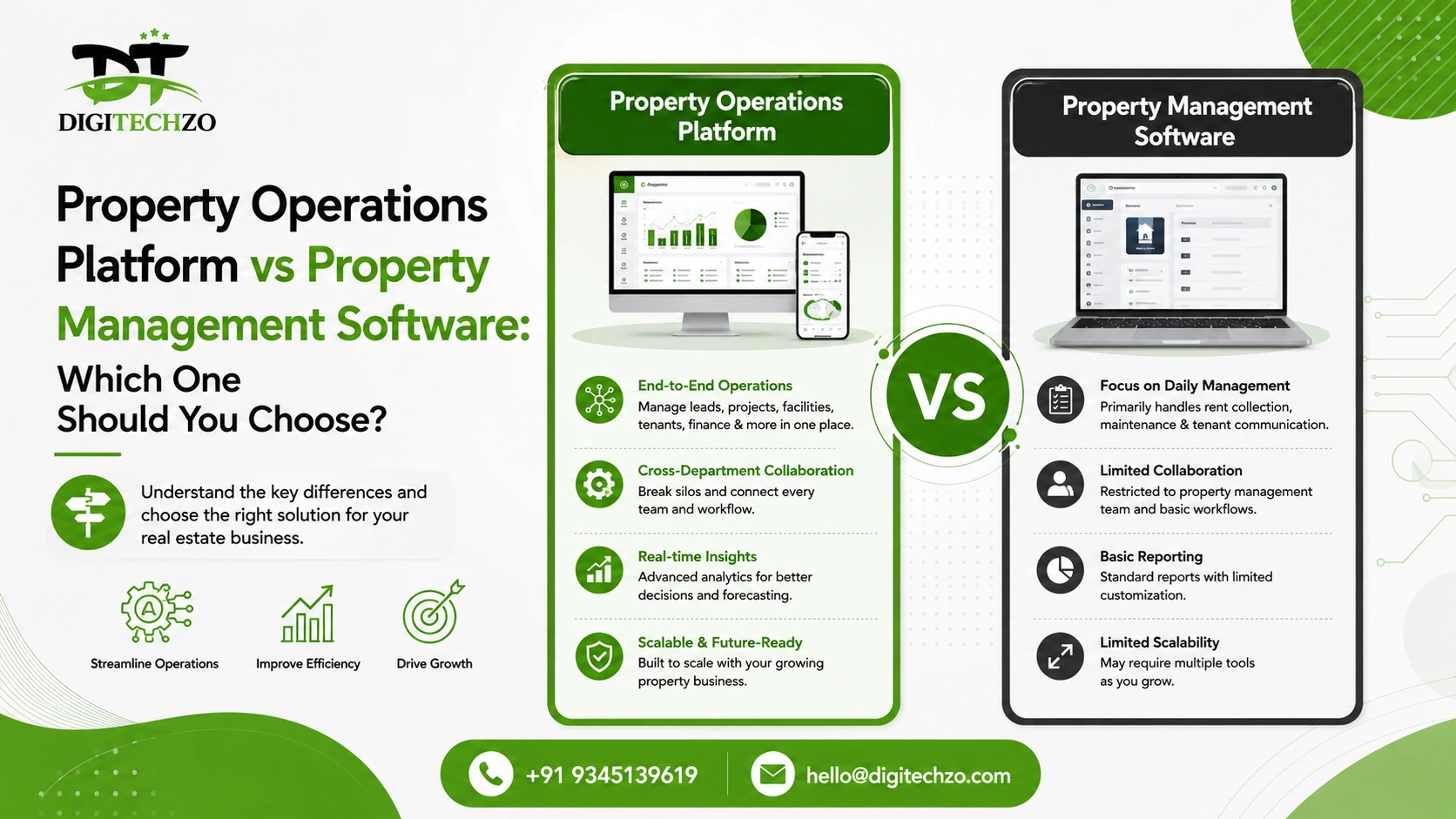
If you manage more than a handful of units, you already know the feeling: five browser tabs open, a spreadsheet nobody trusts, three group chats with vendors, and a tenant portal that only handles rent collection. This is the exact pain point driving one of the fastest-growing debates in real estate technology today — AI Property Operations Platform vs Property Management software.
At Digitechzo, we build technology for operations teams who are tired of stitching together six tools to run one property portfolio, so this comparison isn't theoretical for us — it's the question we get asked in nearly every discovery call. This guide breaks down exactly how an AI Property Operations Platform vs Property Management system differs, when each one makes sense, and how to avoid the costly mistake of choosing the wrong category for your portfolio size and growth plans.
Traditional property management software is built for record-keeping — leases, rent rolls, and maintenance tickets. An AI Property Operations Platform goes further: it uses automation and machine learning to predict issues, coordinate vendors, and run day-to-day operations with minimal human input. If you're managing under 50 units with simple workflows, standard PM software may be enough. If you're scaling, managing distributed teams, or drowning in repetitive operational tasks, an AI Property Operations Platform delivers significantly higher ROI.
What Is Property Management Software?
Property management software is a system of record. It was designed in an era when the biggest operational win was simply moving landlords off paper ledgers and Excel. Core functions typically include:
- Rent collection and accounting
- Lease tracking and renewals
- Basic maintenance ticketing
- Tenant communication portals
- Reporting and compliance documentation
This category has matured over the last two decades, and most platforms do these fundamentals well. But here's the limitation nobody puts on the pricing page: traditional property management software tells you what happened. It rarely tells you what's about to happen, and it almost never acts on your behalf.
A property manager still has to log in, read the ticket, decide who to assign it to, follow up manually, and update the record. The software stores information — it doesn't run operations.
What Is an AI Property Operations Platform?
An AI Property Operations Platform is the next evolution of the category. Instead of being a passive database, it's an active operating layer that uses artificial intelligence to automate the operational decisions a property manager would otherwise make manually.
In practice, this looks like:
- Predictive maintenance — flagging HVAC or plumbing issues before tenants file a complaint, based on patterns in service history
- Automated vendor dispatch — AI matches the right vendor to the right job based on cost, availability, and past performance, without a human coordinating it
- AI-powered tenant communication — chatbots and voice agents that handle routine tenant queries, maintenance requests, and rent reminders 24/7
- Dynamic reporting — real-time operational dashboards that surface anomalies (a spike in maintenance costs, a unit at renewal risk) instead of static monthly PDFs
- Workflow automation — turnover scheduling, inspection reminders, and compliance deadlines triggered automatically
The distinction matters because it changes what your team actually spends time on. With a Property Management system, staff manage the software. With an AI Property Operations Platform, the software manages the operations, and staff manage exceptions.
AI Property Operations Platform vs Property Management: Core Differences
This is the heart of the AI Property Operations Platform vs Property Management decision, so let's break it into the dimensions that actually affect your day-to-day work.
Data Role: Passive vs. Predictive
Traditional property management software is a system of record — it stores what has already happened. An AI Property Operations Platform is a system of prediction — it uses historical and real-time data to anticipate what's likely to happen next, from a lease renewal risk to a maintenance failure.
Human Involvement: High vs. Exception-Based
In the AI Property Operations Platform vs Property Management comparison, this is the difference operations teams feel first. Standard PM software requires a human to initiate nearly every workflow step. An AI-driven platform automates the routine 80% and escalates only the exceptions that genuinely need a person's judgment.
Scalability: Linear vs. Non-Linear
With property management software, headcount tends to scale with unit count — more doors usually means more staff hours. With an AI Property Operations Platform, operational capacity scales without a proportional increase in headcount, because automation absorbs the repetitive volume.
Vendor and Maintenance Coordination
Traditional systems log a ticket and wait for someone to act. AI operations platforms actively coordinate — matching vendors, negotiating scheduling windows, and tracking SLA compliance without manual chasing.
Tenant Experience
Property management software gives tenants a portal to pay rent and submit requests. An AI Property Operations Platform gives tenants an always-on point of contact — answering questions at 11 p.m. on a Sunday instead of making them wait until Monday.
Feature-by-Feature Comparison
This table alone answers most of the "AI Property Operations Platform vs Property Management" search intent people arrive with: it's not that one replaces the other's basic functions — it's that one category stops at data storage while the other acts on that data.
Pros and Cons of Each Approach Property Management Software
Pros:
- Lower learning curve for small teams
- Often cheaper for very small portfolios
- Mature, well-documented feature sets
- Good enough for simple, low-volume operations
Cons:
- Operational bottlenecks scale with portfolio size
- Heavy reliance on manual follow-up
- Limited predictive or preventive capability
- Staff time goes to admin work instead of tenant/owner relationships
AI Property Operations Platform
Pros:
- Reduces manual, repetitive workload significantly
- Predictive maintenance lowers emergency repair costs
- 24/7 tenant responsiveness improves satisfaction and retention
- Scales operations without proportional headcount growth
- Surfaces risks (renewal churn, cost anomalies) before they become expensive
Cons:
- Slightly steeper onboarding curve
- Requires clean, structured data to perform well early on
- Not every vendor's "AI" claim reflects genuine automation — due diligence matters
Real-World Scenarios: Which One Fits You?
Scenario A — The independent landlord with 8 units: Manual workflows are still manageable. A straightforward property management tool covering rent collection and lease tracking is likely sufficient, at least until the portfolio grows.
Scenario B — The regional property manager with 300+ units across multiple sites: This is where the AI Property Operations Platform vs Property Management decision becomes urgent. Manual coordination across dispersed properties creates delays, missed maintenance windows, and inconsistent tenant experience. Automated vendor dispatch and predictive maintenance directly cut cost and response time here.
Scenario C — A property management company scaling from 500 to 2,000 units in 18 months: Hiring linearly to match growth is expensive and slow. An AI Property Operations Platform lets the same core team absorb 3-4x the volume by automating routine coordination, freeing staff to focus on owner relationships and lease-up strategy.
Scenario D — A commercial or mixed-use portfolio with complex compliance needs: Predictive reporting and anomaly detection catch compliance risks — like an expiring certificate or a budget overrun — before they become liabilities, something static reporting tools routinely miss.
Cost Comparison: What You're Really Paying For
Sticker price is only part of the equation in the AI Property Operations Platform vs Property Management decision. The real cost comparison should include:
- Software subscription cost — often comparable at entry tiers between both categories
- Labor cost of manual coordination — this is where standard PM software gets expensive fast; every manual follow-up, every missed vendor call, every late-night tenant email someone has to answer manually is a hidden labor cost
- Cost of reactive vs. preventive maintenance — industry data consistently shows preventive maintenance costs a fraction of emergency repairs, and predictive AI systems shift the ratio toward preventive work
- Tenant turnover cost — faster response times and 24/7 availability measurably improve tenant retention, and retention is almost always cheaper than re-leasing
Global market research shows the property management software industry is now worth tens of billions of dollars and is increasingly shifting toward cloud-based, AI-integrated platforms as the new standard rather than a premium add-on — a signal that the market itself is voting for automation over static record-keeping. Industry adoption surveys have also found that a majority of property managers already use some form of digital property management system, and a majority of landlords have moved to digital rent collection — meaning the baseline expectation has already shifted; the real competitive question now is whether that system is passive or predictive.
Common Mistakes When Choosing Between an AI Property Operations Platform and Property Management Software
- Assuming "AI-powered" always means genuine automation. Some vendors slap an AI label on a basic chatbot. Ask specifically what decisions the system makes without human input.
- Choosing based on unit count alone, ignoring workflow complexity. A 40-unit portfolio with heavy maintenance turnover can outgrow basic PM software faster than a 100-unit portfolio with simple leases.
- Underestimating data migration effort. Moving from spreadsheets or legacy PM software to an AI-driven platform requires clean historical data — plan for this, don't skip it.
- Ignoring integration requirements. If your accounting, screening, or insurance tools don't integrate, you'll recreate the exact manual bottleneck you were trying to eliminate.
- Picking the platform your competitor uses without evaluating your own workflow. What works for a single-family rental portfolio often fails for mixed-use commercial operations, and vice versa.
- Overlooking change management. Even the best AI Property Operations Platform underperforms if your team isn't trained to trust and act on its recommendations.
Expert Tips for Making the Right Decision
- Map your current manual workflows first. Before comparing tools, write down every recurring task your team does by hand — this becomes your evaluation checklist.
- Ask vendors for a live demo of an actual automated decision, not just a dashboard tour. Watch how a maintenance ticket moves from creation to vendor dispatch without a human touching it.
- Start with your highest-friction workflow. If maintenance coordination eats the most staff time, prioritize a platform's automation depth in that specific area over flashier but less-used features.
- Run a pilot on one property or region before a full portfolio migration — this limits risk and builds internal confidence in the system.
- Revisit the decision annually. Portfolios that were "too small" for an AI Property Operations Platform two years ago often aren't anymore; growth changes the math faster than most teams expect.
- Treat the AI Property Operations Platform vs Property Management decision as a growth-stage question, not a one-time purchase. The right answer at 50 units is often different from the right answer at 500.
Why Choose DigiTechzo for SushiSwap Clone Script Development?
Launching a decentralized exchange using a SushiSwap clone script requires more than speed—it demands secure smart contracts, reliable liquidity mechanisms, and compatibility across multiple EVM networks. Ensuring that AMM logic, staking, and yield farming features function seamlessly is critical for long-term platform stability and user trust.
Digitechzo approaches this with a strong foundation in blockchain architecture and DeFi systems. With 25+ blockchain developers and hands-on experience building blockchain platforms, the team brings deep expertise in smart contract development, Web3 integrations, and multi-chain environments. This allows projects to move beyond basic clones into scalable, production-ready DEX platforms tailored to specific business goals.
For businesses planning to build or scale decentralized exchange platforms, working with Digitechzo, a WEB3 DEVELOPMENT COMPANY, provides the technical depth and execution capability needed to deliver secure and high-performing solutions.
Frequently Asked Questions
Is an AI Property Operations Platform the same as property management software?
No. Property management software is primarily a record-keeping system for leases, rent, and maintenance logs. An AI Property Operations Platform builds on those same core functions but adds predictive automation — it actively coordinates maintenance, vendors, and tenant communication instead of just storing the data.
Do I need an AI Property Operations Platform if I only manage a small portfolio?
Not necessarily. If you manage a small number of units with simple, low-volume workflows, standard property management software may cover your needs. The value of an AI Property Operations Platform grows sharply as unit count, vendor complexity, and tenant volume increase.
Is AI property management software more expensive than traditional software?
Entry-level pricing is often comparable. The real cost difference shows up in labor: traditional software requires more manual coordination hours, while an AI Property Operations Platform reduces that hidden labor cost as your portfolio scales.
Can I switch from property management software to an AI Property Operations Platform later?
Yes, and many operators do exactly this as they scale. The main consideration is data migration — clean, well-organized historical records make the transition significantly smoother.
What's the biggest sign it's time to move from property management software to an AI Property Operations Platform?
When your team spends more time coordinating manual follow-ups than talking to tenants and owners, that's the clearest signal. Recurring maintenance delays, missed renewal windows, and slow tenant response times are usually the first symptoms of outgrowing basic PM software.