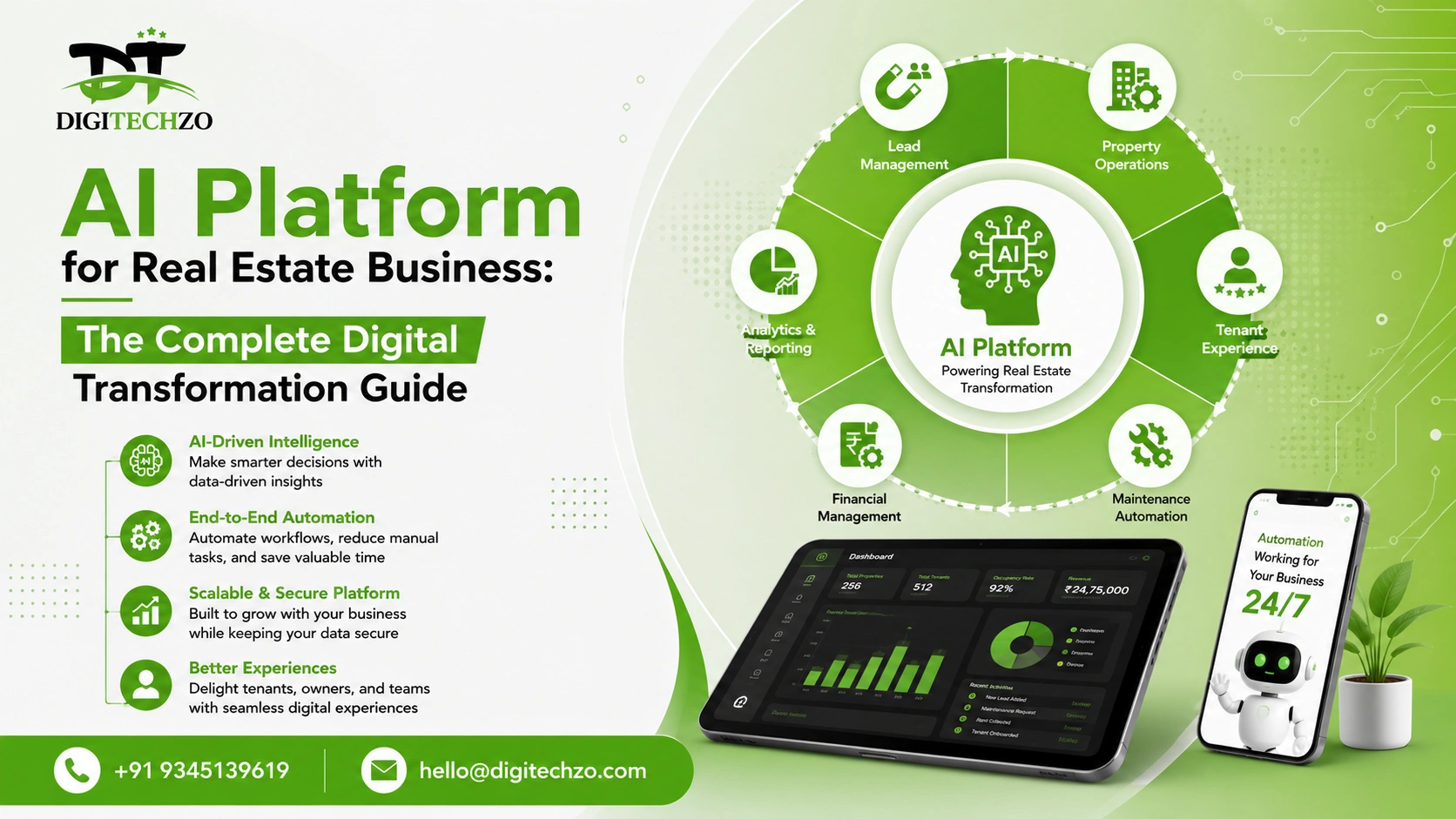
Real estate has always been a relationship business — but relationships alone no longer close deals fast enough. Buyers expect instant answers. Sellers expect accurate pricing in seconds. Investors expect predictive insights, not gut feelings. If your brokerage, agency, or property firm is still running on spreadsheets, cold calls, and manual follow-ups, you are already losing leads to competitors who moved first.
This is exactly why an AI Platform for Real Estate Business has shifted from "nice to have" to "non-negotiable." At digitechzo we've spent years building and implementing AI-driven systems for real estate companies — from independent agencies to multi-city property groups — and we've seen firsthand how the right AI Platform for Real Estate Business can cut lead response time from hours to seconds, increase conversion rates, and free up agents to focus on closing rather than chasing.
This guide breaks down everything you need to know: what an AI Platform for Real Estate Business actually does, how to choose one, real use cases, common mistakes, and a practical framework for implementation — written from real project experience, not theory.
An AI Platform for Real Estate Business is a software system that uses artificial intelligence — machine learning, predictive analytics, and automation — to handle lead scoring, property valuation, chatbots, marketing personalization, and transaction workflows. The best AI Platform for Real Estate Business options combine CRM automation, predictive pricing, and 24/7 conversational AI to shorten sales cycles and increase deal volume without adding headcount. Choosing the right one depends on your business size, data readiness, and integration needs.
What Is an AI Platform for Real Estate Business?
An AI Platform for Real Estate Business is a centralized software system that applies artificial intelligence to core real estate functions — lead generation, property valuation, customer communication, marketing, and transaction management. Instead of relying on agents to manually sort leads or estimate prices, the platform uses data models trained on market trends, buyer behavior, and historical transactions to make faster, more accurate decisions.
Think of it as the operating system for a modern real estate business. Where a traditional CRM stores contact information, an AI Platform for Real Estate Business actively analyzes that data, predicts outcomes, and automates the next best action — whether that's sending a personalized property recommendation or flagging a lead as sales-ready.
How It Differs from a Traditional Real Estate CRM
A standard CRM is passive. It logs calls, stores documents, and reminds agents to follow up. An AI Platform for Real Estate Business is active — it scores leads automatically, predicts which properties a buyer is most likely to purchase, and can hold a full conversation with a prospect before a human ever gets involved.
| Feature | Traditional CRM | AI Platform for Real Estate Business |
|---|---|---|
| Lead sorting | Manual, agent-driven | Automated lead scoring based on behavior |
| Property valuation | Manual comps analysis | AI-driven predictive pricing |
| Follow-up | Reminders only | Automated, personalized outreach |
| Chat support | None or basic forms | 24/7 conversational AI |
| Insights | Static reports | Predictive analytics and forecasting |
Why Real Estate Businesses Need AI Platforms Now
Buyer expectations have changed faster than most real estate businesses have adapted. Industry research consistently shows that leads contacted within the first five minutes convert significantly higher than those contacted an hour later — yet most agencies still take hours to respond to a website inquiry. This gap is precisely where an AI Platform for Real Estate Business earns its ROI.
Three forces are driving adoption:
- Speed expectations — Buyers compare properties across multiple platforms simultaneously and expect instant, relevant responses.
- Data overload — Listings, market comps, buyer history, and marketing performance data have grown too large for manual analysis.
- Rising acquisition costs — Paid leads are more expensive than ever, making it critical to convert every qualified lead an AI Platform for Real Estate Business helps identify.
From our work at Digitechzo implementing these systems across brokerages of different sizes, the pattern is consistent: businesses that delay adoption don't lose to bigger competitors — they lose to smaller, faster-moving ones running a lean AI Platform for Real Estate Business.
Core Features Every AI Platform for Real Estate Business Should Have
Not all platforms are built equally. When evaluating an AI Platform for Real Estate Business, these are the non-negotiable capabilities.
AI Lead Scoring and Qualification
The platform should automatically rank leads by likelihood to convert, using behavioral signals like page visits, time spent on listings, and response patterns — not just demographic guesswork.
Predictive Property Valuation (AVM)
An Automated Valuation Model uses comparable sales, location data, and market trends to generate price estimates in seconds. This is one of the most valuable functions of any modern AI Platform for Real Estate Business, especially for pricing strategy and investment analysis.
Conversational AI Chatbots
24/7 chatbots that answer property questions, schedule viewings, and qualify buyers before handing off to a human agent — reducing response time from hours to seconds.
Marketing Automation and Personalization
AI segments your audience and personalizes email, SMS, and ad content automatically based on browsing behavior and past interactions.
Predictive Market Analytics
Forecasting demand trends, rental yield projections, and neighborhood growth patterns helps agents and investors make decisions backed by data, not intuition.
Document and Contract Automation
Natural language processing can extract, summarize, and flag risks in contracts and lease agreements — cutting legal review time significantly.
Integration Capabilities
A strong AI Platform for Real Estate Business must integrate with your existing MLS, CRM, and marketing stack — otherwise, it becomes another disconnected tool.
Types of AI Platforms for Real Estate Business
Not every business needs the same solution. Here's how they typically break down:
All-in-One Platforms
Combine CRM, valuation, chatbot, and marketing tools in a single system. Best for agencies wanting one dashboard and lower integration overhead.
Specialized Point Solutions
Focused on one function — like AI valuation only, or chatbot-only tools. Best for businesses that already have a strong CRM and want to plug in specific capabilities.
Custom-Built AI Platforms
Built specifically around a company's data and workflows. This is the route larger firms or those with unique processes often take, since off-the-shelf tools can't always match proprietary data models or legacy system requirements. This is also where a development partner like Digitechzo typically gets involved — designing an AI Platform for Real Estate Business tailored to a company's exact data, market, and workflow instead of forcing the business to adapt to generic software.
Real-World Use Cases and Examples
Use Case 1: The Independent Agency Cutting Response Time
A mid-sized agency handling 200+ monthly inquiries was losing leads simply because agents couldn't respond fast enough after hours. After deploying an AI Platform for Real Estate Business with a conversational chatbot, the agency automated first-response and qualification, freeing agents to focus only on sales-ready leads. Faster first response is one of the most consistent conversion drivers in real estate, and this is where automation delivers immediate impact.
Use Case 2: The Property Investment Firm Using Predictive Analytics
An investment firm evaluating multiple markets used an AI Platform for Real Estate Business to forecast rental yield and price appreciation across neighborhoods, replacing weeks of manual comp analysis with data-driven shortlists — allowing analysts to spend their time on due diligence instead of data gathering.
Use Case 3: The Brokerage Automating Personalized Marketing
A brokerage used AI segmentation to send property recommendations based on individual buyer browsing behavior instead of generic newsletters, resulting in noticeably higher email engagement compared to their previous blanket campaigns.
How to Choose the Right AI Platform for Real Estate Business
Use this checklist when evaluating vendors or custom-build options:
- Does it integrate with your current MLS and CRM? Integration failures are the #1 reason AI Platform for Real Estate Business rollouts stall.
- Is the pricing model scalable? Per-seat pricing can get expensive fast for growing teams.
- How transparent is the AI's decision-making? You need to understand why a lead was scored high or a valuation was generated a certain way.
- What's the onboarding and training support like? Even the best AI Platform for Real Estate Business fails without proper team adoption.
- Can it be customized to your market? Generic valuation models trained on one region often underperform in local markets with unique dynamics.
Pros and Cons of Adopting an AI Platform for Real Estate Business
Pros
- Faster lead response and higher conversion rates
- Reduced manual workload for agents and admin staff
- More accurate, data-backed pricing decisions
- Scalable customer engagement without proportional headcount growth
- Better forecasting for investment and portfolio decisions
Cons
- Upfront setup and data migration can take time
- Requires clean, structured data to perform well
- Team resistance to workflow change is common in early stages
- Ongoing tuning is needed — it's not a "set and forget" system
Implementation Roadmap: From Legacy Systems to AI-Driven Operations
A successful rollout of an AI Platform for Real Estate Business generally follows this sequence:
Step 1: Audit Your Current Data and Workflows
Identify where leads are lost, how long response times currently are, and how clean your existing data is. AI is only as good as the data feeding it.
Step 2: Define Clear Success Metrics
Response time, conversion rate, and cost per lead are the three metrics most businesses should track before and after implementation.
Step 3: Pilot Before Full Rollout
Start with one function — usually lead scoring or chatbot response — before expanding to valuation and marketing automation.
Step 4: Train Your Team
Agents need to trust the system's recommendations. Skipping training is the fastest way to sabotage adoption.
Step 5: Monitor, Tune, and Scale
AI models improve with feedback loops. Review performance monthly and adjust scoring criteria as your market shifts.
Common Mistakes Businesses Make
- Buying an AI Platform for Real Estate Business without clean data — Garbage in, garbage out. Poor CRM hygiene undermines even the best AI models.
- Automating everything at once — Sudden, full-scale automation overwhelms teams and increases resistance. Phase it in.
- Ignoring integration compatibility — A platform that doesn't sync with your MLS or CRM creates duplicate work instead of saving time.
- Treating AI as "set and forget" — Models need regular retraining and monitoring as market conditions change.
- Choosing based on price alone — The cheapest AI Platform for Real Estate Business is rarely the one with the strongest data models or support.
Expert Tips for Getting the Most Out of Your AI Platform
- Start with lead response time — It's the metric with the fastest, most visible ROI when you deploy an AI Platform for Real Estate Business.
- Keep a human in the loop for high-value deals — AI should qualify and support, not fully replace agent judgment on large transactions.
- Localize your valuation model — Generic national pricing models underperform; local comps and neighborhood-level data matter more.
- Review chatbot conversations weekly — Early on, this reveals gaps in scripting and missed buyer questions.
- Align sales and marketing on lead scoring criteria — Mismatched definitions of a "qualified lead" cause friction between teams even with great AI in place.
Why Choose DigiTechzo for AI Platform for Real Estate Business?
Adopting an AI platform in real estate is not just about adding automation—it’s about building a system that can accurately handle lead scoring, predictive pricing, and customer interactions without disrupting existing workflows. The challenge lies in integrating AI capabilities with CRM systems, data pipelines, and user-facing applications in a way that actually improves deal velocity and operational efficiency.
Digitechzo brings a structured approach to this by combining AI-driven architecture with practical business understanding. The focus is on building scalable systems that align with real estate operations, ensuring that automation, analytics, and user experience work together rather than as isolated features.
For businesses evaluating long-term AI adoption, partnering with Digitechzo, an AI DEVELOPMENT COMPANY, provides the technical depth needed to design and implement platforms that deliver measurable business outcomes.
FAQs
What does an AI Platform for Real Estate Business actually do?
It automates lead scoring, property valuation, customer communication, and marketing personalization using machine learning and predictive analytics, allowing real estate businesses to respond faster and make more data-driven decisions.
Is an AI Platform for Real Estate Business only for large brokerages?
No. Independent agents and small agencies benefit significantly, often seeing faster ROI since automation directly replaces time-consuming manual tasks they can't afford to outsource.
How long does it take to implement an AI Platform for Real Estate Business?
Timelines vary based on data readiness and integration complexity, but most businesses can pilot a core function like lead scoring or chatbot response within a few weeks, with full rollout over two to three months.
Does AI replace real estate agents?
No. An AI Platform for Real Estate Business handles repetitive, data-heavy tasks — qualification, valuation, first response — so agents can focus on negotiation, relationship-building, and closing, which still require human judgment.
What's the biggest factor in AI platform success?
Data quality and team adoption. Even the most advanced AI Platform for Real Estate Business underperforms if fed messy data or if agents don't trust and use its recommendations.