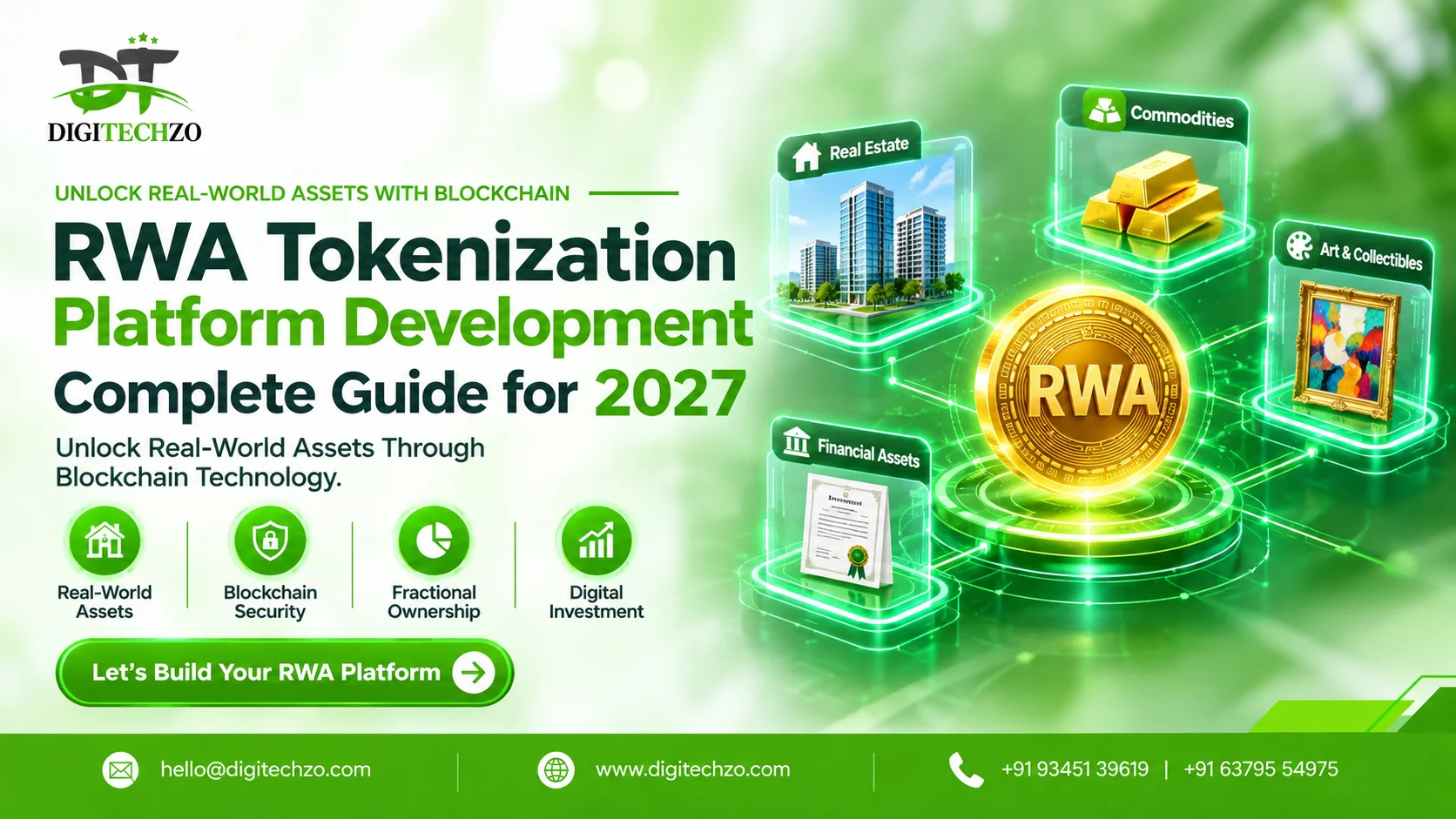
Real-world asset (RWA) tokenization turns ownership of assets such as real estate, private credit, invoices, commodities or funds into digital tokens on a blockchain. The idea is simple. The build is not. Most of the work is compliance, identity, custody and legal structure, and the token is only one part of it.
This guide explains what an RWA tokenization platform must include, which token standards and chains are used, what compliance requires, and what it costs to build one in 2027. If you want a team to scope and build your platform, you can explore our RWA tokenization platform development service or book a scoping call.
What an RWA tokenization platform is
A tokenization platform lets an issuer create tokens that represent a share of an asset, then lets approved investors hold, transfer and sometimes trade those tokens. The platform has to answer three questions for every transfer: who is allowed to hold this token, where they are allowed to hold it, and what rules apply to the asset.
That is why an RWA platform looks more like a regulated financial system with a blockchain layer than a typical crypto app.
Core modules of an RWA tokenization platform
- Issuance module: asset onboarding, legal documents, token creation and supply rules.
- Identity and KYC/AML: investor verification, sanctions screening and accreditation checks.
- Compliance engine: holding limits, country restrictions, investor eligibility and transfer rules.
- Custody and asset linkage: how the real asset is held and how token ownership maps to it, often through a legal entity such as an SPV.
- Investor dashboard: portfolio view, documents, distributions and transfer requests.
- Admin and reporting: cap table, investor registry, audit logs and regulatory reports.
- Secondary trading (optional): order books or approved transfer marketplaces, if your model allows trading.
- Oracles and data feeds: valuation, interest or price data where the asset requires it.
Most failed projects skip the compliance engine and try to add it later. It is much harder to retrofit.
Token standards: ERC-20, ERC-1400 and ERC-3643
A plain ERC-20 token moves freely between any wallet, which does not work for regulated assets. Security token standards add permissions:
- ERC-20: simple and widely supported, but has no built-in transfer rules. Suitable for non-security use cases only.
- ERC-1400: adds partitions, transfer restrictions and controller roles for security tokens.
- ERC-3643 (T-REX): built for permissioned transfers, with an identity registry and compliance rules checked on every transfer. Widely used for regulated RWA platforms.
Read more about these standards in our guide to ERC token standards.
Which blockchain to build on
Ethereum and EVM-compatible chains such as Polygon and Avalanche are common choices because of tooling and token standard support. Permissioned networks such as Hyperledger Besu or Quorum are used where a consortium of institutions needs private control. The right choice depends on who your investors are, where the asset is located and how much public visibility you need.
Compliance is the hard part
Compliance decides what you can launch and where. Depending on the asset and market, you may need to address securities registration, investor accreditation, transfer restrictions, AML requirements and local licensing. Examples of frameworks that come up in RWA projects include SEC rules in the United States, MiCA in the European Union, VARA in the UAE and MiFID II for certain European investment services.
Enterprise buyers also ask for security and governance evidence such as SOC 2 Type II or ISO 27001. Plan for these early, because they shape your architecture and vendor choices.
This section is general information, not legal advice. Confirm your structure with a lawyer who works in securities and digital assets in each target market.
Security and audits
Smart contracts that control ownership and transfers need independent audits before launch. A focused smart contract audit typically costs $8,000 to $20,000, and changes after launch usually need a re-audit. Key management, custody integrations and admin access controls need the same level of attention.
How much does RWA tokenization platform development cost?
Published project estimates vary by scope and jurisdiction. These ranges reflect common 2027 planning figures:
| Scope | Typical cost | Typical timeline |
|---|---|---|
| MVP with one asset class and basic compliance | $50,000 to $150,000 | 3 to 5 months |
| Production-ready platform | $100,000 to $250,000 | 6 to 9 months |
| Enterprise, multi-jurisdiction platform | $250,000 to $1,000,000+ | 9 to 18 months |
Cost by component often includes compliance engine work ($15,000 to $40,000), smart contract development ($20,000 to $60,000), custody integration ($10,000 to $25,000) and dashboards ($15,000 to $35,000). For a line-by-line view, see our guide to how much it costs to build an RWA tokenization platform.
Step-by-step development roadmap
- Define the asset and investor model. Asset class, investor types, jurisdictions and whether trading is included.
- Confirm the legal structure. SPV or fund wrapper, transfer rules and disclosures, with legal counsel.
- Design the compliance rules. Eligibility, limits and restrictions written as clear rules before any code.
- Choose the token standard and chain. Based on compliance needs and investor reach.
- Build the core platform. Identity, compliance engine, token contracts, investor dashboard and admin tools.
- Audit and test. Smart contract audit, penetration testing and compliance test cases.
- Pilot and launch. Start with a small set of verified investors and one asset.
Common mistakes in RWA platform projects
- Using a plain ERC-20 token for assets that need transfer restrictions.
- Adding compliance after the build, which often means rewriting core contracts.
- Underestimating custody and legal setup, which can delay launch more than development.
- Skipping the audit to save budget on a product that controls ownership.
- Launching many asset classes at once instead of proving one use case first.
Why choose DigiTechzo for RWA tokenization
RWA projects need a partner who understands both the blockchain build and the compliance workflow around it. DigiTechzo works with founders and institutions on scoping, development, security coordination and launch support.
- Compliance-aware architecture planned from the start, not added later.
- Clear phased scope, from a focused MVP to a multi-jurisdiction platform.
- Security-first delivery, with audit coordination before launch.
- Experience across Web3 platforms, with 120+ clients and 160+ projects delivered.
Read our RWA tokenization platform development service page, browse our case studies, or book a free scoping call to discuss your asset and timeline.
Related guides: blockchain development cost, custom blockchain development and hire blockchain developers.
Frequently Asked Questions
What is RWA Tokenization Platform Development and how does it work?
Real-world asset (RWA) tokenization turns ownership of assets such as real estate, private credit, invoices, commodities or funds into digital tokens on a blockchain. The idea is simple. The build is not.
What technology stack and backend architecture are recommended for RWA Tokenization Platform Development?
RWA projects need a partner who understands both the blockchain build and the compliance workflow around it. DigiTechzo works with founders and institutions on scoping, development, security coordination and launch support. Compliance-aware architecture planned from the start, not added later.
How much does RWA tokenization platform development cost?
Published project estimates vary by scope and jurisdiction. These ranges reflect common 2027 planning figures: Cost by component often includes compliance engine work ($15,000 to $40,000), smart contract development ($20,000 to $60,000), custody integration ($10,000 to $25,000) and dashboards ($15,000 to $35,000).
How are trust, user privacy, and compliance handled in RWA Tokenization Platform Development?
Compliance decides what you can launch and where. Depending on the asset and market, you may need to address securities registration, investor accreditation, transfer restrictions, AML requirements and local licensing. Examples of frameworks that come up in RWA projects include SEC rules in the United States, MiCA in the European Union, VARA in the UAE and MiFID II for certain European investment services.
What is the recommended roadmap to launch and scale RWA Tokenization Platform Development?
Define the asset and investor model. Asset class, investor types, jurisdictions and whether trading is included. Confirm the legal structure.
Related Web3 Asset Architecture
Interested in compliant asset tokenization on-chain? Explore DigiTechzo's specialized architectures on our RWA Tokenization Platform Development and Real Estate Tokenization Platform Development pages.