You've collected three quotes for the same blockchain idea. One agency says $25,000. Another says $180,000. A third won't give you a number until you've sat through two discovery calls. None of them are lying to you - they're just quoting different projects that happen to share a name.
That's the real problem with blockchain development cost: the term covers everything from a $5,000 token deployment to a $1 million regulated enterprise platform, and most guides don't tell you which one you're actually budgeting for. At digitechzo, this is the first question nearly every founder and CTO asks us before they've even finalized their tech stack - and it's usually the wrong question until the project is properly scoped.
This guide breaks blockchain development cost down by project type, region, pricing model, and the hidden line items most quotes leave out, so you walk away with a number you can actually plan around.
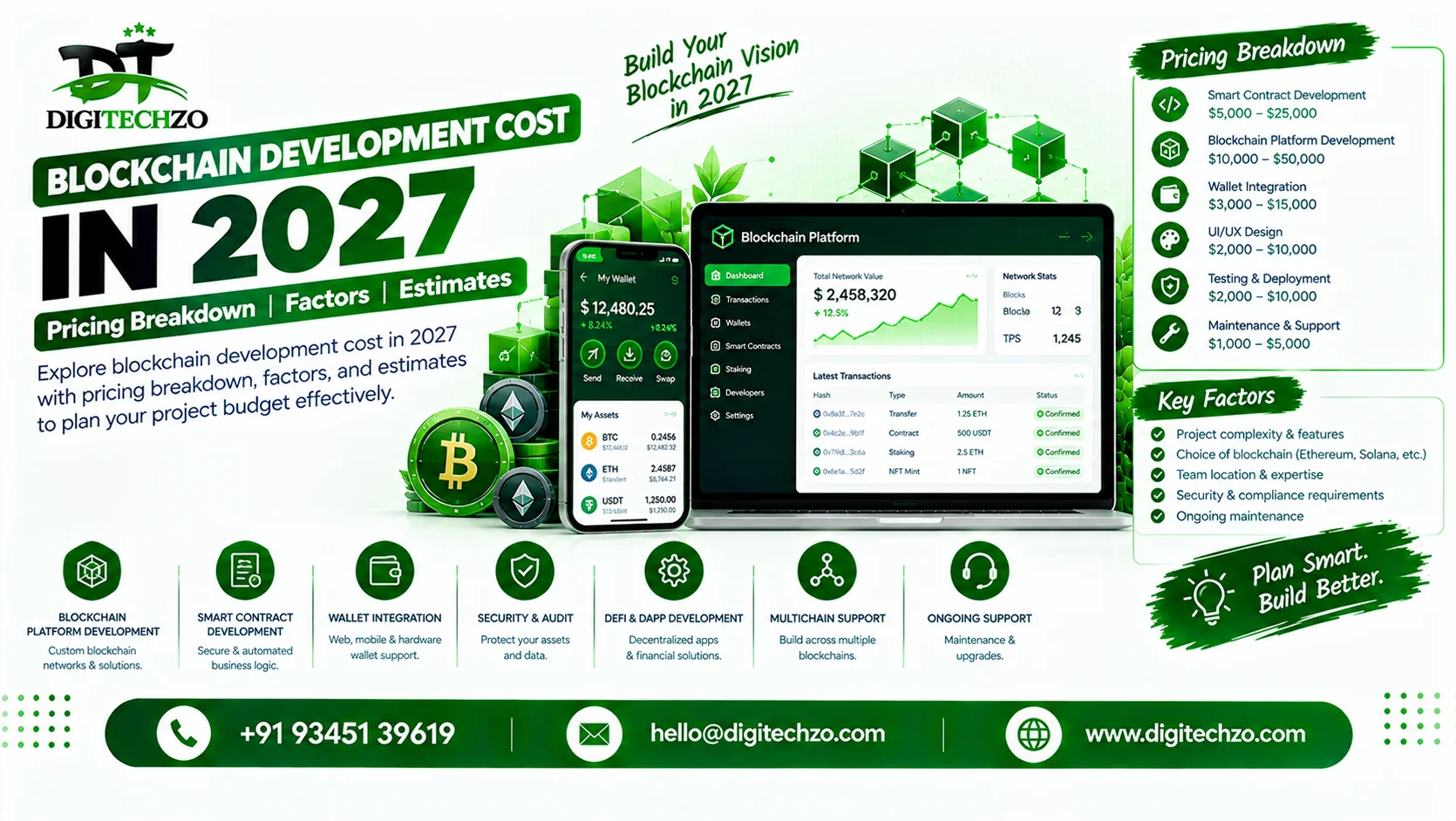
Blockchain development cost in 2027 typically ranges from $20,000 for a simple MVP to $750,000+ for an enterprise-grade platform. Most mid-complexity projects - a functioning dApp, NFT marketplace, or DeFi feature - land between $80,000 and $250,000. Add 15-20% of the build cost per year for audits, maintenance, and infrastructure once the product is live.
What Blockchain Development Cost Actually Covers
When people ask "how much does blockchain cost," they usually mean "how much does the coding cost." That's only part of it. A realistic quote is built from six phases:
- Discovery & scoping - 8-12% of total cost
- UI/UX and architecture design - 8-12%
- Core development (smart contracts, frontend, backend) - 35-45%
- Security audit - 8-15%
- QA & testing - 12-15%
- Deployment & DevOps - 5-8%
If a quote only reflects the "development" line, you're looking at roughly 40% of the real number. This is the single biggest reason two agencies can quote the same project at $45,000 and $200,000 and both be telling the truth - one priced the code, the other priced the product.
Blockchain Development Cost by Project Type
Here's what different project types typically cost to build in 2027:
| Project Type | Estimated Cost Range |
|---|---|
| Smart contract / token only | $5,000 - $50,000 |
| Simple MVP / single-chain dApp | $20,000 - $80,000 |
| NFT marketplace | $50,000 - $180,000 |
| Blockchain wallet (multi-chain) | $60,000 - $250,000 |
| DAO / governance system | $35,000 - $200,000+ |
| DeFi platform (lending, DEX, staking) | $100,000 - $350,000 |
| Enterprise blockchain platform | $150,000 - $750,000+ |
| Custom Layer-1 or heavily regulated platform | $750,000 - $1,000,000+ |
These ranges assume a working, audited product - not a prototype that stops at "it runs on testnet."
What Drives Blockchain Development Cost Up or Down
Blockchain Network Choice
Building on an established Layer 2 (Base, Arbitrum, Polygon) is dramatically cheaper than building your own chain - and can cut transaction fees by up to 80% compared to deploying straight to a Layer 1 mainnet. Network choice alone can swing your build cost by 2x before a single feature is added.
Smart Contract Complexity
A simple token transfer contract is a few days of work. Staking logic, delegation, cross-chain messaging, or custom AMM math can add 25-30% to total project cost, because every added function is another attack surface an auditor has to examine line by line.
Compliance & Regulatory Requirements
Fintech, healthcare, and any product touching KYC/AML adds 15-30% on top of base development cost. This isn't optional overhead - it's legal review, identity verification integration, and audit trail requirements that a generic dApp doesn't need.
Team Location & Engagement Model
Where your developers sit is one of the most controllable levers in the entire budget, covered in detail below.
Cost to Build a Blockchain Platform: From Scratch vs. Existing Infrastructure
There are two fundamentally different ways to answer "what's the cost to build a blockchain platform":
Building on existing infrastructure (a Layer 2, an app-chain framework, or a modular stack like Cosmos SDK) means you're paying for the application layer - smart contracts, UX, integrations - while inheriting consensus, security, and validator infrastructure someone else maintains. This is the route behind the vast majority of the cost ranges above.
Building a custom Layer-1 or fully sovereign chain means owning consensus mechanism design, validator economics, and network security from the ground up. This is a different category of project - typically $750,000 to well over $1 million - and it's rarely the right choice unless your product's core value proposition is the chain itself (a new settlement layer, a specialized L1 for a specific industry, etc.).
Practical rule of thumb: if you can't clearly articulate why an existing chain can't do what you need, you don't need a custom chain. Most "we need our own blockchain" conversations end with a modular build that's 60-80% cheaper and ships months faster.
Blockchain Development Pricing Models Explained
Fixed-Price
Best for tightly scoped projects with a locked feature set - a token launch, a single smart contract, an audit. Predictable, but expensive to change mid-build.
Time & Materials (Hourly)
Best for evolving products where requirements will shift - most dApps and platforms fall here. You pay for actual hours, but budget discipline depends entirely on scope control.
Dedicated Team
Best for long-term products needing continuous development post-launch. You're essentially hiring an extension of your team at a monthly retainer, which usually works out cheaper than repeated fixed-price contracts once a project passes six months.
Most blockchain development pricing in 2027 blends these: fixed-price for the audited MVP, time-and-materials or dedicated team for ongoing iteration afterward.
Hire Blockchain Developers Cost: Regional Rate Comparison
If you're staffing in-house or supplementing an agency with contractors, here's what hiring blockchain developers costs by region:
| Region | Hourly Rate (USD) |
|---|---|
| North America | $90 - $180+ |
| Western Europe | $70 - $130 |
| Eastern Europe | $40 - $90 |
| India / South Asia | $15 - $70 |
| Latin America | $35 - $85 |
Two things worth knowing before you chase the lowest number on this table:
- Blockchain talent is scarcer than general app development talent everywhere, so the discount between regions is smaller than it is for, say, standard web development.
- A senior Solidity or Rust developer's loaded cost (salary plus benefits, taxes, and overhead) typically runs 1.7-1.9x their base rate if hired directly - a detail that makes agency or dedicated-team pricing look more competitive than it first appears.
Enterprise Blockchain Development Cost
Enterprise blockchain development cost sits in its own tier - typically $150,000 to $750,000+, and it's rarely about the smart contract itself. What pushes enterprise budgets up:
- Legacy system integration - connecting the chain to existing ERPs, CRMs, or databases is usually where budgets blow out, not the blockchain layer
- Multi-party governance - consortiums and permissioned networks need onboarding, access control, and dispute-resolution logic
- Compliance documentation - audit trails, regulatory reporting, and data residency requirements
- Ongoing operational cost - gas subsidies for users, node infrastructure, and monitoring, which enterprise buyers often forget to budget as recurring cost rather than one-time build cost
A useful gut-check for enterprise buyers: if your vendor's quote doesn't have separate line items for integration and post-launch infrastructure, it's not a complete quote yet.
Hidden Costs Nobody Puts in the Initial Quote
The initial build is typically only 30-40% of your real three-year blockchain spend. The rest shows up here:
- Security re-audits - every meaningful contract change needs a re-audit, typically $5,000-$25,000 depending on scope
- Gas optimization - inefficient contracts cost your users money on every transaction; fixing this after launch costs more than building it in from day one
- Node and infrastructure hosting - ongoing, not one-time
- Third-party oracle and API fees - price feeds, cross-chain bridges, and identity verification services usually bill monthly
- Bug bounty programs - increasingly expected for anything holding real user funds
- Post-launch maintenance - realistically $3,000-$10,000/month for monitoring, bug fixes, and small feature work
A quote without audit, infrastructure, and maintenance line items isn't a real quote - it's the down payment.
Blockchain Project Cost Estimation: A Practical Framework
Most blockchain project cost estimation stops at "what will it cost to build." That's the wrong question if you're planning further than six months out. Use this three-layer framework instead:
Layer 1 - Build Cost: Discovery, design, development, initial audit, QA, deployment. This is the number most quotes give you.
Layer 2 - Secure Cost: Ongoing audits after every meaningful update, bug bounties, and compliance reviews. Budget 8-15% of build cost annually.
Layer 3 - Sustain Cost: Infrastructure, monitoring, maintenance, and iteration. Budget 15-20% of build cost annually.
Rule of thumb: your real three-year cost of ownership runs roughly 1.6x to 2.2x your initial build cost. A $100,000 MVP is realistically a $160,000-$220,000 three-year commitment. Estimating from Layer 1 alone is the single most common reason blockchain budgets run out before the product finds product-market fit.
In-House vs. Agency vs. Freelancer vs. White-Label
| Approach | Pros | Cons |
|---|---|---|
| In-house team | Full control, institutional knowledge stays internal | Slow to hire, expensive (loaded cost 1.7-1.9x salary), hard to scale down |
| Development agency | Full-stack expertise, faster delivery, built-in QA/audit process | Higher hourly blended rate, less day-to-day control |
| Freelancer(s) | Lowest hourly cost, flexible | No built-in QA/audit safety net, coordination overhead, risk if they leave mid-project |
| White-label solution | Fastest to market, lowest cost | Limited customization, you don't own the core architecture |
There's no universally "best" option - a token launch might be fine as a freelance job; an enterprise platform handling real funds almost never should be.
Common Mistakes That Blow Up Blockchain Development Budgets
- Pricing "coding only" and being surprised when audit, QA, and DevOps add 50%+ to the number
- Choosing a blockchain network based on hype rather than fit for the actual use case
- Skipping a written scope document before requesting quotes, which makes every quote impossible to compare fairly
- Budgeting zero for re-audits, then treating every post-launch change as "just a small update"
- Treating security audits as optional for anything that isn't explicitly labeled "high value"
- Comparing quotes on price alone without checking what's actually included
Expert Tips to Control Blockchain Development Costs Without Cutting Corners
- Get milestone-based contracts, not lump-sum payments - it protects you if scope needs to shift
- Default to Layer 2 or an app-chain framework instead of a custom chain unless you have a specific reason not to
- Bake gas optimization into the original build rather than retrofitting it later
- Ask vendors for a "true quote" with audit, infrastructure, and post-launch support as separate line items
- Ship a scoped, audited MVP first, then scale - don't build the full enterprise vision before you've validated demand
- Vet auditors on track record, not price - a cheap audit that misses a critical vulnerability costs infinitely more than an expensive one that catches it
Why Businesses Trust Digitechzo for Blockchain Solutions?
Understanding blockchain development cost is not just about budget ranges - it's about making the right architectural and technical decisions that directly impact long-term scalability, security, and maintenance. Businesses evaluating costs in 2027 need a partner who can align technical execution with real business outcomes, not just deliver code.
Digitechzo brings practical experience in building blockchain platforms with a strong focus on smart contract development, Web3 integrations, and multi-ecosystem compatibility. This ensures that projects are designed with efficiency in mind from the start, avoiding costly rework, security gaps, or scalability issues later. The emphasis is always on building systems that remain sustainable beyond initial deployment.
For businesses looking to move forward with clarity and confidence, working with Digitechzo as a BLOCKCHAIN DEVELOPMENT COMPANY provides a structured and reliable approach to turning blockchain investments into functional, scalable products.
Frequently Asked Questions
How much does it cost to build a blockchain platform from scratch?
Building on existing infrastructure (Layer 2 or an app-chain framework) typically costs $60,000-$350,000 depending on complexity. A fully custom Layer-1 blockchain built from the ground up costs $750,000 to over $1 million.
How much does it cost to hire a blockchain developer?
Rates range from $15-$70/hour in India and South Asia, $40-$90/hour in Eastern Europe, $70-$130/hour in Western Europe, and $90-$180+/hour in North America, with seniors and specialists at the top of each range.
Is blockchain development more expensive than regular app development?
Yes, typically. Blockchain projects require specialized smart contract and cryptography skills, mandatory security audits, and often compliance work - cost drivers a standard web or mobile app doesn't carry.
How can I estimate blockchain project cost accurately before hiring a developer?
Use the three-layer framework above: price the build, then add 8-15% annually for security, and 15-20% annually for infrastructure and maintenance. Your real cost of ownership over three years runs roughly 1.6x-2.2x the initial build cost.
What's the cheapest way to build a blockchain application?
Deploy on an existing Layer 2 network instead of a custom chain, scope a tightly defined MVP instead of a full platform, and get a fixed-price quote for that MVP plus a mandatory security audit - skipping the audit to save money is the one cut that regularly costs the most later.