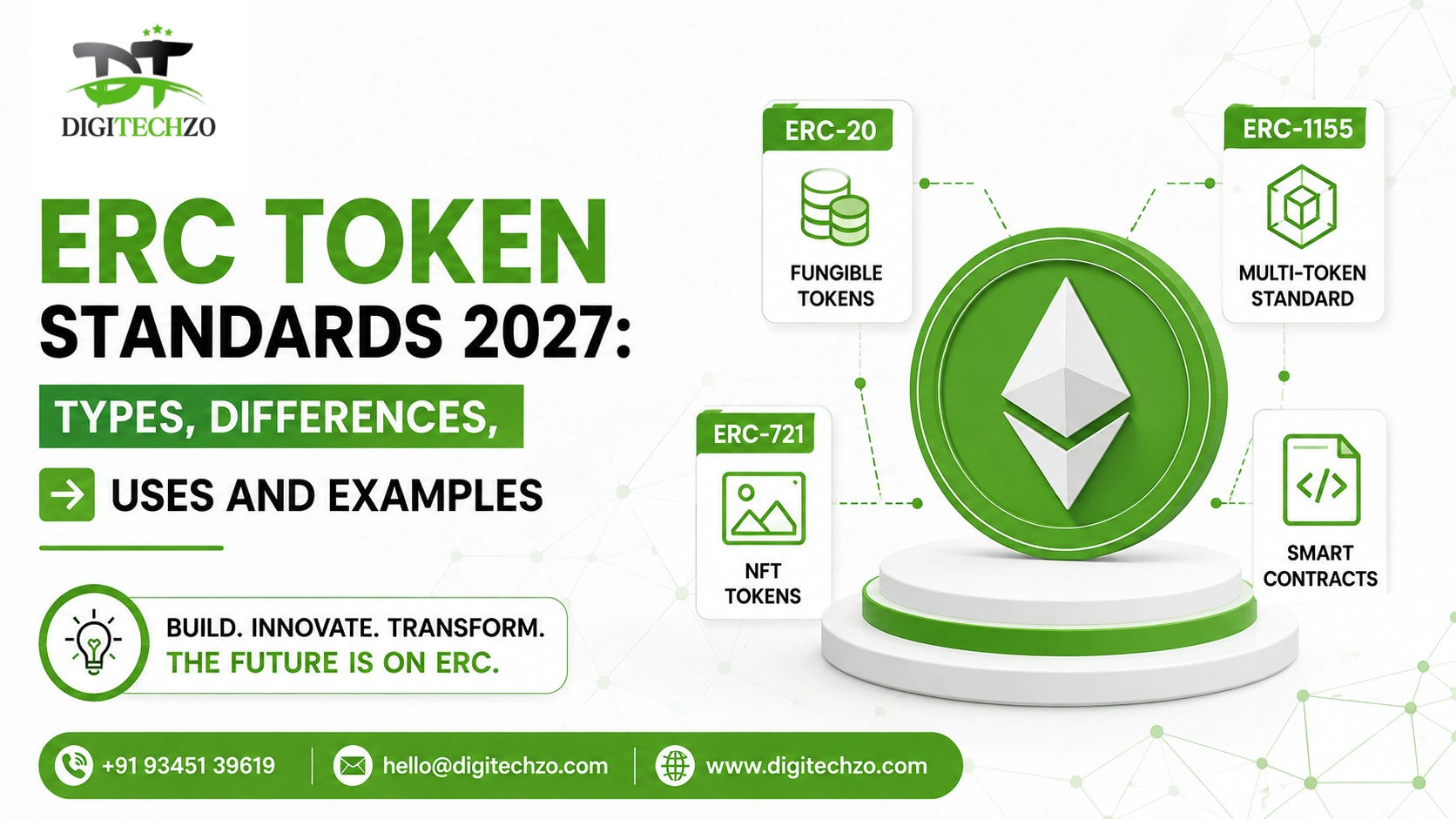
Here's a mistake we see constantly: a founder launches a project on ERC-20 because "that's what everyone uses," only to realize six months later they actually needed ERC-1155 for their in-game economy, or ERC-3643 because regulators are asking about KYC-gated transfers. By then, the token is already live, liquidity is already deployed, and migrating means a full redeployment — with all the gas costs, audits, and community confusion that comes with it.
ERC token standards aren't a formality you check off before deployment. They're the architectural decision that determines what your token can do — how it's traded, who can hold it, how much gas it burns, and which wallets, exchanges, and marketplaces will even support it. At digitechzo, we work with teams navigating exactly this decision before code gets written, and the standard picked on day one is almost always harder to undo than people expect.
This guide covers every ERC standard that actually matters in 2027 — not just the three everyone already knows, but the account abstraction, vault, and compliance standards reshaping how tokens get built.
ERC token standards are technical specifications (Ethereum Request for Comments) that define how tokens behave on Ethereum — covering everything from basic fungible tokens (ERC-20) and NFTs (ERC-721) to advanced standards for vaults, compliant securities, smart wallets, and cross-chain transfers. Choosing the right one depends on whether your asset is unique or interchangeable, whether you need built-in compliance, and how your tokens will be used across wallets and dApps.
What Are ERC Token Standards?
ERC token standards are application-layer specifications that define common interfaces for tokens and smart contracts on Ethereum — essentially the shared rulebook that lets wallets, exchanges, and dApps interact with any compliant token without custom integration work.
ERC stands for "Ethereum Request for Comment," and each standard begins life as an Ethereum Improvement Proposal (EIP) submitted to the ethereum/EIPs GitHub repository. From there, a proposal moves through Draft, Review, Last Call, and finally Final status, with debate happening in public on Ethereum Magicians among wallet developers, exchange engineers, and protocol authors.
Importantly, ERCs don't touch Ethereum's consensus rules — they only govern function signatures, event names, and behavioral conventions at the application layer. That's what makes them so powerful: any developer can implement one without needing network-level approval.
The Core ERC Token Standards Everyone Uses
Three standards handle the overwhelming majority of real-world token activity. Everything else builds on top of these.
ERC-20 — Fungible Tokens
ERC-20 defines interchangeable tokens using balance mappings and allowance mechanics — think of it like currency, where every unit is identical and worth the same as any other unit. It was authored by Fabian Vogelsteller and Vitalik Buterin and formalized in November 2015, making it the oldest and most battle-tested token standard on Ethereum.
Use cases: stablecoins, governance tokens, utility tokens, reward points, ICO fundraising tokens.
Its scale today is hard to overstate — ERC-20 underpins more than $230 billion in stablecoin supply across networks, according to DeFiLlama stablecoin data.
ERC-721 — Non-Fungible Tokens (NFTs)
ERC-721 introduces unique token IDs for one-of-a-kind assets, each with its own metadata pointer. No two ERC-721 tokens are interchangeable, even within the same contract.
Use cases: digital art, collectibles, deeds, in-game unique items, event tickets, domain names.
Adoption tells an interesting story here: ERC-721 was proposed in January 2018 and finalized in June 2018, but didn't become economically meaningful until late 2020, when CryptoKitties and OpenSea scaled the NFT market into billions in monthly volume. By early 2026, ERC-721 tokens were generating roughly $720 million in monthly average trading volume, with gaming NFTs accounting for about 38% of all NFT transaction volume.
ERC-1155 — The Multi-Token Standard
ERC-1155 merges fungible and non-fungible logic into a single contract using ID-based balance mappings, enabling batch transfers — moving multiple token types in one transaction instead of one at a time.
Use cases: blockchain gaming (currencies + unique items in one contract), edition-based NFT drops, marketplaces managing mixed inventories.
The gas savings are substantial and often underappreciated: a batch mint of 1,000 NFTs on ERC-721 can cost roughly 70,000,000 gas, while ERC-1155's nested-mapping structure amortizes the per-token cost across a single batch operation, cutting deployment costs significantly for high-volume projects.
ERC Token Standards Compared: Key Differences
| Standard | Fungibility | Compliance Built-In? | Best For | Gas Efficiency |
|---|---|---|---|---|
| ERC-20 | Fungible only | No | Currencies, stablecoins, governance | High for simple transfers |
| ERC-721 | Non-fungible only | No | Unique collectibles, deeds | Lower for bulk minting |
| ERC-1155 | Both | No | Gaming, mixed-asset inventories | High via batching |
| ERC-1400 | Fungible, partition-able | Off-chain (signing keys, registries) | Traditional security tokens | Moderate |
| ERC-3643 | Fungible | On-chain (identity registry) | Regulated/KYC-gated securities | Moderate |
| ERC-4626 | Fungible (vault shares) | No | Yield-bearing DeFi vaults | High, standardized |
The compliance distinction matters more than most guides explain: ERC-20, ERC-721, and ERC-1155 carry no built-in compliance logic, while ERC-1400 adds compliance through off-chain signing keys and document registries, and ERC-3643 embeds it directly on-chain via an identity registry that validates every wallet before every transfer. For any asset touching securities law, that difference determines whether you're building on solid ground or bolting compliance on as an afterthought. CoinPaprika
Beyond the Basics: Advanced ERC Token Standards
This is where most competing guides stop short — and it's exactly where serious builders need the most guidance in 2027.
ERC-4626 — Tokenized Vaults
ERC-4626 standardizes how yield-bearing vaults issue shares, letting any DeFi protocol read vault balances, deposits, and withdrawals through one predictable interface instead of custom integrations per vault.
Use case: lending protocols, yield aggregators, staking vaults.
ERC-4337 — Account Abstraction
ERC-4337 doesn't create tokens — it redefines how wallets work. It enables "smart accounts" with programmable logic (social recovery, gas sponsorship, batched transactions) without requiring changes to Ethereum's core consensus rules. This is arguably the most consequential non-token ERC of the last few years, because it's rebuilding the wallet experience beneath everything else.
ERC-6551 — Token Bound Accounts
ERC-6551 gives an NFT its own wallet. An ERC-6551 token-bound account can hold ERC-20 tokens, ERC-721 NFTs, and vault shares within a single transferable unit — meaning an NFT can literally own other assets. Think of a game character NFT that owns its own inventory of weapons and currency, transferable as one bundle.
ERC-1400 & ERC-3643 — Security and Compliance Tokens
Covered above in the comparison table, these standards exist because real-world asset tokenization — real estate, private equity, bonds — requires transfer restrictions that base ERC-20/721 simply don't support.
ERC-7683 — Cross-Chain Intents
ERC-7683 specifies a cross-chain intent format now used by multiple solver networks, letting users express "I want X asset on chain B" without manually bridging assets themselves — a foundational piece of the multichain future.
ERC-7518 (DyCIST) — Dynamic Compliant Security Tokens
A newer entrant extending ERC-1155, ERC-7518 layers dynamic eligibility rules and partitioning on top of the multi-token standard specifically for institutional real-world asset tokenization, letting issuers represent tranches (senior, mezzanine, junior) with distinct risk and eligibility profiles within one framework.
Quick-Reference: Other Notable Standards
- ERC-777 — an ERC-20 upgrade adding operator permissions and hooks for better security
- ERC-2612 / ERC-3009 / Permit2 — gasless approval standards, letting users sign approvals off-chain
- ERC-165 — lets a contract publish which interfaces it supports, so other contracts know how to interact with it
- ERC-998 — enables composable token ownership hierarchies (tokens owning tokens)
How to Choose the Right ERC Token Standard
Skip the generic advice. Ask these four questions in order:
Is the asset identical across units, or is each one unique?
Identical → ERC-20. Unique → ERC-721. Mixed → ERC-1155.
Does this asset touch securities regulation or need KYC-gated transfers?
If yes, base ERC-20/721/1155 alone is insufficient — you need ERC-1400, ERC-3643, or ERC-7518 layered in.
Will users manage many token types together at scale (gaming, marketplaces)?
If yes, ERC-1155's batch operations will save significant gas versus deploying separate contracts.
Does your target ecosystem already support the standard?
Check wallet support, exchange listing requirements, and marketplace compatibility before finalizing — a technically superior standard with no wallet support is a dead end.
Real-World Examples of ERC Token Standards
- ERC-20: USDC and USDT — the backbone of on-chain dollar liquidity
- ERC-721: CryptoPunks and Bored Ape Yacht Club — pioneered the digital collectibles market
- ERC-1155: Enjin's gaming ecosystem — fungible in-game currency and unique items in one contract
- ERC-4626: Yearn Finance-style vaults — standardized yield share accounting
- ERC-4337: Smart contract wallets from providers like Safe and Alchemy's Account Kit
- ERC-6551: NFT-based gaming characters that own their in-game inventory as bound assets
Pros & Cons of Major ERC Token Standards
ERC-20
- Maximum wallet/exchange compatibility, simplest to audit
- No native way to recover tokens sent to an incompatible contract
ERC-721
- True on-chain uniqueness and provenance
- Expensive for bulk minting compared to ERC-1155
ERC-1155
- Dramatically cheaper for multi-asset, high-volume use cases
- More complex contract logic, steeper audit requirements
ERC-3643 / ERC-1400
- Regulatory compliance built into the transfer logic itself
- Smaller ecosystem support; requires specialized custody and issuance partners
Common Mistakes With ERC Token Standards
- Defaulting to ERC-20 without evaluating fungibility needs — locks a project out of NFT or hybrid functionality later.
- Ignoring compliance requirements until after launch — retrofitting KYC logic onto a live ERC-20 contract is far harder than starting with ERC-3643.
- Underestimating gas costs at scale — choosing ERC-721 for a high-volume gaming project when ERC-1155's batching would cut costs dramatically.
- Skipping ERC-165 interface detection — leads to contracts that can't reliably tell other contracts what they support, causing integration failures.
- Not checking wallet and exchange support before deployment — a technically sound token nobody's wallet can display is a functionally broken product.
- Treating account abstraction (ERC-4337) as optional — teams ignoring it now are building wallet experiences that will feel outdated within a year or two.
Expert Tips for Working With ERC Token Standards
- Audit against the specific standard's known vulnerability classes — ERC-20 needs reentrancy guards on approve/transferFrom; ERC-721 mandates safe transfer checks to prevent tokens getting stuck in incompatible contracts.
- Use OpenZeppelin's audited implementations as your base rather than writing standard logic from scratch.
- Combine standards deliberately, not accidentally — an ERC-4337 smart account can hold ERC-20 tokens and ERC-721 NFTs simultaneously; design your architecture around that layering from day one.
- Model gas costs at your expected transaction volume, not just at prototype scale — the ERC-721 vs. ERC-1155 gas gap only becomes painful at volume.
- Plan for cross-chain from the start if multichain deployment is even a possibility — retrofitting ERC-7683 intent compatibility later is harder than designing for it upfront.
The Future of ERC Token Standards
Three shifts define where ERC standards are heading:
Account abstraction is becoming default, not optional. ERC-4337 wallets are increasingly how new users onboard to Ethereum at all, abstracting away seed phrases and gas complexity.
Compliance is moving on-chain. As real-world asset tokenization scales, standards like ERC-3643 and ERC-7518 are replacing the old pattern of bolting KYC logic onto vanilla ERC-20/721 contracts after the fact.
Cross-chain is becoming standard-native. With ERC-7683 and related intent-based standards gaining solver network adoption, the future isn't "which chain is your token on" — it's tokens designed to move fluidly across chains by default.
Why Choose Digitechzo for ERC Token Standard Development?
Choosing an ERC token standard is a strategic technology decision that can influence smart contract functionality, wallet compatibility, transaction efficiency, compliance requirements, and future scalability. Selecting the right standard early helps businesses avoid unnecessary development changes as their token ecosystem evolves.
Digitechzo approaches token development by first understanding the project's purpose, whether it involves fungible assets, NFTs, security-focused tokens, or specialized blockchain applications. As a Blockchain Development Company, Digitechzo can help evaluate suitable ERC standards and translate those requirements into secure, scalable blockchain solutions.
This approach allows businesses to build token infrastructure around actual use cases rather than selecting a standard simply because it is widely adopted. Proper architecture can also support smoother integrations, better ecosystem compatibility, and easier expansion as the project grows.
For businesses planning an ERC-based token project, Digitechzo provides practical blockchain development expertise to move from standard selection and technical planning to implementation with a clear focus on long-term usability and business objectives.
FAQs
What is the difference between ERC-20 and ERC-721?
ERC-20 defines fungible tokens where every unit is identical and interchangeable, like currency. ERC-721 defines non-fungible tokens where each token is unique with its own ID and metadata, like a deed or a piece of art.
Which ERC standard should I use for an NFT project?
Use ERC-721 for one-of-a-kind collectibles where every item is unique. Use ERC-1155 instead if your project needs both unique items and fungible in-game currency or editions within one contract.
Is ERC-1155 better than ERC-721?
Neither is universally "better" — ERC-1155 is more gas-efficient for high-volume, mixed-asset use cases like gaming, while ERC-721 remains the standard for pure one-of-one digital collectibles and provenance-critical assets.
Do security tokens need a special ERC standard?
Yes. Standard ERC-20 or ERC-721 tokens have no built-in transfer restrictions, so regulated securities typically use ERC-1400 or ERC-3643, which embed compliance and identity-verification logic directly into the transfer function.
What is ERC-4337 and why does it matter?
ERC-4337 enables account abstraction — smart contract wallets with programmable features like social recovery and gas sponsorship — without requiring changes to Ethereum's core protocol, and it's increasingly the foundation for how new users experience Web3 wallets.