Building an NFT marketplace from scratch sounds exciting until you actually try to do it. Smart contract audits alone can take 6-8 weeks. Add front-end development, wallet integrations, gas optimization, and security testing, and you're easily looking at 6-9 months and a budget north of $80,000 before you even onboard your first creator. Meanwhile, competitors using pre-built solutions are already live, minting NFTs, and collecting marketplace fees.
This is exactly why a Rarible Clone Script has become the go-to route for entrepreneurs, Web3 startups, and enterprises that want to launch a fully functional NFT marketplace without reinventing the wheel. At DigitTechzo, we've worked with founders across gaming, art, real estate, and music who needed a Rarible-style platform live in weeks, not quarters — and a clone script is how they got there.
In this guide, we'll break down what a Rarible Clone Script actually is, how it works under the hood, what it costs, the mistakes most buyers make, and how to evaluate a development partner before you sign a contract
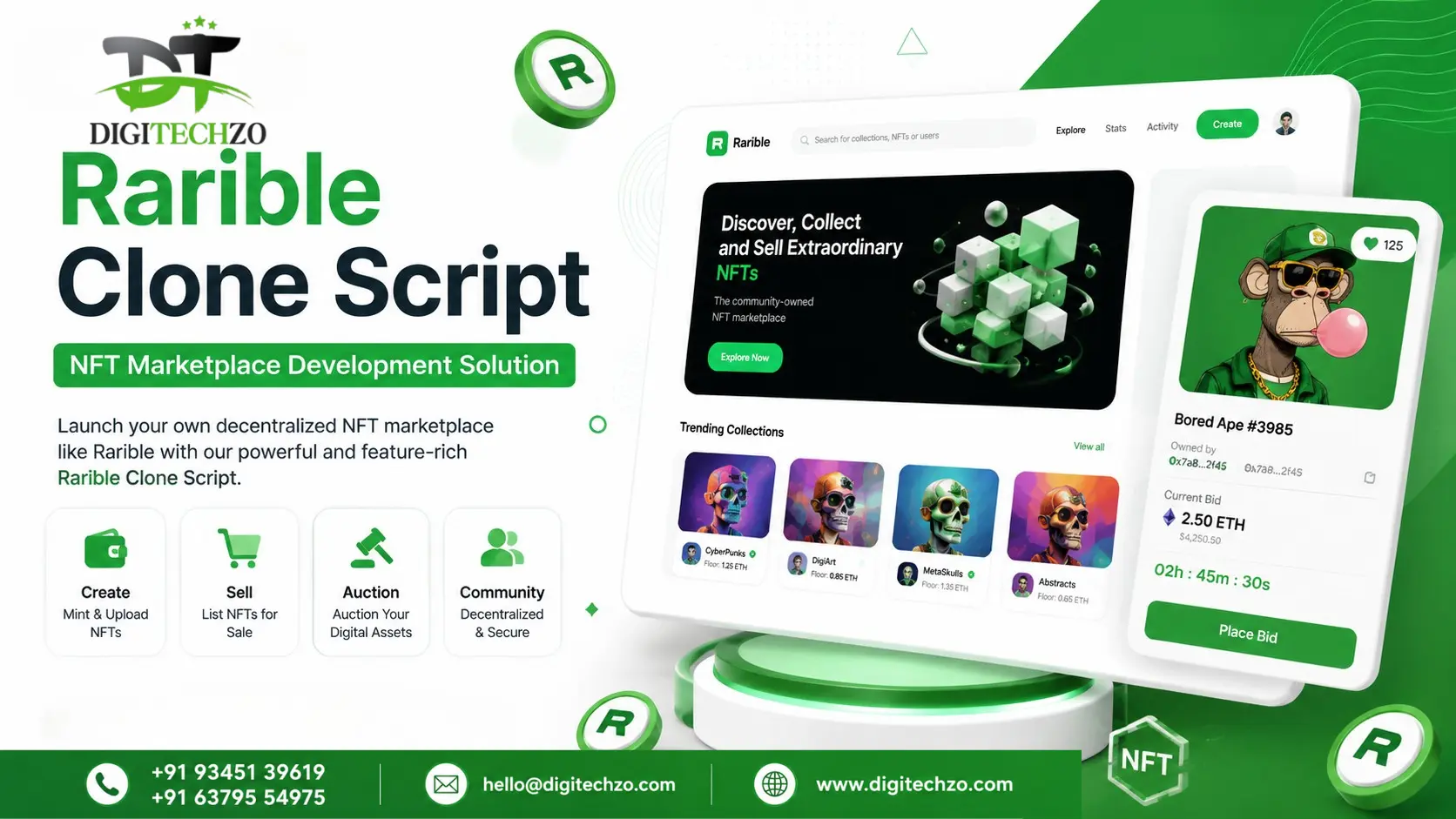
A Rarible Clone Script is pre-built, customizable software that replicates Rarible's core NFT marketplace features — minting, buying, selling, auctions, and royalty management — allowing businesses to launch a branded NFT platform in 3-6 weeks instead of building from scratch. Costs typically range from $8,000 to $35,000+ depending on customization depth, blockchain choice, and security auditing requirements.
What Is a Rarible Clone Script?
A Rarible Clone Script is a white-label NFT marketplace solution built to mirror the functionality, user flow, and monetization model of Rarible — one of the earliest and most influential multi-chain NFT platforms, known for its community-governed marketplace and creator royalty system.
Rather than copying Rarible's brand or code verbatim (which would be a legal and ethical problem), a legitimate clone script replicates the feature set and architecture: lazy minting, royalty enforcement, auction mechanics, and multi-chain support. Reputable development studios rebuild this stack independently and then customize it to your brand, blockchain preference, and monetization strategy.
In practice, this means you get:
- A marketplace where users can mint, list, buy, and sell NFTs
- Auction and fixed-price sale options
- Creator royalty payouts on secondary sales
- Wallet integration (MetaMask, WalletConnect, Coinbase Wallet, etc.)
- An admin dashboard to manage commissions, categories, and disputes
Think of it as a proven blueprint. You're not starting from a blank page — you're starting from a marketplace model that's already processed billions of dollars in trading volume industry-wide, then adapting it to your niche.
How Rarible's Original Marketplace Works
To build a good clone, you first need to understand what made the original work. Rarible popularized a few mechanics that are now considered baseline expectations for any NFT marketplace:
Lazy Minting
Instead of paying gas fees upfront to mint an NFT, creators sign a cryptographic listing that only gets minted on-chain when a buyer completes a purchase. This removed a massive barrier for new artists who didn't want to risk money minting NFTs that might never sell.
On-Chain Royalties
Rarible embedded royalty logic directly into its smart contracts, so creators automatically earn a percentage (commonly 2.5%-10%) every time their NFT resells — without needing a middleman to enforce it manually.
Multi-Chain Support
Rarible expanded beyond Ethereum to support Polygon, Flow, and Tezos, reducing gas costs and widening its user base. This multi-chain approach is now a competitive necessity, not a nice-to-have.
Real-world example: A digital art collective we consulted for launched on Ethereum only, expecting premium positioning. Within two months, they added Polygon support after seeing 70% of prospective buyers abandon checkout due to gas fees exceeding the NFT price itself. This is the kind of practical lesson that only shows up once you're actually operating a marketplace — and it's why platform architecture decisions matter more than most first-time founders expect.
Core Features to Look For
Not all "Rarible clone scripts" sold online are created equal. Many vendors ship a bare-bones template and call it a full solution. Here's what a genuinely production-ready script should include:
Must-Have Features
- Multi-chain wallet integration — Ethereum, Polygon, BNB Chain, Solana at minimum
- Lazy minting to reduce creator friction
- Auction module — English auction, Dutch auction, and fixed-price listings
- Royalty management with on-chain enforcement
- Bidding and offer system with automatic expiry
- Admin panel for commission control, KYC, and dispute resolution
- IPFS/Filecoin integration for decentralized metadata and file storage
- Search and filter engine (by collection, price, rarity, blockchain)
- Responsive UI/UX optimized for both desktop and mobile wallets
Nice-to-Have (Differentiators)
- Lazy-mint batch uploads for large collections
- Gasless transactions via meta-transactions
- Built-in fiat on-ramp (credit card NFT purchases)
- DAO or governance token integration
- AI-based NFT rarity scoring
Rarible Clone Script vs Building From Scratch
| Factor | Rarible Clone Script | Built From Scratch |
|---|---|---|
| Time to launch | 3-6 weeks | 6-9 months |
| Cost | $8,000-$35,000+ | $80,000-$250,000+ |
| Smart contract risk | Lower (pre-audited base code) | Higher (new code needs full audit) |
| Customization depth | Moderate to high | Unlimited |
| Best for | Startups, agencies, fast market entry | Enterprises with unique protocol needs |
Our take: Unless you're building a fundamentally novel token standard or consensus mechanism, a clone script is the more rational choice. The underlying marketplace mechanics — listing, bidding, minting, royalty distribution — are largely solved problems. Your competitive edge should come from curation, community, and go-to-market strategy, not from re-engineering an auction contract that's already been battle-tested.
Pros and Cons of a Clone Script Approach
Pros:
- Significantly faster time-to-market
- Lower development risk (proven, tested base architecture)
- Easier to budget with fixed-scope pricing
- Ongoing support from the development vendor
Cons:
- Customization limits if the vendor's codebase is rigid
- Risk of vendor lock-in for future updates
- Quality varies enormously between providers — due diligence is essential
Blockchain Options and Technical Architecture
Choosing the right blockchain affects gas fees, transaction speed, and your target audience. Here's a practical breakdown:
Ethereum
Best for high-value, prestige collections (fine art, 1/1 pieces). Highest brand recognition, but gas fees can spike during high demand.
Polygon
Best for high-volume, low-cost minting (gaming assets, collectibles). Near-instant transactions and fractions-of-a-cent fees make it the most popular choice for new marketplaces in 2025-2026.
Solana
Best for speed-sensitive use cases like generative art drops and gaming. Sub-second finality, though it requires different wallet integrations (Phantom, Solflare) than EVM chains.
BNB Chain
Best for cost-conscious markets, particularly in Asia, where BNB Chain has strong existing user adoption.
Technical stack typically includes:
- Smart contracts written in Solidity (EVM chains) or Rust (Solana)
- Backend: Node.js or Python with a REST/GraphQL API layer
- Frontend: React.js or Next.js for SEO-friendly, fast-loading pages
- Storage: IPFS/Filecoin/Arweave for decentralized asset storage
- Database: PostgreSQL or MongoDB for off-chain metadata indexing
Development Process, Timeline & Cost
A realistic, phased development timeline looks like this:
- Discovery & Requirement Mapping (3-5 days) — blockchain selection, monetization model, feature scoping
- UI/UX Customization (1-2 weeks) — branding, wireframes, mobile responsiveness
- Smart Contract Customization (1-2 weeks) — royalty logic, commission structure, auction rules
- Backend & Frontend Integration (1-2 weeks) — wallet connections, API wiring, admin dashboard
- Testing & Security Audit (1 week minimum) — testnet deployment, penetration testing
- Mainnet Deployment & Launch Support (3-5 days)
Total: roughly 4-7 weeks for a fully customized, audited marketplace — versus 6+ months for a from-scratch build.
Cost Breakdown
| Component | Estimated Cost |
|---|---|
| Base clone script license/development | $6,000-$15,000 |
| Custom UI/UX branding | $2,000-$6,000 |
| Multi-chain integration | $2,000-$5,000 per additional chain |
| Smart contract audit | $3,000-$10,000 |
| Post-launch support (monthly) | $500-$2,000 |
Prices vary significantly based on your region, the vendor's experience level, and whether you need enterprise features like KYC/AML compliance modules.
Common Mistakes Buyers Make
- Skipping the smart contract audit. Even "pre-audited" base scripts need re-auditing once customized. Unaudited royalty or commission logic is one of the top causes of post-launch exploits.
- Choosing a single blockchain too early. Locking into Ethereum-only support alienates cost-sensitive users. Plan for multi-chain from day one, even if you launch on one chain first.
- Underestimating admin panel needs. Founders often focus entirely on the buyer-facing marketplace and forget dispute resolution, commission adjustment, and content moderation tools until it's too late.
- Ignoring mobile wallet UX. A huge share of NFT traffic now comes from mobile. If wallet connection flows aren't mobile-optimized, conversion drops sharply.
- Not clarifying source code ownership. Some vendors retain rights to the core codebase, limiting your ability to migrate or scale independently. Always confirm full IP transfer in the contract.
- Overlooking gas fee UX. Not showing estimated gas costs before checkout leads to abandoned transactions and support tickets.
Expert Tips Before You Invest
- Ask for a live demo on testnet, not just screenshots. A working demo reveals UI responsiveness, wallet connection speed, and gas estimation accuracy far better than a pitch deck.
- Request the vendor's past audit reports. A credible development partner will have third-party audit documentation for previous marketplace launches (e.g., CertiK, Hacken, or similar firms).
- Negotiate a phased payment structure tied to milestones (UI approval, testnet deployment, mainnet launch) rather than paying the full amount upfront.
- Plan your commission model before development starts. Whether you're charging 2.5% per sale or a tiered structure, this needs to be baked into the smart contract logic early — retrofitting it later is expensive.
- Build in a soft-launch/beta phase with a limited creator group before public launch. This surfaces UX issues while your reputational risk is still low.
Why Choose DigiTechzo for Rarible Clone Script Development?
Launching an NFT marketplace using a clone script still requires careful technical execution to ensure performance, security, and long-term scalability. While pre-built frameworks accelerate development, the real challenge lies in customizing core features like minting, auctions, and royalty distribution to match specific business goals and user expectations.
Digitechzo brings hands-on experience in building blockchain platforms, supported by strong smart contract development expertise and Web3 implementation capabilities. With exposure across multiple blockchain ecosystems, the team understands how to refine clone architectures, integrate wallet systems, and optimize marketplace functionality without compromising security or user experience. This ensures the platform is not just launched quickly, but is stable and adaptable as the ecosystem grows.
Businesses aiming to build reliable NFT marketplaces can partner with Digitechzo as a WEB3 DEVELOPMENT COMPANY capable of delivering customized and production-ready solutions aligned with real-world use cases.
Frequently Asked Questions
Is a Rarible Clone Script legal?
Yes. A clone script replicates functionality and workflows — not Rarible's brand name, logo, or proprietary code. Reputable development firms build the codebase independently, which makes it a legitimate business model similar to using a proven SaaS architecture pattern.
How much does a Rarible Clone Script cost?
Costs typically range from $8,000 to $35,000+, depending on the number of blockchains supported, depth of UI customization, and whether a third-party smart contract audit is included.
How long does it take to launch an NFT marketplace using a clone script?
Most fully customized marketplaces launch within 4-7 weeks, compared to 6-9 months for a marketplace built entirely from scratch.
Can I add my own branding and custom features?
Yes. Quality clone scripts are built to be modular, allowing full rebranding, custom fee structures, and additional features like fiat on-ramps or DAO governance layered on top of the base architecture.
Which blockchain should I choose for my NFT marketplace?
It depends on your audience. Polygon suits high-volume, low-cost collections; Ethereum suits premium/prestige art; Solana suits speed-sensitive drops. Many successful marketplaces launch multi-chain from the start to avoid limiting their user base.