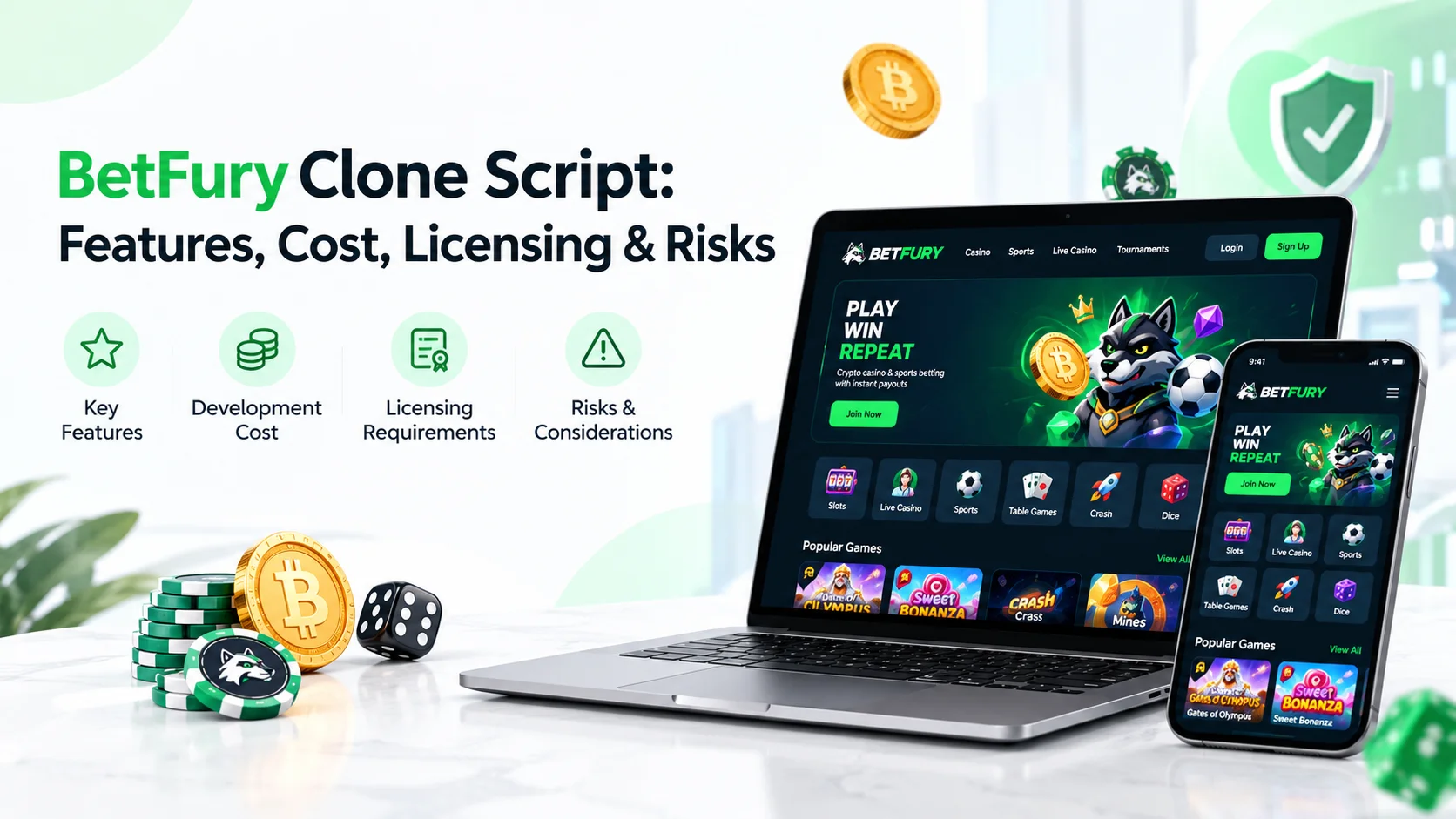
Search for a BetFury clone script and you will find dozens of pages promising a launch-ready crypto casino in weeks. Almost none of them tell you what the script leaves out. A script is only software. It does not come with a gaming licence, access to payment providers, licensed third-party game content, player liquidity or protection from legal and security risk.
This guide explains what a BetFury clone script actually contains, how the model behind it works, where the real risks sit, and what to check before you spend money. It is written for entrepreneurs and operators who are still deciding, not for people who have already chosen a vendor.
This article is technical and business information, not legal, regulatory or financial advice. Online gambling is restricted or prohibited in many places. Take advice from a qualified gaming lawyer in every market you intend to serve.
A BetFury clone script is ready-made software that replicates the main features of a crypto casino and betting platform like BetFury: crypto wallets, in-house games, a rewards or token system, an admin panel and an affiliate module. It speeds up development, but it does not provide a licence, payment access, licensed game content or compliance. For most buyers the real cost and risk lie in those missing pieces rather than in the code.
What a BetFury Clone Script Is (and Is Not)
BetFury is a crypto-focused casino and sportsbook that has been operating since 2019. Public reviews describe it as running under a Curaçao licence and built around a native token called BFG, which is used for staking and rewards. Review sites disagree on details such as the size of its game library, which suggests the numbers change and should be checked directly.
A BetFury clone script is third-party software that aims to reproduce the platform's functional model: crypto deposits and withdrawals, a catalog of games, a rewards and token layer, and back-office tools. Vendors describe it as customizable and white-label, meaning you can apply your own branding.
Clone does not mean copy
This distinction matters legally and commercially:
- Brand and trademarks. You cannot use BetFury's name, logo, token name or visual identity. A responsible vendor will sell you functionality, not a lookalike.
- Source code. The script is not BetFury's code. It is another company's implementation of similar features, so its quality depends entirely on that company.
- Token. A clone does not give you BFG or access to its economy. You would design your own token, if you use one at all.
If a vendor promises an "exact" replica of BetFury, treat that as a warning, not a selling point.
How the BetFury-Style Model Works
The model combines four layers:
- Games. In-house "originals" such as dice, crash and plinko, plus (on larger platforms) slots and live casino content from third-party providers, and sometimes a sportsbook supplied by a betting-feed provider.
- Crypto payments. Players deposit and withdraw in Bitcoin, Ethereum, USDT, Tron and other assets, usually through generated wallet addresses.
- Rewards. Rakeback, cashback, VIP tiers and bonuses with wagering requirements.
- Token economy. A native token that can be staked, with holders receiving a share of platform revenue according to published rules.
Reviews describe BetFury's token as paying out a share of casino profits to stakers. Treat those figures as claims by reviewers, not verified facts, and note that the structure carries its own regulatory questions (covered below).
What a Typical Crypto Casino Script Includes
Feature lists vary, but most crypto gaming scripts include some version of the following:
| Module | Typical contents |
|---|---|
| Player front end | Registration, lobby, game pages, responsive or mobile layout |
| Original games | Dice, crash, plinko, coin flip, mines, roulette variations |
| Wallet system | Multi-currency balances, deposit addresses, withdrawals, transaction history |
| Provably fair engine | Server seed, client seed and verification page |
| Rewards | Rakeback, bonuses, VIP levels, referral and affiliate tracking |
| Token / staking module | Optional token logic, staking, reward distribution |
| Admin panel | User management, game settings, limits, financial reports, content |
| Security | Two-factor authentication, role-based access, logging |
| Integrations | Third-party game aggregators, sportsbook feeds, payment processors, KYC tools |
Ask each vendor which of these are actually built, which are paid add-ons, and which are only "supported" via a third party.
What a Script Does Not Include
This is where budgets go wrong. A clone script usually does not include:
| Missing item | Why it matters |
|---|---|
| Gaming licence | You generally need a licence to offer real-money games legally. |
| Licensed game content | Third-party slots and live games require agreements with providers or aggregators. |
| Payment and banking access | Processors and wallet providers have their own onboarding and restrictions. |
| KYC/AML tooling and policies | Compliance processes must be set up and operated, not just installed. |
| Liquidity and bankroll | The house needs capital to pay winners, especially at launch. |
| Independent audits | RNG, game fairness and smart contract reviews cost extra. |
| Marketing and player acquisition | Gambling advertising is restricted on many channels. |
| Ongoing operations | Support, fraud monitoring, responsible gambling controls and maintenance. |
A script that costs a fraction of your total launch budget is normal. Budget for the rest from day one.
Provably Fair Games Explained
"Provably fair" lets a player check that a game result was not changed after they placed a bet. The common approach works like this:
- The platform generates a secret server seed and shows the player its hash (a fingerprint) before play begins.
- The player supplies or accepts a client seed.
- Each bet uses the two seeds plus a nonce (a bet counter) to produce the result through a cryptographic function such as HMAC-SHA256.
- After the seed is rotated, the platform reveals the original server seed so the player can confirm it matches the earlier hash and recompute past results.
What this proves and what it does not:
- It proves a specific game round was derived from committed inputs.
- It does not prove the platform will pay out, that the house edge is as advertised, or that the operator is solvent.
- Third-party content (slots, live dealers) is usually not provably fair in this sense and relies on certified RNGs and provider audits.
If a vendor says "provably fair" without a public verification page and documented algorithm, ask to see both.
Token and Rewards Models: Where the Real Risk Sits
The BFG-style token is the most distinctive part of the model, and the part buyers should examine most carefully.
- Utility vs profit-sharing. A token that pays holders a share of operator revenue can raise securities, investment-scheme or gambling-regulation questions in some jurisdictions. Whether it does depends on local law and on how the token is designed and marketed. Get advice before you create or sell one.
- Sustainability. Rewards paid from revenue depend on continuous wagering. Rewards funded by new deposits look very different from rewards funded by house edge, and regulators and players treat them differently.
- Price volatility. Token value moves independently of your platform's health, which affects reward value and player trust.
- Smart contract risk. Staking and distribution contracts need independent audits. Bugs in these contracts are a common cause of losses across crypto projects.
A clone without a token is a legitimate, simpler option. Many operators start with rakeback, VIP tiers and cashback and add a token only after the core business works.
Technology and Architecture
You do not need to pick every technology yourself, but you should understand the choices.
| Layer | Typical options | What to check |
|---|---|---|
| Front end | React, Vue, Next.js; mobile web or native/hybrid apps | Speed, mobile experience, accessibility |
| Back end | Node.js, Go, Java, PHP frameworks | Concurrency, security, code quality |
| Database | PostgreSQL, MySQL, Redis | Transaction integrity, auditability |
| Blockchain | Ethereum/EVM chains, Tron, BNB Chain, Bitcoin, Solana | Fees, confirmation speed, wallet support |
| Wallets | Hot/cold wallet architecture, custodial or non-custodial support | Key management, withdrawal controls |
| Games | In-house engine, third-party aggregators | Certification, licence requirements |
| Infrastructure | Cloud hosting, CDN, DDoS protection | Uptime during peak traffic |
Three decisions matter more than the brand names:
- Key management. Hot wallet design, multi-signature controls and withdrawal limits decide whether a breach is an incident or a catastrophe.
- Ledger integrity. Every bet, win and balance change should be recorded in an auditable, tamper-evident ledger.
- Scalability. Crash and dice games generate large volumes of small transactions. Test for traffic spikes, not average load.
Licensing and Regulation: The Part Most Scripts Skip
This section is general information, not legal advice.
Operating a real-money casino or betting platform without the right licence is illegal in many jurisdictions, and some countries and US states prohibit online gambling entirely or tightly restrict it. Offering games to players in a restricted territory can create liability even if your company is based elsewhere.
Curaçao is a common choice for crypto casinos. In December 2024 the Curaçao parliament approved the National Ordinance on Games of Chance (LOK), replacing the old master-licence and sub-licence structure with direct licensing by a single authority. Commentary on the new regime points to stricter due diligence, a requirement to establish a local presence, and higher fees, with one guide citing annual fees of roughly €47,000 for a business-to-consumer licence. Fees and rules change, so confirm current figures with the regulator or a gaming lawyer.
Whichever jurisdiction you consider, expect regulators to look at:
- Ownership and beneficial-owner disclosure
- KYC, AML and sanctions screening
- Responsible gambling tools (limits, self-exclusion, age checks)
- Technical and security standards, game certification and audit access
- Restricted-territory blocking
- Advertising and affiliate rules
Many licences also require that suppliers and platform providers be vetted, so the script vendor itself may need to meet requirements. Tier-one payment processors and acquirers often favour stricter licences such as EU or UK ones, which affects fiat access.
Clone Script, White-Label or Custom Build?
| Option | What you get | Strengths | Trade-offs |
|---|---|---|---|
| Clone script | Pre-built software replicating a known model, branded to you | Fastest and cheapest start; you often receive source code | Code quality varies; you handle licensing, hosting, audits and operations |
| White-label platform | A hosted, operated platform with your brand, often with licence and game content bundled | Lower compliance burden; faster launch | Revenue share or fees; limited control; dependency on the provider |
| Custom build | Bespoke platform built to your requirements | Full control, differentiation, owned IP | Highest cost and time; you carry all compliance and security responsibility |
A practical rule: use a white-label or licensed platform if you want to validate demand with minimal compliance work, a clone script if you have licensing in hand and want control, and custom development when you have a differentiated product and the budget to support it.
Cost and Timeline
Why published ranges vary
There is no standard price. Ranges published by vendors in 2026 describe different things:
- One casino-development cost guide puts online casino development at about $10,000 for a white-label launch up to more than $1,000,000 for a fully custom platform with proprietary content and global compliance infrastructure, and lists custom crypto casino platforms at roughly $80,000-$300,000+ with a 5-12 month timeline. sourcecodelab
- Another figure from the same guide places white-label launches at $10,000-$50,000 and fully custom builds at $150,000-$600,000+. sourcecodelab
- For crypto-exchange clone scripts, which are a different product but a useful comparison, vendors quote figures such as $30,000-$100,000 for a white-label or clone script with a one to three month timeline. purrweb
These numbers come from vendors selling services, so treat them as a rough map, not a quote. The same label can cover a basic script with a handful of games or a full platform with audits and integrations.
What moves the price:
- Number and type of games, and whether you build or license them
- Chains and currencies supported
- Token and staking modules, including smart contract audits
- Sportsbook or live-casino integration
- Mobile apps versus responsive web
- Security architecture and penetration testing
- Admin, risk and reporting tools
- Source-code ownership and customization depth
Costs outside the script
Plan separately for:
- Gaming licence application, annual fees and legal counsel
- Corporate structure and local substance requirements where applicable
- Game aggregator and sportsbook feed fees or revenue share
- Independent audits (RNG, smart contracts, penetration tests)
- KYC/AML tools and compliance staff
- Hosting, DDoS protection and monitoring
- Bankroll and treasury management
- Customer support and fraud monitoring
- Marketing and affiliate commissions
For many operators these combined costs exceed the cost of the script itself.
How to Evaluate a Clone Script Provider
Before paying a deposit, ask for:
- A live demo with an admin panel, not only screenshots.
- Source-code ownership terms, including whether you receive full code and what restrictions apply.
- The provably fair algorithm and a public verification page.
- Audit evidence for any smart contracts, and a security testing summary.
- A clear list of included and excluded features, with add-on pricing.
- Third-party licences for any integrated games or sportsbook feeds.
- Wallet and key-management design, including who controls private keys.
- Support and update terms, including how security fixes are delivered.
- Verifiable references you can contact.
- How the vendor handles regulatory questions. A trustworthy vendor will ask about your licence and target markets, not promise to "bypass" restrictions.
Walk away from any vendor that offers to help you avoid licensing, hide ownership, or serve restricted regions.
Common Mistakes
- Buying the script before securing a licence path. The licence timeline can be longer than development.
- Assuming the script includes games players expect. Large slot and live libraries require provider agreements.
- Copying BetFury's branding or token design. That invites trademark claims and loses differentiation.
- Launching a profit-sharing token without legal advice.
- Skipping audits. Both RNG and wallet security need independent review.
- Underfunding the bankroll. Variance can wipe out a thin treasury early.
- Ignoring responsible gambling tooling. Limits, self-exclusion and age checks are expected by regulators and payment partners.
- Treating launch speed as the main goal. A fast launch of a non-compliant or insecure product is a liability.
Choosing a Crypto Gaming Platform Development Partner: Why Businesses Consider DigiTechzo
Whoever builds your platform will shape your security, your ability to pass audits and your flexibility after launch. Choosing a partner is therefore as important as choosing the script.
DigiTechzo is a technology company whose publicly listed capabilities include blockchain, software and mobile app development, websites and AI development. For a crypto gaming project, those capabilities are relevant because a platform like this combines wallet and blockchain integration, a transactional back end, a player-facing web or mobile experience and an admin system.
A sensible first conversation with DigiTechzo, or any provider, would cover your target markets and licensing plan, which games you will build versus license, whether you want a token, and what security and audit work is needed. Ask for a scoped plan that separates the platform build from licensing, content and operations so you can compare proposals fairly.
If you are evaluating a crypto gaming platform and want to discuss scope, you can contact the DigiTechzo team through its website.
Frequently Asked Questions
How do provably fair algorithms work in a BetFury clone script?
Provably fair games use cryptographic hashing (typically HMAC-SHA256) combining a server seed, a player-generated client seed, and a nonce. Before a bet is placed, the player receives an encrypted hash of the server seed. Once the round finishes, the unhashed seed is revealed, allowing the player to mathematically verify that the platform did not manipulate the outcome.
Does buying a BetFury clone script include an online gaming license?
No. Software clone scripts provide the technical source code and database architecture only. Operating legally requires obtaining an iGaming license from established jurisdictions such as Curaçao, Anjouan, or Kahnawake, alongside implementing compliant KYC and Anti-Money Laundering (AML) procedures.
How does native token staking and dividend distribution operate?
BetFury-style platforms create an internal reward token that players mine through active wagering. A percentage of the casino's net gaming revenue is funneled into a daily dividend pool, which is automatically distributed to token holders who stake their tokens on the platform.
What security architecture protects crypto deposits and player balances?
Production-ready crypto gaming systems utilize automated hot wallet and cold storage segregation. Daily betting payouts are drawn from a strictly capped hot wallet, while the vast majority of treasury reserves remain in multi-signature cold wallets to mitigate breach risks.
Can third-party casino game providers be integrated into the script?
Yes. In addition to proprietary in-house provably fair mini-games (Dice, Crash, Plinko), standard scripts connect to major iGaming aggregators (such as Pragmatic Play, Evolution, and BGaming) via standardized game provider APIs.