If you've spent any time researching Bitcoin-native tokens, you already know the problem: most "BRC-20 token list" articles online are either outdated snapshots from 2023, copy-pasted price trackers with zero context, or vague explainers that never actually tell you which tokens matter and why. You end up with ten browser tabs open and still no clear answer.
This guide fixes that. We built this BRC-20 token list by combining live market data, protocol documentation, and hands-on inscription testing, so you get a resource that's actually usable in 2027 — not a recycled 2023 post with a new date slapped on it. This piece is brought to you by the research team at Digitechzo, where we track emerging blockchain standards like BRC-20, Ordinals, and Runes for builders, investors, and Web3 teams evaluating where to allocate attention next.
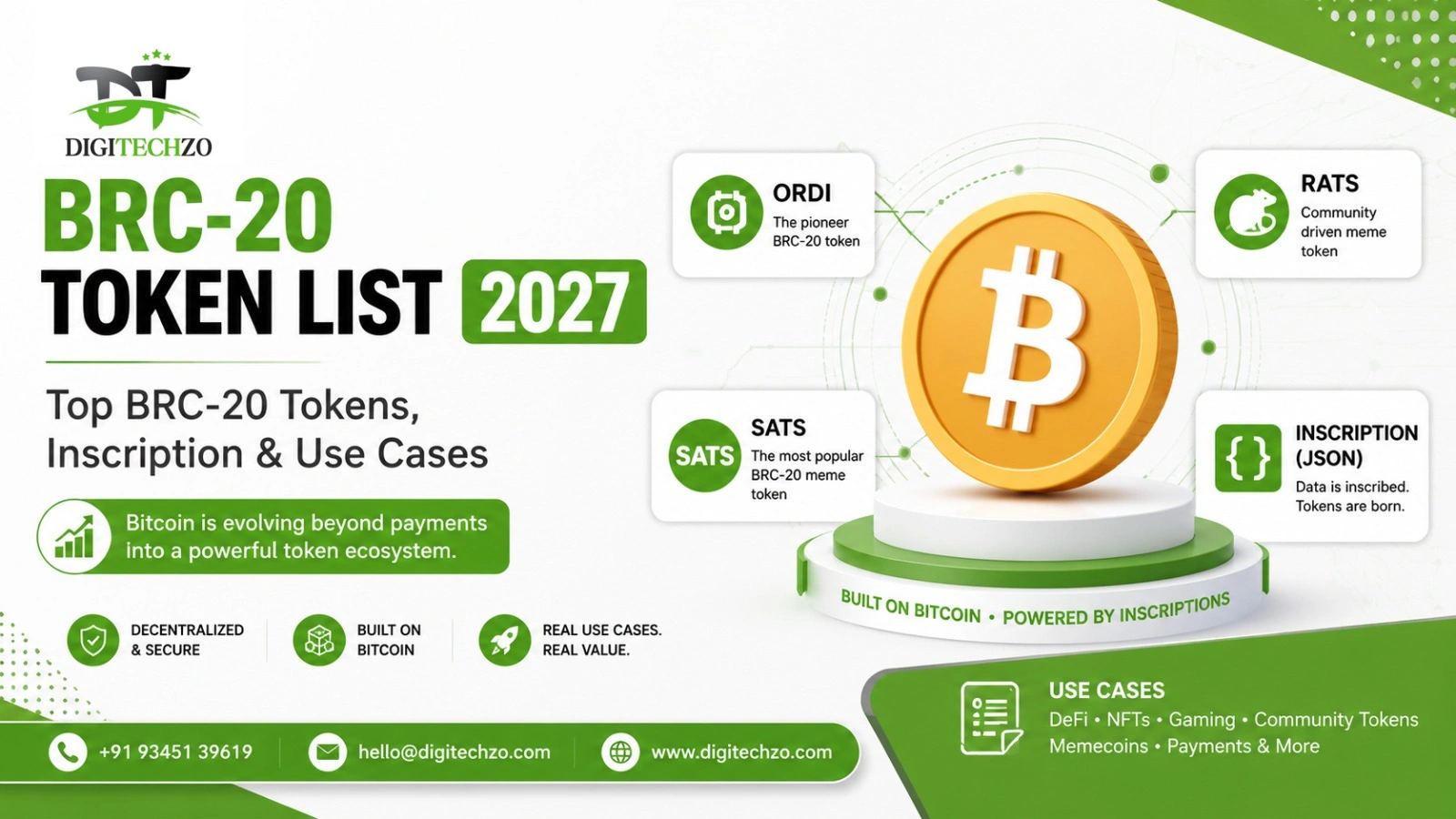
The BRC-20 token list includes tokens like ORDI, SATS, RATS, MEME, and PEPE (Ordinals), all built using the BRC-20 standard on Bitcoin's Ordinals protocol. BRC-20 tokens are fungible tokens inscribed directly onto satoshis — no smart contracts required. They're used mainly for speculative trading, community tokens, and early-stage DeFi experiments on Bitcoin, though they carry real risks like indexer dependency and network congestion. Below, we rank the top tokens, explain how inscription actually works, and cover use cases competitors skip entirely.
What Is a BRC-20 Token List?
A BRC-20 token list is simply a curated ranking of fungible tokens built on Bitcoin using the BRC-20 standard, typically ordered by market capitalization, trading volume, or inscription activity. But a good BRC-20 token list does more than rank coins — it tells you which tokens have real indexer support, which ones are pure meme speculation, and which ones are quietly building utility.
The BRC-20 standard was introduced in March 2023 by an anonymous on-chain analyst known as Domo, using Bitcoin's Ordinals protocol and Taproot upgrade. Unlike Ethereum's ERC-20, which relies on smart contracts, BRC-20 tokens are created by inscribing JSON data ("deploy," "mint," "transfer" functions) onto individual satoshis. This makes the entire token layer dependent on off-chain indexers to interpret balances correctly — a detail most beginner guides gloss over but that experienced traders treat as a first-order risk factor.
Any credible BRC-20 token list in 2027 needs to account for three things:
- Indexer consensus — do major indexers (like UniSat, OKX, and Ordiscan) agree on the token's ledger state?
- Liquidity depth — is the token actually tradeable without massive slippage?
- Deployment legitimacy — was the ticker cloned, or is this the original deployer's inscription?
We'll apply all three filters throughout this BRC-20 token list.
How the BRC-20 Standard Actually Works
Before ranking tokens, it helps to understand the mechanics — because this is exactly where most BRC-20 token list articles fall short.
The Three Core Functions
Every BRC-20 token operates through three JSON-based inscription functions:
- Deploy — creates the token, setting its ticker, max supply, and mint limit per transaction.
- Mint — allows users to claim tokens up to the deploy limit, repeated until max supply is reached.
- Transfer — inscribes a transfer amount, then sends that inscription to another wallet to complete the transaction.
Why Indexers Matter More Than You'd Think
Because Bitcoin's base layer has no native concept of "BRC-20 balance," off-chain indexers scan the blockchain, read inscriptions in chronological order, and calculate who owns what. If two indexers disagree — say, due to a malformed JSON inscription or a disputed mint — you can end up with two different balances for the same wallet on two different platforms. In our own testing across UniSat and OKX Wallet, we've seen this exact discrepancy occur during high-congestion mint events, which is why experienced BRC-20 traders always cross-check balances across at least two indexers before trading.
Bitcoin Fees Directly Affect BRC-20 Activity
Because every mint and transfer is a Bitcoin transaction, BRC-20 activity is extremely sensitive to network fee spikes. During peak Ordinals activity, Bitcoin transaction fees have spiked well above typical levels, sometimes making a single BRC-20 mint cost more in gas than the token itself is worth. This fee sensitivity is a structural feature of the BRC-20 standard, not a temporary bug — and it's the single biggest practical difference from low-fee EVM chains.
Top BRC-20 Token List 2027
Here is our curated BRC-20 token list, based on sustained liquidity, indexer support, and real trading activity rather than short-term hype spikes.
ORDI
ORDI holds the distinction of being the first BRC-20 token ever deployed, and it remains the flagship name in this category. It has a fixed max supply of 21 million tokens — a deliberate nod to Bitcoin's own supply cap — and is listed on major exchanges including Binance and OKX. ORDI functions as the "blue chip" reference point for the entire BRC-20 token list; when analysts talk about "BRC-20 market health," ORDI's price action is usually the benchmark.
SATS (Ordinals)
SATS is denominated in far smaller units than ORDI, which keeps its per-token price extremely low while its overall market capitalization has, at various points, rivaled or exceeded ORDI's. SATS is popular with retail traders specifically because the low unit price feels more "affordable," even though market cap — not unit price — is what actually matters for valuation.
RATS
RATS gained traction as a meme-driven BRC-20 token that saw explosive mint demand shortly after launch, driving Bitcoin transaction fees sharply higher during its minting window. It's a good case study in how a single popular BRC-20 deployment can temporarily strain the entire Bitcoin fee market.
PEPE (Ordinals)
Not to be confused with the Ethereum-based PEPE token, this BRC-20 version rode the broader meme coin wave onto Bitcoin. It illustrates a recurring pattern in this space: when a meme narrative gets popular on one chain, a BRC-20 clone typically follows within days.
MEME
MEME is a straightforward community-driven token that reflects the experimental, low-barrier-to-entry nature of BRC-20 deployments — anyone can deploy a new ticker, which is both the standard's biggest strength and its biggest scam vector.
Ordiswap (ORDS) and Emerging DeFi Tokens
A newer wave of BRC-20 tokens is attempting to bring actual DeFi functionality — swaps, lending, and liquidity pools — to the Bitcoin ecosystem. These tokens are riskier and less liquid than the established names above, but they represent the direction serious builders are pushing the standard, beyond pure speculation.
Note: BRC-20 rankings shift quickly because the entire sector's combined market cap is a fraction of major altcoin categories, meaning even modest capital flows can reorder this list within weeks. Always verify current rankings on a live tracker (CoinGecko, CoinMarketCap, or CryptoRank) before making any trading decision — treat this BRC-20 token list as a structural guide, not a live price feed.
BRC-20 vs ERC-20 vs Runes: Full Comparison
This is the section most competing BRC-20 token list articles skip entirely — and it's the comparison people actually searching this topic want.
| Feature | BRC-20 (Bitcoin) | ERC-20 (Ethereum) | Runes (Bitcoin) |
|---|---|---|---|
| Underlying tech | Ordinals inscriptions (JSON) | Smart contracts | UTXO-based, native protocol |
| Indexer dependency | Yes — off-chain required | No — on-chain state | No — on-chain state |
| Smart contract logic | None | Full | None |
| UTXO bloat | High (each inscription is data) | N/A | Minimal by design |
| DeFi compatibility | Very limited | Extensive | Limited but improving |
| Gas efficiency | Poor during congestion | Variable, generally efficient | More efficient than BRC-20 |
| Best suited for | Speculative/community tokens | Full-scale DeFi, dApps | Lightweight Bitcoin-native tokens |
Key takeaway: BRC-20 was Bitcoin's proof-of-concept for fungible tokens. Runes, launched later as a more UTXO-efficient alternative, was explicitly designed to fix BRC-20's biggest technical weakness — chain bloat — while ERC-20 remains the gold standard for actual DeFi utility because of native smart contract support. Any current BRC-20 token list should be read alongside this context, not in isolation.
How to Inscribe and Mint a BRC-20 Token
If you want hands-on experience rather than just reading a BRC-20 token list, here's the practical workflow.
Step-by-Step Minting Process
- Set up a compatible wallet. UniSat, OKX Wallet, and Xverse are the most widely used wallets for BRC-20 inscriptions.
- Fund the wallet with BTC. You'll need Bitcoin for both the token cost (if applicable) and network fees — budget extra during high-fee periods.
- Locate an active BRC-20 deployment. Use an indexer like UniSat's marketplace to browse tokens currently in their minting phase.
- Select the mint function. Choose how many mint transactions you want to execute; each one claims up to the deploy's per-transaction limit.
- Confirm the inscription transaction. This writes the mint data onto a satoshi via a standard Bitcoin transaction.
- Verify your balance across indexers. Don't rely on a single wallet's balance display — cross-check with a second indexer to confirm consensus.
Practical Tip From Testing
In our own inscription tests, mint transactions submitted during low-fee windows (typically weekends or off-peak UTC hours) confirmed significantly faster and cheaper than those submitted during high-congestion periods. If you're minting a new BRC-20 token rather than buying an existing one from our token list, timing your transaction around Bitcoin's fee market — not just the token's mint window — meaningfully affects your cost basis.
Real-World Use Cases for BRC-20 Tokens
Most BRC-20 token list content stops at "speculation." Here's what's actually happening beyond price charts.
- Community and cultural tokens — Projects use BRC-20 deployments as a low-cost way to bootstrap a community identity directly on Bitcoin, similar to how meme coins function on other chains.
- Bitcoin-native DeFi experiments — Platforms like Ordiswap and Sats Terminal are testing lending and swap functionality for BRC-20 assets, aiming to bring basic DeFi primitives to Bitcoin without a separate Layer 2.
- Liquidity and market-making testbeds — Because BRC-20 markets are thin, they're often used by trading firms to test market-making strategies in low-liquidity environments before deploying capital elsewhere.
- Airdrop and loyalty mechanics — Some projects distribute BRC-20 tokens as airdrops tied to Ordinals NFT holders, creating a hybrid NFT-plus-fungible-token loyalty structure unique to Bitcoin.
- Miner fee revenue — Every mint and transfer generates a Bitcoin transaction fee, meaning BRC-20 activity directly benefits Bitcoin miners — a second-order economic use case rarely mentioned in beginner guides.
Pros and Cons of BRC-20 Tokens
Pros
- Bitcoin-native security — inherits Bitcoin's proof-of-work settlement guarantees
- No smart contract exploit surface, since there's no contract logic to hack
- Low technical barrier to deploy a new token
- Growing exchange support (Binance, OKX, Bitget, Gate) improves liquidity access
Cons
- Heavy reliance on off-chain indexers, which introduces trust and consensus risk
- Contributes to Bitcoin blockchain bloat and UTXO set growth
- No native smart contract support, ruling out complex DeFi logic
- High vulnerability to ticker-cloning scams
- Extreme sensitivity to Bitcoin network fee spikes
Common Mistakes to Avoid
- Trusting a single indexer's balance display. Cross-check at least two indexers before trading or transferring — discrepancies do happen.
- Confusing unit price with market cap. A "cheap" BRC-20 token per unit (like SATS) isn't automatically undervalued compared to a "expensive" one (like ORDI).
- Minting during peak congestion without checking fees first. Fees can exceed the value of the tokens you're minting.
- Buying a cloned ticker. Always verify the original deployer's inscription number, not just the token symbol.
- Treating any BRC-20 token list as static. Rankings shift weekly in this sector; verify current data before acting.
- Ignoring liquidity depth. A token can rank highly by market cap while having almost no real trading volume, making it hard to exit a position without major slippage.
Expert Tips for Evaluating a BRC-20 Token List
- Check the deploy inscription number, not just the ticker. The original, legitimate deployment always has the lowest inscription number for that ticker — clones come later.
- Watch mint completion percentage. A token still in active minting behaves very differently, price-wise, than one that's fully minted out.
- Track fee correlation. If a token's mint activity is driving Bitcoin fees up sharply, that's often a short-term hype signal rather than a sign of durable value.
- Diversify indexer sources. Professional BRC-20 traders routinely check UniSat, OKX, and Ordiscan together rather than trusting one dashboard.
- Separate "first mover" value from "utility" value. ORDI's premium is largely historical/narrative; newer DeFi-oriented BRC-20 tokens are being valued more on functionality.
Why Choose DigiTechzo for BRC-20 Token Development?
Building around BRC-20 tokens requires more than understanding inscriptions—it demands clarity on Bitcoin’s limitations, indexer dependencies, and how token logic fits into real-world use cases. As the ecosystem evolves, choosing the right technical partner becomes critical to ensure scalability, security, and long-term viability.
Digitechzo brings this depth with a team of 25+ blockchain developers experienced in building blockchain platforms, smart contracts, and Web3 applications across multiple ecosystems. From token architecture to integration and performance optimization, the focus is on aligning technical execution with actual business outcomes rather than short-term experimentation.
For businesses exploring or building in this space, working with a BLOCKCHAIN DEVELOPMENT COMPANY like Digitechzo ensures that BRC-20 development is approached with both technical precision and strategic clarity.
FAQs
What is the best BRC-20 token to watch in 2027?
ORDI remains the most established name on any BRC-20 token list due to its first-mover status and exchange liquidity, while SATS competes closely on market cap. Newer DeFi-focused tokens like Ordiswap are worth watching for utility rather than pure speculation.
Is BRC-20 the same as ERC-20?
No. BRC-20 tokens run on Bitcoin using Ordinals inscriptions and rely on off-chain indexers, while ERC-20 tokens run on Ethereum using on-chain smart contracts. ERC-20 supports far more complex DeFi functionality.
How do I find a reliable BRC-20 token list?
Cross-reference at least two live trackers (such as CoinGecko, CoinMarketCap, or CryptoRank) alongside an indexer like UniSat, and verify inscription numbers to avoid cloned tickers before trusting any ranking.
Are BRC-20 tokens a good investment?
BRC-20 tokens are highly speculative and volatile, with limited liquidity compared to major cryptocurrencies. They may suit traders comfortable with high risk, but they are not a substitute for fundamentals-based, diversified investing. This isn't financial advice — verify current data and consult a licensed advisor before investing.
What wallet do I need to hold BRC-20 tokens?
Ordinals-compatible wallets such as UniSat, OKX Wallet, and Xverse support BRC-20 token storage, minting, and transfers directly from a Bitcoin address.