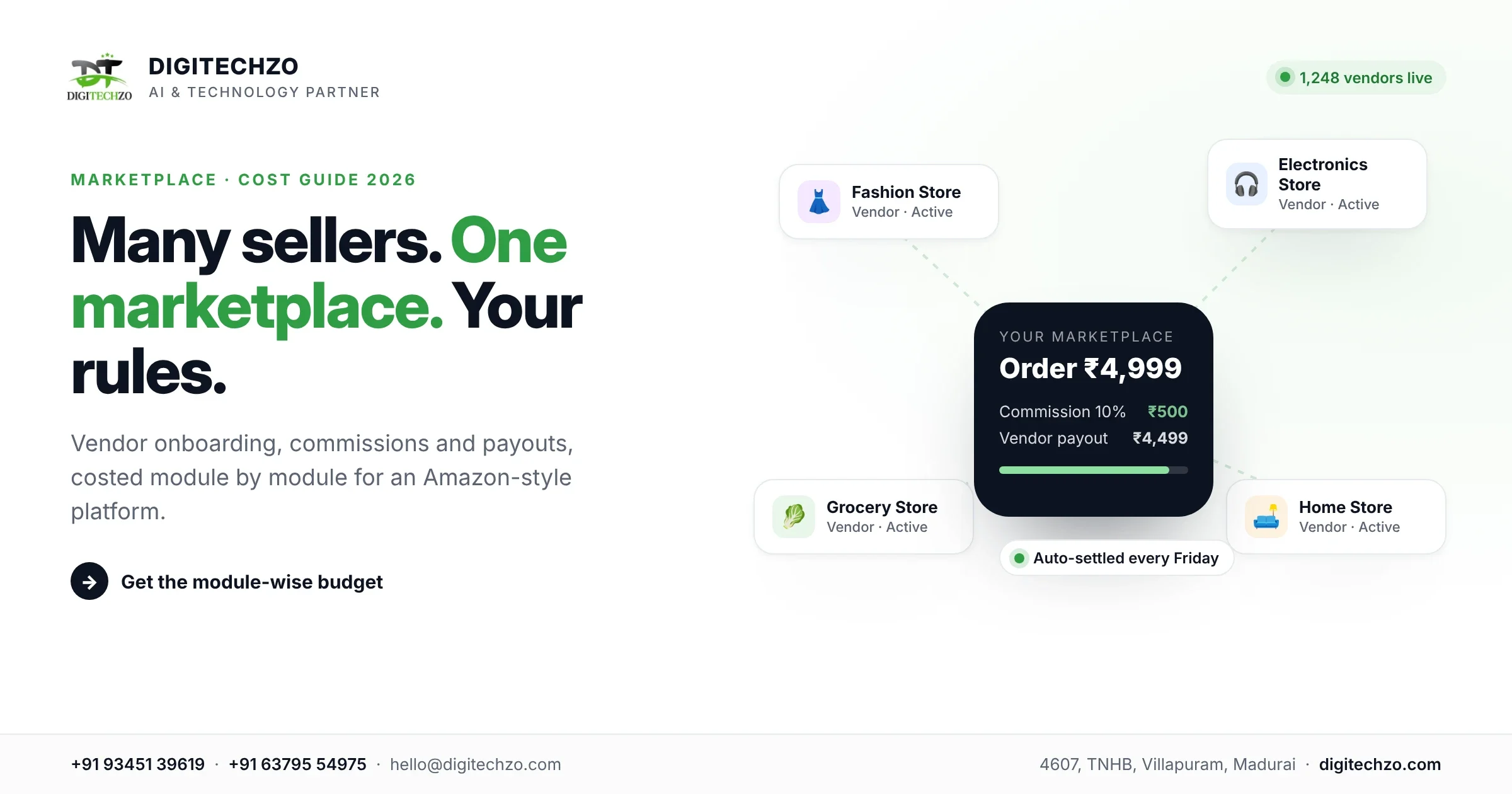
Building a marketplace is a different game from building a store. You are not selling products; you are building a place where other sellers sell, buyers trust, and you earn on every transaction. That is why quotes for an "Amazon-like" platform range so widely. This guide explains what a multi-vendor marketplace costs in India, module by module, and how to launch without burning your budget on features nobody uses yet.
Quick Answer: Marketplace Cost by Stage
These are indicative planning ranges and will vary with scope, design and integrations.
| Stage | Typical investment | Purpose |
|---|---|---|
| Marketplace MVP (web) | Roughly ₹8 lakh to ₹20 lakh | Prove that vendors and buyers show up |
| Full marketplace with web and apps | Roughly ₹20 lakh to ₹50 lakh | Scale with vendor tools, apps and analytics |
| Enterprise or hyperlocal / quick-commerce platform | Roughly ₹50 lakh and above | Delivery, dispatch, multi-city operations |
If you want a deeper global view of large catalogue platforms, our companion guide on the cost to create an e-commerce website like Amazon covers the upper end. This page focuses on the multi-vendor mechanics and the Indian market.
The Three Sides of Every Marketplace
1. The buyer experience
Search, filters, product pages, cart, checkout, order tracking, returns and reviews. This must feel fast and trustworthy on a mobile phone, because that is where most Indian buyers shop.
2. The vendor experience
Vendor onboarding and KYC, product listing, inventory, order handling, payouts and performance reports. A weak vendor panel means a thin catalogue, and a thin catalogue means no buyers.
3. The admin engine
Vendor approval, commission rules, dispute handling, payouts, taxes and fraud control. This is where the marketplace makes its money, so it deserves the most careful design.
Module-Wise Cost Drivers
- Vendor onboarding and KYC: document checks, approvals and agreements.
- Commission and payout engine: category-wise commission, split payments, settlement cycles and GST handling are often the most complex part.
- Catalogue and search: variants, bulk upload and advanced filters.
- Order management: multi-vendor carts that split into separate orders, shipping and returns.
- Payments: UPI, cards and wallets with marketplace-grade split settlement.
- Mobile apps: separate or combined buyer and vendor apps.
- Delivery and dispatch (hyperlocal only): rider assignment and live tracking, as in a quick-commerce marketplace.
Build Custom or Start with a Clone Script?
A ready-made base such as our Amazon clone shortens the time to market because the core multi-vendor flows already exist. You then customise the design, commission rules and workflows to your niche. A fully bespoke build costs more but suits businesses with unusual models such as rentals, services or B2B pricing. The right choice depends on how different your model is from a standard marketplace.
Where AI Makes a Marketplace Smarter
With thousands of products and sellers, AI is the difference between a cluttered catalogue and a marketplace people trust.
- Smart search and recommendations that surface what each buyer is likely to want.
- AI product-listing assistant that helps vendors write titles and descriptions and tag correctly.
- Fraud and fake-review detection to protect buyer trust and your commissions.
- Dynamic pricing hints for vendors based on demand and competition.
- AI support assistant for order, refund and vendor queries across the website and WhatsApp.
- Dispatch optimisation for hyperlocal and quick-commerce models.
We build these with our AI development practice so they are part of the platform, not an afterthought.
How to Launch Lean and Still Look Premium
- Pick one niche and one city first. A focused marketplace gets supply and demand faster than a general one.
- Seed the vendors before the launch. An empty marketplace repels buyers.
- Launch web with a strong mobile experience and add native apps once orders are flowing. See our e-commerce app development options.
- Design commission rules early. Changing them after vendors join is painful.
- Keep the code and data yours. A marketplace is an asset, so own it.
Frequently Asked Questions
What is Multi-Vendor Marketplace Development Cost in India and how does it work?
Building a marketplace is a different game from building a store. You are not selling products; you are building a place where other sellers sell, buyers trust, and you earn on every transaction. That is why quotes for an "Amazon-like" platform range so widely.
What factors determine the development cost and timeline of Multi-Vendor Marketplace Development Cost in India?
These are indicative planning ranges and will vary with scope, design and integrations. If you want a deeper global view of large catalogue platforms, our companion guide on the cost to create an e-commerce website like Amazon covers the upper end. This page focuses on the multi-vendor mechanics and the Indian market.
Build Custom or Start with a Clone Script?
A ready-made base such as our Amazon clone shortens the time to market because the core multi-vendor flows already exist. You then customise the design, commission rules and workflows to your niche. A fully bespoke build costs more but suits businesses with unusual models such as rentals, services or B2B pricing.
What is the recommended roadmap to launch and scale Multi-Vendor Marketplace Development Cost in India?
Pick one niche and one city first. A focused marketplace gets supply and demand faster than a general one. Seed the vendors before the launch.
What should businesses consider regarding The buyer experience?
Search, filters, product pages, cart, checkout, order tracking, returns and reviews. This must feel fast and trustworthy on a mobile phone, because that is where most Indian buyers shop.
Explore DigiTechzo's Dedicated Engineering Squads
Accelerate product velocity with forward-deployed software engineers embedded directly into your core product architecture. Discover our model on our Forward Deployed Engineering Services page.