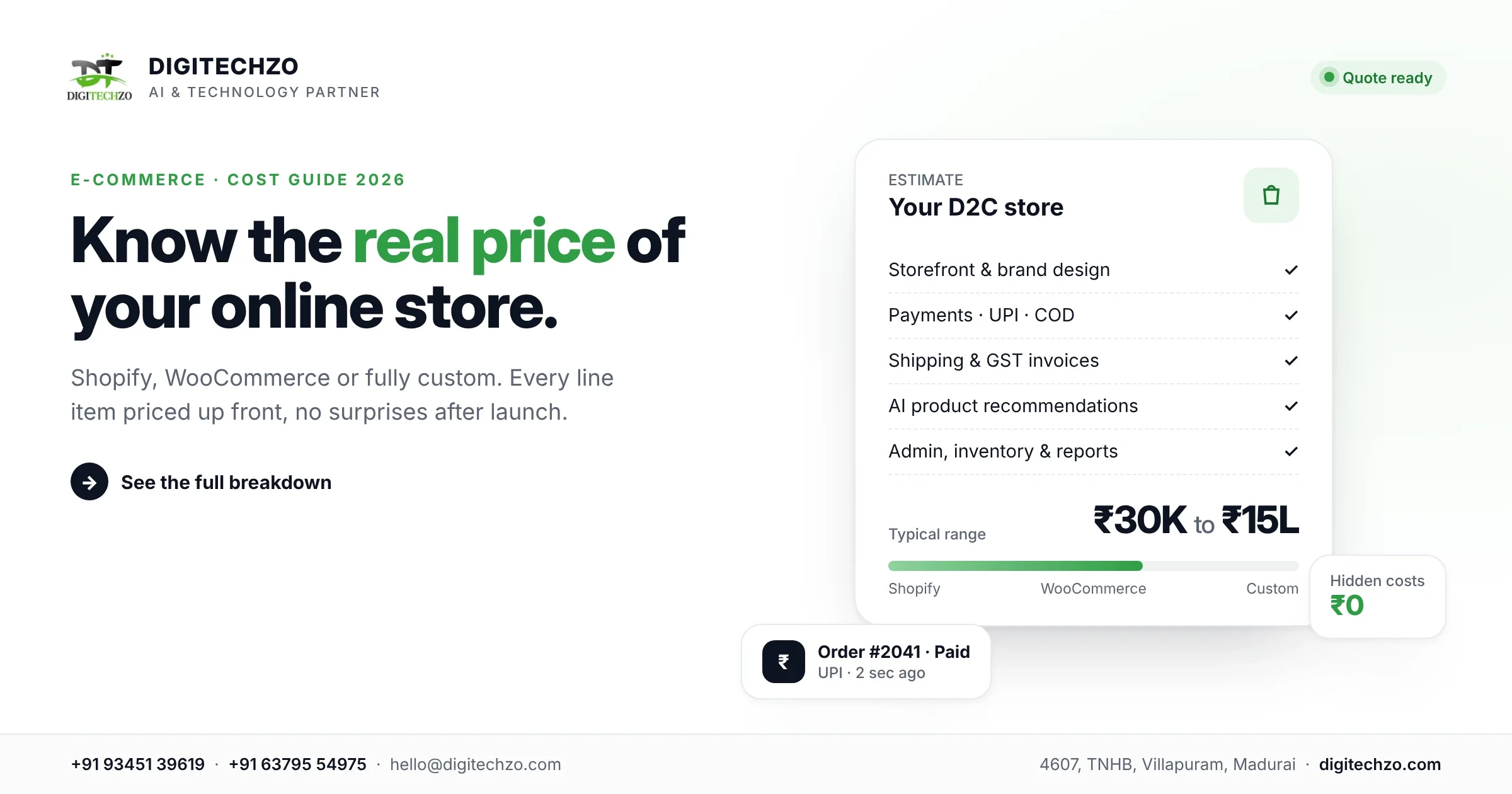
You have probably already collected three quotes for an online store, and none of them match. One agency says a few thousand rupees, another says several lakhs, and nobody explains why. This guide is meant to end that confusion. It walks through what an e-commerce website actually costs in India, what each price band includes, where the hidden costs sit, and how to spend in a way that brings customers back instead of just putting a store online.
Quick Answer: E-commerce Website Cost in India by Type
These are indicative market ranges, not a fixed price list. Your final number depends on scope, integrations and design depth, so treat this as a planning guide.
| Store type | Typical investment (one-time) | Best for |
|---|---|---|
| Template store on Shopify or WooCommerce | Roughly ₹30,000 to ₹1.5 lakh | New brands testing a small catalogue |
| Customised store with branded design and integrations | Roughly ₹1.5 lakh to ₹5 lakh | Growing D2C brands with a clear identity |
| Fully custom e-commerce platform | Roughly ₹5 lakh to ₹15 lakh | Businesses with unique workflows, subscriptions or B2B pricing |
| Store plus iOS and Android app | Add roughly ₹3 lakh to ₹10 lakh | Brands with strong repeat customers |
Recurring costs (hosting, payment gateway fees, apps, maintenance and marketing) come on top of this, and they are usually where budgets get surprised.
What Decides the Cost of an Online Store?
Platform choice
Shopify and WooCommerce get you live quickly and cost less upfront. A custom build costs more initially but removes plugin limits, monthly app stacking and the "we cannot do that on this platform" wall. If you are unsure, read our breakdown of e-commerce website development services to see which route fits your stage.
Design depth
A theme with your logo is one thing. A conversion-focused design with custom product pages, a fast mobile checkout and a premium brand feel is another. Design is the line item that most directly affects how much a visitor trusts you in the first five seconds.
Catalogue and product data
Ten products and ten thousand products are different projects. Variants, bulk upload, filters, and search all add effort.
Payments, shipping and tax
Razorpay, PayU, Cashfree and UPI, plus shipping aggregators and GST invoicing, are standard for India. Each integration is small, but together they shape the checkout experience.
Admin, inventory and ERP connections
If your stock lives in an accounting or ERP system, syncing it avoids overselling. Businesses with that need often pair the store with ERP software development or a custom CRM.
The Costs Nobody Mentions in the Quote
- Hosting and CDN: a slow store loses sales long before anyone reads your product copy.
- Payment gateway fees: a small percentage on every order, forever.
- Paid apps and plugins: on Shopify and WooCommerce these can quietly add up every month.
- Maintenance and security: updates, backups and bug fixes.
- Content and photography: product photos often decide whether a store looks premium or amateur.
- SEO foundations: clean structure, schema and speed should be built in, not added later.
Where AI Changes E-commerce Cost and Returns
Customers now expect a store that understands them. AI is no longer a "later" feature; it is the part of the build that most directly pays for itself.
- AI product search and recommendations show shoppers what they are likely to buy, which lifts average order value.
- WhatsApp and website AI assistants answer product, order and delivery questions at any hour, so enquiries do not go cold overnight.
- Abandoned-cart recovery that writes personalised follow-ups instead of generic reminders.
- AI-assisted catalogue writing that cuts the time to list hundreds of products.
- Demand and stock forecasting to avoid dead stock and stock-outs.
Adding these at the planning stage is far cheaper than retrofitting them later. Our AI development team builds these as part of the store, not as a separate project.
How to Avoid Overpaying for Your Store
- Launch the lean version first. Start with the features that drive orders and add the rest as revenue arrives.
- Ask for a module-wise quote. If an agency cannot break down the number, the number is a guess.
- Own your code and data. Make sure the store, the customer data and the domain are in your name.
- Plan the app later, not never. A good store architecture lets you add a mobile app without rebuilding. See our e-commerce app development approach.
- Budget for growth. Keep a share of the budget for SEO and ads; a beautiful store with no traffic is an expensive brochure.
Shopify, WooCommerce or Custom: A Simple Way to Decide
Choose a template platform if you are validating a product and want to be live in weeks. Choose a customised build when your brand needs a distinct experience and you expect steady growth. Go fully custom when your pricing, subscriptions, B2B rules or marketplace logic do not fit a standard platform. If you are thinking even bigger, our guide on the cost of an Amazon-like website shows what a large catalogue platform involves.
Our Process, in Plain Words
We start with your product, buyer and margin, not with a template. Then we scope the store module by module, design the mobile-first shopping journey, build, test payments end to end, and launch with SEO and tracking already in place. You can see the kind of brand work we deliver in our Ilai Organics case study.
Frequently Asked Questions
What is E-commerce Website Cost in India and how does it work?
You have probably already collected three quotes for an online store, and none of them match. One agency says a few thousand rupees, another says several lakhs, and nobody explains why. This guide is meant to end that confusion.
What factors determine the development cost and timeline of E-commerce Website Cost in India?
These are indicative market ranges, not a fixed price list. Your final number depends on scope, integrations and design depth, so treat this as a planning guide. Recurring costs (hosting, payment gateway fees, apps, maintenance and marketing) come on top of this, and they are usually where budgets get surprised.
What should businesses consider regarding Platform choice?
Shopify and WooCommerce get you live quickly and cost less upfront. A custom build costs more initially but removes plugin limits, monthly app stacking and the "we cannot do that on this platform" wall. If you are unsure, read our breakdown of e-commerce website development services to see which route fits your stage.
What should businesses consider regarding Design depth?
A theme with your logo is one thing. A conversion-focused design with custom product pages, a fast mobile checkout and a premium brand feel is another. Design is the line item that most directly affects how much a visitor trusts you in the first five seconds.
What should businesses consider regarding Catalogue and product data?
Ten products and ten thousand products are different projects. Variants, bulk upload, filters, and search all add effort.
Explore DigiTechzo's Dedicated Engineering Squads
Accelerate product velocity with forward-deployed software engineers embedded directly into your core product architecture. Discover our model on our Forward Deployed Engineering Services page.