The global food delivery sector has evolved from a convenience-based luxury into a critical infrastructure component for modern urban economies. As businesses look to capture market share, the demand for a reliable, scalable, and feature-rich Talabat clone app has surged. At DigiTechzo, we recognize that success in this space requires more than just a functional interface; it demands a robust, high-availability architecture capable of managing complex logistics, real-time data synchronization, and high-concurrency user traffic.
Quick Takeaway / Direct Answer: A Talabat clone app is a pre-engineered software solution that replicates the core functionality of a multi-vendor food delivery platform, including customer ordering, restaurant management, and real-time courier tracking. By leveraging a professional clone script, businesses can significantly reduce time-to-market and development costs while maintaining the flexibility to customize features for specific regional markets and business models.
Launch Your Own Food Delivery Marketplace
Entering the food delivery market requires a strategic balance between user experience and operational efficiency. A marketplace model connects three distinct stakeholders: hungry customers, hungry restaurants, and delivery partners. The primary objective is to create a seamless ecosystem where orders are placed, accepted, and fulfilled with minimal friction, ensuring that the platform remains profitable while scaling to meet demand.
Building from scratch is often resource-intensive and prone to architectural pitfalls. Utilizing a proven script allows entrepreneurs to focus on market penetration, branding, and local partnerships rather than reinventing the wheel. Whether you are targeting a niche local market or a broader regional footprint, your platform must be built to handle the complexities of on-demand logistics.
Challenges of Building a Food Delivery Business
The most significant challenge in the food delivery industry is managing the "last-mile" logistics problem. Coordinating hundreds of concurrent orders while ensuring food quality and delivery speed requires sophisticated algorithms for route optimization and order batching. Without a robust backend, businesses often face bottlenecks during peak hours, leading to customer churn and operational inefficiencies.
Furthermore, maintaining data consistency across the customer, restaurant, and rider apps is technically demanding. Real-time updates, such as order status changes or location tracking, require low-latency communication protocols like WebSockets. Additionally, ensuring the platform remains secure against fraudulent orders and data breaches is paramount to maintaining trust in a competitive landscape.
How a Talabat-Like Platform Works
A Talabat-like platform operates as a multi-sided marketplace. The customer app serves as the storefront, providing a catalog of restaurants and a streamlined checkout process. Once an order is placed, the system triggers a notification to the restaurant management panel, where the merchant accepts the order and prepares the food.
Simultaneously, the admin dashboard acts as the central nervous system, assigning the order to the nearest available delivery partner based on geolocation data. The delivery partner receives the request via their app, navigates to the restaurant, and completes the delivery. Throughout this lifecycle, the system provides real-time tracking, automated status updates, and secure payment processing to ensure transparency for all parties involved.
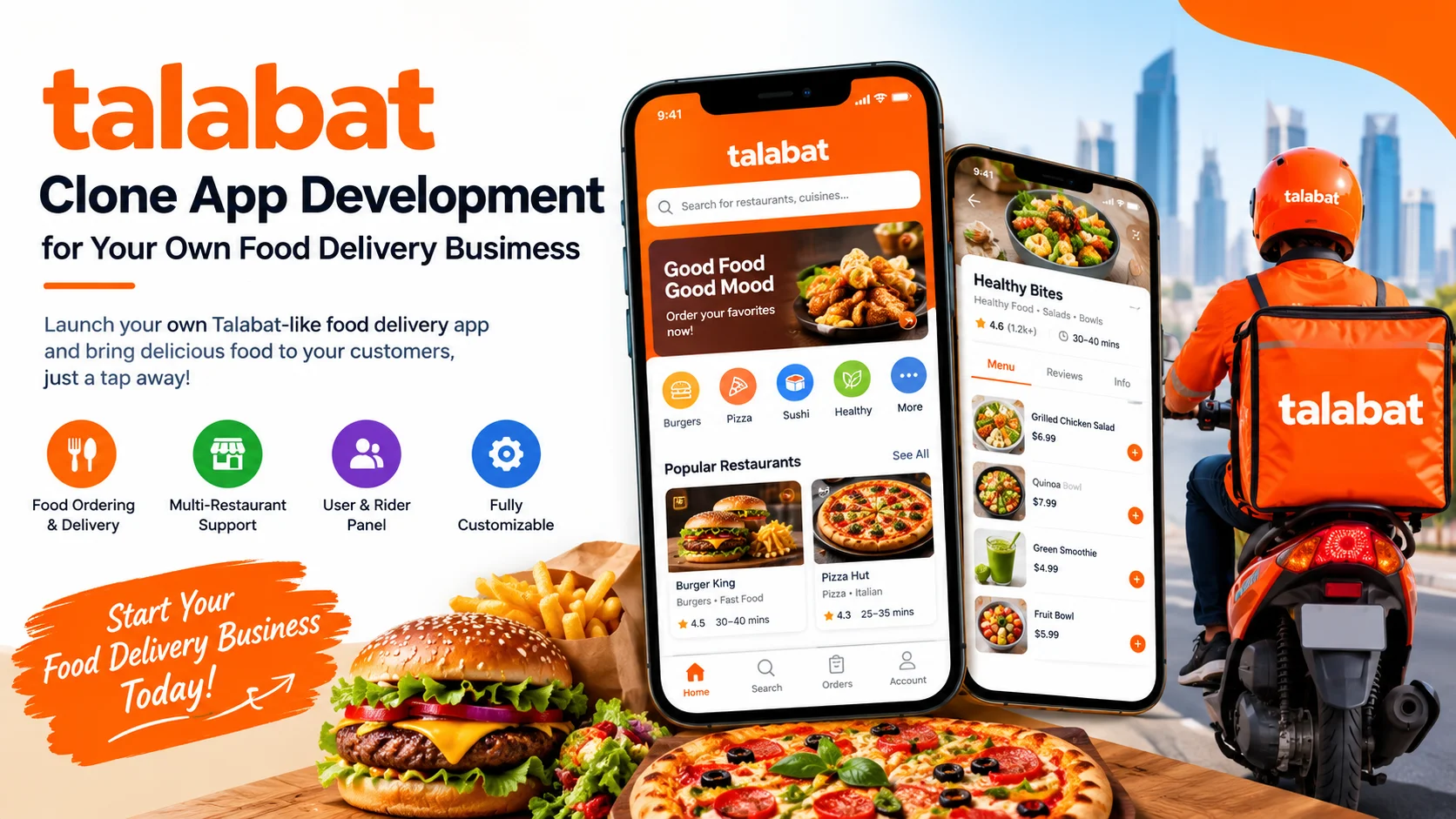
Four Connected Components of Your Talabat Clone App
Customer App
The customer application is the primary interface for revenue generation. It must feature an intuitive UI/UX, advanced search filters, secure payment gateways, and a transparent order tracking system. Performance is key; users expect rapid load times and a frictionless path from discovery to checkout.
Restaurant Management Panel
This panel empowers restaurant owners to manage their digital presence. Key functionalities include menu management, real-time order acceptance, and access to performance reports. An effective panel allows merchants to toggle availability, update pricing, and manage special offers without requiring technical intervention.
Delivery Partner App
The rider app is designed for high-mobility usage. It provides navigation, order details, and earnings tracking. Crucially, it must include a robust status update mechanism that communicates with the admin dashboard to ensure accurate ETA calculations and efficient resource allocation.
Admin Dashboard
The admin dashboard is the command center. It provides a bird’s-eye view of the entire business, including order logs, user management, commission settings, and analytics. It is here that business owners configure delivery zones, manage promotional campaigns, and monitor the health of the entire ecosystem.
Essential Features of a Talabat Clone App
A competitive platform must include features that drive user retention and operational efficiency. Restaurant discovery should be powered by intelligent search and categorization, while the checkout process must support multiple payment methods, including credit cards, digital wallets, and cash on delivery. Real-time tracking is non-negotiable in today's market, as it directly impacts user satisfaction.
Beyond the basics, successful platforms integrate loyalty programs and coupon management to incentivize repeat orders. Analytics and business reporting are equally vital, providing the insights needed to make data-driven decisions regarding commission structures, marketing spend, and operational adjustments. These features, when implemented correctly, create a self-sustaining growth loop.
| Feature Category | Standard Approach | Enterprise Approach |
|---|---|---|
| Architecture | Monolithic | Microservices |
| Scalability | Vertical | Horizontal (Auto-scaling) |
| Data Handling | Relational DB | Hybrid (NoSQL + Relational) |
| Real-time | Polling | WebSockets/Pub-Sub |
Build a Platform Around Your Business Model
Your platform should be flexible enough to adapt to your specific business model. Whether you are managing a single restaurant chain or a multi-vendor marketplace, the system must support configurable commission rates and delivery fees. This allows you to experiment with different revenue streams and adjust your strategy based on market feedback.
Centralized management is the cornerstone of operational success. By having a single dashboard that controls all aspects of the business, you can monitor performance across different regions, manage restaurant onboarding, and execute marketing campaigns. This level of control is essential for maintaining brand consistency and operational efficiency as you scale.
Customize Your Platform for Your Target Market
Localization is the key to regional success. Your platform must support multiple languages, particularly Arabic and English, to cater to diverse demographics. Furthermore, integrating local payment gateways is essential for building trust and ensuring that customers can pay using their preferred methods.
Location-based delivery zones and localized notifications help in managing logistics effectively. By segmenting your delivery areas, you can optimize rider distribution and reduce delivery times. Additionally, expanding your platform to support grocery and multi-category delivery can significantly increase your total addressable market and customer lifetime value.
Who Can Benefit From a Talabat-Like Platform?
Food delivery startups, restaurant chains, and cloud kitchens are the primary beneficiaries of this technology. For startups, it provides a cost-effective entry point into the market. For established restaurant chains, it offers a proprietary channel to bypass third-party aggregator commissions and own their customer data.
Local delivery businesses and grocery retailers can also leverage this platform to digitize their operations. By providing a seamless ordering experience, these businesses can compete with larger players and build a loyal customer base. The versatility of the platform makes it an ideal solution for any business looking to enter the on-demand delivery space.
Food Delivery App Business Models and Revenue Streams
The most common revenue model is the commission-based approach, where the platform takes a percentage of each order. This can be supplemented by charging delivery and service fees to the customer. Additionally, restaurant subscription plans provide a predictable recurring revenue stream, while sponsored listings allow restaurants to pay for increased visibility on the app.
Diversifying your revenue streams is crucial for long-term sustainability. By combining commission, subscription, and advertising models, you can create a resilient financial structure that supports ongoing development and marketing efforts. This multi-faceted approach ensures that your platform remains profitable even as market dynamics shift.
Talabat Clone App Development Cost and Timeline
The cost and timeline for developing a food delivery platform depend on whether you choose a white-label solution or custom development. A white-label solution is generally faster and more cost-effective, while custom development offers greater flexibility for unique feature requirements. An MVP (Minimum Viable Product) approach is recommended for startups to test the market before investing in full-scale development.
Factors affecting cost include the complexity of the UI/UX, the number of integrations, and the scalability requirements. Development timelines typically range from a few months for an MVP to a year or more for a fully customized, enterprise-grade platform. Ongoing costs such as hosting, maintenance, and security updates should also be factored into your long-term budget.
Technology, Integrations, Security and Scalability
A robust platform is built on modern technology stacks that prioritize performance and security. Mobile apps should be developed using cross-platform frameworks for efficiency, while the backend should utilize scalable cloud infrastructure. Payment and map integrations are critical, requiring secure APIs and reliable geolocation services.
Security is paramount. Implementing role-based access control, end-to-end encryption, and regular security audits ensures that user data remains protected. Furthermore, performance optimization techniques such as caching and database indexing are necessary to ensure that the platform remains responsive under high load. Ownership of the source code is a critical requirement for long-term independence and customization.
What Makes a Food Delivery Platform Ready for Growth?
Growth readiness is defined by the platform's ability to handle increased volume without degradation in performance. End-to-end order management systems, intelligent dispatch algorithms, and automated workflows are essential for scaling operations. A modular architecture allows you to add features or integrate new services as your business evolves.
An MVP-to-expansion roadmap is the most effective way to manage growth. By starting with a core set of features and iteratively adding complexity, you can ensure that your platform remains aligned with user needs and market demands. This agile approach minimizes risk and maximizes the return on investment as you scale your business.
Our Food Delivery App Development Process
At DigiTechzo, we follow a rigorous development process that begins with business requirements and discovery. We work closely with our clients to understand their goals, target market, and operational challenges. This is followed by UI/UX design and prototyping to ensure that the final product meets user expectations.
Application development and integration are conducted using industry best practices, with a focus on code quality and scalability. Testing and quality assurance are integrated throughout the development lifecycle to identify and resolve issues early. Finally, we provide comprehensive deployment and post-launch support to ensure a smooth transition and long-term success.
Scaling Your Food Delivery Platform with DigiTechzo
Building a successful food delivery business requires a partner who understands the intersection of high-load engineering, user-centric design, and scalable business logic. At DigiTechzo, we specialize in delivering enterprise-grade solutions that empower businesses to disrupt the market. Our engineering team works with founders and product directors to design systems that handle complex logistics, real-time data, and high-concurrency traffic with ease.
Whether you are looking to launch an MVP or scale an existing platform, our expertise in AI-driven automation, cloud architecture, and custom software development ensures that your platform is built for growth. We invite you to discuss your vision with our technical team and explore how we can help you build a robust, future-proof food delivery ecosystem. Contact us today to start your journey toward digital transformation.
Ready to Build Your Delivery Platform?
Our expert engineering team at DigiTechzo is ready to help you architect and deploy a high-performance food delivery solution tailored to your business needs.
Schedule a Technical Consultation →Frequently Asked Questions
What Is a Talabat Clone App?
A Talabat clone app is a comprehensive, pre-built software solution that provides the essential infrastructure for a multi-vendor food delivery business. It includes synchronized applications for customers, restaurants, and delivery riders, managed by a centralized admin dashboard.
How Much Does It Cost to Develop an App Like Talabat?
Development costs vary significantly based on the level of customization, feature set, and technical complexity. While white-label solutions offer a lower entry cost, custom enterprise-grade development requires a higher investment to ensure scalability, security, and unique brand alignment.
How Long Does It Take to Build a Food Delivery App?
A basic MVP can typically be deployed within 3 to 5 months, while a full-scale, feature-rich platform with advanced integrations and custom architecture may take 6 to 12 months. The timeline is primarily driven by the scope of requirements and the complexity of the backend logistics.
Will I Receive the Source Code?
Yes, when working with a professional development partner like DigiTechzo, you retain full ownership of your source code. This is critical for long-term independence, allowing you to scale, modify, and maintain your platform without vendor lock-in.
Can I Start With an MVP and Add Features Later?
Absolutely. Starting with an MVP is the recommended strategy for most startups, as it allows you to test your business model in the market with minimal risk. You can then iteratively add advanced features, such as AI-based recommendations or multi-category delivery, as your user base grows.
Explore DigiTechzo's Enterprise AI Engineering Practice
Accelerate operational intelligence with autonomous multi-agent workflows, custom LLM fine-tuning, and predictive analytics on our AI Development Company page.