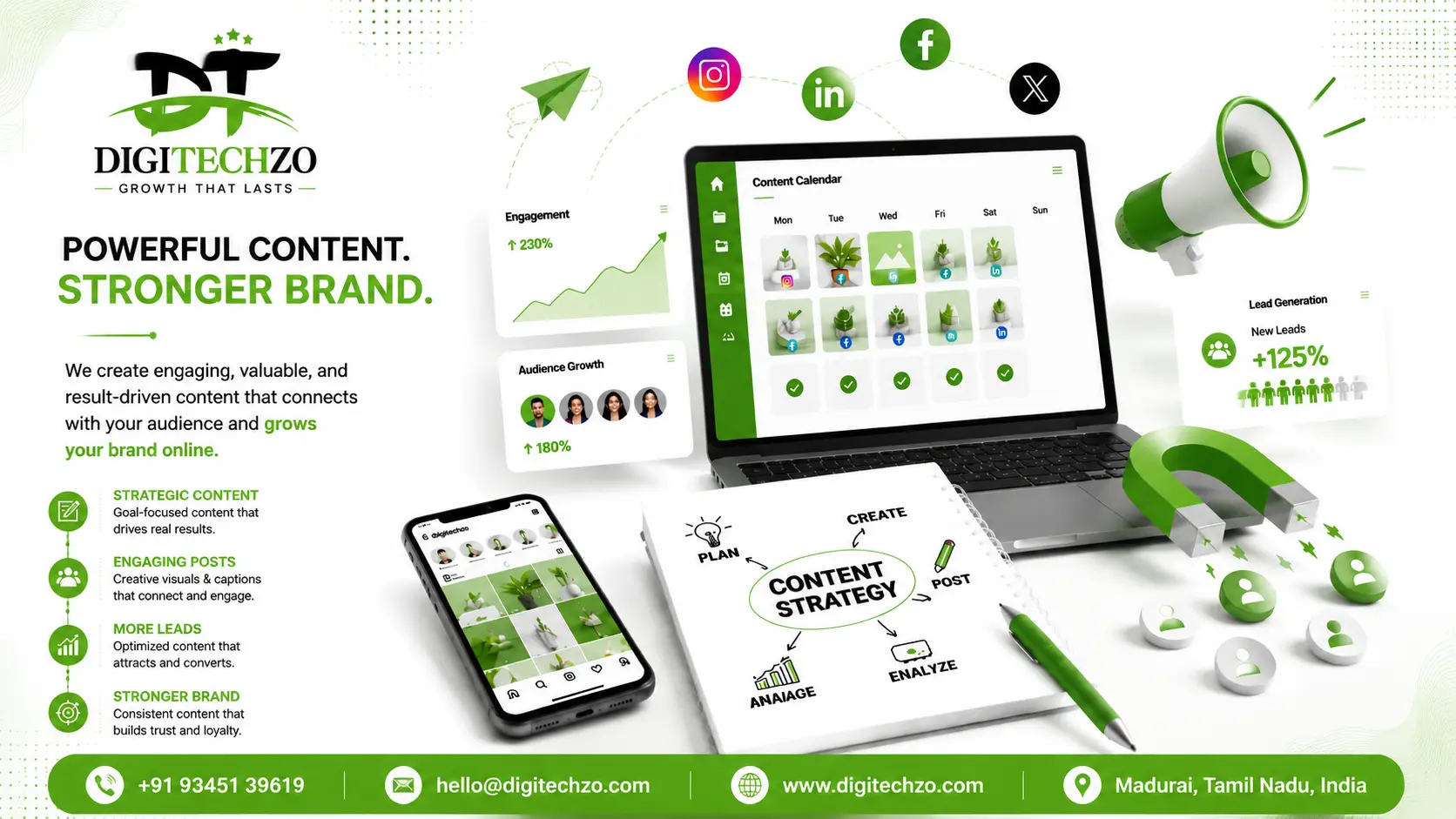
Most brands post consistently on social media and still get almost nothing back — no leads, no real engagement, just likes from bots and followers who never convert. If that sounds familiar, the problem usually isn't your posting frequency. It's your social media content creation process.
At Digitechzo, we've spent years building content systems for brands across e-commerce, SaaS, and local services, and the pattern is always the same: teams that treat content as a checklist ("post something today") lose to teams that treat it as a system built around a specific reader, a specific goal, and a specific offer. This guide breaks down exactly how to build that system — not generic tips you've read a hundred times, but a practical, repeatable framework you can start using this week.
Quick Answer
Effective social media content creation combines audience-specific messaging, platform-native formats (especially short-form video), a consistent publishing system, and clear calls-to-action tied to a funnel — not just "engagement for engagement's sake." Brands that treat content as a lead-generation asset, not a popularity contest, see measurably higher conversion rates because every post earns attention and moves someone closer to a decision.
What "Social Media Content Creation" Actually Means
Social media content creation is the process of planning, producing, and publishing content designed to achieve a specific business outcome on a specific platform — not just "being active online." That outcome could be brand awareness, community building, or direct lead generation, but the strategy behind each is different.
A common misconception is that content creation is a creative task first and a strategic task second. In reality, it's the opposite. The creative execution (the video, the caption, the graphic) is the easy part. The hard part is answering three questions before you create anything:
- Who exactly is this for? Not "small business owners" — a specific role, pain point, and stage of awareness.
- What do I want them to do after seeing this? Follow, comment, click, DM, buy.
- Why would they care today, specifically, out of everything else in their feed?
Skip these questions and you get content that looks fine but performs poorly — which is exactly what happens to most brand accounts.
Why Most Content Fails to Generate Leads
Social platforms have become genuine discovery engines. Consumer research now shows short-form video and creator content driving product discovery on channels like TikTok, Instagram, and YouTube ahead of traditional search for large segments of shoppers. That's a massive opportunity — but only for brands whose content is built to be discovered and acted on.
Here's why most content misses that opportunity:
- It's built for the brand, not the audience. Product-first posts ("Check out our new feature!") ignore the fact that nobody opens social media looking for your product. They're looking for entertainment, information, or connection — your content needs to meet them there first.
- There's no next step. A great post with no call-to-action is just entertainment. If a viewer is interested, they need an obvious, low-friction way to act — a comment prompt, a link in bio, a "DM me X."
- Engagement is treated as the finish line. Comments and shares feel good, but they're a leading indicator, not the goal. A viral post that never mentions what you sell doesn't grow your pipeline.
- Consistency collapses after a few weeks. Algorithms reward accounts that publish reliably. Sporadic posting resets momentum every time.
Human, authentic content is winning right now — audiences are actively fatigued by over-produced or obviously AI-generated posts and are gravitating toward creators and brands that feel real, which is exactly why a strategic-but-authentic approach outperforms both extremes.
The Core Framework: Content That Converts
We use a simple structure with clients at Digitechzo called the 3-Layer Content Model. Every piece of content should fall into one of three layers, and a healthy content calendar mixes all three.
Layer 1: Attract (Top of Funnel)
Purpose: get in front of people who don't know you yet. This is where reach and shareability matter most.
- Educational content answering a common question your audience searches for
- Trend-based content (using a trending sound, format, or topic — adapted to your niche)
- Relatable, "this is so us" style content that invites shares
Layer 2: Engage (Middle of Funnel)
Purpose: turn a passive scroller into someone who feels like they know your brand.
- Behind-the-scenes content showing your process or team
- Customer stories and results (case studies in short-form)
- Opinion or point-of-view content that positions you as an authority
Layer 3: Convert (Bottom of Funnel)
Purpose: give people who are already warm a clear reason to take action now.
- Offer-based posts with a specific, time-bound CTA
- Comparison or "why us" content addressing objections directly
- UGC and testimonials paired with a direct link or DM prompt
Example: A skincare brand posting only Layer 1 content (trend videos) might get views but no sales. Add one Layer 3 post per week — "Comment ROUTINE and I'll send you the exact 3-step routine for combination skin" — and you convert existing attention into leads without changing your entire strategy.
Content Formats Ranked by Engagement and Lead Potential
| Format | Engagement Potential | Lead-Gen Potential | Best Use Case |
|---|---|---|---|
| Short-form video (Reels/TikTok/Shorts) | Very High | High | Discovery, education, trend participation |
| Carousels | High | Medium-High | Step-by-step guides, listicles, saves |
| Live video | Medium | High | Q&A, launches, real-time trust building |
| Static image posts | Low-Medium | Low | Announcements, quotes, quick updates |
| Stories/Ephemeral | Medium | High (with polls/links) | Daily engagement, direct DMs, polls |
| Long-form (YouTube/LinkedIn articles) | Medium | Very High | Authority-building, high-intent audiences |
Pros of short-form video: highest reach-to-effort ratio, favored heavily by current platform algorithms, and it consistently outperforms static content in both watch time and conversion rate. Cons of short-form video: shorter shelf life, requires consistent production, and doesn't build deep trust the way long-form content does.
The strongest strategies don't pick one format — they use short-form video to attract, carousels and Stories to engage, and long-form or live content to convert high-intent followers into leads.
Platform-by-Platform Strategy
Reels and carousels consistently outperform static posts for both reach and saves. Use Reels for discovery and carousels for retention — carousels keep people on your profile longer, which signals relevance to the algorithm. Link-in-bio tools and "DM keyword" automations are especially effective here for lead capture.
TikTok
Built for volume and speed. Post more frequently (4–7x/week is common among fast-growing accounts) and lean into native trends rather than repurposed polished content. Integrated, in-video commerce and affiliate-style content now consistently outperforms interruptive ads on this platform.
The highest-intent platform for B2B lead generation. Long-form text posts, founder-led storytelling, and document/carousel posts (PDFs uploaded natively) drive disproportionate reach relative to follower count. LinkedIn lead-gen ad formats also convert notably better than most other paid social channels for B2B.
Still one of the highest-ROI paid channels for direct response, especially for local and service-based businesses. Organic reach is limited, so pair strong content with small, targeted ad spend rather than relying on organic alone.
YouTube / YouTube Shorts
The best platform for compounding authority — long-form content keeps working for months or years after publishing, and Shorts feed your long-form audience growth. If lead generation is the goal, YouTube's search-driven discovery makes it one of the most underused channels by small and mid-sized brands.
Building a Repeatable Content System
Strategy without a system falls apart within a month. Here's the operational structure we recommend:
- Content pillars (3–5 max). Fixed themes you always create around (e.g., education, behind-the-scenes, customer proof, industry commentary, offers).
- Batch production. Film or design a week's or month's worth of content in one sitting. This is the single biggest factor in consistency.
- A simple calendar. Track platform, pillar, format, and CTA for every post — not just the date.
- A repurposing workflow. One long-form piece (a webinar, blog post, or podcast) should generate 5–10 pieces of short-form content. This is how lean teams stay consistent without burning out.
- A weekly performance review. Track saves, shares, comments, click-throughs, and — most importantly — leads generated, not just likes.
Common Mistakes in Social Media Content Creation
- Posting without a goal for each piece. If you can't say what a post is supposed to achieve, it's a guess, not a strategy.
- Copying competitors instead of studying your own audience's comments and DMs. Your best content ideas are usually already sitting in your inbox.
- Ignoring the first 2 seconds of video. Most short-form content loses viewers before the message even starts — the hook matters more than the production quality.
- Over-relying on AI-generated content without a human editing pass. Audiences are increasingly good at spotting generic AI output, and it measurably hurts trust and engagement.
- No clear CTA, or too many CTAs at once. One post, one action. Asking someone to "follow, comment, share, and buy" in one caption gets none of those things.
- Treating every platform the same. Cross-posting identical content without adapting format or tone consistently underperforms native content.
- Abandoning formats too early. Most content underperforms in the first 2–3 weeks simply because the algorithm needs signal data. Give a format a fair test before dropping it.
Expert Tips for Higher-Converting Content
- Write the CTA before you write the content. Decide what action you want, then reverse-engineer the content to support it — not the other way around.
- Use "pattern interrupts" in the first line or first frame. A specific number, a bold claim, or a direct question outperforms generic openers almost every time.
- Comment-gate your best resources. "Comment GUIDE and I'll send it" builds both engagement and a warm DM list simultaneously — one of the most efficient lead-capture tactics on organic social right now.
- Reuse your top 10% of content. Your highest-performing posts from six months ago will usually work again with a small refresh. Don't assume an audience has seen everything you've posted.
- Let real customers do the talking. User-generated and customer-story content consistently earns more trust than brand-produced content, because audiences perceive it as more credible.
- Track content-to-lead attribution, not just vanity metrics. Use UTM links, unique promo codes, or dedicated landing pages per platform so you know which content actually drives revenue, not just reach.
FAQs
What is social media content creation?
Social media content creation is the process of planning, producing, and publishing content — video, images, text, and audio — tailored to specific platforms and audiences in order to achieve a measurable business goal, such as brand awareness, engagement, or lead generation.
How often should a business post on social media to generate leads?
There's no universal number, but consistency matters more than frequency. Most brands see solid results posting 3–5 times per week on primary platforms like Instagram or LinkedIn, and daily on faster-moving platforms like TikTok. What matters most is maintaining a steady cadence rather than posting in bursts.
What type of social media content generates the most leads?
Content that combines education with a clear, low-friction call-to-action typically converts best — think how-to content, case studies, and comment-gated resources. Short-form video currently has the strongest reach-to-conversion ratio across most platforms.
Should small businesses use AI to create social media content?
AI tools can speed up ideation, scripting, and editing, but content should always go through a human review pass. Audiences increasingly notice and disengage from content that feels fully automated, so AI is best used as a production assistant, not a replacement for a genuine brand voice.
How do I measure if my social media content is actually working?
Look beyond likes and follower count. Track saves, shares, comment quality, click-through rate to your bio link or website, and — most importantly — how many leads or conversions are attributable to specific posts using UTM tracking or unique offer codes.
Conclusion
Social media content creation stops being a guessing game the moment you treat it as a system: a clear audience, a mix of Attract-Engage-Convert content, platform-native formats, and consistent measurement tied to real business outcomes — not just likes. The brands winning right now aren't necessarily the most creative ones; they're the most consistent and strategic ones.
If you'd rather have a team build and run this system for you, Digitechzo works with brands to design content strategies that are built specifically to generate leads, not just impressions. Get in touch with our team to talk through what a lead-focused content system could look like for your business.