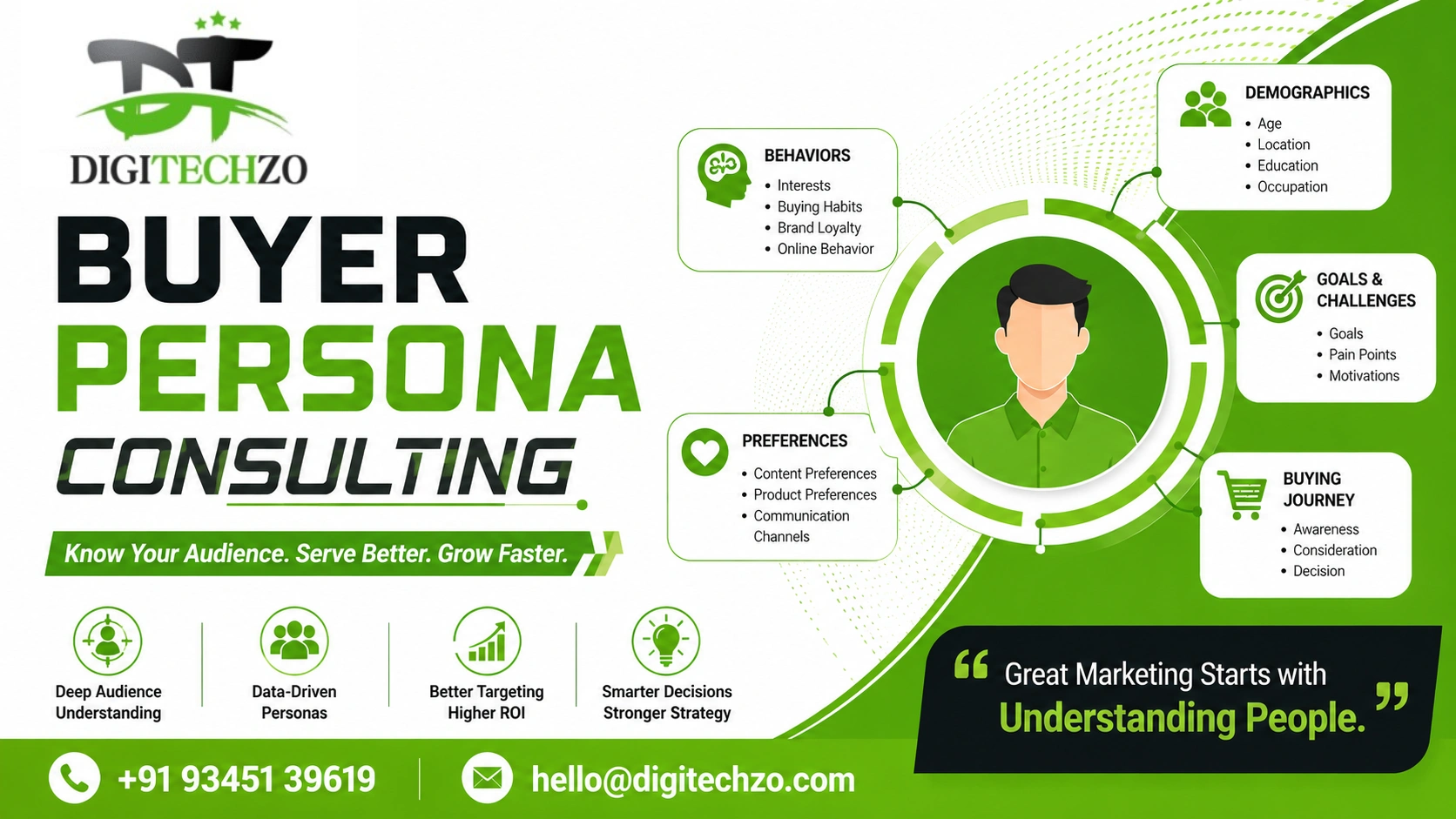
Most buyer personas are useless the moment they're printed. "Marketing Mary, 35, enjoys yoga and reads Marketing Week" tells a sales rep nothing about what Mary actually gets measured on, what she's afraid will go wrong if she recommends the wrong vendor, or who else in the room needs to sign off before she can say yes. A persona built around demographic trivia instead of real decision-making behavior looks thorough in a slide deck and does almost nothing to help a team sell. That's exactly the gap genuine Buyer Persona Consulting is built to close.
At Digitechzo, we consistently see companies that already have an ICP — a solid definition of which companies to target — still lose deals because they never mapped who, specifically, inside those companies actually needs to be convinced, and what would convince each of them. This guide breaks down what genuinely effective Buyer Persona Consulting looks like, the framework we use to build personas that reflect real buying committees instead of a single fictional composite character, and the subtopics most competitor content never covers.
Buyer Persona Consulting builds personas around real decision-making behavior — goals, success metrics, objections, and buying committee role — rather than demographic details that don't influence how a prospect actually evaluates and buys. Most B2B deals involve multiple distinct personas with different priorities, and companies that map the full buying committee consistently sell more effectively than those working from a single generic persona.
What Buyer Persona Consulting Actually Covers
Buyer Persona Consulting covers the research and analysis needed to define, with real evidence, who the individual decision-makers and influencers are within your target accounts — what they care about, what they're afraid of, and what would actually change their mind. The core scope typically includes:
- Buying committee mapping — identifying every distinct role involved in a typical purchase decision, since most B2B deals involve several people with genuinely different priorities, not one buyer making the call alone
- Goals and success metrics research — understanding what each persona is actually evaluated on at work, since this shapes what they care about far more than generic job title assumptions do
- Objection and risk mapping — identifying the specific fears and hesitations each persona brings to the decision, which differ meaningfully by role
- Information source and behavior research — understanding where each persona actually looks for information and who they trust, so content and outreach can meet them where they really are
- Messaging implications by persona — translating research into specific messaging and proof points tailored to what actually moves each distinct role forward
Buyer Persona Consulting exists because a single, generic persona built around demographic guesswork tends to produce messaging that's technically about "the buyer" but doesn't actually address any real person's specific concerns in the room.
Why Most Buyer Personas Don't Actually Help Anyone Sell
They're Built Around Demographic Trivia Instead of Decision-Making Behavior
Age, hobbies, and favorite publications rarely influence a B2B purchase decision. What actually matters — what this person is measured on, what risk they're personally taking by recommending your product, who they have to convince internally — almost never makes it into a typical persona document.
They Assume One Buyer Instead of a Committee
Most meaningful B2B purchases involve multiple people: an economic buyer who controls budget, a technical evaluator who assesses feasibility, an end user who'll actually use the product daily, and often an internal champion advocating on your behalf. A single persona collapses all of these genuinely different perspectives into one fictional composite, losing the nuance that actually determines whether a deal closes.
They're Built From Internal Assumption, Not Real Buyer Interviews
Many personas get created in an internal workshop based on what the team assumes buyers care about, rather than from direct conversations with real buyers and recently closed or lost prospects. This produces personas that reflect internal bias more than genuine buyer psychology.
They Never Translate Into Anything Sales or Marketing Actually Uses
A persona document that sits in a shared drive without directly informing messaging, content, or sales conversations was effectively wasted effort — the value of persona work only shows up when it changes what a rep says on a call or what a landing page emphasizes.
The Buying Committee Map: A Framework for Real Personas
This is the framework we use at Digitechzo for Buyer Persona Consulting engagements, and it's a useful way to evaluate whether a proposed persona set actually reflects how real purchase decisions get made.
Dimension 1: Role and Influence
Identify each distinct role in the buying committee — economic buyer, technical evaluator, end user, internal champion, and potential blockers — and how much influence each one genuinely has over the final decision.
Dimension 2: Goals and Success Metrics
Define what each persona is actually evaluated on in their job, since this shapes what a "good decision" looks like from their specific vantage point far more than generic job responsibilities do.
Dimension 3: Objections and Risk Perception
Map the specific fears and hesitations each persona brings — a technical evaluator's risk concern is rarely the same as an economic buyer's, even when they're assessing the same purchase.
Dimension 4: Information Sources and Buying Behavior
Research where each persona actually looks for information, who they trust, and how they prefer to be engaged, since this directly shapes channel and content strategy.
Dimension 5: Messaging Implications
Translate the first four dimensions into specific messaging and proof points for each persona, so the research produces something sales and marketing can immediately put to use.
Buyer Persona Consulting that stops at Dimension 1 — simply naming the roles involved — without mapping goals, objections, and messaging implications for each one produces a list of titles, not personas anyone can actually use to sell more effectively.
Buyer Persona vs. ICP: Why Both Are Necessary
An ideal customer profile defines which companies to target. A buyer persona defines who, specifically, within those companies needs to be convinced, and how. Confusing the two — or skipping one in favor of the other — leaves a real gap in go-to-market strategy.
| Question | Answered By |
|---|---|
| Which companies should we target? | Ideal Customer Profile (ICP) |
| Who, specifically, within those companies makes or influences the decision? | Buyer Persona |
| What does this specific person care about, and what would convince them? | Buyer Persona |
| Is this company worth pursuing at all? | ICP |
Buyer Persona Consulting works best when it starts from an already-validated ICP, since persona research aimed at the wrong companies wastes effort building detailed profiles of people at accounts that were never a genuine fit in the first place.
Core Components of Buyer Persona Consulting
Buying Committee Identification
Mapping every distinct role typically involved in a purchase decision for your specific product category, since B2B buying committees frequently include more stakeholders than companies initially assume.
This prevents the common mistake of building messaging around a single assumed decision-maker while ignoring several other people who actually have real influence over the outcome.
Direct Buyer and Stakeholder Interviews
Conducting real interviews with current customers, and ideally recently lost prospects, across each identified role — not relying solely on internal assumptions about what each persona cares about.
This is consistently the single highest-value input in Buyer Persona Consulting, since it replaces internal guesswork with what buyers actually say when asked directly.
Goals, Metrics, and Success Criteria Research
Understanding specifically what each persona is evaluated on at work, since this shapes what they need your product to deliver and how they'll justify the decision internally.
Objection and Risk Mapping by Role
Documenting the specific concerns and hesitations that show up repeatedly for each persona, so sales and content can address them proactively rather than reactively during a live deal.
Messaging and Content Translation
Converting research findings into specific messaging frameworks, content recommendations, and talking points tailored to each persona, ensuring the research actually changes what gets said and written.
Demographic Personas vs. Behavioral Personas: A Comparison
| Approach | Focus | Strength | Weakness |
|---|---|---|---|
| Demographic persona | Age, title, industry, general interests | Easy to build quickly from assumption | Rarely correlates with actual buying behavior or decision criteria |
| Behavioral persona | Goals, success metrics, objections, buying role | Directly informs messaging and sales conversations | Requires real research and interviews, takes longer to build properly |
Buyer Persona Consulting should prioritize behavioral depth over demographic breadth every time — a persona with fewer demographic details but a precise understanding of goals and objections is far more useful to a sales team than an elaborate profile built around traits that don't actually predict buying behavior.
A Realistic Persona Rebuild Scenario
Consider a B2B software company with a single, generic buyer persona built years earlier — a demographic profile with a job title, company size, and a few assumed interests — while sales reps consistently reported deals stalling at a specific stage without a clear, consistent explanation why.
A focused Buyer Persona Consulting engagement typically restructures this over two phases:
- Buying committee mapping and interviews — identifying that deals actually involved three distinct roles, not the single decision-maker the original persona assumed, and conducting interviews revealing that a specific technical evaluator role had unaddressed security concerns consistently causing deals to stall at that stage
- Messaging translation — building role-specific messaging and a dedicated proof-point document addressing the technical evaluator's security concerns directly, integrated into sales enablement material
In situations structured this way, addressing the previously unmapped technical evaluator persona's specific objection typically reduces the stall pattern sales had been experiencing, since the deal blocker was a real, identifiable concern the original single-persona approach had never actually surfaced.
Common Mistakes Companies Make With Buyer Personas
- Building personas around demographic trivia instead of decision-making behavior. Age and hobbies rarely predict how someone evaluates a B2B purchase.
- Assuming a single buyer instead of mapping the full buying committee. Most meaningful B2B deals involve multiple stakeholders with genuinely different priorities and objections.
- Relying on internal assumption instead of direct buyer interviews. Personas built without talking to real buyers tend to reflect internal bias more than actual buyer psychology.
- Treating persona work as a one-time exercise. Buyer priorities and buying committees shift as products, markets, and organizational structures evolve.
- Skipping the translation step into actual messaging and sales enablement. A persona document that never changes what gets said on a sales call or written on a landing page was effectively wasted effort.
- Building persona work disconnected from a validated ICP. Detailed persona research aimed at the wrong target companies wastes effort on prospects who were never a genuine fit.
Expert Tips for Personas That Actually Get Used
- Interview real buyers and recently lost prospects directly, rather than relying on internal assumptions about what each persona cares about.
- Map the full buying committee for your category, not just the single most obvious decision-maker, since unaddressed stakeholders are a common, underappreciated source of stalled deals.
- Prioritize goals, success metrics, and objections over demographic detail. This is what actually predicts and informs buying behavior.
- Translate every persona directly into specific messaging and sales enablement material. Research that doesn't change what gets said or written wasn't worth the investment.
- Build personas after your ICP is validated, not before. Persona depth is only useful when aimed at companies genuinely worth targeting in the first place.
- Revisit personas on a regular cadence. Buying committees and priorities shift as your product, market, and customer base evolve.
Why Choose DigiTechzo for Buyer Persona Consulting?
Effective buyer personas are not built from surface-level data—they require a deep understanding of how different stakeholders evaluate solutions, make decisions, and influence the buying process. For B2B companies, this becomes even more critical as multiple personas with competing priorities shape each deal.
Digitechzo approaches buyer persona consulting as part of a larger go-to-market framework, focusing on mapping real decision-making behavior, objections, and success metrics across the entire buying committee. This ensures that personas are not just descriptive, but actionable—guiding messaging, content strategy, and sales alignment. The emphasis is on creating clarity around who to target, how to position, and what drives conversions in complex B2B environments.
Businesses aiming to connect persona insights with execution can work with Digitechzo, a GTM AGENCY FOR B2B that aligns strategy with measurable business outcomes.
FAQs
What is Buyer Persona Consulting?
Buyer Persona Consulting builds detailed profiles of the individual decision-makers and influencers within target companies, based on real research into their goals, objections, and buying behavior, rather than demographic assumptions that don't actually predict purchase decisions.
How is a buyer persona different from an ICP?
An ideal customer profile defines which companies to target, while a buyer persona defines who, specifically, within those companies makes or influences the purchase decision, and what would actually convince each of them.
Why do most B2B products need more than one buyer persona?
Because most meaningful B2B purchases involve a buying committee — an economic buyer, a technical evaluator, an end user, and often an internal champion — each with genuinely different goals and objections that a single generic persona can't adequately capture.
Should buyer personas be based on real interviews or internal assumptions?
Real interviews with actual buyers and recently lost prospects consistently produce more accurate, useful personas than internal assumptions, since they replace guesswork about buyer psychology with what buyers actually say when asked directly.
How often should buyer personas be updated?
Most companies benefit from revisiting personas at least annually, or whenever the buying committee, product, or market shifts meaningfully, since personas built once and never revisited tend to drift out of sync with how prospects are actually evaluating and buying over time.