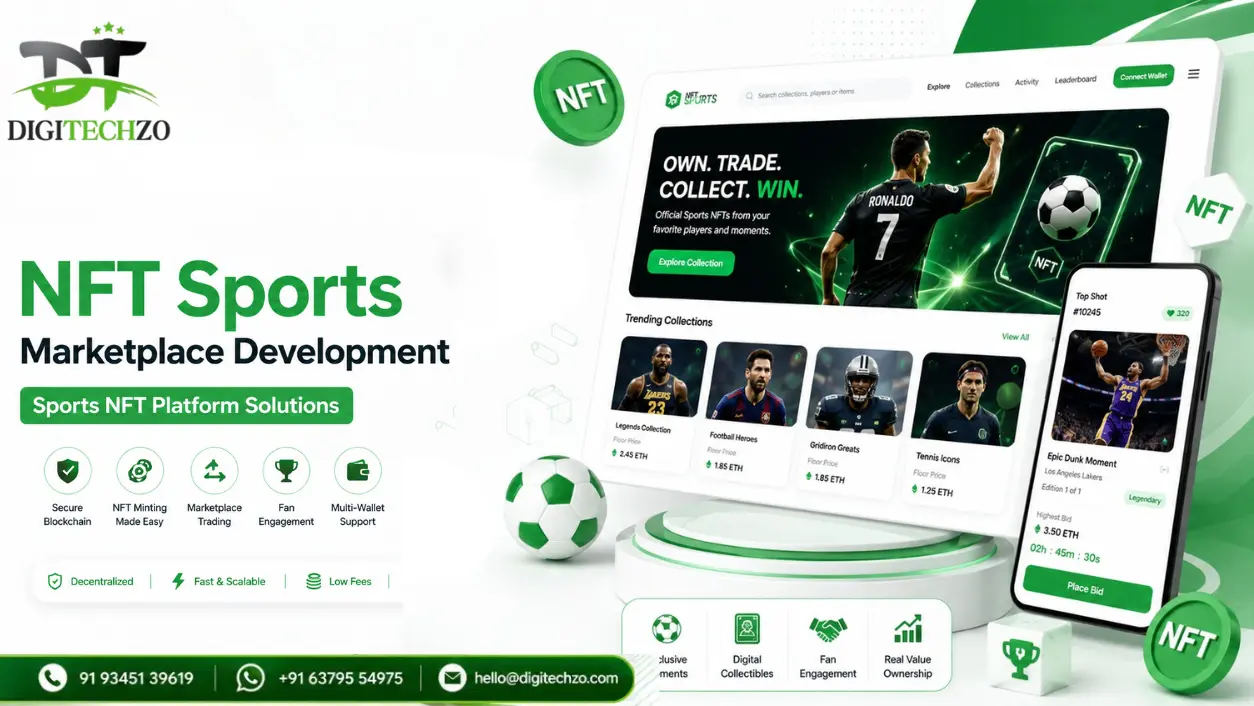
Sports fans don't just watch the game anymore — they want to own a piece of it. A slam-dunk highlight, a rookie card, a stadium seat with digital bragging rights. That shift in fan behavior is exactly why NFT sports marketplace development has moved from a niche experiment to a serious revenue line for sports brands, leagues, and Web3 startups.
But here's the problem most teams run into: building a sports NFT platform isn't the same as forking a generic NFT marketplace template. Sports collectibles need real-time data feeds, athlete royalty structures, fan engagement mechanics, and licensing compliance that a standard marketplace build simply doesn't account for. Get this wrong, and you end up with a platform that looks good in a demo but fails the moment real trading volume hits it.
At DigiTechzo, we've worked with sports-tech founders and blockchain teams on marketplace architecture, smart contract design, and platform scalability — and this guide reflects what actually works in production, not just what looks good on a whiteboard.
NFT sports marketplace development involves building a blockchain-based platform where fans can mint, buy, sell, and trade sports collectibles — moments, cards, tickets, and fan tokens. A production-ready platform needs smart contracts for royalties, multi-chain wallet support, real-time sports data integration, and a licensing framework with athletes or leagues. Development typically costs $25,000–$150,000+ and takes 3–7 months, depending on features and blockchain choice.
What Is an NFT Sports Marketplace?
An NFT sports marketplace is a blockchain-powered platform where verified digital sports assets are minted, listed, bought, and traded. Think of NBA Top Shot's video highlight moments, Sorare's football player cards, or a football club selling limited-edition digital jerseys tied to real match performance.
Unlike a generic NFT marketplace, a sports platform typically layers in:
- Verified provenance — proving an NFT is officially licensed by a league, club, or athlete
- Dynamic metadata — stats or rankings that update the NFT's value or rarity based on real performance
- Fan utility — voting rights, meet-and-greet access, or fantasy league integration tied to ownership
This is what separates a sports NFT platform from a JPEG marketplace — the asset has a living connection to real-world sports events.
Why Sports Brands Are Investing in NFT Platforms
The numbers back up the shift. The global NFT market in sports and entertainment has consistently ranked among the top-performing NFT categories by trading volume since 2021, driven largely by platforms like NBA Top Shot and Sorare, which together processed hundreds of millions of dollars in collectible trades. Beyond the hype cycle, three durable business drivers remain:
- New revenue without cannibalizing merchandise sales — digital collectibles are a separate purchase decision from jerseys or tickets
- Direct fan-to-brand relationships — bypassing ticket resellers and third-party marketplaces
- Programmable royalties — clubs and athletes earn a percentage on every resale, not just the primary sale
From our engagements, the clients who succeed treat the NFT platform as a fan engagement product first, and a trading platform second. Marketplaces built purely for speculation see volume spike and crash. Marketplaces tied to genuine fan utility retain users through off-season lulls.
Core Features Every Sports NFT Marketplace Needs
Must-Have Features
- Multi-wallet support (MetaMask, WalletConnect, Coinbase Wallet) so fans aren't locked into one ecosystem
- Minting engine for teams/leagues to batch-create collections tied to matches, seasons, or milestones
- Smart contract royalty enforcement (ERC-721 or ERC-1155 standards) so athletes/clubs earn on secondary sales
- Auction and fixed-price listing modes — auctions work well for rare drops, fixed pricing for standard packs
- KYC/AML compliance module — increasingly required as regulators scrutinize NFT marketplaces handling real payment volume
- Fiat on-ramp integration — most casual sports fans won't own crypto already; Stripe or MoonPay-style on-ramps remove that friction
Nice-to-Have (But Increasingly Expected) Features
- Dynamic NFTs that update visually or statistically based on live game data (via oracles like Chainlink)
- Fantasy league integration — letting NFT ownership feed directly into fantasy scoring
- Fan tokens/governance — token holders vote on minor club decisions (kit designs, warm-up playlists)
- Mobile-first marketplace app — sports fans browse on mobile far more than desktop; a responsive web app is not the same as a native experience
Security Features You Can't Skip
- Smart contract audits before mainnet deployment (non-negotiable — skipping this is how projects get drained)
- Rate limiting and bot detection during high-demand drops to prevent scalper bots from buying entire collections in seconds
- Escrow-based settlement for auctions to prevent bid manipulation
Step-by-Step Development Process
- Discovery & Licensing Alignment – Before writing a line of code, confirm IP rights with the league, club, or athlete. This is the step most first-time founders skip, and it's the single biggest legal risk in sports NFTs.
- Blockchain & Token Standard Selection – Decide between ERC-721 (unique 1-of-1 assets) and ERC-1155 (batch, semi-fungible packs like trading cards).
- Smart Contract Development – Build minting, royalty, and marketplace escrow contracts. Test extensively on a testnet (Goerli/Sepolia equivalents on your chosen chain).
- Marketplace Front-End & Wallet Integration – Build the buy/sell/auction UI with wallet connect flows that don't intimidate non-crypto-native sports fans.
- Off-Chain Data Integration – Connect sports data APIs (e.g., live stats providers) for dynamic NFT behavior.
- Security Audit – Third-party smart contract audit before any real transactions occur.
- Beta Launch with a Limited Drop – Test with a small collection before a full-scale marketplace launch to catch UX and load issues.
- Full Launch & Marketing Push – Coordinate launch timing with a real sports event (season opener, playoff run) for organic demand.
Choosing the Right Blockchain
| Blockchain | Best For | Trade-off |
|---|---|---|
| Ethereum | Maximum trust, liquidity, integrations | High gas fees during peak demand |
| Polygon | Low fees, fast transactions, Ethereum-compatible | Slightly less brand prestige with collectors |
| Flow | Purpose-built for NFT platforms (used by NBA Top Shot) | Smaller developer ecosystem |
| Solana | Very low fees, high throughput | Historically more network instability |
Our take: For most mid-sized sports brands, Polygon offers the best balance of cost and credibility. Flow makes sense if you're building a Top Shot-style, high-volume collectible platform from day one.
Cost Breakdown & Timeline
- MVP Marketplace (core minting + buy/sell, single chain): $25,000–$45,000, 8–12 weeks
- Mid-tier Platform (auctions, fiat on-ramp, mobile-responsive): $50,000–$90,000, 4–5 months
- Enterprise Sports Platform (dynamic NFTs, fantasy integration, multi-chain): $100,000–$150,000+, 6–7+ months
Ongoing costs matter too — budget 15–20% of build cost annually for maintenance, security monitoring, and API/data feed subscriptions.
Sports NFT Marketplace vs. Generic NFT Marketplace
| Factor | Sports NFT Marketplace | Generic NFT Marketplace |
|---|---|---|
| Licensing complexity | High (league/athlete rights) | Low to none |
| Data integration | Requires live sports data feeds | Rarely needed |
| Royalty structure | Multi-party (athlete + club + platform) | Usually single-party |
| Fan retention driver | Live season/event cycles | Art trends, community hype |
| Regulatory exposure | Higher (real-money resale volume) | Moderate |
Common Mistakes to Avoid
- Skipping licensing due diligence — minting an athlete's likeness without a signed agreement is a lawsuit waiting to happen, not a growth hack
- Choosing a blockchain based on hype, not fit — the "trendiest" chain isn't always the cheapest or most reliable for your transaction volume
- Launching without a bot-mitigation strategy — high-demand drops without rate limiting get bought out by bots in seconds, alienating real fans
- Ignoring mobile UX — most sports fans browse on their phones; a desktop-only marketplace loses the majority of casual buyers
- Treating it as a one-time drop instead of an ongoing platform — the marketplaces that survive keep releasing new collections tied to the live season
Expert Tips for Higher Adoption
- Tie drops to real match moments, not arbitrary calendar dates — scarcity tied to a game-winning goal converts better than a random Tuesday release
- Offer a "starter pack" at low cost to onboard non-crypto-native fans before pushing premium collections
- Build a secondary marketplace fee model that rewards long-term holders, not just flippers — this stabilizes price floors
- Integrate customer support with live chat during drops — high-traffic minting windows are exactly when things break and fans get frustrated
- Publish a public roadmap — sports fans are loyalty-driven; showing what's coming next keeps them engaged between drops
Why Choose DigiTechzo for NFT Sports Marketplace Development?
Building an NFT sports marketplace requires more than minting digital collectibles—it involves creating a reliable platform where ownership, royalties, and real-time engagement work seamlessly. From handling licensed content to enabling secure transactions and multi-chain interactions, the technical foundation directly impacts user trust and long-term platform viability.
Digitechzo brings practical experience in building blockchain platforms with strong smart contract development expertise and Web3 implementation capabilities. Working across multiple blockchain ecosystems, the team understands how to structure marketplaces that support royalty logic, wallet integrations, and scalable user activity while maintaining performance and security. This ensures that sports NFT platforms are not only functional at launch but also adaptable as user demand and features expand.
Businesses looking to build robust NFT ecosystems can collaborate with Digitechzo as a BLOCKCHAIN DEVELOPMENT COMPANY capable of delivering technically sound and scalable marketplace solutions.
FAQs
How much does it cost to build an NFT sports marketplace?
Costs typically range from $25,000 for a basic MVP to $150,000+ for an enterprise-grade platform with dynamic NFTs, multi-chain support, and fantasy league integration.
Which blockchain is best for a sports NFT platform?
Polygon is often the best balance of low fees and Ethereum compatibility for most sports brands. Flow is purpose-built for high-volume collectible platforms like NBA Top Shot.
Do I need a license from the athlete or league to launch a sports NFT?
Yes. Minting an athlete's likeness, team logo, or league branding without a signed licensing agreement creates significant legal risk, regardless of platform size.
How long does it take to build a sports NFT marketplace?
An MVP can launch in 8–12 weeks. A full-featured platform with dynamic NFTs and fiat on-ramps typically takes 4–7 months.
What makes a sports NFT marketplace different from a regular NFT marketplace?
Sports platforms require live data integration, multi-party royalty structures (athlete, club, platform), and stricter licensing compliance that generic art or PFP marketplaces don't need.