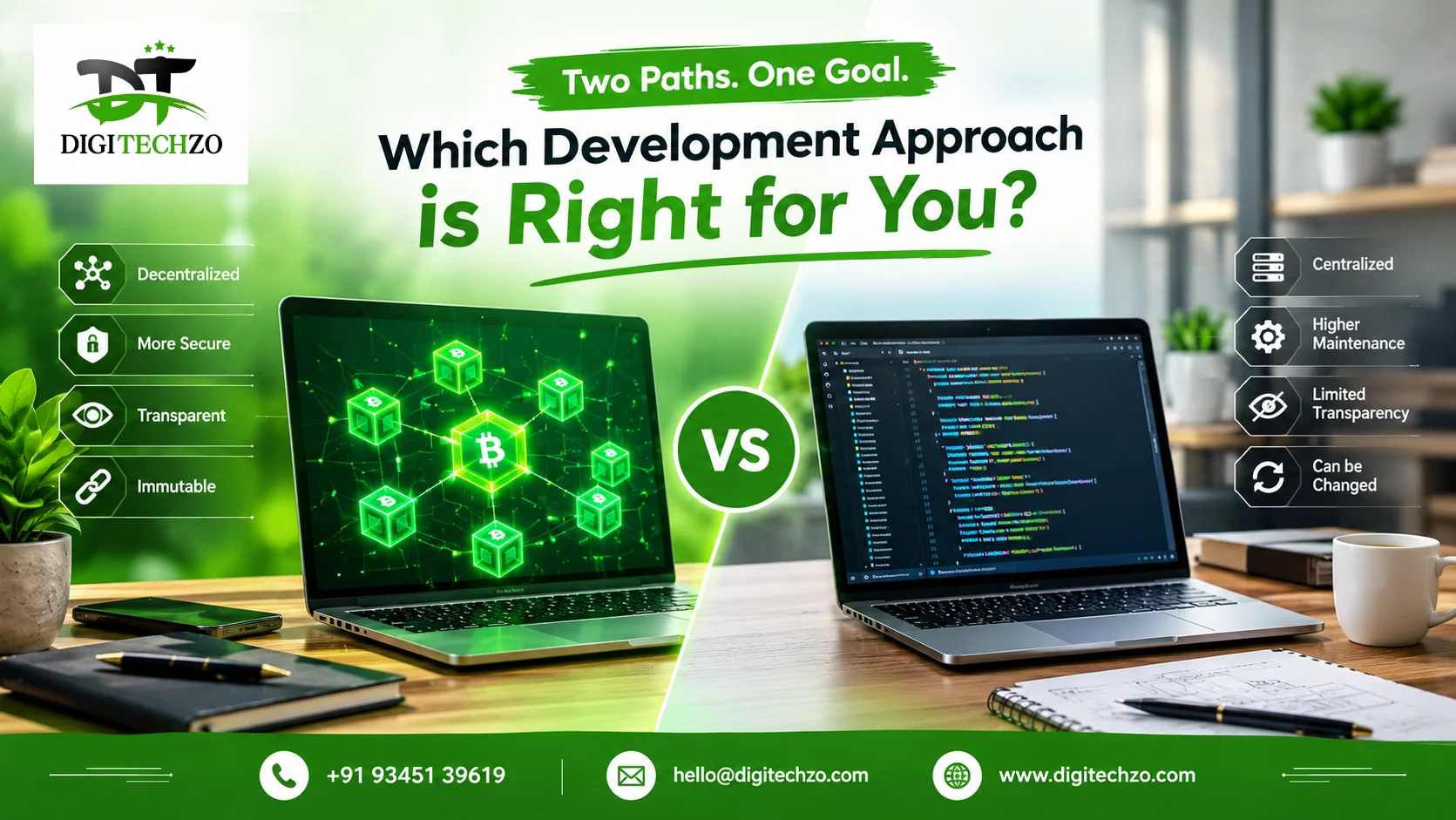
The difference between blockchain and traditional systems comes down to control and mutability. Traditional software development runs on a centralized backend architecture where one organization owns the database and can update the logic at any time. Blockchain development distributes data and execution across a decentralized network using distributed ledger technology and smart contracts, trading that easy mutability for shared, verifiable trust between parties who don't control a single system.
What's Fundamentally Different Between Blockchain and Traditional Software Development?
Traditional software is built around a trusted operator: a company runs the servers, owns the database, and can change the rules whenever it needs to. That's not a flaw - it's what makes rapid iteration, quick bug fixes, and fast feature releases possible.
Blockchain development inverts that assumption. Instead of trusting one operator, participants trust cryptography and a consensus mechanism - a set of rules the network follows to agree on what's true, without a single party being able to override it. Once logic is deployed as a smart contract, it generally can't be changed by any one party unilaterally; the code, in practice, becomes the rulebook. That "code is law" mindset is the single biggest philosophical difference between the two disciplines, and it's the reason the two development processes end up looking so different in practice.
Difference Between Blockchain and Traditional Systems: Side-by-Side Comparison
| Aspect | Traditional Software Development | Blockchain Development |
|---|---|---|
| Control | Single organization owns the system | Distributed across network participants |
| Data storage | Centralized database | Distributed ledger technology replicated across nodes |
| Change management | Can be patched or updated at any time | Immutable once deployed, unless an upgrade pattern is designed in from the start |
| Trust model | Relies on the operator behaving honestly | Relies on cryptography and network consensus |
| Performance | Generally high throughput, low latency | Often lower throughput and higher latency unless paired with scaling solutions |
| Security focus | Perimeter defense and access control | Cryptographic integrity plus smart contract code correctness |
| Typical fit | Single-owner products, internal tools, most SaaS development | Multi-party trust problems, tokenized assets, decentralized applications |
Backend Architecture: Client-Server vs Distributed Ledger Technology
Traditional backend architecture is usually a client-server or three-tier model: a front end talks to an application server, which talks to a centralized database that one team controls end to end. Scaling means adding more servers or a bigger database; fixing a bug means shipping a patch.
Blockchain development replaces the centralized database with distributed ledger technology - a ledger replicated across many independent nodes that all have to agree on its state through a consensus mechanism before a change is accepted. This is a fundamentally different kind of backend: no single node can quietly alter the record, but every write also has to be validated across the network, which is inherently slower than writing to one database you control.
In practice, most production blockchain products aren't purely decentralized end to end. Wallet integration, notifications, analytics, and user authentication typically still run on a conventional backend, with only the parts that genuinely need shared trust - ownership records, transfers, contract logic - actually living on-chain. Understanding blockchain development means understanding this hybrid reality, not assuming everything moves on-chain.
How Smart Contracts Change the Development Model
In traditional software, business logic lives in application code that a team can update on its own schedule - a new release, a hotfix, a rollback if something goes wrong. Smart contracts don't work that way. Once deployed to a public network, a smart contract typically can't be edited directly; any correction requires either a pre-planned upgrade mechanism (like a proxy contract pattern) or, in the worst case, an entirely new deployment and migration.
That constraint changes the entire development discipline around smart contracts. Where a traditional bug might mean an inconvenient patch, a smart contract vulnerability can mean a permanent, unrecoverable loss of funds or data, because there's often no way to simply "roll it back" after the fact. This is why smart contract development leans so heavily on extensive testing, formal verification where warranted, and independent security audits before anything touches a live network - steps that exist in traditional development too, but rarely carry the same all-or-nothing stakes.
Data Security in Blockchain vs Traditional Systems
Data security in blockchain and traditional systems isn't a matter of one being "more secure" than the other - they defend against different threats.
Traditional software security centers on perimeter defense and access control: firewalls, authentication, database permissions, and the assumption that a competent administrator is protecting a centrally stored dataset. The risk is concentrated - a breached server, an exposed database, or a compromised admin account can expose everything at once.
Blockchain security is built into the code and the network's cryptographic structure. There's no single database to breach, and altering historical records would require overwhelming the network's consensus mechanism, which is deliberately difficult by design. But that doesn't eliminate risk - it relocates it. A vulnerability in a smart contract's logic, a lost or stolen private key, or a manipulated oracle feeding bad external data onto the chain can be just as damaging as a traditional breach, and often harder to reverse once it happens. A responsible comparison treats these as two different risk profiles, not a simple better-or-worse ranking.
The Software Development Lifecycle: Blockchain vs Traditional Projects
The software development lifecycle looks broadly similar on paper for both - requirements, design, build, test, deploy, maintain - but the substance of each stage diverges sharply.
A traditional SDLC typically runs on frequent releases: features ship, get tested in staging, deploy to production, and get patched again next sprint if something's wrong. A blockchain SDLC front-loads far more decision-making before a single line of contract code gets written - deciding what actually needs to live on-chain versus off-chain, whether a token or economic model is involved, and how gas costs affect the user experience. Independent security audits become a mandatory gate before deployment rather than an optional best practice, and "deployment" to a mainnet is a much higher-stakes, harder-to-reverse event than a typical software release. After launch, "maintenance" usually means governance-based upgrades through a pre-built mechanism, not routine patching.
Neither lifecycle is more rigorous than the other across the board - they're front-loaded differently based on how expensive it is to fix a mistake after the fact.
When Should a Business Choose Blockchain Over Traditional Software Development?
Blockchain development for business earns its complexity in a fairly specific set of blockchain use cases: decentralized applications (dApps) where no single party should control the logic, tokenized assets that need a shared and verifiable ownership record, and Web3 development where multiple independent participants - not one company's customers - need to interact without a central intermediary. Supply chain networks and multi-party settlement systems fall into this category too, because the core problem is trust between organizations that don't share a system today.
Traditional software development, including most SaaS development, remains the better fit when a single organization legitimately owns the product, when the team needs to iterate and patch quickly, when throughput and latency matter more than distributed trust, or when the "multi-party trust" problem blockchain solves simply doesn't exist in the use case. Forcing blockchain onto a single-owner product usually adds cost and rigidity without a corresponding benefit.
Cost, Speed, and Talent Differences
Because blockchain development combines conventional programming skills with cryptography, peer-to-peer networking, and chain-specific languages like Solidity or Rust, it draws from a smaller, more specialized talent pool - industry compensation data consistently shows blockchain developers commanding a meaningful premium over general software developers. Traditional software teams are typically larger, more available, and set up for continuous iteration; blockchain teams tend to be leaner but need more time up front on architecture and audits before anything ships to a live network. Budget conversations should reflect that difference in cadence, not just headcount.
Common Misconceptions About Blockchain vs Traditional Development
- "Blockchain is always more secure." It defends against different threats than traditional systems, not strictly more of them - smart contract bugs and key management failures are real, often irreversible risks of their own.
- "Blockchain is just a distributed database." A database replicates data; a blockchain also enforces consensus and trustless validation between parties who don't control it together, which is a materially different problem to solve.
- "Smart contracts remove the need for a traditional backend." Most production blockchain products still run authentication, notifications, and analytics on a conventional backend, with only the trust-critical logic living on-chain.
How Digitechzo Approaches Choosing Between Blockchain and Traditional Development
Because the two paradigms solve different problems rather than one simply being a "better version" of the other, Digitechzo starts by testing whether a project's core requirement is actually a multi-party trust problem before recommending blockchain at all. Where it isn't, traditional software development - including standard SaaS development - is usually the faster, lower-risk, and more cost-effective path, and that's the honest recommendation even when blockchain is the more exciting-sounding option.
Why DigiTechzo Delivers Smarter Tech Decisions, Not Just Code
The biggest mistake isn't choosing the wrong protocol - it's choosing blockchain when traditional software would be faster and cheaper, or vice versa.
As a Blockchain development company, Digitechzo works across both blockchain and traditional systems, ensuring the solution fits the actual business problem, not a default preference.
This includes clear scoping before decisions, strong security practices (from regular system updates to smart contract audits), and recommending hybrid architectures when they make more sense than fully on-chain builds.
If you're still deciding which approach fits your project, it's a conversation worth having before development begins.
Frequently Asked Questions
Is blockchain development harder than traditional software development?
It's not harder so much as differently weighted - more decision-making and testing happen before deployment, because fixing a mistake afterward is far more difficult than in a typical software release.
Can a blockchain project use traditional backend architecture too?
Yes, and most do. Authentication, notifications, and analytics commonly run on a conventional backend, with only the logic that needs shared trust - ownership, transfers, contract execution - living on-chain.
Is blockchain always more secure than traditional software?
No. It defends against a different threat model - no central database to breach - but introduces its own risks, including smart contract vulnerabilities and private key loss, that don't exist in traditional systems.
How is the software development lifecycle different for blockchain projects?
Blockchain projects front-load more architecture and economic-model decisions before development, treat independent security audits as a mandatory pre-deployment gate, and rely on governance-based upgrade mechanisms instead of routine patching after launch.
When should a business avoid blockchain and use traditional software instead?
When a single organization legitimately owns the product, rapid iteration matters more than distributed trust, or there's no genuine multi-party trust problem to solve - blockchain adds cost and rigidity without a matching benefit in those cases.