Here's the pattern that quietly kills most blockchain timelines: a team gets excited about the idea, skips straight to writing smart contracts, and only discovers the architecture is wrong once real users are trying to use it. (cite index="42-1">Projects that skip proper architecture definition and jump straight into coding typically add 8 to 12 weeks of rework later</cite> - an expensive way to relearn that "move fast" and "blockchain" don't mix well.
This guide lays out the actual blockchain development process - every stage from initial concept to a live mainnet launch - the way it should be run, not the shortcut version that causes the rework. At digitechzo, we structure every engagement around this exact sequence, because the projects that skip stages are the ones that come back to us later asking for a rebuild.
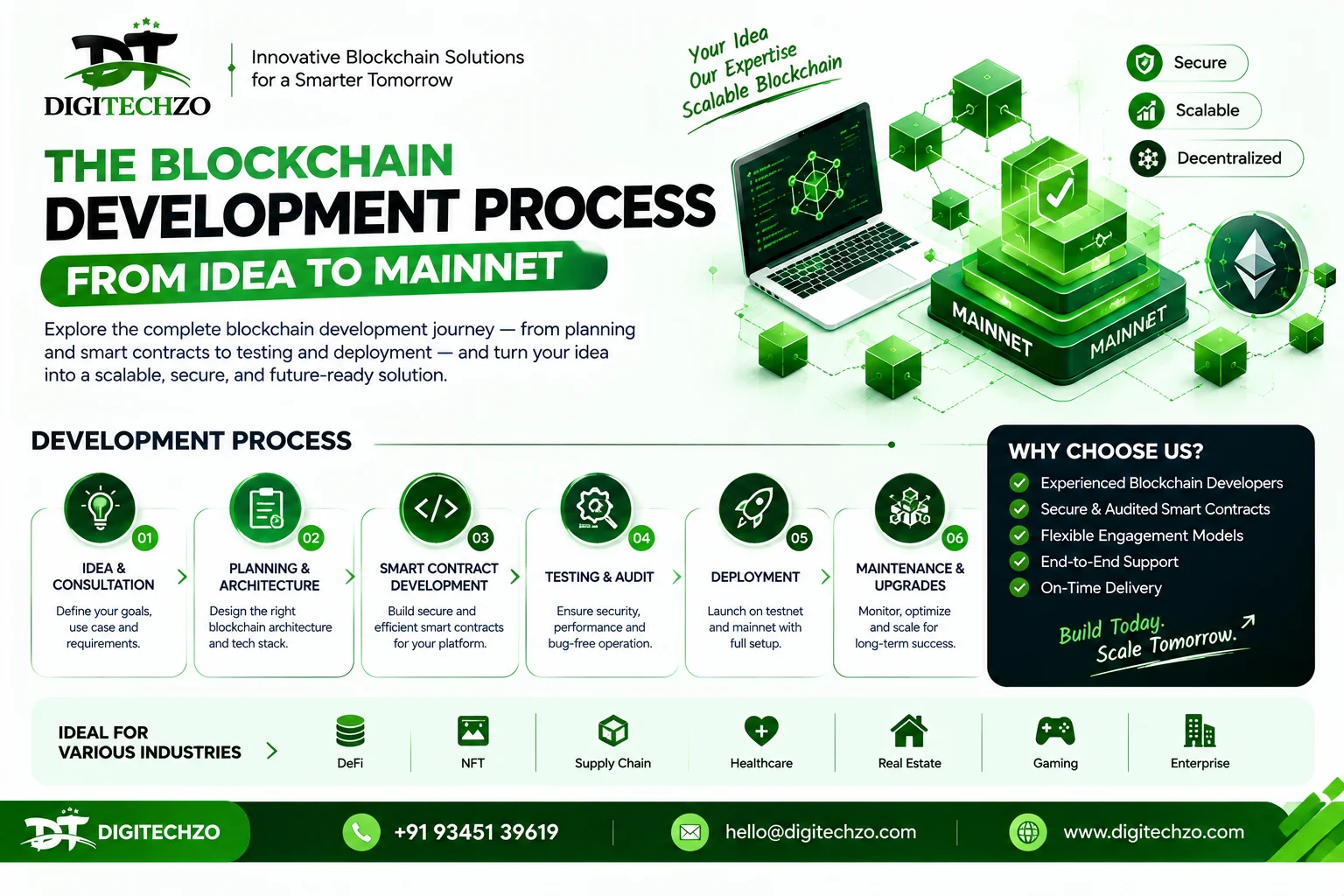
The blockchain development process runs through eight core stages - discovery, architecture design, protocol selection, smart contract development, integration, testing and auditing, testnet deployment, and mainnet launch with ongoing monitoring. A focused MVP typically takes 6-12 weeks; a full enterprise-grade platform typically takes 4-9 months, depending on integration and compliance scope.
What the Blockchain Development Process Actually Involves
The blockchain development process is the structured sequence of stages a team follows to take a blockchain application from concept to a live, production network - covering architecture design, smart contract development, security auditing, and phased deployment through testnet before mainnet. Skipping or compressing any stage is where most costly failures originate, not the underlying technology itself.
If you're specifically asking how to build a blockchain application from scratch, this lifecycle is the answer - each stage below is a checkpoint, not an optional suggestion.
The Blockchain Development Lifecycle: 8 Stages from Idea to Mainnet
This is the blockchain project roadmap we run internally, adapted to project scope. Treat it as a checklist, not a formality.
Stage 1: Discovery & Business Case
Define the exact problem blockchain needs to solve - and confirm a traditional database genuinely can't solve it as well. This stage should produce a one-page brief: the problem, the parties involved, and the success metric.
Stage 2: Blockchain Architecture Design
This is the stage most teams rush - and the one with the highest cost of getting wrong. Architecture design covers data flow (what lives on-chain vs. off-chain), how the system will scale, and how it integrates with existing tools like your ERP or CRM.
Stage 3: Protocol & Network Selection
Choosing Ethereum, Polygon, Hyperledger Fabric, Solana, or another protocol based on your throughput needs, cost tolerance, and whether you need a public or permissioned network - not based on whichever protocol is trending.
Stage 4: Smart Contract Development
The smart contract development process is where business logic becomes executable code - payment conditions, escrow rules, access permissions. This stage demands rigorous internal code review before anything touches a live network.
Stage 5: Backend & Frontend Integration
Not every piece of your application belongs on-chain. User preferences, analytics, and non-critical data typically live in traditional databases, with APIs connecting the on-chain and off-chain layers.
Stage 6: Testing and Auditing
Unit testing, integration testing, and - critically - independent third-party security auditing. (cite index="29-1">Deduplicated industry tracking logged 122 smart contract security incidents in 2025 totaling roughly $905 million in losses</cite>, and a disproportionate share trace back to skipped or rushed audits at exactly this stage.
Stage 7: Testnet Deployment
Your contracts go live on a testnet - a live but consequence-free network - to catch bugs under real network conditions before any real assets are at risk. This is not optional, regardless of timeline pressure.
Stage 8: Mainnet Deployment & Post-Launch Monitoring
The system goes live on mainnet, and monitoring begins immediately: transaction success rates, gas costs, and contract interactions. Blockchain deployment doesn't end at launch - node maintenance and upgrade planning continue indefinitely.
Web3 dApp Development vs. Enterprise Blockchain Development Process
The same eight stages apply either way, but priorities shift significantly depending on what you're building:
| Factor | Web3 / dApp Development Process | Enterprise Blockchain Development Process |
|---|---|---|
| Network type | Usually public (Ethereum, Solana, Polygon) | Usually permissioned or consortium |
| Primary risk | Public gas costs, user-facing UX | Compliance, legacy system integration |
| Testing focus | Load under real public traffic | Multi-party data governance rules |
| Typical stakeholder count | Individual end-users | Multiple organizations (banks, partners) |
| Post-launch priority | Community growth, iteration speed | Uptime SLAs, audit trails, regulatory reporting |
Blockchain Development Steps by Project Type: MVP vs. Full Product
Not every project needs the full eight-stage cycle at enterprise depth. Scope the rigor to the stakes:
- Simple token or NFT-based MVP: (cite index="45-1">Can typically be completed in 6-8 weeks with an experienced team</cite>
- Full-scope blockchain MVP: (cite index="45-1">Generally takes 3-4 months from architecture through testnet</cite>
- Full enterprise blockchain product: (cite index="45-1">Typically runs 8-12 months</cite>, driven mostly by integration and compliance work, not the smart contract code itself
The mistake isn't picking MVP or full-product - it's applying full enterprise rigor to a scope that didn't need it, or skipping stages on a project that did.
Cost of the Blockchain Development Process: What Each Stage Adds
The cost of blockchain development process work concentrates in a few specific stages, not evenly across the timeline:
- Discovery & architecture: Often underpriced by first-time buyers, but skipping it is what causes the 8-12 weeks of rework mentioned earlier.
- Smart contract development: Scales with logic complexity - a simple token contract costs far less than multi-condition DeFi or escrow logic.
- Security auditing: (cite index="34-1">Comprehensive third-party smart contract audits typically run $25,000 to $150,000</cite>, depending on complexity - this is the line item most likely to get cut, and the one that shouldn't be.
- Integration: Connecting to existing ERP, CRM, or banking systems is frequently underestimated and can rival the smart contract work in effort.
- Post-launch monitoring: An ongoing cost, not a one-time line item - budget for it as such.
Common Mistakes in the Blockchain Development Process
- Jumping straight to smart contract code before architecture is finalized - the single most common source of expensive rework.
- Treating testnet as a formality rather than a real testing environment. (cite index="42-1">One documented production failure involved withdrawals that passed every testnet validation and still failed on mainnet, because testnet gas economics don't reflect real mempool congestion and priority bidding</cite> - a lesson every team learns eventually, ideally not the hard way.
- Under-scoping the integration stage, assuming the blockchain layer is the hard part when connecting it to existing systems often takes longer.
- Compressing or skipping the audit to hit a launch date.
- Applying enterprise-grade process rigor to a simple MVP, or the reverse - under-resourcing a compliance-heavy enterprise build.
Expert Tips for a Smooth Blockchain Implementation Process
- Write the one-page discovery brief before any code is written - problem, parties, success metric. If you can't fill it in, you're not ready to build.
- Budget testnet time as real engineering time, not a quick pre-launch formality.
- Separate what must live on-chain from what doesn't. Over-engineering on-chain storage adds cost and gas fees without adding trust value.
- Build your monitoring dashboard before mainnet launch, not after - you want visibility from minute one, not after the first incident.
- Treat the audit report as a to-do list, not a formality to file away. Every finding should be resolved or explicitly accepted as a documented risk before launch.
Why Digitechzo Delivers Scalable Blockchain Solutions
A well-defined blockchain development process demands precision at every stage - from architecture design and smart contract logic to testing, auditing, and mainnet deployment. As outlined in , missing even one critical phase can impact security, scalability, and long-term performance.
Digitechzo focuses on executing this process with clarity and technical depth. With experience in building blockchain platforms, smart contract development, and working across multiple Web3 ecosystems, the team ensures each stage - from MVP to enterprise-grade deployment - is handled with a strong emphasis on security, integration, and scalability. This approach helps businesses move from concept to mainnet with confidence while minimizing operational risks.
Businesses looking to implement a structured development approach can work with Digitechzo, a BLOCKCHAIN DEVELOPMENT COMPANY, to turn complex blockchain ideas into reliable, scalable solutions aligned with business objectives.
FAQs
What are the main steps in the blockchain development process?
Discovery, architecture design, protocol selection, smart contract development, system integration, testing and auditing, testnet deployment, and mainnet launch with ongoing monitoring.
How long does the blockchain development process take?
A simple MVP typically takes 6-12 weeks. A full enterprise-grade platform generally takes 4-9 months, depending on integration complexity and compliance requirements.
What's the difference between testnet and mainnet in the blockchain deployment process?
A testnet is a live but consequence-free network used to catch bugs before real assets are at risk. Mainnet is the live, production network where real transactions and real value are on the line.
How much does the blockchain development process cost overall?
Costs vary from around $15,000 for a simple pilot to $500,000+ for enterprise-grade platforms, with security audits alone typically running $25,000-$150,000 depending on contract complexity.
Can you skip stages in the blockchain development process to launch faster?
You can scale the depth of each stage to your project's stakes, but skipping architecture design or security auditing entirely is the most common cause of expensive post-launch rework and security incidents.