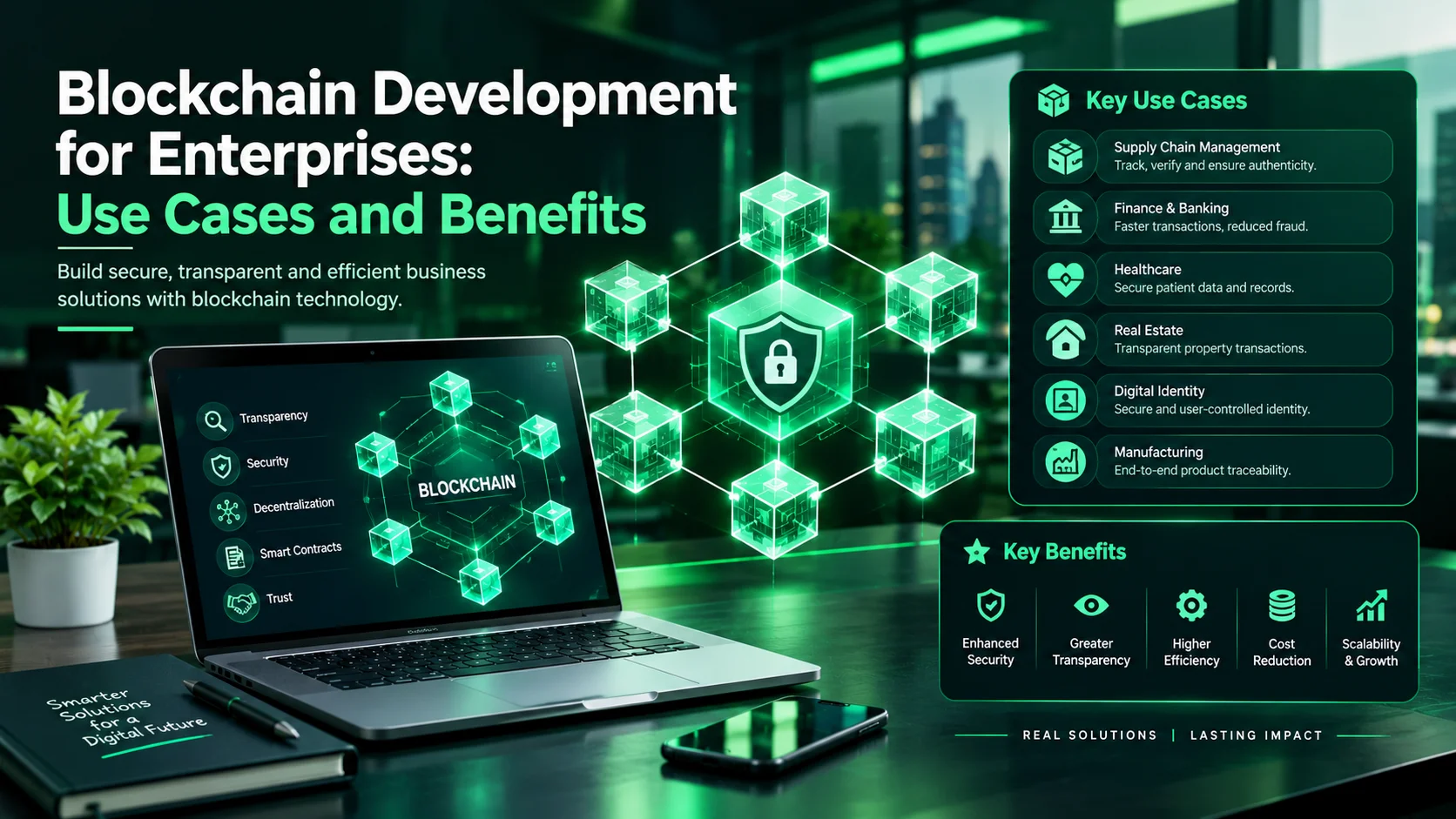
A multinational manufacturer can spend weeks reconciling shipment records with a dozen suppliers before an audit can even begin. A bank settling a cross-border payment routes it through three or four correspondent institutions, each adding a day and a fee. A hospital network wants to share diagnostic records with a specialist across state lines but has no way to do it without duplicating data or violating patient consent rules.
These are the exact problems enterprise blockchain development was built to solve - not speculative crypto trading, but shared infrastructure for organizations that need to trust the same record without trusting each other. This is where DigiTechzo steps in, helping enterprises design and implement blockchain solutions that eliminate inefficiencies, improve transparency, and enable secure data sharing across complex ecosystems.
Blockchain development for enterprises is the process of designing, building, and integrating permissioned or consortium blockchain networks that let multiple organizations share a single, tamper-evident record of transactions without relying on a central intermediary. In practice, it delivers three concrete outcomes: fewer reconciliation and settlement delays, stronger audit trails for compliance, and reduced fraud across multi-party processes such as trade finance, supply chain management, and asset tokenization.
What Is Enterprise Blockchain Development?
Enterprise blockchain development is the practice of building distributed ledger systems for organizations with known, identifiable participants - banks, manufacturers, hospitals, logistics providers - rather than anonymous public networks. The ledger itself works the same way a public blockchain does: transactions are grouped into blocks, validated through a consensus mechanism, and cryptographically linked so that no single participant can alter history without everyone else noticing. What changes is the governance layer wrapped around it - who can join, who can see what, and how disputes get resolved.
Smart contracts are usually the operational core. Instead of a bank, a supplier, and a logistics company each maintaining separate spreadsheets and reconciling them manually, a smart contract can release payment automatically once a shipment is confirmed delivered, or flag a compliance exception the moment a threshold is breached. That's the actual business value: fewer manual handoffs, fewer disputes, and a shared source of truth that every party can verify independently.
How It Differs From Public Blockchain Networks
Public networks like the original Bitcoin and Ethereum chains are open to anyone, prioritize censorship-resistance, and use consensus mechanisms designed for a trustless, anonymous environment. Enterprises generally need the opposite set of trade-offs: known participants, configurable privacy, predictable transaction throughput, and the ability to satisfy regulators. That's why, even as public infrastructure matures, most enterprises still default to permissioned, consortium, or hybrid architectures - they want control over participation, regulatory alignment, and consistent performance rather than open access.
That said, the line is blurring. Institutional-grade products are increasingly launching on public infrastructure when liquidity and interoperability with existing DeFi rails matter more than closed governance - a signal that the "public vs. permissioned" decision is now a design choice per use case, not an ideological one.
The Platforms Enterprises Actually Use
Three technology families dominate enterprise deployments today:
- Hyperledger Fabric - the most widely used framework for permissioned, industry-specific networks; commonly cited as powering the large majority of permissioned enterprise blockchain deployments, particularly in supply chain and consortium settings.
- R3 Corda - built specifically for regulated financial use cases, and the technology underpinning production trade finance networks such as Contour (formerly Voltron), which counts HSBC, Citi, and Standard Chartered among its participants, and Marco Polo, used for supply chain financing among major European banks.
- Enterprise Ethereum, Quorum, and Besu - Ethereum-compatible infrastructure that lets enterprises build privacy-enabled networks while retaining a path to public-chain interoperability. This is the direction institutional finance has been moving: in 2026, JPMorgan filed to launch a tokenized Treasury fund directly on Ethereum, and BlackRock's tokenized Treasury fund, BUIDL, has grown to roughly $2.4 billion in assets across nine blockchain networks and become usable as collateral on major exchanges.
Choosing among these isn't a branding decision - it depends on who your counterparties are, what regulatory regime governs the asset or data involved, and whether you need to interoperate with public liquidity.
Why Enterprises Are Investing in Blockchain Development Now
For years, enterprise blockchain was a pilot-stage technology - plenty of proofs of concept, few production systems. That's changed. Gartner estimates that roughly a quarter of Global 2000 companies will be running blockchain in production by the end of 2026, up from about 11% in 2024, with financial services and supply chain accounting for the majority of live deployments.
Three things are driving the shift from pilot to production:
- Regulatory clarity. Frameworks like the EU's MiCA regulation and more defined U.S. digital asset guidance have removed much of the legal ambiguity that kept legal and compliance teams from signing off on blockchain projects involving tokenized assets or cross-border transfers.
- Technical maturity. Modern consensus mechanisms are faster and more efficient than early proof-of-work designs, and privacy-preserving techniques such as zero-knowledge proofs now let enterprises get transparency and confidentiality at the same time - a combination that used to be a genuine trade-off.
- Measurable, not theoretical, ROI. The organizations reporting real returns are the ones that used blockchain to fix a specific, expensive coordination problem - not the ones that treated it as a transformation mandate from the top down. That distinction matters more than almost anything else in this list.
Benefits of Blockchain for Enterprises
Transparency and Trust Across Multi-Party Processes
Whenever multiple independent organizations need to agree on the state of a shared process - who shipped what, who owns which asset, whose data was accessed and when - blockchain provides a single, tamper-evident record that every authorized party can verify without needing to trust a central administrator. This is the foundational benefit almost every other use case builds on.
Operational Efficiency and Cost Reduction
Smart contracts automate reconciliation, payment release, and compliance checks that would otherwise require manual processing across multiple back offices. Enterprises consistently report lower operational costs from cutting out intermediary steps, along with faster settlement of financial transactions that used to take days.
Stronger Security and Fraud Resistance
Because the ledger is distributed and cryptographically secured, there's no single point of failure for an attacker to target, and altering a historical record would require compromising the majority of network participants simultaneously - a far higher bar than breaching one centralized database.
Better Compliance and Audit Readiness
Immutable, cryptographically timestamped records give auditors and regulators a verifiable trail that's difficult to dispute or falsify after the fact. For industries under heavy reporting obligations - banking, pharmaceuticals, insurance - this alone can justify the investment.
Blockchain Use Cases in Business Driving Real ROI
Of the many proposed applications for enterprise blockchain, a small number consistently reach production and deliver measurable returns.
Supply Chain Traceability
Supply chain traceability is the single largest enterprise blockchain use case by deployment volume, according to World Economic Forum research, and IDC projects billions of dollars in supply chain-specific blockchain spending for 2026 alone. Large retailers, shippers, and materials companies run production networks that track goods from raw material sourcing through final delivery, giving every participant real-time visibility and provenance data that a shared spreadsheet or point-to-point EDI integration can't match.
Trade Finance and Cross-Border Payments
Trade finance has one of the cleanest ROI stories in enterprise blockchain because the paper-based alternative is so slow and expensive. Networks like Contour and Marco Polo have moved letters of credit and supply chain financing from physical documentation to blockchain-based digital ecosystems, cutting processing time enough that even modest efficiency gains can pay back the deployment cost within twelve to eighteen months. On the payments side, enterprises are increasingly using blockchain-based rails and stablecoins to settle cross-border invoices in minutes rather than days, with smart contracts releasing payment automatically once predefined conditions are met.
Asset Tokenization and Capital Markets
Tokenization - representing ownership of bonds, funds, real estate, or other assets as programmable digital tokens - is arguably 2026's most consequential enterprise blockchain story. The tokenized real-world asset market surpassed $34.5 billion in on-chain value by May 2026, and Boston Consulting Group projects the broader tokenized asset market could reach into the trillions by the end of the decade. Institutional players are moving from experimentation to production: DTCC has received regulatory clearance for tokenization pilots covering custodied stocks, ETFs, and Treasuries, and major asset managers now run tokenized money market funds that are tradable on decentralized exchanges and accepted as collateral by major trading platforms.
Digital Identity and KYC
Enterprises operating across jurisdictions or partner networks are using blockchain-based identity frameworks to reduce duplicated know-your-customer checks and give individuals or organizations more control over which credentials they share and with whom. This reduces onboarding friction for banks, marketplaces, and any business that currently re-verifies the same counterparties repeatedly.
Healthcare Data Exchange
Healthcare adoption remains more cautious than finance or supply chain, largely because of HIPAA, GDPR, and hospitals' general reluctance to share patient data broadly. Where it has moved into production, it's concentrated in clinical trial data integrity and pharmaceutical supply chain verification. On the research side, projects like MedRec - developed through a research collaboration involving MIT - have explored letting patients control encrypted access to their own medical records across providers, while platforms like Blockcerts let universities issue tamper-proof academic credentials that can be verified for life without contacting the issuing institution.
Blockchain Integration for Enterprises: What It Actually Takes
Connecting Blockchain to Legacy ERP and Core Systems
Integration complexity is the single biggest obstacle enterprises run into. ERPs, core banking platforms, and CRMs were not designed to talk to a distributed ledger, so most projects need custom middleware, API gateways, and data transformation layers to bridge the two worlds. This is also where projects most often stall - not because the blockchain technology fails, but because the surrounding integration work was underestimated.
Choosing the Right Network Type
Permissioned and consortium architectures remain the default for enterprises that need governance control, predictable performance, and regulatory alignment. Public or hybrid infrastructure makes more sense when the use case depends on liquidity or interoperability with a broader ecosystem - tokenized funds trading on public exchanges being the clearest example. The right answer depends on your counterparties and your regulatory obligations, not on which architecture is trending.
Solving for Interoperability From Day One
Enterprises rarely run a single blockchain in isolation - supply chain, finance, and identity systems often sit on different networks that need to exchange data or assets. Industry groups including Hyperledger's interoperability working group and the Enterprise Ethereum Alliance have published cross-chain standards specifically because fragmentation was becoming a real cost center. Building interoperability in from the start is significantly cheaper than retrofitting it after three departments have each picked a different chain.
Common Challenges in Enterprise Blockchain Development
No credible discussion of enterprise blockchain should skip the trade-offs. The most commonly cited obstacles include:
- Integration complexity with decades-old core systems, as covered above
- Privacy versus transparency tension - balancing open auditability with regulations like GDPR
- Scalability and cost trade-offs - blockchain still generally can't match the raw throughput of a well-tuned traditional database
- Interoperability gaps between different chains and standards
- A persistent skills gap - professionals who understand both distributed systems and the specific business process being automated are still relatively scarce
It's also worth being honest about the cases where blockchain isn't the right tool. If your problem doesn't genuinely involve multiple parties who don't fully trust each other, a well-run relational database with solid audit logging will usually outperform a blockchain on cost, speed, and simplicity. The technology earns its complexity in trade finance, multi-party supply chain provenance, and securities settlement - situations where a shared, tamper-evident ledger solves something a database structurally can't.
What Enterprise Blockchain Development Costs
There's no single number that applies across enterprises, because cost is driven by scope rather than the technology itself. The variables that matter most are the network type you choose (a permissioned Hyperledger Fabric deployment has a very different cost profile than an institutional tokenization project on public infrastructure), the number of legacy systems you need to integrate with, the depth of security auditing your industry requires, and whether you're building a scoped pilot around one workflow or a production system from day one.
The pattern that works best in practice: start with a single, well-defined, expensive problem - a reconciliation bottleneck, a slow settlement cycle, a costly counterfeit or compliance risk - rather than a broad transformation mandate. Trade finance projects, for example, often see the deployment cost recovered within twelve to eighteen months simply because the paper-based alternative is so inefficient. Scoping a pilot around a measurable business case, rather than building for every possible future use case, is consistently what separates blockchain investments that pay off from ones that produce an impressive demo and a disappointing return.
How to Choose an Enterprise Blockchain Development Company
Not every development partner that lists "blockchain" as a service has shipped a production system. When evaluating an enterprise blockchain development company, look for:
- Production experience, not just proofs of concept - ask specifically what they've taken live, not just what they've prototyped
- Relevant network expertise - Hyperledger Fabric, Corda, or Ethereum/Quorum, depending on which fits your use case
- Regulatory fluency in your sector - a partner who understands GDPR, HIPAA, or MiCA implications for your specific data or asset type
- A real integration methodology for connecting to your existing ERP, core banking, or CRM systems, not just the blockchain layer itself
- A plan for interoperability and long-term support, so you're not locked into a network that can't talk to anything else
Questions to Ask Before You Sign
Ask any prospective partner what they'd recommend against building on blockchain - a partner who can tell you when a database is the better answer is more trustworthy than one who says yes to everything. Ask how they handle post-launch monitoring, key management, and security audits, since these are where enterprise blockchain projects most often run into trouble after go-live.
Why DigiTechzo is Your Enterprise Blockchain Growth Partner
Choosing the right blockchain partner is crucial, as even small architectural mistakes can lead to long-term challenges. DigiTechzo focuses on understanding your business first, ensuring every solution is practical, scalable, and aligned with real outcomes.
Partner with a reliable Blockchain development company that builds secure, efficient, and enterprise-ready blockchain solutions designed for growth.
DigiTechzo goes beyond development by delivering end-to-end support - from strategy and integration to deployment and optimization. The goal is simple: help your business achieve transparency, efficiency, and measurable ROI through blockchain.
Frequently Asked Questions
What is enterprise blockchain development?
It's the process of designing and building permissioned or consortium blockchain networks - plus the smart contracts and integrations around them - that let multiple organizations share a verifiable record without a central intermediary.
How is enterprise blockchain different from Bitcoin or public crypto networks?
Enterprise blockchain networks restrict participation to known, vetted organizations and are built for compliance, privacy controls, and predictable performance, whereas public networks like Bitcoin prioritize open access and censorship resistance.
What are the most common blockchain use cases for enterprises?
Supply chain traceability, trade finance and cross-border payments, asset tokenization, digital identity/KYC, and - more selectively - healthcare data exchange currently account for the large majority of production deployments.
How long does enterprise blockchain integration take?
It depends heavily on how many legacy systems need to connect to the network and how much custom middleware that requires; a tightly scoped pilot around one workflow moves considerably faster than an enterprise-wide rollout.
Is enterprise blockchain development expensive?
Cost is driven by scope - network type, integration complexity, and compliance requirements - more than by the underlying technology. Projects scoped around a specific, high-cost problem tend to show the clearest return.
Which industries benefit most from blockchain integration?
Financial services and supply chain currently account for the majority of live enterprise deployments, though healthcare, insurance, and manufacturing are increasingly moving specific use cases into production as well.