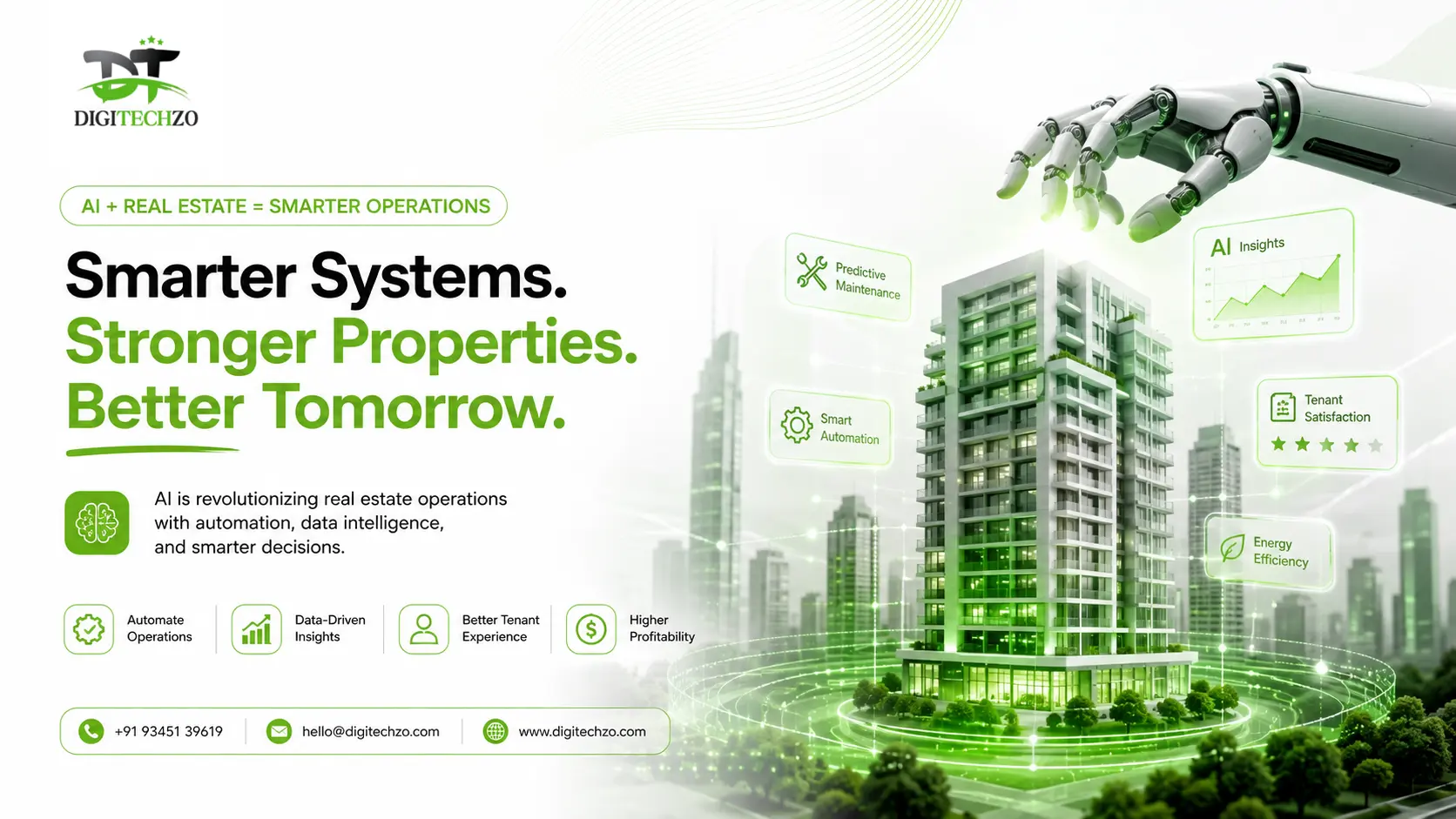
Property managers are drowning in the same problems they had a decade ago — overdue maintenance requests, vacant units sitting too long, rent collection chasing, and spreadsheets that never quite match reality. The difference now is that the tools to fix it finally exist. AI is transforming real estate operations at every level, from how a single landlord screens tenants to how a national portfolio prices thousands of units in real time, and the operators who adopt it early are pulling ahead of the ones still running everything manually.
At digitechzo, we've worked with real estate and proptech companies building the exact AI-driven systems this shift depends on — from predictive maintenance models to automated leasing workflows — and seen firsthand which implementations actually move the needle versus which ones just add another dashboard nobody checks. This guide breaks down what's real, what's hype, and exactly how to start transforming real estate operations with AI without wasting a budget cycle on the wrong tools.
AI is transforming real estate operations by automating maintenance prediction, tenant screening, leasing communication, and pricing decisions that used to take hours of manual work. The result is fewer vacancies, lower operating costs, and property teams that manage more units without proportionally more staff.
What "Transforming Real Estate Operations" With AI Actually Means
"AI in real estate" gets thrown around loosely, so it's worth being precise. Transforming real estate operations with AI means replacing manual, reactive workflows with systems that predict, automate, and optimize — before a human has to notice the problem.
That shows up in three practical layers:
- Predictive layer — AI flags a maintenance issue or lease renewal risk before it becomes a costly emergency.
- Automation layer — Routine tasks like tenant inquiries, rent reminders, and document processing happen without staff intervention.
- Optimization layer — Pricing, marketing spend, and staffing decisions get continuously adjusted based on real-time data instead of quarterly reviews.
Most real estate companies are still operating entirely in the reactive world — waiting for a tenant complaint, a late payment, or a vacancy report to trigger action. AI shifts operations from reactive to predictive, and that shift is where the real cost savings live.
Why Real Estate Operations Need AI Right Now
The Cost of Manual Property Management
Manual operations don't just cost time — they cost money in ways that are easy to underestimate. A maintenance issue caught late costs significantly more to fix than one caught early. A vacant unit that sits an extra two weeks because leasing follow-up was slow is lost revenue that never gets recovered. A tenant who churns because of a slow response to a request is a re-leasing cost that predictive systems are specifically designed to prevent.
The Shift Already Underway
Real estate has historically lagged behind other industries in technology adoption, but that gap is closing fast. Institutional landlords, property management platforms, and even small multifamily operators are now budgeting specifically for AI-enabled tools rather than treating them as optional add-ons. The proptech sector has seen consistent year-over-year growth in AI-specific tooling, and the operators still waiting to "see how it plays out" are increasingly competing against portfolios that already run leaner because of it.
Core Ways AI Is Transforming Real Estate Operations
AI-Powered Predictive Maintenance
Sensors and historical maintenance data feed AI models that predict equipment failure — HVAC systems, water heaters, elevators — before a breakdown happens. Instead of emergency repair calls, teams get scheduled interventions.
Why it matters: Preventive fixes cost a fraction of emergency repairs, and tenants stop associating your property with unreliable infrastructure.
Smart Leasing & AI Virtual Leasing Agents
AI chat assistants now handle initial leasing inquiries, schedule tours, and answer FAQs 24/7 — capturing leads that would otherwise go cold overnight or over a weekend.
Why it matters: Leasing speed is directly tied to vacancy loss; a prospect who gets an instant response is far more likely to convert than one who waits until Monday.
Dynamic Pricing & Revenue Management
AI pricing engines analyze local demand, comparable listings, seasonality, and unit-level data to adjust rents continuously, similar to how airlines and hotels price inventory.
Why it matters: Static annual rent reviews leave money on the table in strong markets and hold vacant units too long in soft ones.
AI Tenant Screening & Risk Scoring
Beyond basic credit checks, AI models assess a broader risk profile — payment history patterns, rental history consistency, and behavioral signals — to flag higher-risk applicants more accurately than manual review.
Why it matters: Fewer evictions and delinquencies directly protect net operating income.
Automated Rent Collection & Financial Operations
AI-driven systems handle reminders, flexible payment plan offers, and delinquency prediction, often resolving late payments before they escalate to collections.
Why it matters: Cash flow predictability improves, and staff time shifts away from chasing payments manually.
Smart Building & IoT Integration
Connected sensors monitor energy use, occupancy patterns, and building systems in real time, feeding AI models that optimize everything from HVAC scheduling to security monitoring.
Why it matters: Energy costs — often one of the largest controllable operating expenses — drop measurably when systems adjust automatically instead of running on fixed schedules.
AI-Driven Reporting & Portfolio Analytics
Instead of monthly static reports, AI dashboards surface anomalies and trends across a portfolio in real time — which properties are underperforming, where turnover risk is rising, and where budget is being wasted.
Why it matters: Decisions get made on current data, not last quarter's snapshot.
AI vs. Traditional Property Management
| Traditional Approach | AI-Driven Approach | |
|---|---|---|
| Maintenance | Reactive, based on complaints | Predictive, based on data patterns |
| Leasing response time | Hours to days | Instant, 24/7 |
| Pricing | Fixed or annual review | Continuously optimized |
| Tenant screening | Manual, limited data points | Broader risk modeling |
| Reporting | Periodic, backward-looking | Real-time, forward-looking |
| Staffing needs | Scales with unit count | Scales more slowly per unit |
Pros & Cons of AI Adoption in Real Estate Operations
Pros:
- Lower operating costs through preventive maintenance and energy optimization
- Faster leasing cycles and reduced vacancy loss
- More accurate tenant risk assessment
- Real-time visibility across a portfolio instead of periodic reporting
- Ability to scale unit count without a proportional increase in staff
Cons:
- Upfront investment in software, sensors, or integration work
- Requires clean, consistent data to work well — poor data undermines AI accuracy
- Staff need training and buy-in, or adoption stalls
- Not every tool fits every portfolio size — small operators need different solutions than institutional ones
How to Start Transforming Real Estate Operations With AI
- Audit your current operations — Identify where manual work is costing the most time or money: maintenance, leasing, or collections are usually the biggest wins.
- Start with one high-impact use case — Don't overhaul everything at once; predictive maintenance or leasing automation typically shows ROI fastest.
- Ensure your data is usable — AI tools are only as good as the data feeding them; disorganized records need cleanup before automation adds value.
- Pilot on a subset of your portfolio — Test on a manageable number of properties before rolling out company-wide.
- Train your team on the new workflow — Tools fail when staff route around them instead of using them.
- Measure against real operating metrics — Track vacancy days, maintenance costs, and delinquency rates before and after, not just tool usage.
- Scale what works — Expand the use cases that show measurable impact before adding new ones.
Common Mistakes Companies Make When Adopting AI
- Buying tools before fixing data problems. AI built on inconsistent, incomplete data produces unreliable predictions and erodes staff trust in the system fast.
- Trying to automate everything at once. Portfolios that attempt a full AI overhaul in one quarter usually see adoption collapse under the change management burden.
- Ignoring staff input during rollout. Property managers who feel replaced rather than supported tend to quietly avoid the new tools.
- Choosing tools built for a different portfolio size. Enterprise-grade platforms often overwhelm small operators, while lightweight tools underdeliver for large portfolios.
- Measuring the wrong metrics. Tracking "logins" or "features used" instead of vacancy days, maintenance costs, or delinquency rates hides whether the investment is actually working.
Expert Tips for a Successful AI Transformation
- Pick the use case with the clearest dollar impact first — predictive maintenance and leasing automation tend to prove ROI faster than broader analytics platforms.
- Involve your on-the-ground property managers early — the people using the tool daily will catch practical issues a vendor demo never surfaces.
- Don't treat AI as "set and forget" — models improve with feedback; flagging inaccurate predictions early sharpens results over time.
- Integrate rather than replace where possible — tools that plug into your existing property management system see far higher adoption than standalone platforms requiring duplicate data entry.
- Revisit ROI quarterly, not annually — real estate operations move fast enough that a full year between reviews is too slow to catch what's underperforming.
A Real-World Scenario
A mid-sized multifamily operator managing several thousand units across multiple markets was losing significant revenue to slow leasing response times — prospects inquiring after hours simply moved on to the next listing. After implementing an AI leasing assistant to handle after-hours inquiries and tour scheduling, response time dropped from hours to under a minute, and lease conversion from inbound inquiries improved meaningfully within the first two leasing cycles. The same operator layered in predictive maintenance for HVAC systems the following quarter, cutting emergency repair calls and extending equipment life across older properties in the portfolio.
Neither change required replacing their core property management software — both integrated directly into the existing workflow, which is precisely why adoption stuck instead of fading out after the initial rollout.
What's Next for AI in Real Estate Operations
Most coverage of this topic stops at maintenance and leasing, but a few emerging areas are worth watching closely:
- Generative AI for lease abstraction and compliance review — pulling key terms, renewal dates, and risk clauses out of lease documents automatically, a task that currently consumes enormous manual hours at scale.
- Agentic AI workflows — systems that don't just flag an issue but take the next action autonomously, like scheduling a vendor or adjusting pricing within pre-approved limits.
- AI-driven ESG and energy reporting — increasingly required by institutional investors and easier to automate than compile manually property by property.
- Predictive tenant retention modeling — flagging renewal risk months in advance based on behavioral signals, not just lease expiration dates.
Operators who build AI literacy now will be positioned to adopt these next-generation tools faster than competitors still catching up on the basics.
Why choose DigiTechzo for Transforming real estate?
Transforming real estate operations with AI requires more than automating individual tasks. Property businesses need intelligent systems that can support predictive maintenance, tenant screening, leasing communication, and data-driven pricing while remaining scalable as portfolios grow. DigiTechzo brings relevant expertise across AI strategy, generative AI, machine learning, AI automation, AI agents, LLM integrations, and AI-powered applications.
This technical capability enables businesses to explore AI solutions around operational efficiency, workflow automation, and data-driven decision-making rather than relying on isolated automation tools. DigiTechzo’s focus on scalable AI architecture also aligns with the growing need for property teams to manage increasingly complex operations efficiently.
For real estate businesses looking to build intelligent solutions around their operational requirements, AI DEVELOPMENT COMPANY provides a natural next step to explore DigiTechzo’s AI development capabilities.
FAQs
How is AI transforming real estate operations?
AI is transforming real estate operations by automating predictive maintenance, leasing communication, tenant screening, and pricing decisions — reducing vacancy loss, operating costs, and manual staff workload across a portfolio.
Is AI only useful for large real estate portfolios?
No. While enterprise landlords adopted AI tools first, lightweight AI-powered leasing and maintenance tools now exist for smaller operators and single-property managers at accessible price points.
What's the fastest way to see ROI from AI in property management?
Predictive maintenance and AI leasing assistants typically show measurable ROI fastest, since they directly reduce emergency repair costs and vacancy days within the first few months of implementation.
Does adopting AI in real estate operations require replacing existing software?
Not usually. Most effective AI tools integrate directly into existing property management platforms rather than requiring a full system replacement, which is a major factor in successful adoption.
What data do I need before implementing AI in property management?
Clean, consistent records of maintenance history, leasing activity, and tenant payment history are the minimum foundation — AI predictions are only as reliable as the data they're trained on.