Property managers today are drowning in spreadsheets, sticky notes, and disconnected apps — and most of them don't even realize their biggest bottleneck is the very tool they trust to run their business. If you've ever missed a maintenance request because it got buried in an email inbox, or spent an entire Sunday reconciling rent payments manually, you already know the problem. Traditional property management software was built for a different era of real estate, and it's quietly costing landlords, property managers, and real estate firms thousands of dollars every year in inefficiency, tenant churn, and missed opportunities.
At digitechzo, we work with property management companies every day to modernize how they operate, and we've seen firsthand where legacy systems break down — and what actually fixes it. This guide breaks down exactly why traditional property management software is falling behind, what to look for instead, and how to make a smarter decision for your portfolio.
Traditional property management software was designed for basic tasks like rent tracking and lease storage — not for today's demands around automation, tenant experience, real-time data, and scalability. Modern property managers need platforms that integrate AI, automate communication, and unify accounting, maintenance, and leasing in one system. If your current software requires manual workarounds for core tasks, it's already outdated.
What Is Traditional Property Management Software?
Traditional property management software refers to the first and second generation of digital tools built to replace paper ledgers and filing cabinets. Think of platforms designed primarily around rent collection, basic lease tracking, and static reporting. These systems emerged in the early 2000s and were revolutionary at the time — but the real estate industry has changed dramatically since then, and traditional property management software hasn't kept pace.
Most traditional property management software shares a few defining traits:
- Desktop-first or clunky web interfaces with limited mobile functionality
- Manual data entry for maintenance requests, lease renewals, and vendor management
- Siloed modules that don't talk to each other (accounting separate from leasing separate from maintenance)
- Minimal or no automation, AI, or predictive analytics
- Slow, ticket-based customer support instead of real-time help
If this list sounds familiar, you're not alone. Industry surveys consistently show that a significant share of property managers still rely on tools that haven't had a meaningful feature update in years, forcing teams to build manual workarounds just to keep operations running.
Why Traditional Property Management Software Falls Short Today
It Wasn't Built for Tenant Expectations in 2026
Tenants today expect the same digital convenience they get from banking apps and food delivery services. They want to pay rent in two taps, submit a maintenance request with a photo, and get a response within hours — not days. Traditional property management software simply wasn't architected with this level of tenant self-service in mind, which means property managers end up as the middleman for every small request.
Manual Processes Create Costly Errors
When traditional property management software requires manual entry for lease renewals, late fees, or vendor invoices, human error becomes inevitable. A missed renewal date or a miscalculated late fee doesn't just cost money — it damages trust with tenants and owners alike. In our work at Digitechzo, one of the most common issues we uncover during audits is duplicate or mismatched data caused by manually re-entering the same information across disconnected tools.
No Real-Time Visibility for Owners and Investors
Property owners and investors increasingly expect real-time dashboards showing occupancy, cash flow, and maintenance status. Traditional property management software often relies on static monthly reports that are outdated the moment they're generated. This lag makes it nearly impossible to make fast, data-driven decisions.
Lack of Automation Increases Operational Costs
Automation isn't a luxury anymore — it's the difference between managing 50 units and managing 500 units with the same size team. Traditional property management software rarely includes automated rent reminders, AI-assisted maintenance triage, or workflow automation, which means staff spend hours on repetitive tasks that software should handle instantly.
Poor Integration With Modern Tools
Today's property managers use a stack of tools: accounting software, CRM systems, marketing platforms, and payment processors. Traditional property management software was rarely built with open APIs, making integrations expensive, fragile, or outright impossible. This forces teams into a frustrating cycle of exporting and importing spreadsheets between systems.
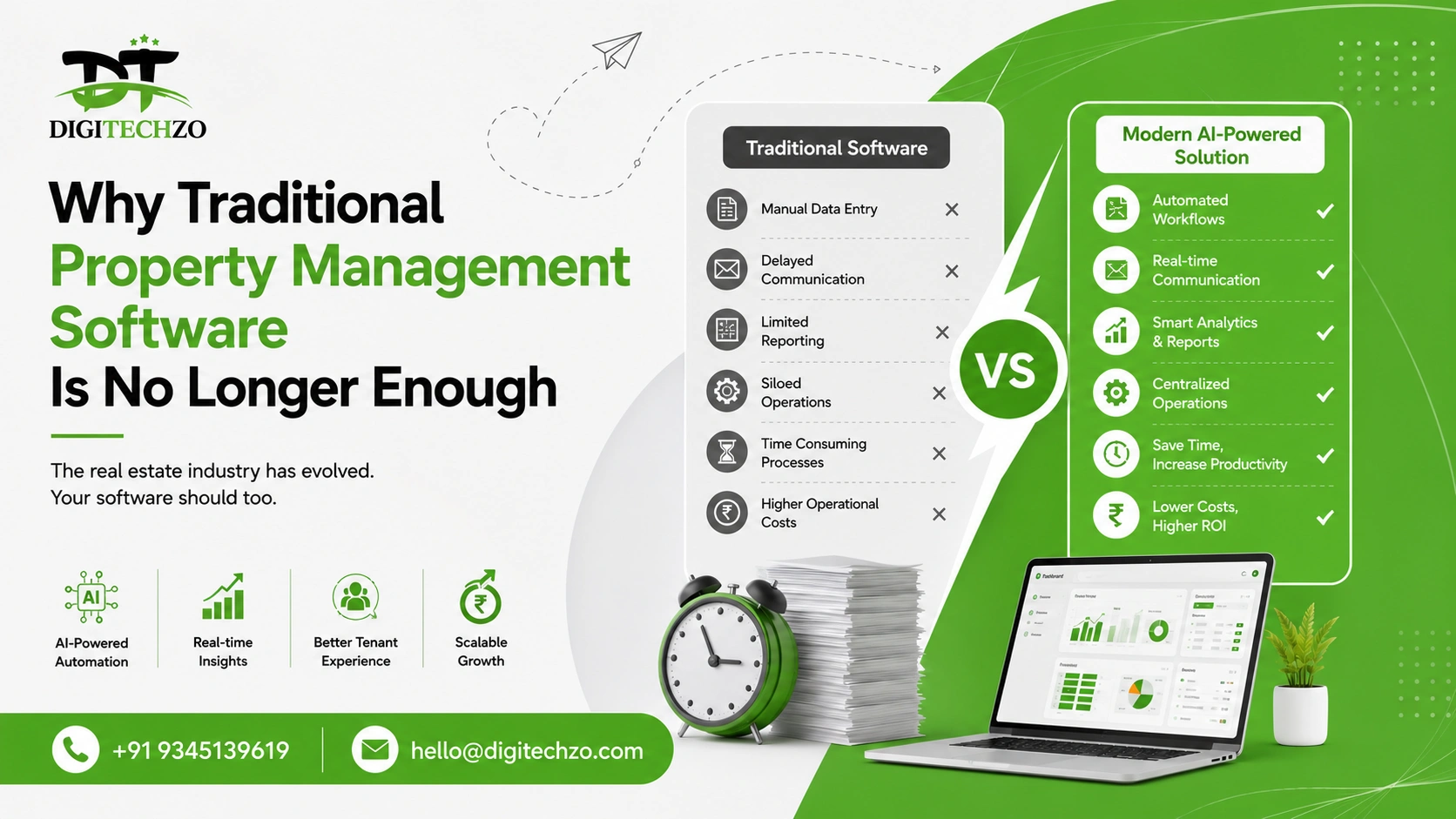
Traditional vs. Modern Property Management Software
| Feature | Traditional Property Management Software | Modern Property Management Software |
|---|---|---|
| Rent Collection | Manual or basic online payment | Automated, multi-channel payment options |
| Maintenance Requests | Email or phone-based | App-based with AI triage and vendor auto-assignment |
| Reporting | Static, monthly reports | Real-time dashboards |
| Tenant Communication | Manual follow-ups | Automated messaging and chatbots |
| Integrations | Limited or none | Open APIs, third-party integrations |
| Scalability | Struggles beyond a few hundred units | Built to scale across large portfolios |
| Mobile Access | Limited functionality | Full-featured mobile apps |
This comparison makes it clear: traditional property management software was designed to digitize paperwork, while modern platforms are designed to actively run and optimize your business.
Real-World Scenarios Where Traditional Software Fails
Scenario 1: The Maintenance Bottleneck A mid-sized property management firm managing 300 units relied on traditional property management software that routed maintenance requests through email. Requests regularly sat unread for 48+ hours, leading to a spike in negative tenant reviews and increased turnover. After switching to a platform with automated ticket routing, average response time dropped from two days to under four hours.
Scenario 2: The Owner Reporting Gap An investment firm managing a portfolio across multiple states struggled to give owners timely financial updates because their traditional property management software only generated reports at month-end. Owners were making leasing and pricing decisions on data that was sometimes five weeks old — a significant risk in a fast-moving rental market.
Scenario 3: The Scaling Wall A growing property manager hit a hard ceiling at around 400 units because their traditional property management software couldn't handle the volume of manual data entry required. Adding more staff just to manage the software became more expensive than switching platforms altogether.
These aren't edge cases — they're patterns we see repeatedly across the industry, and they all trace back to the same root cause: traditional property management software wasn't designed for the scale, speed, or automation the modern rental market demands.
Pros and Cons of Traditional Property Management Software
Pros
- Lower upfront cost for very small portfolios (under 20 units)
- Familiar interface for long-time users
- Adequate for extremely basic rent tracking needs
- Some established platforms have large user communities and documentation
Cons
- Limited or no automation
- Poor scalability as portfolios grow
- Weak tenant self-service options
- Minimal integration capabilities
- Outdated reporting that lacks real-time insight
- Higher long-term labor costs due to manual processes
For portfolios under roughly 20 units with simple needs, traditional property management software might still get the job done. But for anything beyond that, the cons quickly outweigh the initial cost savings.
What Modern Property Management Software Should Include
If you're evaluating a move away from traditional property management software, prioritize these capabilities:
Automation and AI-Driven Workflows
Look for automated rent reminders, AI-assisted maintenance triage, and smart vendor matching that reduce manual workload.
Real-Time Financial Dashboards
Owners and managers should be able to view occupancy, income, and expenses live — not wait for a monthly PDF.
Integrated Tenant Communication
A built-in messaging system or chatbot reduces email overload and speeds up response times significantly.
Open API and Integration Support
Your software should connect cleanly with accounting tools, CRMs, and marketing platforms without manual data transfers.
Mobile-First Design
Both tenants and property managers should be able to complete core tasks entirely from a phone.
Scalable Architecture
The platform should handle growth from 50 to 5,000 units without requiring a complete system overhaul.
Common Mistakes Property Managers Make
- Sticking with traditional property management software out of habit, even after outgrowing it, simply because switching feels disruptive.
- Underestimating hidden labor costs — manual workarounds consume far more staff time than owners realize.
- Choosing software based on price alone rather than long-term scalability and automation potential.
- Ignoring tenant experience when evaluating software, which directly impacts retention and reviews.
- Failing to audit integrations before switching, leading to data silos even after upgrading.
- Not involving frontline staff in the software evaluation process, resulting in poor adoption post-switch.
Expert Tips for Transitioning Away from Traditional Systems
- Start with a workflow audit. Map out every manual step your team currently performs — this reveals exactly where automation will save the most time.
- Prioritize integrations over features. A platform with fewer bells and whistles but strong integrations will outperform a feature-heavy tool that operates in isolation.
- Run a parallel pilot. Test new software on a subset of your portfolio before a full migration to catch issues early.
- Involve tenants early. Communicate upcoming changes to payment or maintenance systems well in advance to minimize confusion.
- Measure before and after. Track metrics like average maintenance response time and late payment rates before switching so you can quantify ROI post-migration.
At Digitechzo, we typically recommend a phased migration rather than a full cutover — it reduces risk and gives your team time to adjust to new automated workflows without disrupting day-to-day operations.
FAQs
Is traditional property management software still worth using in 2026?
For very small portfolios with simple, low-volume needs, traditional property management software can still function adequately. However, most growing property management businesses find that the lack of automation and real-time data creates more cost than it saves.
What's the biggest difference between traditional and modern property management software?
The biggest difference is automation. Traditional property management software relies heavily on manual processes for maintenance, communication, and reporting, while modern platforms automate these workflows end-to-end.
How do I know if I've outgrown my traditional property management software?
Common signs include frequent manual workarounds, delayed maintenance response times, difficulty scaling past a certain unit count, and owners requesting more frequent financial updates than your system can easily provide.
Does switching from traditional property management software require a lot of downtime?
Not necessarily. A phased migration with a parallel pilot period, as outlined above, typically minimizes disruption and allows your team to transition gradually.
Can traditional property management software be upgraded instead of replaced?
In some cases, vendors offer add-ons or updated modules. However, because traditional property management software is often built on older architecture, upgrades are usually limited compared to switching to a platform designed for automation from the ground up.
Why Choose Digitechzo for AI-Driven Property Management Solutions?
Traditional property management software struggles to keep up with modern demands—manual workflows, delayed responses, and limited scalability often slow down operations and impact tenant experience. As portfolios grow, these inefficiencies turn into higher costs and missed opportunities that legacy systems weren’t designed to handle.
Digitechzo works as an AI Development Company focused on transforming these limitations into streamlined, intelligent systems. Instead of replacing one tool with another, the approach starts with analyzing your existing workflows and identifying where automation, real-time data processing, and AI-driven decision-making can create the most impact. From automated tenant communication and maintenance tracking to predictive analytics and CRM integration, each solution is built around your operational reality.
The result is faster response times, reduced manual workload, improved tenant satisfaction, and better visibility across your portfolio. Processes that once required constant oversight become automated and scalable.
For property managers ready to move beyond outdated systems, Digitechzo provides a practical, execution-focused path to building a more efficient, AI-driven operation.