Research on new product development consistently shows a sobering pattern: roughly two out of three new products fail within their first two years, and for early-stage startups, failure rates on new launches can climb as high as 80-90%, according to data compiled from Columbia Business School Publishing and the European Conference on Innovation and Entrepreneurship. The product itself is rarely the root cause. Weak positioning, the wrong channel mix, unclear messaging, and a sales team that wasn't ready are.
This is exactly the gap that product go-to-market services exist to close. Whether you're a SaaS startup shipping your first release, an enterprise entering a new vertical, or a D2C brand launching a new SKU, a structured GTM engagement turns "we built something great" into "we built something people are actually buying."
At digitechzo, we've sat inside enough launch post-mortems to know the pattern by heart: brilliant engineering, thin go-to-market thinking, and a launch that fizzles in week three. This guide breaks down exactly what professional product go-to-market services include, what they cost, how to evaluate a partner, and the frameworks that separate launches that compound from launches that quietly disappear.
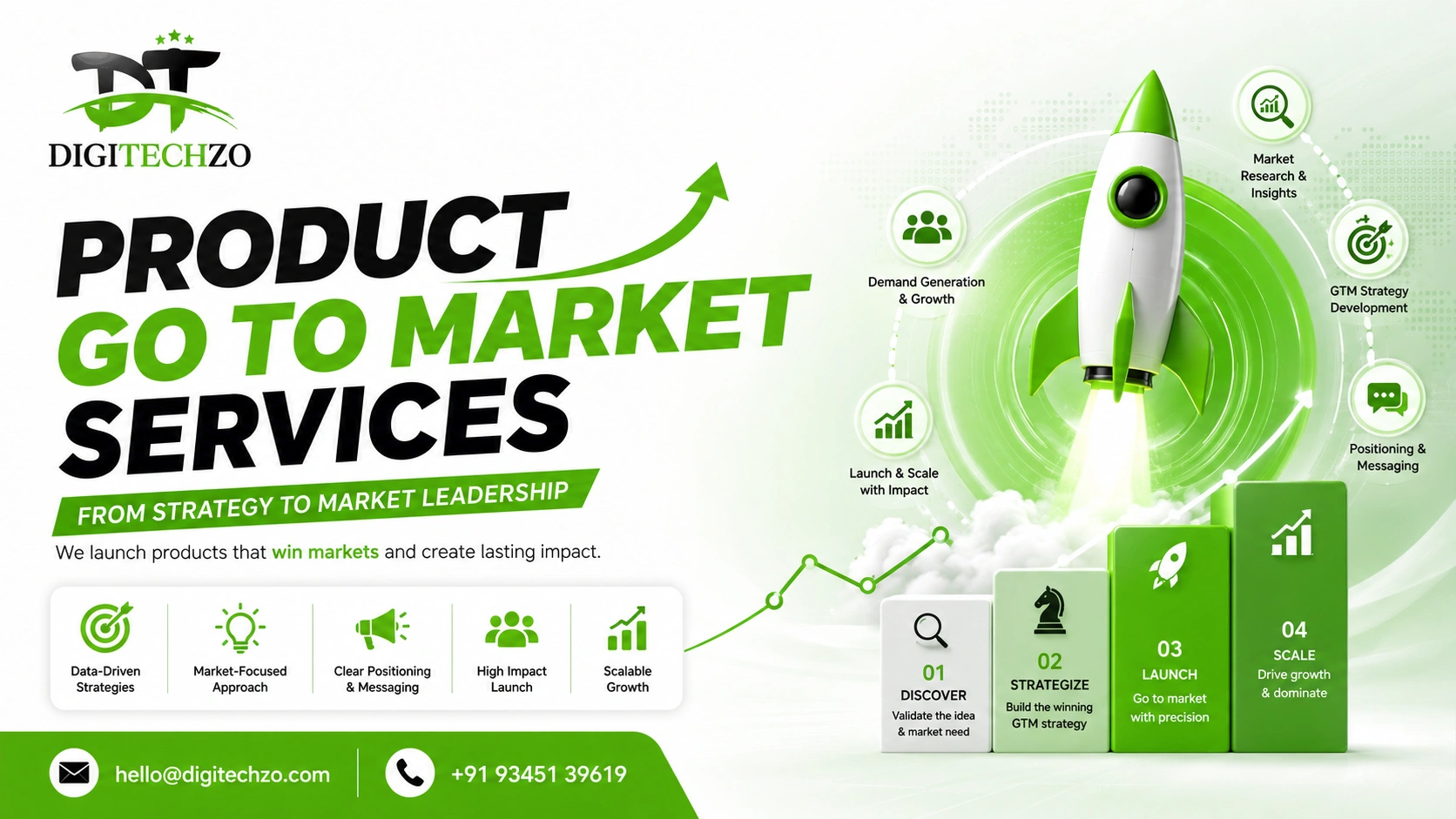
Product go-to-market services are the strategic and execution support a business uses to bring a new product, feature, or market entry to customers successfully — covering market research, positioning, pricing, channel strategy, sales enablement, and launch execution. Done well, they reduce time-to-revenue, cut wasted marketing spend, and materially improve the odds that a launch survives past year one.
What Are Product Go-to-Market Services?
The Core Definition
Product go-to-market (GTM) services are a bundled set of strategic and execution deliverables that answer one question: how will this specific product reach and convert its specific buyer, profitably and repeatably?
Unlike a general marketing plan, a GTM engagement is tied to a single moment — a launch, a market entry, or a repositioning — and it connects five things that usually live in separate departments:
- Who the buyer actually is (not who you assume it is)
- What makes the product genuinely different
- What price the market will bear
- Which channels will realistically reach that buyer
- How sales and marketing hand off leads without dropping them
A go-to-market strategy consultancy typically delivers this as a combination of research, a written strategy, and — increasingly — hands-on execution support through the first 90-180 days after launch.
Why "Just Launching" Isn't a Strategy
Plenty of teams treat go-to-market as a launch day checklist: press release, email blast, a few paid ads. That's activity, not strategy.
A real GTM motion is a system with feedback loops. It defines success metrics before launch, tests messaging on a small segment first, and has a plan for what happens if week one doesn't go as expected. Teams that skip this step tend to discover their targeting problems in month three — after the ad budget is already spent.
Why Most Product Launches Fail
Before getting into what good GTM services include, it's worth understanding what they're protecting against. The numbers are consistent across multiple independent studies:
- New product development (NPD) failure rates range from 35% to 49% across industries, based on research published in the Journal of Marketing and Consumer Behaviour in Emerging Markets, with rates climbing sharply for early-stage startups.
- CB Insights research on startup failure found that roughly 35% of startups fail specifically because there was no real market demand for what they built — not because the product didn't work.
- A PwC survey found that more than half of failed launches trace back to poor internal alignment — marketing, sales, and product teams working from different assumptions about the customer.
- Nearly half of product marketers report they don't have a formal sales enablement function, according to G2 benchmark data — meaning the sales team is often improvising the pitch on day one.
- Thorough upfront market research can lift the odds of a successful launch by up to 30%, per CB Insights analysis — one of the clearest ROI arguments for structured GTM work.
The pattern across all of this data points to the same root cause: launches fail at the strategy layer, not the execution layer. The ad creative wasn't the problem. The audience it was shown to was.
The Core Components of Professional Product GTM Services
A comprehensive product go-to-market service typically covers seven interlocking workstreams. Skipping any one of them creates a weak link the rest of the launch has to compensate for.
Market & Customer Intelligence
This is the foundation everything else sits on: sizing the market, mapping the competitive landscape, and building a real Ideal Customer Profile (ICP) based on interviews and data — not internal assumptions. Good GTM providers run structured customer discovery calls, analyze win/loss data if it exists, and identify the specific trigger events that make a buyer start looking for a solution.
Example: A B2B fintech tool assumed its buyer was "finance teams." Customer interviews revealed the actual champion was often a controller at companies going through a specific accounting system migration — a much narrower, much more targetable segment.
Positioning & Messaging
Positioning defines what the product is, who it's for, and why it wins against the alternative — including the alternative of doing nothing. Messaging translates that positioning into language a buyer actually uses, not internal jargon.
A strong positioning statement typically answers:
- For [target customer]
- Who [has this problem]
- Our product is a [category]
- That [key benefit]
- Unlike [main alternative]
- We [key differentiator]
Pricing Strategy
Pricing is a GTM lever, not a finance afterthought. GTM services typically include competitive pricing benchmarking, willingness-to-pay research, and packaging design (tiers, bundles, usage-based vs. flat pricing). Pricing set 20% too low can undercut perceived value; priced too high without justification, it kills conversion before the sales conversation even starts.
Channel & Distribution Strategy
Not every channel fits every product. A GTM engagement identifies where the buyer already spends attention — organic search, paid social, marketplaces, partnerships, outbound sales, or a hybrid — and sequences them instead of launching everywhere at once with a diluted budget.
Sales Enablement
This is the workstream nearly half of companies skip, per the G2 data cited above. It includes battle cards, objection-handling guides, demo scripts, and ICP-aligned qualification criteria so sales isn't improvising the pitch on live calls.
Launch Execution & Demand Generation
The visible part: campaign build, landing pages, launch sequencing, PR/analyst outreach where relevant, and paid/organic demand generation tied back to the positioning work — not disconnected from it.
Post-Launch Measurement & Iteration
The launch date is the start of the data collection, not the finish line. This workstream defines the metrics that actually matter (activation rate, CAC, sales cycle length, win rate against named competitors) and builds in a review checkpoint — typically at 30, 60, and 90 days — to adjust messaging or channel mix based on real signal.
The GTM Readiness Stack
Here's a framework we use internally at digitechzo to diagnose how launch-ready a product actually is, structured as six layers. Each layer depends on the one below it — weakness at the bottom shows up as underperformance at the top, even if the top layer looks fine on paper.
| Layer | Question It Answers | Common Failure Point |
|---|---|---|
| 1. Market Layer | Is there validated demand? | Assuming demand instead of testing it |
| 2. Positioning Layer | Why us, why now? | Feature-first messaging instead of outcome-first |
| 3. Pricing Layer | What will they actually pay? | Pricing based on cost, not perceived value |
| 4. Channel Layer | Where do we reach them? | Spreading budget across too many channels at once |
| 5. Enablement Layer | Can sales/support carry the message? | No battle cards, inconsistent pitch |
| 6. Feedback Layer | How do we know it's working? | No defined success metric before launch |
Most teams jump straight to Layer 6 activity (running ads, sending emails) without validating Layers 1-3. The fix isn't more spend — it's going back down the stack.
In-House vs. Outsourced GTM Services: Which Should You Choose?
This is the most common decision point for teams evaluating product go-to-market services, and the honest answer is: it depends on internal bandwidth and how many launches you're planning per year.
| Factor | In-House Team | Outsourced GTM Services |
|---|---|---|
| Speed to strategy | Slower — team learns as it goes | Faster — pattern recognition from prior launches |
| Cost structure | Fixed salaries, ongoing | Project-based or retainer, scalable |
| Objectivity | Can be biased by internal assumptions | Outside view, less attachment to sunk decisions |
| Institutional knowledge | Deep product context builds over time | Requires ramp-up per engagement |
| Best for | Frequent launches, mature product lines | First launches, new market entry, lean teams |
Pros of outsourcing GTM services:
- Access to frameworks tested across multiple industries, not just one
- Faster turnaround on research and strategy documents
- No hiring/onboarding lag for a function you may only need quarterly
Cons of outsourcing GTM services:
- Requires clear internal ownership so the strategy doesn't sit unused
- Ramp-up time needed for the partner to understand your product deeply
- Ongoing execution (not just strategy) needs a defined handoff plan
Many growing companies land on a hybrid model: outsourced strategy and research at the start of a launch cycle, with an internal owner responsible for execution and iteration afterward.
How Product GTM Services Work in Practice
Here's a realistic version of how this plays out, based on common patterns across B2B SaaS launches:
A 40-person SaaS company is adding a second product line — an analytics add-on to their core platform. Internally, the assumption is that existing customers will "obviously" want it.
A structured GTM engagement starts differently:
- Discovery interviews with 15 existing customers reveal that only a subset — those with a dedicated data/ops role — actually feel the pain point the add-on solves. The "obvious" buyer was wrong.
- Competitive analysis shows two adjacent tools already solve part of this problem, forcing a sharper differentiation angle.
- Pricing testing finds customers expect this bundled into a higher tier, not sold as a standalone SKU — reshaping the entire pricing model before launch.
- Channel strategy shifts from a broad email blast to a targeted in-app + sales-assisted motion aimed only at accounts matching the validated ICP.
- Sales enablement materials are built around the specific objections raised in discovery calls, not hypothetical ones.
- Launch goes out to a 20% segment first, messaging is refined based on real reply/conversion data, then rolled out company-wide.
The result isn't a bigger launch — it's a narrower, sharper one that converts at a meaningfully higher rate because every assumption was tested before the money was spent.
How Much Do Product Go-to-Market Services Cost?
Pricing varies widely based on scope, but here's a realistic range based on how the market typically structures these engagements:
- Strategy-only engagement (research, positioning, launch plan document): Often a fixed project fee, typically running from the low thousands into the low five figures depending on market complexity and company size.
- Strategy + execution retainer: Monthly retainers scale with the amount of hands-on campaign, content, and enablement work involved, and usually run for a 3-6 month launch cycle minimum.
- Enterprise/multi-market launches: Larger engagements involving multiple regions, product lines, or channel partners scale accordingly and are typically scoped individually.
What drives the cost up or down:
- Breadth of research required (new market vs. existing customer base)
- Number of channels included in execution
- Whether sales enablement and training are included
- Ongoing measurement/iteration support vs. a one-time deliverable
The cheapest option is rarely the best value here — a strategy document that never gets executed, or gets executed by a team without the context behind it, delivers close to zero ROI regardless of price.
How to Choose the Right GTM Services Partner
Use this checklist when evaluating providers:
- Do they ask about your customer before pitching a solution? A partner who jumps straight to tactics without discovery is a red flag.
- Can they show a comparable launch, even anonymized? Relevant experience in your business model (B2B vs. D2C, SaaS vs. hardware) matters more than a long client logo list.
- Do they define success metrics upfront? Vague promises like "more visibility" or "more buzz" aren't measurable outcomes.
- Is there a clear execution handoff plan? Strategy without an execution owner just becomes a document nobody opens again.
- Do they build in a review checkpoint? Launches need a planned 30/60/90-day check-in, not a "see you at the finish line" engagement.
Common Mistakes Companies Make With Product Go-to-Market Strategy
- Skipping customer discovery and relying on internal assumptions. The team building the product is usually the worst-positioned group to predict how a stranger will react to it.
- Positioning around features instead of outcomes. Buyers don't buy "AI-powered analytics." They buy "two fewer hours spent reconciling spreadsheets every week."
- Launching on every channel at once. Spreading a limited budget across five channels usually means none of them get enough signal to actually work.
- Treating sales enablement as an afterthought. If sales finds out about the launch messaging the same day customers do, expect an inconsistent pitch.
- No defined success metric before launch day. Without a baseline, "how did it go?" becomes a subjective, political conversation instead of a data-driven one.
- Ignoring the first 90 days. The launch event isn't the finish line — it's the point where real data starts coming in and the plan should adapt.
Expert Tips for a Successful Launch
- Validate demand with a small segment before a full rollout. A 10-20% soft launch surfaces messaging and targeting problems while they're still cheap to fix.
- Write the press release and FAQ before you build anything. If you can't clearly explain the value in plain language before development starts, that's a signal worth acting on early.
- Interview lost deals, not just won ones. Win/loss analysis on deals you lost to a competitor — or to "no decision" — usually reveals more about positioning gaps than customer interviews with happy users.
- Build the objection-handling doc from real sales calls, not guesses. Sit in on actual discovery or demo calls and capture the exact language buyers use to push back.
- Set a hard checkpoint at day 30. Decide in advance what "this isn't working" looks like, so the team isn't emotionally attached to a channel or message that clearly isn't converting.
- Align pricing to the value metric, not to cost-plus math. Customers pay for outcomes, not for your infrastructure bill.
Frequently Asked Questions
What is included in product go-to-market services?
Product go-to-market services typically include market and customer research, positioning and messaging, pricing strategy, channel and distribution planning, sales enablement materials, launch execution support, and post-launch measurement. Full-service providers cover all seven; some specialize in strategy only.
How long does it take to build and execute a go-to-market strategy?
Strategy development typically takes 3-6 weeks depending on research depth, followed by a 60-90 day execution and measurement window after launch. Enterprise or multi-market launches often run longer, closer to 3-6 months end to end.
How much do go-to-market services cost?
Costs range from a few thousand dollars for a focused strategy engagement to tens of thousands or more for combined strategy-plus-execution retainers, depending on market complexity, number of channels, and whether sales enablement and ongoing measurement are included.
What's the difference between a go-to-market strategy and a marketing plan?
A marketing plan covers ongoing promotional activity across a business. A go-to-market strategy is narrower and time-bound — it's specifically built around launching one product, feature, or market entry, and it includes pricing and sales alignment, not just marketing channels.
Do startups need go-to-market services, or is this only for large companies?
Startups often benefit more, since a failed first launch burns limited runway. Because early-stage products see notably higher failure rates than those from established companies, validating demand and positioning before spending on paid channels matters even more when the budget is small.
Why Choose Digitechzo for Product Go To Market Services?
Launching a product today is less about the idea and more about how clearly it’s positioned, validated, and brought to market. Without a structured go-to-market approach, even strong products struggle with misaligned messaging, inefficient channels, and stalled early traction.
At Digitechzo, we work as a GTM Consulting Company that connects research, positioning, and execution into one system. We help teams define real buyer segments, craft messaging that resonates across decision-makers, and build channel strategies backed by data — not assumptions. This is supported by practical execution, from sales enablement to early-stage campaign rollout, ensuring your GTM plan works beyond theory.
The result is a more confident launch: faster market validation, better conversion across channels, and stronger alignment between product, marketing, and sales. Instead of reactive adjustments post-launch, your team operates with clarity and measurable direction from day one.
If you’re preparing for a product launch or refining an existing GTM motion, Digitechzo provides a grounded, execution-focused path to turning strategy into real market traction.