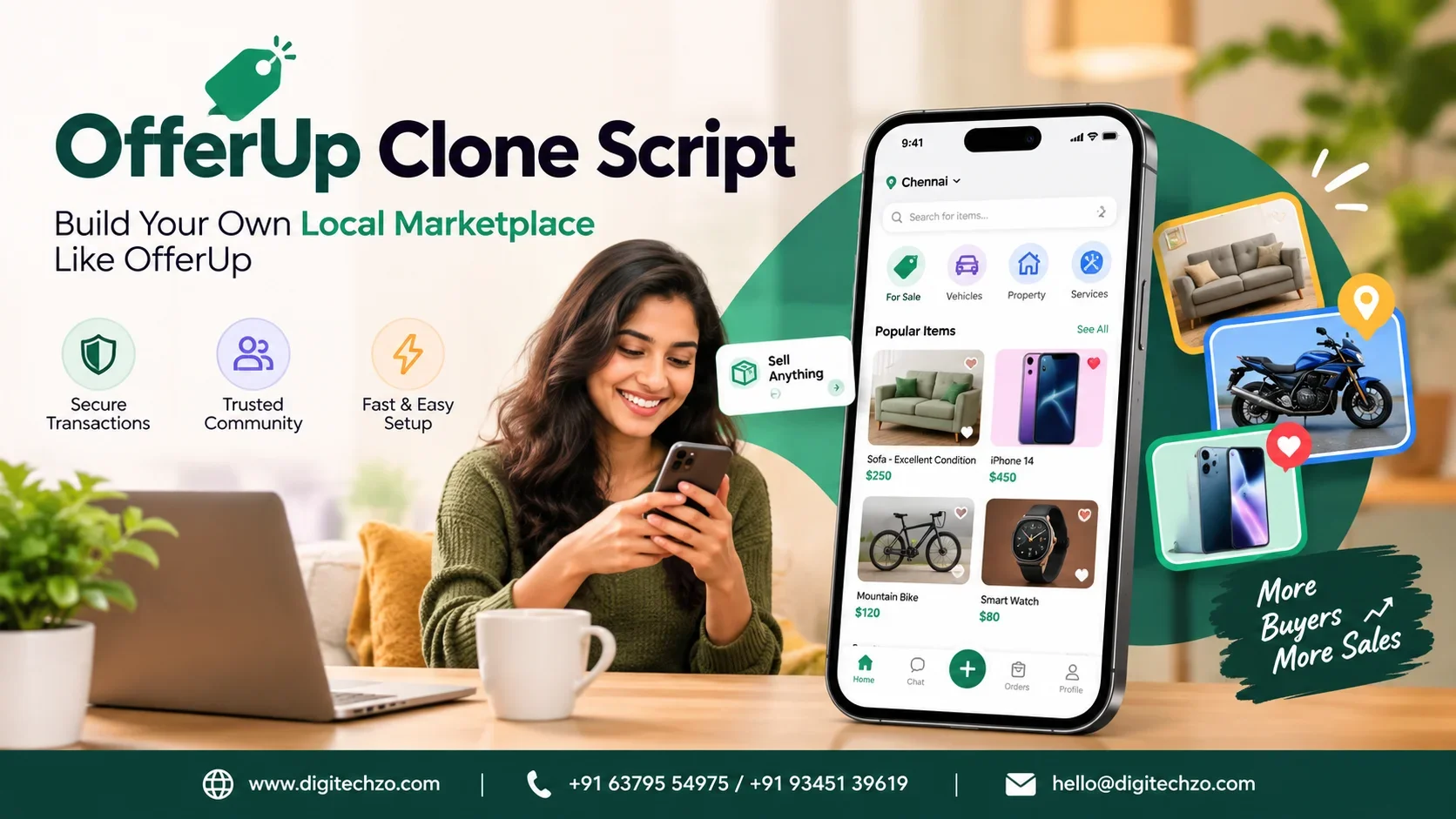
People sell used phones, furniture, bikes and cars to neighbors every day, yet most local classifieds still feel unsafe, cluttered or slow. That gap is why founders keep asking about an OfferUp clone script: a faster way to launch a mobile-first marketplace where people list items, chat, negotiate and meet locally.
In this guide, DigiTechzo explains what an OfferUp clone script really includes, when a ready-made script is smart and when custom development is the better call, which features matter in version one, how these platforms earn money, what drives cost, and how to avoid the mistakes that sink most new marketplaces.
An OfferUp clone script is a pre-built or customizable software foundation for a local buy-and-sell marketplace, with listings, location-based search, in-app chat, user profiles, ratings and an admin panel. It shortens development time, but success depends less on code than on trust features, moderation and getting enough local buyers and sellers in one area. Most serious businesses start with a lean MVP and customize from there rather than copying every feature at once.
What Is an OfferUp Clone Script?
OfferUp is a mobile-first marketplace where individuals list second-hand and local items and complete deals in their own area. A clone script replicates that functional model: the workflow of posting, discovering, chatting, offering and closing a local sale.
Two clarifications save money and legal trouble:
- A clone is a functional model, not a copy of the brand. Your platform needs its own name, logo, interface and identity. Copying another company's trademarks, design assets or copyrighted content creates avoidable risk.
- "Script" can mean different things. It may be an off-the-shelf codebase, a white-label product, or a custom build modeled on proven marketplace patterns. These differ sharply in flexibility, ownership and long-term cost.
The category sits inside peer-to-peer (C2C) marketplace software and classified ads app development. The same foundation can serve general second-hand trading, or niches such as electronics, vehicles, furniture, baby gear, campus resale or regional communities.
How a Local Buy-and-Sell Marketplace Actually Works
The core transaction loop
Every platform of this type runs on one loop:
- A seller photographs an item and publishes a listing with price, category and location.
- A buyer discovers it through search, filters or a nearby feed.
- They chat and negotiate, often through offers.
- They agree on a meeting point or delivery method.
- The sale completes, and both sides rate the experience.
Anything that makes this loop faster, safer or more rewarding is a feature worth building. Anything that does not is a distraction in version one.
Why trust and local density decide success
Two forces matter more than any feature list.
Trust. Strangers are exchanging goods and money. Fake listings, no-shows, scams, abusive messages and counterfeit goods are the daily reality of this category. Platforms that win make trust visible: verified profiles, reviews, safe-meeting guidance, reporting tools and fast moderation.
Local liquidity. A marketplace with 10,000 listings spread across a whole country feels empty in any one city. A buyer who opens the app and sees nothing nearby may never return. Density in a defined area beats scale across a broad one.
Most generic guides skip both points, and they are exactly where launches succeed or fail.
Ready-Made Script vs Custom Development
| Factor | Ready-Made / White-Label Script | Custom Development |
|---|---|---|
| Time to launch | Faster, since core modules exist | Longer, built from your specification |
| Upfront cost | Typically lower | Typically higher |
| Flexibility | Limited by the codebase | High; built around your model |
| Differentiation | Harder, as many competitors may use similar bases | Strong; unique workflows and UX |
| Scalability | Depends on code quality and architecture | Planned for your growth path |
| Code ownership | Varies; check licensing carefully | Usually full ownership if contracted so |
| Best for | Validating a market quickly | Long-term products with distinct strategy |
A practical middle path is a script-based or modular foundation that is then heavily customized: the faster start of a base, plus tailored trust, payment and regional features. Whichever route you choose, confirm source-code access, license terms, update policy and security practices before signing anything.
Essential Features for the First Version
Buyer features
- Registration and login via phone, email or social sign-in, with OTP verification
- Location-based discovery showing nearby listings first
- Search and filters by category, price, distance, condition and recency
- Listing detail pages with multiple photos, description, seller profile and map area
- Favorites and alerts for saved searches and price drops
- In-app chat with image sharing and offer messages
- Make-an-offer flow so negotiation stays on-platform
- Ratings and reviews after each completed deal
Seller features
- Fast listing creation: photo upload, category selection, price and location in under a minute
- Listing management: edit, mark as sold, renew or delete
- Seller profile showing activity, reviews and verification status
- Notifications for messages, offers and listing activity
- Optional promotion tools to boost visibility
Admin panel
Many first-time founders underbuild this, and it becomes their biggest operational pain. A solid admin panel should include:
- User and listing management with suspend, ban and edit controls
- A moderation queue for reported content
- Category, location and attribute management
- Banner, promotion and featured-listing control
- Transaction and revenue reporting
- Analytics on searches, listings and conversion
- Content and policy management for prohibited items
Advanced Features That Set a Marketplace Apart
Once the core loop works, differentiation comes from the features below. Add them based on user evidence, not curiosity.
| Feature | Why It Matters |
|---|---|
| ID and phone verification badges | Visible trust signals reduce scams and hesitation |
| Image-based listing assistance | Faster posting and cleaner listing quality |
| Automated moderation (text and image screening) | Catches prohibited items, spam and duplicates at scale |
| Safe-meeting suggestions | Encourages public meeting points and responsible local trades |
| Secure in-app payments or escrow | Protects both sides, especially on higher-value items |
| Shipping integration | Extends reach beyond the immediate neighborhood |
| Seller storefronts | Supports small businesses and frequent sellers |
| Smart recommendations | Improves return visits and listing discovery |
| Multilingual and multi-currency support | Essential for regions with several languages |
| Dispute handling workflow | Gives users a path when deals go wrong |
For local markets with many languages and varied payment habits, localization often matters more than novelty. Local payment methods, regional categories and language support can outperform a long list of generic features.
Recommended Architecture and Tech Stack
The right stack depends on team skills and growth plans, but a modern local marketplace typically includes:
- Mobile apps: native (Swift/Kotlin) or cross-platform (Flutter, React Native) for iOS and Android
- Web front end and admin dashboard: React, Vue or similar frameworks
- Backend: Node.js, Python, PHP/Laravel or similar, exposed through well-documented APIs
- Database: PostgreSQL or MySQL for structured data; Redis for caching and sessions
- Search: Elasticsearch or OpenSearch for fast, filterable, location-aware queries
- Real-time chat: WebSockets or a managed messaging layer
- Media handling: cloud object storage with a CDN and image compression
- Notifications: push (FCM/APNs), SMS and email
- Cloud infrastructure: AWS, Google Cloud or Azure with monitoring and backups
- Security: encrypted traffic, secure authentication, rate limiting, role-based admin access and abuse detection
Architecture advice that matters: design search, chat and media as separable components. These three are the first to strain under growth, and separating them early makes scaling less painful than a rewrite later.
How an OfferUp-Style Marketplace Makes Money
Free listing is common in this category because it feeds supply. Revenue usually comes from layers added on top:
- Promoted and featured listings: sellers pay for visibility
- Transaction fees: a fixed or percentage fee on in-app payments or shipped orders
- Display advertising: banners and sponsored placements, once traffic is meaningful
- Business and storefront subscriptions: for dealers and frequent sellers
- Premium seller tools: analytics, bulk listing, priority support
- Category-specific fees: for example, higher-value vehicle or property categories
Match monetization to your stage. Charging too early can slow supply growth; charging too late can leave a good product without a business model. Many operators keep basic listing free, then introduce paid visibility once there is steady buyer demand.
Cost and Timeline: What Actually Drives the Budget
Published estimates for OfferUp-style apps vary enormously, from low five-figure ranges to well over six figures. That spread is not a mystery. It reflects very different scopes. Instead of chasing a single number, understand the drivers:
- Platforms: iOS, Android, web and admin each add effort
- Feature depth: basic listing and chat versus verification, payments, moderation and analytics
- Script vs custom: a base product reduces initial effort but may add customization cost
- UI/UX design: a custom, tested experience costs more than a template
- Integrations: payments, maps, SMS, KYC, shipping
- Security and compliance work: privacy, data protection and payment requirements
- Scalability planning: infrastructure and architecture decisions
- Team location and experience
- Ongoing costs: hosting, maps and messaging usage, moderation, maintenance and marketing
Timeline logic: a focused MVP generally takes a matter of months; a feature-rich, multi-platform product with advanced trust and payment layers takes longer. Treat any quote that ignores moderation, testing, deployment and post-launch support with caution.
A Phased Roadmap from MVP to Scale
| Phase | Focus | Typical Scope |
|---|---|---|
| Phase 1: MVP | Prove the core loop in one city or niche | Listings, search, chat, profiles, basic admin, reporting |
| Phase 2: Trust & Growth | Reduce friction and risk | Verification badges, offers, reviews, notifications, moderation tools |
| Phase 3: Monetization | Introduce revenue | Promoted listings, storefronts, payments, analytics |
| Phase 4: Scale | Expand reach | Multi-city, multilingual, shipping, recommendations, automation |
This sequencing protects capital and lets real usage, not assumptions, guide spending.
Getting Your First Users: The Cold-Start Problem
A marketplace is empty until it isn't, and empty marketplaces lose users quickly. Practical approaches include:
- Launch in one tightly defined area: a city, a university district or a niche category
- Seed supply first: onboard sellers, small resellers or community groups before opening to buyers
- Make listing effortless: the easier posting is, the faster supply grows
- Use local channels: community groups, campus networks, neighborhood forums and partnerships
- Run focused category pushes: for instance, electronics or furniture, before broadening
- Measure the right signals: listings per active seller, response time, and the share of listings that sell
Resist the temptation to launch everywhere at once. Density in one area beats thin coverage in ten.
Risks, Compliance and Common Mistakes
Common mistakes
- Copying another platform's branding or interface instead of building a distinct identity
- Overbuilding features before proving the core loop
- Ignoring moderation until scams appear
- Choosing a script without checking code quality, licensing or update support
- Launching broadly with no local density
- Weak admin tools that force manual work
- Treating security as a post-launch task
Risk areas to plan for
- Prohibited and regulated items: weapons, counterfeit goods, restricted substances and similar categories need clear policies and enforcement
- Privacy and data protection: location data, chat content and identity documents require careful handling under applicable laws
- Payments: in-app payments or escrow can bring licensing and compliance considerations depending on region
- Platform liability and terms: terms of use, dispute handling and takedown processes matter
- App-store policies: apple and Google rules affect payments, user-generated content and moderation requirements
This is technical and planning guidance, not legal advice. Consult a qualified lawyer in your target market before launch, especially if you handle payments or sensitive data.
How to Evaluate an OfferUp Clone Script or Development Partner
Use this checklist before committing:
- Source code and licensing: Do you receive full code? Are there restrictions or recurring license fees?
- Architecture: Is it modular and API-driven, or a monolith that will be hard to extend?
- Security practices: Authentication, data encryption, vulnerability testing, role-based access
- Admin depth: Moderation, reporting, analytics and configuration without developer help
- Customization ability: Can the team adapt workflows, payments and languages to your market?
- Scalability evidence: How do search and chat behave under load?
- Mobile quality: Real native or well-built cross-platform apps, not thin wrappers
- Support and updates: Maintenance, bug fixes and compatibility with OS and store changes
- Transparency: Clear scope, milestones, timelines and cost breakdown
- References and demos: Working demos and verifiable delivery experience, not just screenshots
A partner that asks about your city, niche, seller base and monetization plan before quoting is usually a better sign than one that sends a price immediately.
Why Choose DigiTechzo for Local Marketplace App Development
Choosing who builds your marketplace is as consequential as choosing the model itself. A weak build leads to slow search, unreliable chat, security gaps and a codebase that is expensive to change, and those problems appear after launch, when fixing them costs the most.
DigiTechzo positions itself as a technology partner covering mobile apps, websites, software development, AI development, blockchain and growth marketing. That combination matters for a marketplace, because a launch needs more than code: it needs app and web development, backend and admin systems, and a plan for attracting early users.
For a business exploring OfferUp-style marketplace development, a partner should help you:
- Define scope realistically: decide what belongs in the MVP and what waits
- Choose the right route: script-based foundation or custom build, based on your goals
- Design for trust: verification, moderation, reporting and admin controls from the start
- Plan for growth: architecture that supports more users, listings and cities
- Connect product and market: build with a launch and user-acquisition plan in mind
The best next step is a clear conversation about your niche, target region, budget range and timeline. A good provider will challenge your assumptions before building, and that is a sign of experience, not hesitation.