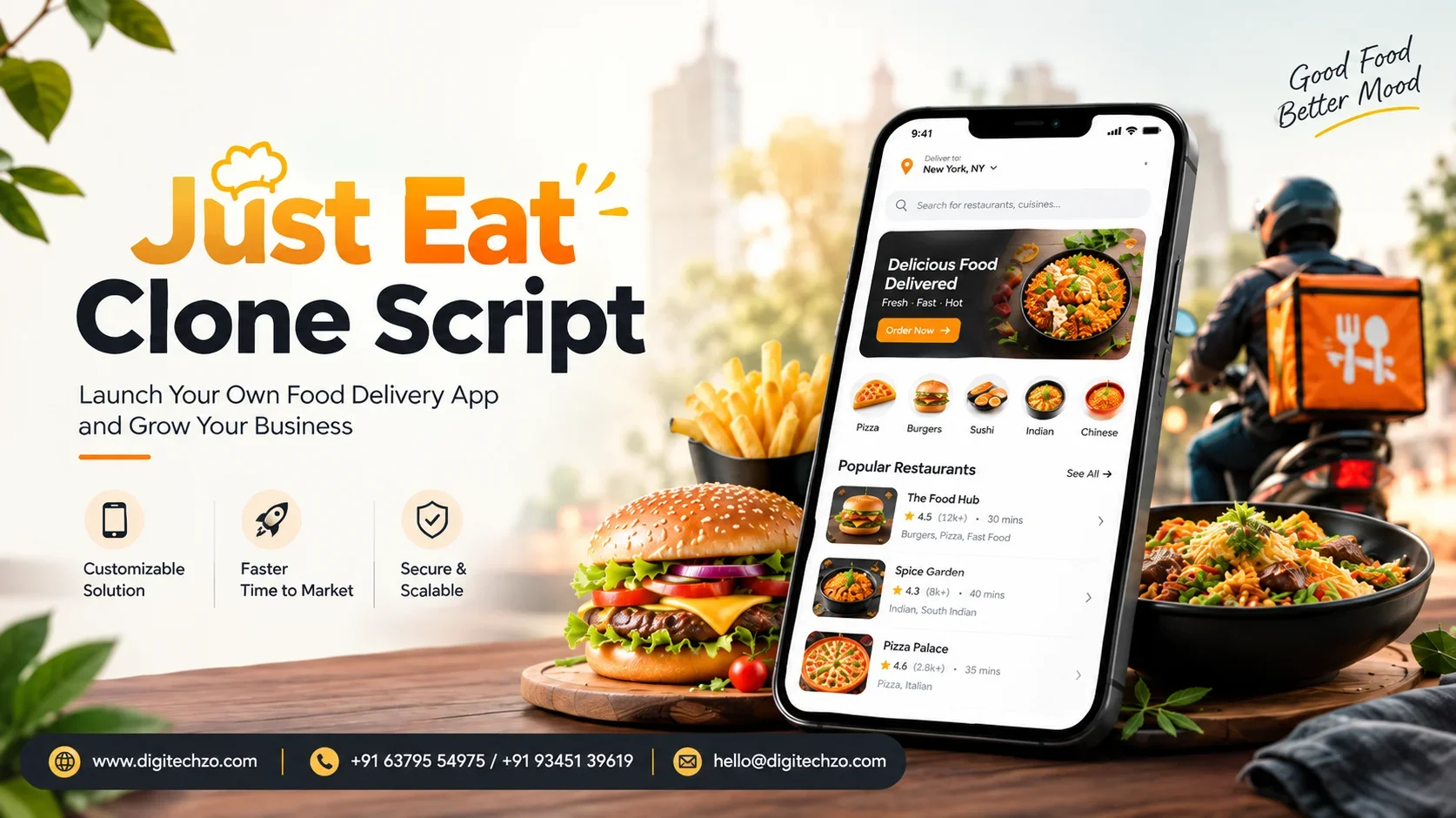
Most food delivery startups don't fail because the idea is bad. They fail because the platform is slow to launch, restaurants are hard to onboard, riders are unreliable, or the software can't handle real order volume. Founders who want to avoid a two-year build often start with a Just Eat clone: a ready-made platform that already includes the core pieces of an online food ordering marketplace.
At Digitechzo, we see the same questions come up before every food delivery project: what does a clone script actually include, what will it cost, and when is it smarter to build custom? This guide answers those questions plainly. You'll learn how the Just Eat model works, which features matter at launch, how scripts, white-label products and custom builds compare, and how to avoid the mistakes that sink new platforms.
A Just Eat clone is a ready-made food ordering and delivery platform that replicates the core model of Just Eat: a marketplace where customers browse restaurants, order food, pay online and track delivery. It typically includes a customer app, restaurant panel, delivery partner app and admin dashboard. It is a faster, lower-cost route than building from scratch, but you must customize the brand, workflows, payments and local compliance to compete.
What Is a Just Eat Clone Script?
A Just Eat clone script is pre-built software that reproduces the functionality of a multi-vendor food ordering marketplace. Instead of designing databases, order flows and apps from zero, you start with a working base and adapt it to your city, cuisine focus or business model.
What "clone" does and does not mean
"Clone" refers to functionality, not identity. A legitimate clone replicates how the platform works: restaurant listings, menus, cart, checkout, order management and delivery tracking. It does not copy Just Eat's logo, name, visual identity, proprietary code or trademarks.
Your platform needs its own brand, design and positioning. Customers choose marketplaces for local selection, reliability and trust, not because the software looks like another product.
Is a Just Eat clone legal?
Building software with similar features to an existing product is generally standard practice across the industry. The legal risks come from how you do it:
- Using another company's trademarks, logo, brand name or copied interface assets
- Using source code you have no licence to use
- Ignoring food licensing, tax and data protection rules in your market
- Weak licence terms that limit your ownership or modification rights
This is general information, not legal advice. Before launch, confirm trademark, licensing and compliance requirements with a qualified advisor in your region.
How the Just Eat Model Works (and Why Founders Copy It)
The marketplace model
Just Eat operates as a marketplace. Restaurants list their menus, customers order through the app or website, and the platform earns revenue per order. The model has expanded significantly: when Prosus completed its acquisition of Just Eat Takeaway.com in October 2025, the group was reported to serve roughly 60 million customers with more than 362,000 restaurant partners across 17 markets.
That scale matters for one reason: it shows the model works when supply (restaurants), demand (customers) and logistics (delivery) are balanced. It also shows why a small new entrant should rarely try to compete everywhere. Local focus is your advantage.
Where the money comes from
A marketplace food delivery platform commonly earns through a combination of:
- Commission on each order placed through the platform
- Delivery fees charged to customers
- Service or platform fees
- Promoted listings and featured placements for restaurants
- Subscriptions or loyalty programmes
- Ad revenue from restaurant brands (at larger scale)
Commission rates, fee structures and local rules differ by market, so model your unit economics before you commit to a pricing structure.
Core Components of a Food Delivery Platform
A complete food delivery platform is not one app. It is four connected parts.
Customer app
The customer app handles discovery and ordering: location-based restaurant search, filters by cuisine, rating and delivery time, menus, cart, coupons, multiple payment options, order history, reorder, ratings and live order tracking.
Restaurant panel
Restaurants need a simple way to receive and manage orders: accept or reject orders, update menus and prices, mark items out of stock, set preparation times and operating hours, and view earnings and payouts. If this panel is clumsy, restaurants stop using it, and your supply side collapses.
Delivery partner app
Riders need order assignment, navigation, pickup and drop-off confirmation, earnings tracking and availability controls. Dispatch quality, meaning how well orders are matched to riders, directly shapes delivery time and customer satisfaction.
Admin dashboard
The admin panel is the control centre: restaurant onboarding and approval, commission settings, order monitoring, dispatch management, customer support, promotions, payouts, reports and analytics.
Must-Have vs Advanced Features
Don't build every feature at launch. Start with what makes orders flow reliably, then add differentiation.
| Priority | Feature | Why It Matters |
|---|---|---|
| Must-have | Location-based restaurant discovery | Customers order from what is nearby and available |
| Must-have | Menu, cart and secure checkout | Core conversion path |
| Must-have | Multiple payment options, including cash on delivery where relevant | Match local payment habits |
| Must-have | Real-time order tracking and notifications | Reduces "where is my order" support load |
| Must-have | Restaurant order management panel | Keeps supply side active |
| Must-have | Delivery partner assignment | Makes delivery operational |
| Must-have | Admin controls for commission, payouts and disputes | Required to run the business |
| Should-have | Ratings and reviews | Builds trust and quality control |
| Should-have | Coupons and referral offers | Drives early acquisition |
| Should-have | Scheduled orders | Matches how people plan meals |
| Advanced | Subscription or loyalty programme | Improves retention |
| Advanced | AI-based recommendations | Increases order value once you have data |
| Advanced | Smart dispatch and route optimization | Matters as order volume grows |
| Advanced | Multi-city and multi-language support | Needed for expansion |
Clone Script vs White Label vs Custom Development
This is the decision most buyers get wrong. The right choice depends on budget, timeline, differentiation and how much control you need.
| Factor | Ready-Made Clone Script | White Label Solution | Custom Development |
|---|---|---|---|
| Launch speed | Fastest | Fast | Slowest |
| Upfront cost | Lowest | Low to moderate | Highest |
| Customization | Limited to moderate | Moderate (within vendor limits) | Full |
| Source code access | Varies by licence | Usually no, or restricted | Typically yes, by agreement |
| Scalability | Depends on architecture | Depends on vendor | Designed for your needs |
| Differentiation | Low | Low to moderate | High |
| Best for | Validating an idea quickly | Launching with a vendor-managed product | Serious marketplaces with unique workflows |
A practical rule: if you are testing a local market with a limited budget, a well-built script plus customization is reasonable. If your business depends on unique logistics, a distinctive customer experience or heavy integrations, custom development, or a script as a base that is heavily extended, protects you from hitting a ceiling later.
How to Evaluate a Just Eat Clone Script Before You Buy
Most scripts look identical in a demo. Differences show up in the details. Ask these questions before paying:
- Do you get full source code, and under what licence? Know whether you can modify, host and resell it.
- Is the architecture scalable? Ask how it handles concurrent orders, peak-hour traffic and growth to multiple cities.
- Can it support multi-vendor operations properly? Separate restaurant accounts, menus, commissions and payouts are essential.
- Which payment gateways are supported? Confirm gateways relevant to your market.
- How is dispatch handled? Manual assignment alone will not scale.
- What is the security posture? Look for secure authentication, encrypted data handling and payment gateway integration that keeps card data out of your servers.
- What do updates and support look like? Ask about maintenance, bug fixes, OS updates and response times.
- Can you see real client deployments? A demo is not proof of production stability.
- How easy is customization? Poorly structured code makes every change expensive.
- What are the hidden costs? Third-party maps, SMS, push notifications, payment fees, hosting and app store fees add up.
What Affects the Cost and Timeline
Honest cost figures depend entirely on scope, so beware any vendor quoting one number without asking questions. These are the real cost drivers:
- Approach: script, white label or custom build
- Number of apps: customer, restaurant, rider and admin (and web versus mobile)
- Platforms: Android, iOS or both
- Design: template-based versus custom UI/UX
- Customization depth: workflows, commission logic, multi-city rules
- Integrations: payment gateways, maps, SMS, email, POS systems, analytics
- Dispatch complexity: manual, rule-based or algorithmic
- Infrastructure: hosting, scaling, monitoring, backups
- Compliance: data protection, payments security and regional rules
- Ongoing costs: maintenance, support, updates and cloud usage
Timeline follows the same logic. A lightly customized script can go live much faster than a custom platform, but a rushed launch with poor testing often costs more in lost restaurants and customers than the time saved. Allow proper time for testing the order flow end to end, especially payments, cancellations, refunds and rider handoffs.
Technology Considerations
You do not need to choose every technology yourself, but you should understand the choices a developer will make:
- Mobile apps: native (Swift, Kotlin) or cross-platform (Flutter, React Native). Cross-platform can reduce effort; native can offer better performance for complex features.
- Backend: scalable APIs (Node.js, Laravel, Python or similar) with a well-designed database.
- Real-time features: WebSockets or similar for live tracking and order status.
- Maps and routing: Google Maps or alternatives for geolocation, distance and delivery estimates.
- Payments: integration with reliable gateways. Using a hosted or tokenized payment flow reduces your PCI DSS burden.
- Notifications: push, SMS and email for order updates.
- Cloud hosting: a setup that can scale during peak meal times.
- Analytics: track conversion, order time, cancellations, repeat rate and rider utilisation.
A Practical Launch Roadmap
- Define your market. Pick a city, cuisine niche or community. Local depth beats broad vagueness.
- Model your economics. Estimate average order value, commission, delivery cost, support cost and promotions before spending on development.
- Choose your build path. Script, white label or custom, using the comparison above.
- Customize brand and workflows. Name, design, commission structure, delivery zones, payment methods.
- Onboard restaurants first. Supply must exist before demand. Start with a focused set of quality restaurants.
- Recruit and train delivery partners. Clear payout rules and reliable dispatch matter more than app features.
- Test the full order lifecycle. Orders, payments, cancellations, refunds, rider reassignment and support flows.
- Soft launch in a limited area. Fix real problems before scaling.
- Launch marketing. Local promotions, restaurant partnerships and referral offers.
- Measure, then expand. Watch order frequency, delivery time and retention before opening new zones.
Common Mistakes to Avoid
- Copying Just Eat's brand instead of building your own. This creates legal risk and no reason for customers to choose you.
- Buying a script based only on a demo. Review code quality, licence and scalability.
- Launching without restaurants. An empty app loses customers permanently on day one.
- Ignoring delivery logistics. Slow or unreliable delivery destroys repeat orders.
- Underestimating ongoing costs. Maps, SMS, hosting, payment fees and support are recurring.
- Overbuilding the first version. Launch with must-have features, then expand based on real data.
- Skipping compliance. Food licensing, tax, data protection and payment rules vary by region and need proper review.
- Having no growth plan. Software alone does not create demand.
Why Choose DigiTechzo for Food Delivery App Development?
Choosing a development partner shapes everything that follows: how fast you launch, how well the platform scales, and how much it costs to change later. A script is only as good as the team that customizes, secures and supports it.
DigiTechzo is a technology company working across mobile apps, software development, AI and growth marketing, which matters for a food delivery business because launching the platform is only half of the work. Strong food delivery app development means getting the architecture, customization and user experience right, and then helping you reach restaurants and customers once you are live. Our approach is to start with your market and business model, recommend the build path that fits (script-based, white label or custom), and keep the scope focused on what drives orders.
If you are comparing options, you can explore our mobile app and software development services and discuss your platform requirements with our team. A short conversation about your market, budget and timeline is usually enough to tell you whether a script-based launch or a custom build makes more sense.
Frequently Asked Questions
What is a Just Eat clone script?
It is ready-made software that replicates the core functions of a multi-vendor food ordering marketplace: customer ordering, restaurant management, delivery handling and an admin dashboard. It lets you launch without building every component from scratch.
Is it legal to build a Just Eat clone?
Replicating general functionality is common in software. The risks come from copying trademarks, logos, proprietary code or unlicensed assets, or from ignoring local regulations. Use your own brand and verify licensing with a qualified advisor.
How does a food delivery platform like Just Eat make money?
Mainly through commission on orders, with additional income from delivery fees, service fees, promoted listings and subscriptions. Exact structures vary by market.
What features should a Just Eat clone have at launch?
Location-based discovery, menus and cart, secure payments, order tracking, a restaurant order panel, delivery partner assignment and admin controls for commission and payouts. Add loyalty, AI recommendations and advanced dispatch after launch.
How much does a Just Eat clone cost?
It depends on whether you choose a script, white label or custom build, how many apps you need, the customization depth, integrations and ongoing running costs. A scoped quote based on your requirements is more reliable than any generic figure.
How long does it take to launch a food delivery app?
A lightly customized script can launch much faster than a custom platform. Plan extra time for restaurant onboarding, rider recruitment and thorough testing, since those usually decide whether the launch succeeds.
Should I choose a clone script or custom development?
Choose a script to validate a local market quickly on a limited budget. Choose custom development, or a heavily extended script, when you need unique workflows, deep integrations or long-term scalability.
Do I get the source code with a clone script?
It depends on the licence. Some vendors provide full source code, others restrict access or offer only hosted products. Confirm this in writing before purchase.