It's 9am on a Monday, and Priya, the ops manager at a mid-sized manufacturing firm in Leeds, is doing what she does every Monday: manually reconciling stock figures from three different spreadsheets, chasing the finance team for last week's numbers, and fielding a call from a customer asking where their order has got to - because the sales team's CRM has no idea what's happening on the warehouse floor.
Sound familiar?
If you're running a growing UK business - whether that's manufacturing, retail, logistics, professional services, or construction - chances are you've hit a similar wall. Your business has outgrown the patchwork of spreadsheets, standalone accounting software, and half-connected tools you started with. Data lives in silos. Reporting takes days instead of minutes. And every new hire has to learn five different systems just to do their job.
This is usually the point where "ERP" starts coming up in leadership meetings. And it's usually followed by one very practical question: how much does custom ERP development cost in the UK?
It's a fair question, and honestly, it doesn't have a single neat answer - because ERP cost depends heavily on your business size, complexity, and what you actually need the system to do. But that's exactly what we're going to unpack in this guide.
At DigiTechzo, we've worked with UK businesses navigating this exact decision - weighing up off-the-shelf ERP software against a custom-built solution designed around how they actually operate. This guide draws on that experience to give you a realistic, no-fluff breakdown of ERP software cost in the UK for 2027, what drives the price up or down, and how to plan your budget sensibly.
What Is Custom ERP Development, and Why Does It Cost What It Does?
Enterprise Resource Planning (ERP) software brings your core business functions - finance, inventory, procurement, HR, sales, production, and reporting - into one connected system, instead of a dozen disconnected tools.
There are two broad routes:
- Off-the-shelf ERP (like NetSuite, SAP Business One, Microsoft Dynamics 365, or Odoo) - pre-built software you configure to fit your business.
- Custom ERP development - a system built from the ground up (or heavily customised on an open-source base) around your specific workflows, industry requirements, and existing tech stack.
Custom ERP development generally costs more upfront than an off-the-shelf licence, but for businesses with unusual workflows, regulatory requirements, or a need to avoid ongoing per-user licence fees, it often works out more cost-effective - and more useful - over three to five years.
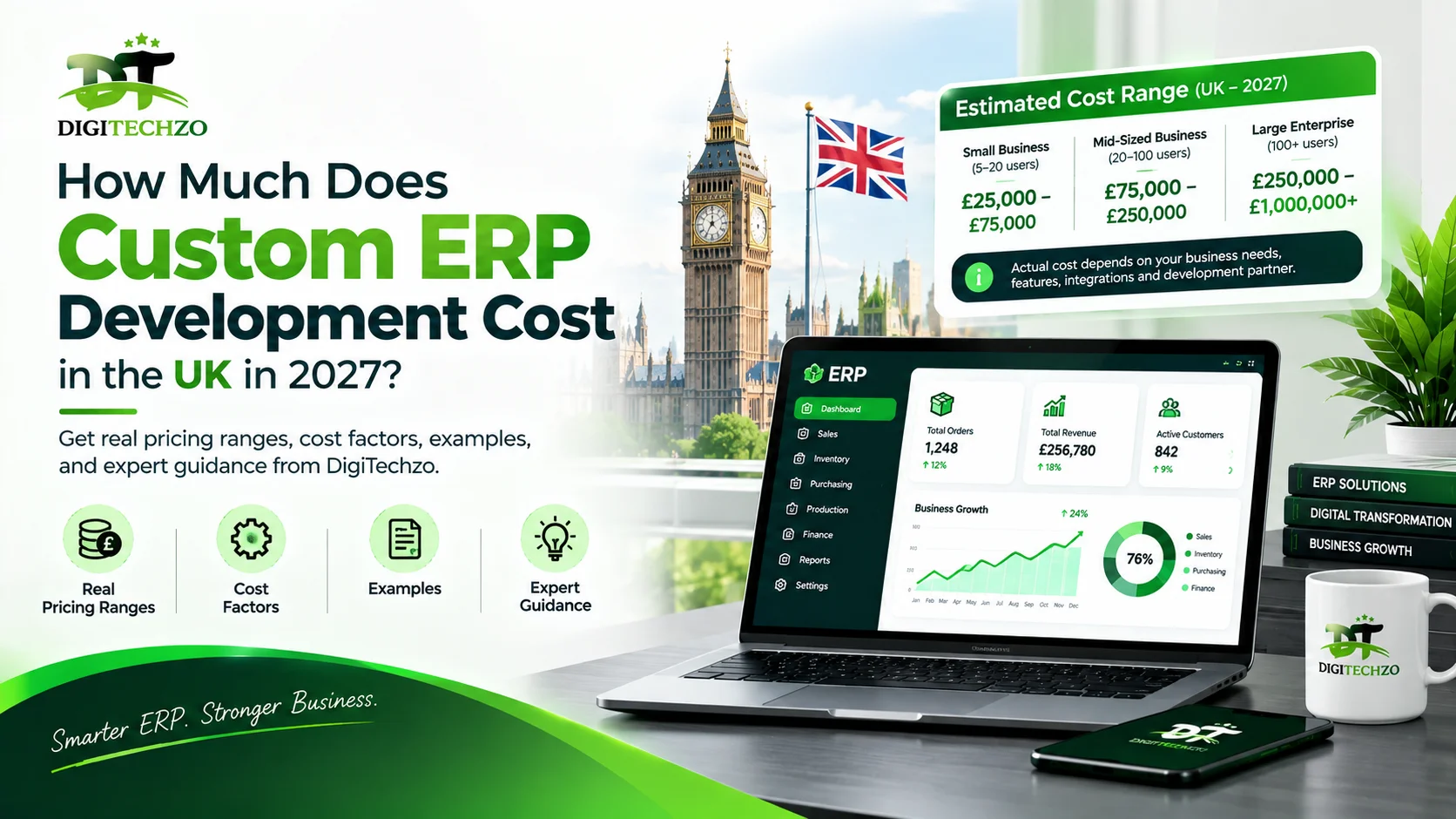
How Much Does Custom ERP Development Cost in the UK in 2027?
Here's the honest, ballpark answer UK business owners are looking for:
| ERP Project Type | Typical UK Cost (2027) | Best Suited For |
|---|---|---|
| Basic custom ERP (core modules only) | £15,000 - £40,000 | Small businesses, single location, 5-20 users |
| Mid-range custom ERP | £40,000 - £120,000 | Growing SMEs, multiple departments, 20-100 users |
| Advanced/enterprise-grade ERP | £120,000 - £350,000+ | Manufacturers, multi-site operations, complex integrations |
| Ongoing maintenance & support | 15-20% of build cost annually | All custom ERP systems |
These figures reflect UK development rates, which are typically higher than offshore alternatives but come with easier communication, GDPR-aligned data handling, and closer collaboration during requirements gathering.
It's worth noting: these are indicative ranges, not fixed quotes. The only way to get an accurate figure for your business is a proper discovery and scoping exercise - but this table should give you a realistic starting point for budget conversations with your finance team.
What Actually Drives ERP Software Cost in the UK?
This is the part most guides skip past - and it's the part that actually matters when you're trying to plan a budget.
1. Number of Modules and Features
A basic ERP covering inventory and accounting will always cost less than one that also handles manufacturing scheduling, HR, CRM, procurement, and multi-currency finance. Every additional module adds development, testing, and integration time.
2. Number of Users and User Roles
More users generally means more complex permission structures, more testing, and sometimes additional infrastructure to handle load - particularly if you have shift workers, remote teams, or external partners accessing parts of the system.
3. Integrations With Existing Tools
Very few UK businesses build ERP in isolation. You'll likely need it to talk to:
- Your accounting software (Xero, QuickBooks, Sage)
- Your e-commerce platform (Shopify, WooCommerce, Magento)
- Payment gateways and banking APIs
- Courier and logistics systems
- HMRC-compliant tax reporting (Making Tax Digital)
Each integration adds development and testing time, particularly where third-party APIs are poorly documented or rate-limited.
4. Industry-Specific Complexity
A construction firm needing job costing and site-based inventory tracking has very different requirements from a retail business needing multi-channel stock sync. Regulated industries - healthcare, finance, food production - also require additional compliance work (data handling, audit trails, traceability).
5. Cloud vs On-Premise Deployment
Cloud-hosted ERP tends to have lower upfront infrastructure costs but ongoing hosting fees. On-premise systems cost more initially (servers, IT setup) but avoid recurring hosting costs - a consideration many UK manufacturers and firms with strict data residency requirements still weigh carefully.
6. UI/UX and Reporting Requirements
A basic functional interface costs less than a polished, role-based dashboard with real-time reporting, custom charts, and mobile access. If your team will live in this system all day, investing here usually pays off in adoption and productivity.
7. Data Migration
Moving years of historical data from old systems or spreadsheets into a new ERP - cleanly and accurately - is often underestimated. Messy legacy data takes longer to migrate and validate.
8. Post-Launch Support and Iteration
ERP isn't a "build it and forget it" project. Budget for bug fixes, staff training, minor feature additions, and ongoing support - typically 15-20% of the original build cost per year.
Custom ERP vs Off-the-Shelf ERP: Which Costs More Long-Term?
This is where a lot of UK businesses get the comparison wrong by only looking at Year 1 pricing.
Off-the-shelf ERP (e.g., NetSuite, Dynamics 365)
- Lower upfront cost
- Faster initial deployment
- Ongoing per-user licence fees (often £70-£200+ per user, per month)
- Customisation limits - you often adapt your processes to fit the software
Custom ERP development
- Higher upfront investment
- No recurring per-user licence fees (you own the system)
- Built entirely around your workflows, not the other way round
- Full control over future features and integrations
For a business with 40 users on a mid-tier off-the-shelf ERP, licence fees alone can run £30,000-£90,000 a year indefinitely. Over five years, that often exceeds what a mid-range custom build would have cost outright - which is why many established UK SMEs eventually make the switch to custom-built systems.
Practical Examples: What UK Businesses Actually Pay
To make this less abstract, here's how the numbers tend to play out in practice:
Example 1 - Small Retailer (Bristol)
A 15-person homeware retailer needed inventory management synced across their shop and online store, plus basic accounting integration. Scope: 3 modules, 2 integrations. Realistic budget: £20,000-£35,000.
Example 2 - Growing Logistics Firm (Manchester)
A logistics company with 60 staff needed route planning, fleet tracking, invoicing, and HR modules, integrated with their existing telematics system. Scope: 5 modules, 4 integrations, custom reporting dashboard. Realistic budget: £70,000-£110,000.
Example 3 - Multi-Site Manufacturer (Birmingham)
A manufacturer with three sites needed production scheduling, quality control tracking, procurement, multi-currency finance, and traceability for compliance. Scope: 8+ modules, complex integrations, on-premise deployment. Realistic budget: £180,000-£300,000.
These aren't quotes - they're illustrations of how scope, not just business size, drives the final number.
Business Benefits That Justify the ERP Investment
A custom ERP isn't just a cost line - done well, it changes how the business runs:
- Faster decision-making - real-time data instead of week-old spreadsheets
- Reduced manual errors - fewer duplicate entries across disconnected tools
- Better cash flow visibility - finance and operations data in one place
- Improved customer experience - accurate stock and order status, every time
- Scalability - the system grows with the business instead of being replaced every few years
- Regulatory compliance - built-in audit trails and reporting for UK requirements like Making Tax Digital
For most businesses, the ROI shows up in the hours saved on manual admin and the errors avoided - savings that compound month after month.
How to Budget Sensibly for ERP Software Development
A few practical tips we share with clients at this stage:
- Start with a discovery phase. A proper requirements-gathering exercise (usually a small fixed fee) will give you a far more accurate quote than any online calculator.
- Prioritise core modules first. Build finance, inventory, and reporting first; add HR, CRM, or advanced analytics in phase two.
- Budget for support, not just the build. Set aside 15-20% annually for maintenance, updates, and staff training.
- Ask for a phased payment structure. Reputable UK development partners will break the project into milestones, not one lump sum upfront.
- Factor in data migration costs separately. It's often quoted as a distinct line item, and rightly so.
Why Choose DigiTechzo for ERP Software Development Services?
If you've read this far, you already understand that ERP pricing isn't one-size-fits-all - and neither is the system itself. That's the philosophy we build on at DigiTechzo.
Custom ERP development, built around how you actually work ;
We don't start with a template and ask you to adapt. We start with your workflows - how stock moves, how invoices get approved, how your teams actually communicate - and build the ERP around that.
Business-specific workflows: Whether you're managing multi-site manufacturing, retail stock across channels, or service-based project tracking, we design modules that match your real processes, not a generic assumption of them.
Scalable ERP architecture: We build systems designed to grow - so adding a new site, a new department, or a new product line doesn't mean starting over.
Integration with existing business tools: Your ERP should work with the tools you already rely on - Xero, Sage, Shopify, courier APIs, HMRC-compliant reporting - not force you to rip everything out and start again.
Automation and reporting: From automated stock reordering to real-time financial dashboards, we focus on removing manual admin wherever it's safe and sensible to do so.
User-friendly ERP solutions : An ERP your team avoids using is a wasted investment. We prioritise clean, role-based interfaces so adoption doesn't become its own project.
Security and performance: UK businesses handle sensitive financial, employee, and customer data. We build with GDPR-aligned data handling, proper access controls, and performance testing as standard, not an afterthought.
Post-development support: ERP systems evolve. We provide ongoing support, bug fixes, and iterative improvements after launch, so the system keeps pace with your business rather than falling behind it.
As an ERP software development service provider working with UK SMEs and growing enterprises, DigiTechzo focuses on practical, transparent scoping - so you know what you're paying for and why, before development ever begins.
FAQ
1. How much does custom ERP development cost in the UK?
Costs typically range from £15,000 for a basic system to £350,000+ for enterprise-grade, multi-site deployments. Most mid-sized UK businesses land somewhere between £40,000 and £120,000, depending on modules, users, and integrations required.
2. Is custom ERP cheaper than off-the-shelf software in the long run?
Often, yes - particularly for businesses over 20-30 users. Off-the-shelf ERP involves ongoing per-user licence fees that can exceed a custom build's cost within three to five years, while a custom system is owned outright.
3. How long does custom ERP development take?
A basic custom ERP can take 3-5 months. Mid-range systems typically take 6-9 months, and enterprise-grade builds with multiple integrations can take 12 months or more, depending on scope and data migration complexity.
4. What's included in ERP software cost in the UK besides development?
Beyond the build itself, budget for data migration, staff training, third-party integration costs, hosting (if cloud-based), and ongoing maintenance - typically 15-20% of the build cost annually.
5. Can a small business afford custom ERP development?
Yes. Many small UK businesses start with a scoped-down custom ERP covering just core modules (inventory, accounting, basic reporting), then expand it in phases as the business grows, rather than paying for a full enterprise build upfront.
6. Does custom ERP support UK compliance requirements like Making Tax Digital?
Yes, when built correctly. Custom ERP systems can be designed with HMRC-compliant tax reporting, audit trails, and GDPR-aligned data handling built in from the start, rather than bolted on later.
7. What's the difference between cloud and on-premise ERP cost?
Cloud ERP usually has lower upfront costs but ongoing hosting fees. On-premise ERP costs more initially (servers, infrastructure) but avoids recurring hosting charges - a common consideration for manufacturers with data residency requirements.
8. How do I get an accurate ERP development quote for my business?
The only reliable way is a discovery or scoping session with a development partner, where your specific workflows, user numbers, and integration needs are assessed in detail - generic online calculators can't account for this.