It was a Tuesday morning in Manchester when Sarah, the operations director of a mid-sized manufacturing firm, found herself juggling four different spreadsheets, two Slack threads and a phone call with her warehouse manager - all to answer one simple question from a customer: "Where's my order?"
She wasn't alone. Her finance team used one system to track invoices. Her sales team logged leads in a CRM that didn't talk to the warehouse software. Stock levels were updated manually at the end of each day, which meant they were often wrong by the time anyone looked at them.
Sound familiar?
If you're running a business - whether it's manufacturing, retail, logistics, professional services or healthcare - chances are you've hit this same wall. Growth brings more moving parts: more staff, more suppliers, more customers, more data. And when your systems don't talk to each other, growth stops feeling exciting and starts feeling chaotic.
This is exactly the problem ERP software development services are built to solve. Rather than forcing your business to bend around off-the-shelf software that only fits 70% of what you actually do, custom ERP development gives you one connected system built around how your business genuinely operates.
At DigiTechzo, we've spent years working alongside businesses to design, build and implement ERP systems that remove exactly this kind of friction - without the eye-watering costs or rigid limitations that often come with big-name ERP platforms. In this article, we'll walk through what ERP software development services actually involve, how they improve day-to-day business operations, and what decision-makers should consider before investing in one.
What Are ERP Software Development Services?
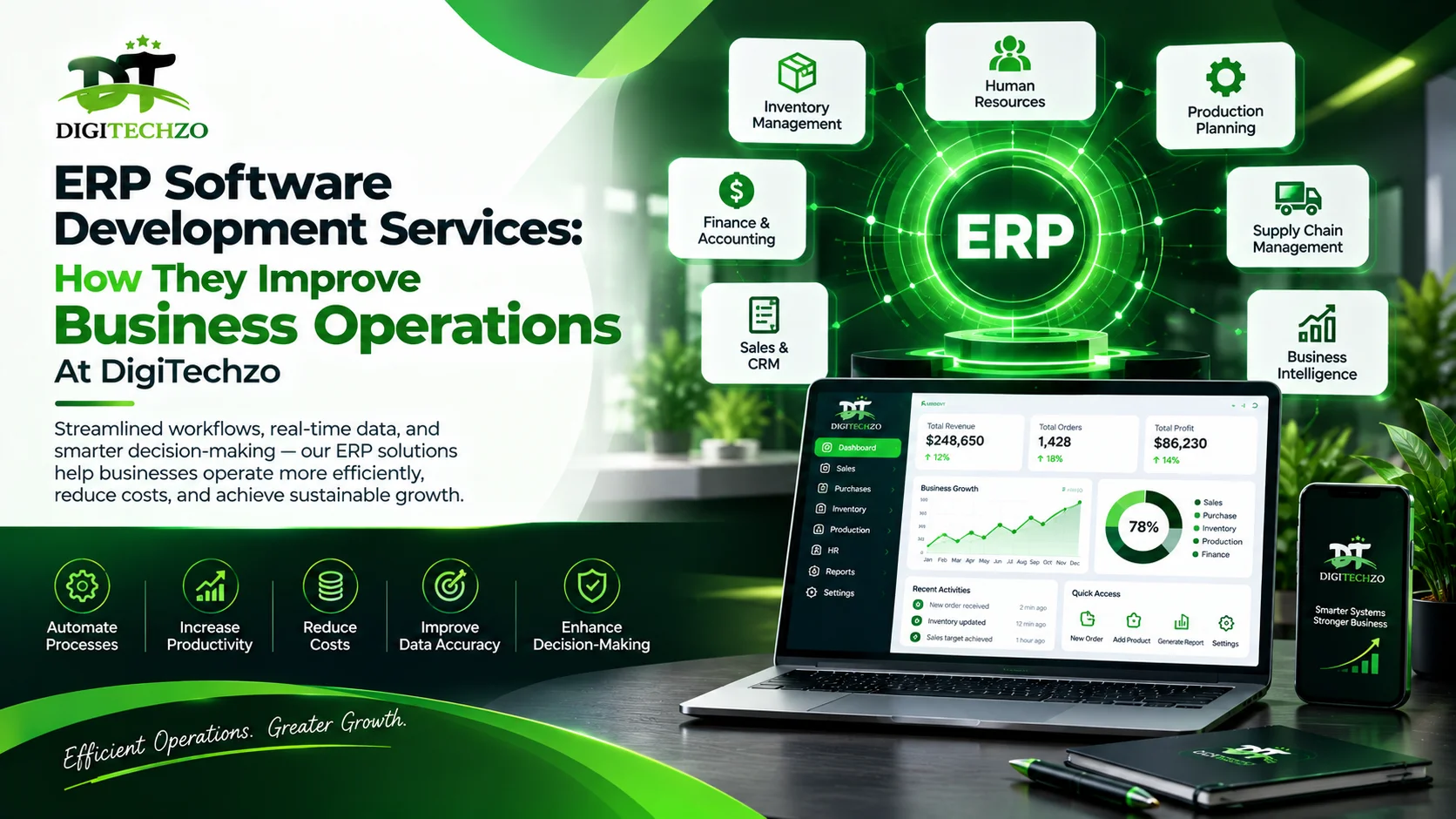
ERP stands for Enterprise Resource Planning. In simple terms, it's software that pulls together the core functions of a business - finance, inventory, HR, sales, procurement, production and reporting - into a single connected platform.
ERP software development services refer to the process of designing, building, customising and maintaining this kind of system, tailored specifically to your business rather than a generic template.
This is different from simply buying an "off-the-shelf" ERP licence. With development services, you're getting:
- A system architected around your actual workflows, not the other way around
- Integrations with tools you already use (accounting software, e-commerce platforms, CRMs)
- The flexibility to scale or adapt as your business changes
- Ongoing support from a team that understands your setup
For many businesses, particularly those with specific compliance needs (HMRC reporting, VAT handling, industry regulations), a custom-built or custom-configured ERP is far more practical than trying to force a one-size-fits-all product to comply.
The Real Cost of Disconnected Business Systems
Before we get into solutions, it's worth being honest about what disconnected systems actually cost a business. It's rarely just "an inconvenience" - it shows up in hard numbers.
- Duplicate data entry - staff entering the same customer or order details into three different systems, each entry a chance for human error.
- Delayed decision-making - finance managers waiting days for accurate stock or sales figures because reports have to be manually compiled.
- Poor customer experience - sales teams promising delivery dates that warehouse teams can't actually meet, because the two departments are working from different information.
- Compliance risk - inconsistent records making VAT returns, audits or regulatory reporting more stressful than they need to be.
- Wasted staff hours - skilled employees spending time reconciling spreadsheets instead of doing work that actually grows the business.
None of these problems are dramatic on their own. But together, they quietly drain time, money and morale - and they tend to get worse, not better, as a company grows.
How ERP Software Development Services Improve Business Operations
This is the core question, so let's break it down properly.
1. Centralised, Real-Time Data
Instead of finance, sales, and operations each working from their own version of the truth, an ERP system gives everyone access to the same live data.
Practical example: A Leeds-based wholesale distributor we've worked with used to update stock counts manually every evening. Orders taken during the day often oversold products that were technically out of stock. After moving to a custom ERP setup with real-time inventory tracking, that problem simply disappeared - because sales and warehouse teams were finally looking at the same numbers, updated instantly.
2. Automated, Repetitive Processes
Manual processes are where most operational time gets lost - invoice generation, purchase order approvals, payroll calculations, stock reordering.
ERP development services allow these processes to be automated according to rules specific to your business, such as:
- Auto-generating purchase orders when stock hits a reorder threshold
- Automatically flagging overdue invoices for the finance team
- Triggering approval workflows for spending above a set amount
- Syncing sales data directly into accounting software
This doesn't just save time - it reduces the human error that comes with repetitive manual tasks.
3. Better Cross-Department Communication
One of the most underrated benefits of ERP is how it changes the way teams work together. When sales, finance, operations and customer service are all pulling from the same system, fewer things fall through the cracks.
Practical example: A professional services firm in Bristol struggled with client billing delays because project managers weren't logging completed milestones anywhere finance could see. A custom ERP workflow connected project tracking directly to invoicing - cutting billing delays from an average of 12 days to under 3.
4. Smarter Reporting and Forecasting
Generic spreadsheets can tell you what happened last month. A properly built ERP system, with the right reporting and dashboard tools, can help you understand trends as they're happening - and forecast more accurately.
For finance managers and CEOs, this means:
- Real-time visibility into cash flow
- Accurate demand forecasting based on actual sales history
- Department-level performance tracking
- Faster, more confident decision-making
5. Scalability Without Rebuilding From Scratch
Off-the-shelf systems often become a limiting factor once a business grows past a certain size, or expands into new markets, products, or service lines. Custom ERP architecture is built with scalability in mind from the start, meaning new modules, users, or integrations can be added without needing to replace the whole system.
6. Improved Compliance and Data Security
For businesses, this matters more than ever. GDPR, VAT reporting requirements, and industry-specific regulations (such as those in healthcare or finance) all demand accurate, well-protected data handling. A properly developed ERP system centralises data governance, access controls and audit trails - making compliance far less of a manual burden.
Signs Your Business Might Need ERP Software Development Services
Not every business needs a full ERP system immediately. But if several of the following sound familiar, it's worth exploring:
- Your team relies heavily on spreadsheets to track core operations
- Different departments use different, disconnected software tools
- You struggle to get accurate, real-time reporting
- Order errors, stock discrepancies, or billing delays are becoming common
- You're growing and current systems feel like they're holding you back
- Compliance reporting takes longer than it should
If two or three of these apply, it's usually a signal that your operational systems have outgrown their current setup.
Custom ERP vs Off-the-Shelf ERP: What Businesses Should Consider
| Factor | Off-the-Shelf ERP | Custom ERP Development |
|---|---|---|
| Fit to business processes | Generic, often needs workarounds | Built around your actual workflows |
| Upfront cost | Can be lower initially | Varies, but avoids paying for unused features |
| Long-term flexibility | Limited by vendor roadmap | Fully adaptable as you grow |
| Integration with existing tools | Sometimes limited | Built to integrate with your current stack |
| Support | Generic support queues | Dedicated support familiar with your system |
There's no universally "right" answer - it depends on business size, complexity, and budget. But for businesses with specific workflows, compliance needs, or growth ambitions, custom development tends to pay off over time.
Why Choose DigiTechzo for ERP Software Development Services?
Choosing the right development partner matters just as much as choosing the right system. Here's how we approach ERP software development service at DigiTechzo:
Custom ERP Development We don't start with a template. We start by understanding how your business actually operates - your processes, your pain points, and your goals - then build accordingly.
Business-Specific Workflows Every business has its own way of doing things. Our ERP systems are designed around your existing workflows, so your team adapts to the software with minimal disruption, not the other way around.
Scalable ERP Architecture Whether you're a 20-person team today or planning to triple in size over the next three years, our systems are architected to grow with you, without needing a costly rebuild.
Integration With Existing Business Tools We connect your ERP with the accounting software, CRMs, e-commerce platforms, and third-party tools you already rely on, so you're not starting from zero.
Automation and Reporting From automated invoicing to real-time dashboards, we build in the automation and reporting features that actually reduce manual workload - not just add complexity.
User-Friendly ERP Solutions A powerful system is only useful if your team can actually use it. We prioritise clean, intuitive interfaces so adoption doesn't become a barrier.
Security and Performance Data security, access control and system performance are built into the foundation of every ERP we develop, not added as an afterthought.
Post-Development Support Our involvement doesn't end at launch. We provide ongoing support, updates and improvements as your business needs evolve.
If you're a business exploring ERP software development services, we're happy to have an honest, no-pressure conversation about whether custom ERP development is the right fit for where you are right now.
FAQ
1. What is the difference between ERP software and ERP software development services?
ERP software is the finished product - the system itself. ERP software development services refer to the process of designing, building, customising and supporting that system, tailored to a specific business rather than a generic off-the-shelf product.
2. How much does custom ERP development cost for a business?
Costs vary significantly depending on business size, complexity, number of users, and required integrations. Small to mid-sized businesses typically see costs scale with the number of modules and workflows required. It's best assessed through a scoping conversation rather than a fixed estimate.
3. How long does it take to develop and implement an ERP system?
Timelines depend on scope, but most custom ERP projects range from a few months for a focused, single-department system to longer timelines for full, multi-department implementations. Phased rollouts are common and often recommended.
4. Can ERP systems integrate with software we already use, like Xero or Sage?
Yes. A well-developed ERP system is designed to integrate with existing accounting, CRM, and e-commerce platforms wherever possible, reducing the need to abandon tools your team already knows.
5. Is a custom ERP system better than an off-the-shelf solution for a small business?
Not always - it depends on complexity and budget. Smaller businesses with simple, standard processes may do fine with off-the-shelf tools. Businesses with specific workflows, compliance needs, or growth plans often benefit more from custom development.
6. Will staff need extensive training to use a new ERP system?
Some training is expected with any new system, but user-friendly design significantly reduces the learning curve. Involving key staff early in the design process also improves adoption.
7. Is ERP software secure enough for handling sensitive business data?
When developed properly, yes. Security measures such as role-based access, encryption, and audit trails should be built into the system from the start, particularly important for GDPR compliance.
8. What happens after the ERP system is launched - is support included
Reputable ERP development providers, including DigiTechzo, offer post-development support to handle updates, troubleshooting, and adjustments as your business evolves.