Building a vacation rental platform looks simple on a whiteboard: list homes, let travelers book them, collect a fee. In practice, the hard parts are the ones nobody sketches: keeping calendars accurate across several channels, moving money safely between guests and hosts, and convincing property owners to list with you before any guests exist.
This guide explains how a HomeAway clone works, which features matter, what development typically costs, how the revenue models compare, and how to decide between a ready-made script and a custom build. At Digitechzo, we build marketplace and booking platforms for founders who want to own their product rather than rent someone else's, and this article reflects the questions those founders ask most.
A HomeAway clone is a vacation rental marketplace app modeled on the whole-home rental concept HomeAway pioneered, where property owners list homes and travelers search, book and pay online. A production-ready platform needs search and availability, secure payments with host payouts, calendar sync, messaging, reviews and an admin panel. Costs range from a few thousand dollars for a white-label script to six figures for a fully custom platform, depending on features, integrations and scale.
What Is a HomeAway Clone (and Why the Name Still Matters)
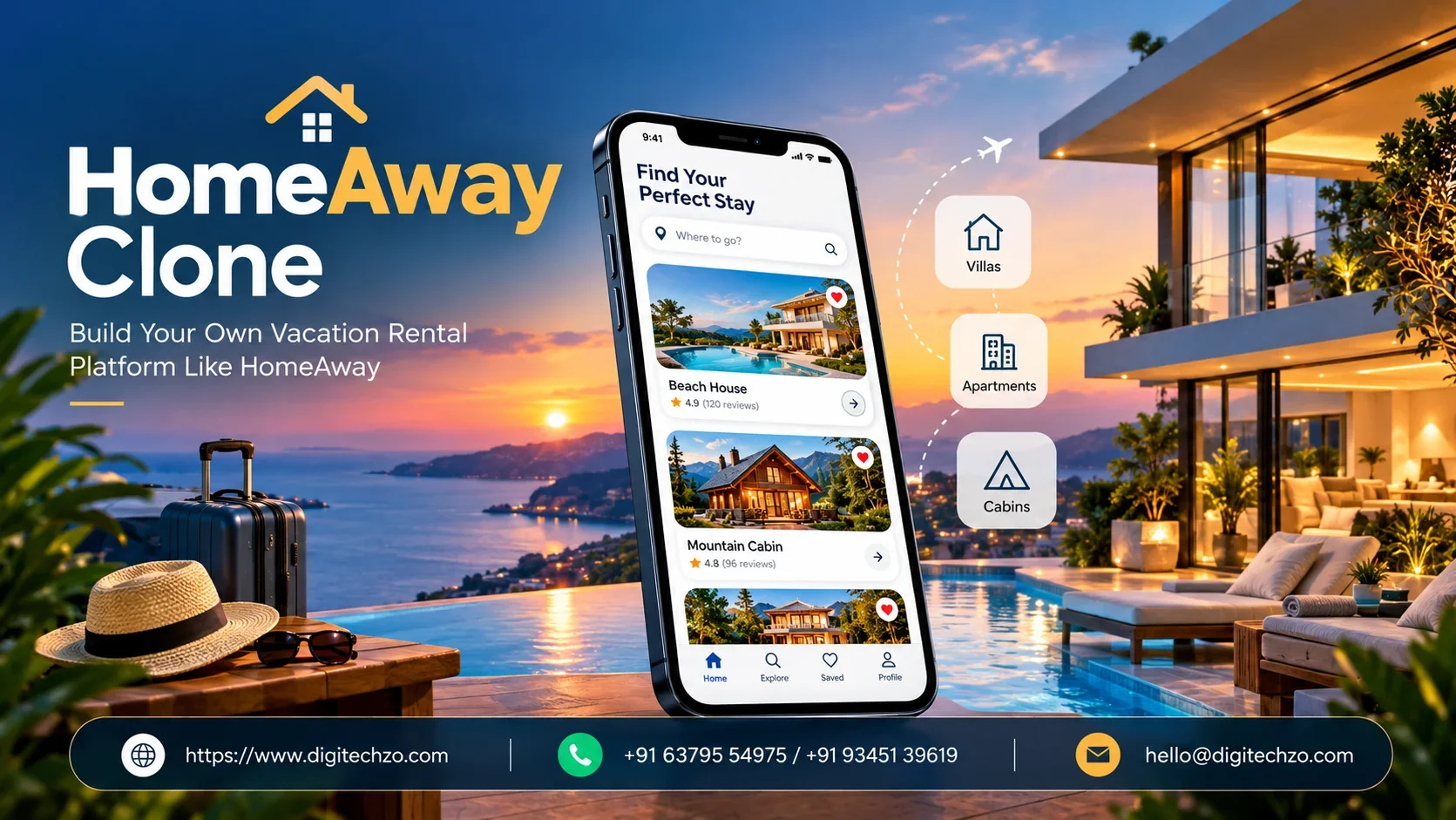
A HomeAway clone is a ready-made or custom-built vacation rental marketplace that reproduces the core workflow of HomeAway: owners and property managers list entire homes, travelers browse, enquire or book instantly, and the platform handles payments, messaging and reviews.
HomeAway, Vrbo and the Market Today
HomeAway was acquired by Expedia Group in 2015 and its websites were later folded into the Vrbo brand. That matters for two reasons.
First, people still search "HomeAway clone" because the name signals a specific model: whole-home, family and group stays, as opposed to single rooms or hotel inventory. Second, when you benchmark features and fees, you are really benchmarking Vrbo and Airbnb as they operate today, so check their current host and guest fee structures before you finalize yours.
Clone vs Inspired-By Platform
The word "clone" can mislead. Copying another brand's name, logo, design or proprietary content creates legal risk. A smart build reproduces the proven workflow, such as listings, booking, payments, reviews and messaging, and then differentiates through branding, niche focus and experience. Think of it as building a HomeAway-style platform with your own identity.
How a Vacation Rental Marketplace Works
A vacation rental marketplace is a two-sided platform. Supply is hosts and property managers. Demand is travelers. Your product succeeds only when both sides get value.
- A host creates a listing with photos, amenities, pricing rules, house rules and a calendar.
- A guest searches by destination, dates, guests and filters, then views availability and total price.
- The guest requests or instantly books, and payment is authorized.
- The host accepts (if required), and the platform confirms the stay.
- The platform releases the payout after check-in, deducting its commission, and both sides leave reviews.
The commercial logic is simple, but each step hides engineering decisions: how availability is stored, how cancellations refund, when payouts release, and how disputes are handled.
Core Features of a HomeAway Clone App
Treat these as the minimum viable feature set. Without them, the platform feels unfinished to hosts and unsafe to guests.
Guest Features
- Search and filters: destination, dates, guests, price, property type, amenities, map view
- Listing pages: photo galleries, amenities, house rules, cancellation policy, reviews, location
- Booking flow: instant book and request-to-book, with a transparent price breakdown showing nightly rate, cleaning fee, taxes and service fee
- Payments: cards and local payment methods, secure checkout, refunds
- Messaging: in-app chat between guest and host before and after booking
- Wishlist and trip management: saved properties, upcoming and past stays
- Reviews and ratings: verified reviews after completed stays
Host Features
- Listing management: photos, descriptions, pricing, seasonal rates, minimum stays
- Calendar management: availability blocking, iCal import and export
- Booking management: accept, decline, modify, cancel
- Payout management: bank or wallet payouts, earnings dashboard, payout history
- Messaging and reviews: respond to guests, review guests
- Analytics: views, enquiries, occupancy and revenue summaries
Admin Panel Features
- User, host and listing management with approval workflows
- Booking, payment and payout monitoring
- Commission and fee configuration
- Cancellation policy and tax settings
- Dispute handling, reports and content moderation
- Marketing tools such as banners, promo codes and featured listings
Advanced Features That Create Differentiation
Copying features gets you to parity. These additions are where a custom holiday rental app can earn a reason to exist.
| Feature | Why It Matters |
|---|---|
| Channel manager integration | Syncs calendars with other travel channels to reduce double bookings |
| Dynamic pricing tools | Helps hosts adjust rates by season, demand and local events |
| Identity verification | Builds trust, especially for high-value homes |
| Damage protection or deposits | Reduces host anxiety about group stays |
| Multi-language and multi-currency | Essential for cross-border travelers |
| Smart check-in support | Lock-code and arrival-instruction workflows |
| Property manager accounts | Lets agencies run many listings from one dashboard |
| AI-assisted listing descriptions and search | Improves listing quality and discovery |
Do not build everything at launch. Pick two differentiators that match your niche, and add the rest after you see real usage.
Recommended Tech Stack and Architecture
There is no single correct stack, but a common, maintainable setup looks like this:
- Mobile apps: Flutter or React Native for iOS and Android from one codebase, or native Swift and Kotlin for maximum performance
- Web front end: React or Next.js, which also helps with search-engine visibility for listing pages
- Back end: Node.js, Python or Java with REST or GraphQL APIs
- Database: PostgreSQL or MySQL for bookings and transactions; Elasticsearch or similar for fast search
- Payments: a payment gateway with split-payment or marketplace support
- Maps and location: Google Maps or Mapbox
- Cloud and storage: AWS, Google Cloud or Azure with a CDN for image delivery
- Notifications: push, email and SMS services
A modular or microservices architecture helps when you expect to add channels, markets or services later. For an MVP, a well-structured monolith is often faster and cheaper to run.
Calendar Sync and Double-Booking Prevention
Double bookings are the quickest way to destroy host trust, and many competing guides skip this problem entirely.
If hosts also list on other platforms, your calendar must stay consistent with theirs. iCal sync is the minimum, but it updates on a delay, so a booking made elsewhere may not appear immediately. Channel-manager or direct API integrations reduce the lag. Within your own platform, use database-level locking or reservation holds during checkout so two guests cannot book the same dates simultaneously. Decide early how you will handle the rare conflict, including compensation and rebooking policy.
HomeAway Clone Script vs Custom Development
This is the most important decision in the project, and the right answer depends on your goals.
| Factor | White-Label Script | Custom Development |
|---|---|---|
| Time to launch | Fast, often weeks | Longer, often several months |
| Upfront cost | Lower | Higher |
| Customization | Limited to what the script allows | Fully tailored |
| Code ownership | Varies by vendor; check the license | Typically full ownership |
| Scalability | Depends on the original architecture | Designed around your growth plan |
| Differentiation | Hard, since others use similar code | Strong, with unique workflows |
| Best for | Validating an idea quickly | Building a long-term brand or niche platform |
Questions to ask any script vendor: Do I receive full source code? Can I modify it freely? How are updates and security patches handled? What happens when payment-gateway APIs change? Can the architecture support the number of listings I expect in year two?
A practical middle path is to start with a script or a lean custom MVP, prove supply and demand in one region, then invest in custom features once you know what users actually do.
How Much Does HomeAway Clone App Development Cost?
Costs vary widely because "a vacation rental app" can mean a simple booking site or a multi-channel enterprise platform. Commonly quoted market ranges run from a few thousand dollars for white-label scripts to well over $100,000 for fully custom platforms. Treat these as orientation only, and get a scoped estimate before budgeting.
| Cost Driver | Impact |
|---|---|
| Platforms (iOS, Android, web) | Each additional platform adds design and testing effort |
| Feature depth | Instant booking, dynamic pricing and verification raise cost |
| Third-party integrations | Payments, maps, channel managers, messaging and KYC services |
| UI/UX design | Custom design costs more than templates |
| Admin panel complexity | Reporting, moderation and finance tools add scope |
| Security and compliance | Payment security, data protection and audits |
| Infrastructure | Hosting, search, storage and monitoring |
| Ongoing maintenance | Updates, bug fixes, OS changes and support |
Remember the costs that sit outside development: payment-processing fees, map and messaging usage, cloud hosting, legal setup, customer support and, above all, marketing to acquire hosts and guests. Many founders underbudget these.
Revenue Models for a Vacation Rental Platform
| Model | How It Works | Trade-Off |
|---|---|---|
| Guest service fee | A percentage added to each booking | Can raise the visible price for guests |
| Host commission | A percentage deducted from the host payout | Hosts may compare it with other platforms |
| Subscription | Hosts pay an annual or monthly listing fee | Predictable revenue, but harder to sell before you have traffic |
| Hybrid | Commission plus optional premium plans | More complex to explain and administer |
| Featured listings | Hosts pay for placement | Needs enough traffic to be worth buying |
| Ancillary revenue | Protection plans, experiences, partner offers | Requires additional partnerships and operations |
Because Vrbo has offered both commission and subscription models, hosts understand the choice. For a new platform, a lower or tiered commission often makes onboarding easier, and you can introduce subscriptions or premium visibility once demand is proven.
Development Process and Realistic Timeline
- Discovery and scoping: market, niche, feature priorities, monetization and compliance review
- UX and UI design: user flows, wireframes, prototypes and visual design
- Architecture and planning: data model, integrations, security approach
- Development: guest, host and admin modules built in sprints
- Testing: functional, payment, load, security and device testing
- Launch preparation: store submissions, analytics, support processes and a seeded set of listings
- Post-launch iteration: monitor bookings, fix friction, add features
A lean MVP commonly takes a few months; a feature-rich, multi-platform build takes longer. Timelines depend more on scope clarity and integration complexity than on developer headcount.
Common Mistakes and Risks
- Launching with demand but no supply. Guests leave if searches return empty results. Seed a specific destination with quality listings first.
- Competing head-on with Vrbo and Airbnb. A niche, such as a region, property type or traveler group, is more defensible than another generic marketplace.
- Ignoring calendar accuracy. Double bookings erode host trust quickly.
- Weak payment design. Define when guests are charged, when hosts are paid, how refunds work and how disputes are resolved before writing code.
- Skipping regulation. Short-term rental rules, licensing and tax collection vary by city and country. This article is technical and business information, not legal advice; consult a qualified professional for your markets.
- Overbuilding the MVP. Features that look impressive but go unused delay launch and burn budget.
- Copying branding. Using another company's name, logo or content creates avoidable legal and reputational risk.
- Underinvesting in trust. Verified profiles, reviews, clear policies and responsive support are product features, not afterthoughts.
Why Choose Digitechzo for Vacation Rental App Development
Choosing a development partner matters more than choosing a feature list. Two teams can quote the same screens and deliver very different products: one with clean architecture, reliable booking logic and room to scale, and one that works in a demo and struggles with real traffic.
Digitechzo is a technology development company that builds custom software and application platforms for businesses. For a vacation rental marketplace, that means starting from your market and niche rather than forcing you into a template, scoping the MVP carefully so you launch with what matters, and designing booking, payment and calendar logic with growth in mind. We aim for transparent communication, clear milestones and software you can own and extend as your marketplace grows.
If you are weighing a script against a custom build, or you already have a concept and need a realistic technical plan, a short discovery conversation is a sensible next step. You can describe your idea, get honest feedback on scope and priorities, and decide from there.
Frequently Asked Questions
How does calendar synchronization work across multiple vacation rental channels?
A robust vacation rental platform uses bidirectional iCal feeds and direct channel manager APIs (such as Guesty or Beds24) to synchronize booking availability with external platforms like Airbnb and Vrbo in real time, preventing double bookings and calendar discrepancies.
How does escrow payment processing protect guests and hosts?
Escrow payment gateways (such as Stripe Connect) hold the guest's booking payment securely until 24 hours after check-in. This protects guests by verifying the property matches listing descriptions and guarantees that hosts receive automated payouts without payment dispute risks.
What are the primary monetization models for a vacation rental app?
Vacation rental platforms generate revenue primarily through guest service fees (6%-12%), host commissions (3%-5% per completed booking), featured property listing promotions, and optional subscription tiers for professional property management companies.
What is the typical cost and development timeline for a HomeAway clone platform?
A functional MVP covering host onboarding, guest booking, search filters, and payments typically costs between $20,000 and $35,000 (10 to 14 weeks). A comprehensive custom platform with dynamic pricing, multi-currency support, and identity verification ranges from $40,000 to $75,000+ over 16 to 24 weeks.
Why is identity verification crucial for a vacation rental marketplace?
Automated KYC and government ID verification (via services like Persona or Stripe Identity) prevent fraudulent bookings, chargebacks, and property damage while fostering trust between independent hosts and traveling guests.