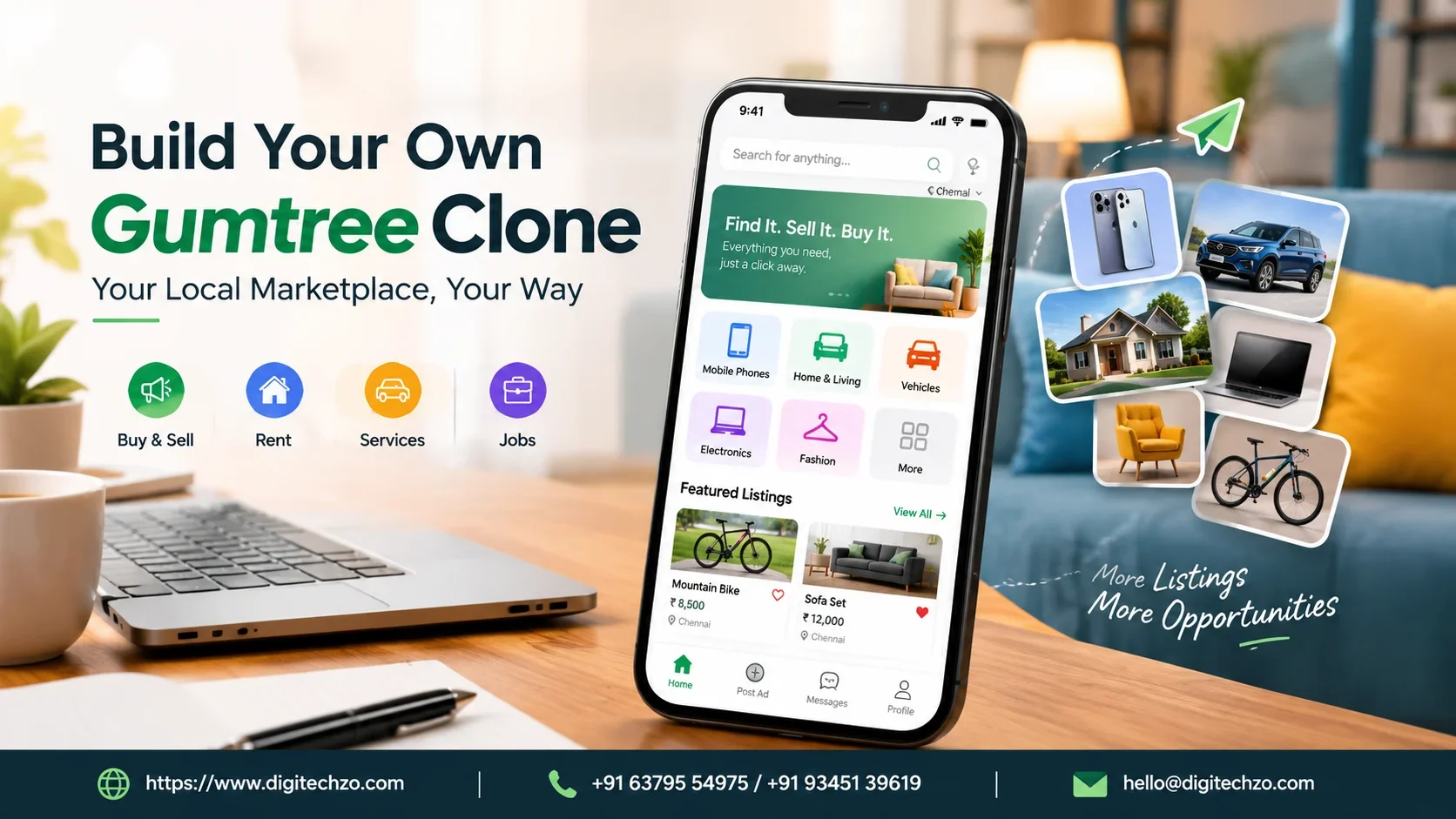
Most classifieds startups do not fail because the app is badly built. They fail because the listings are stale, the scams are unchecked, or nobody in the target city opens the app twice. A Gumtree clone looks simple on the surface: post an ad, search, chat, meet, sell. Underneath, it is a two-sided local marketplace that depends on search quality, trust and steady supply.
This guide explains how Gumtree clone app development really works: which features matter, how the platform earns revenue, what the architecture needs, when a ready-made script makes sense, what drives cost, and what to get right before launch. If you are weighing a build, DigiTechzo's perspective here is practical: ship a focused product, make it trustworthy, and grow it one local market at a time.
A Gumtree clone is a classifieds marketplace app or website that replicates the core model of Gumtree: users post free or paid local ads, buyers search and filter by category and location, and the two sides connect through in-app chat. A production-ready build needs listings, search, messaging, user profiles, moderation tools and monetization such as featured ads. A script gets you live faster, while custom development suits businesses that need unique features, scale and brand control.
What Is a Gumtree Clone?
Gumtree is a well-known classifieds platform that started in London in 2000 and lets people buy, sell and find jobs, property, services and local goods. A Gumtree clone is a platform built on the same model: a general local marketplace organized by categories and locations, funded mainly by advertising, upgrades and promoted listings.
"Clone" describes the business model and user experience pattern, not a copy of someone else's brand. The strongest products in this space rarely stay generic. They pick a region, a niche or a trust advantage and build around it.
What You Can Replicate and What You Should Not
| You can build | You should not copy |
|---|---|
| Category-based listings, location search, chat, saved ads | Gumtree's name, logo, trademarks and brand identity |
| Free ads plus paid promotions | Source code, design assets or proprietary content |
| Seller profiles and ratings | Listings, images or user data from existing platforms |
| Alerts and favourites | Misleading claims of affiliation |
Build an original brand, original code and original design on top of a proven model. That keeps you legally safer and gives you something worth ranking for.
How a Classifieds Marketplace Actually Works
A classifieds platform is a two-sided marketplace. Sellers supply listings; buyers supply attention. Each side is useless without the other, which is why growth is local and gradual. A city with 5,000 relevant active listings and a few thousand weekly buyers is a healthy market. A country with 50 listings per city is an empty one.
The core loop is simple:
- A seller creates a listing with photos, price, category and location.
- Moderation checks it for spam, prohibited items and duplicates.
- Search and category pages surface it to nearby buyers.
- A buyer messages the seller inside the app.
- They meet or arrange delivery, and the listing is marked sold.
Unlike product marketplaces such as Amazon, most classifieds transactions happen offline. That changes what you build: you optimise for discovery, trust and conversation quality, not necessarily for in-app checkout.
Essential Features of a Gumtree Clone App
Buyer Features
- Keyword search with category and location filters
- Filters for price, condition, distance and posting date
- Listing detail pages with image galleries
- In-app chat with push notifications
- Favourites, saved searches and alerts
- Share and report buttons
Seller Features
- Quick ad posting flow with multi-image upload
- Edit, renew, pause and mark-as-sold options
- Seller dashboard showing views, chats and performance
- Promotion options: featured, top and urgent listings
- Profile verification and ratings
Admin Panel
- Listing and user moderation queue
- Category, attribute and location management
- Pricing, plans and promotion configuration
- Reports, flagged content and ban management
- Analytics on listings, searches, conversions and revenue
A useful MVP rule: launch with fast posting, strong search, chat and moderation. Everything else can follow once real usage shows what matters.
Advanced Features That Make a Classifieds App Competitive
Anyone can launch the basics. These features separate platforms that retain users from those that fade:
- Smart category attributes. A car listing needs mileage, fuel and year; a rental needs bedrooms and deposit. Structured attributes make filtering precise and improve search quality.
- Map and radius search. Hyperlocal discovery is the main reason people choose local classifieds.
- Image-based moderation. Automated checks catch prohibited or duplicate images before listings go live.
- Scam and spam detection. Signals such as repeated listings, suspicious links, price anomalies and rapid account creation should trigger review.
- Verified profiles. Phone or email verification, and optional ID checks for high-value categories, reduce fraud.
- Saved-search alerts. Notifying buyers when a matching listing appears is one of the strongest retention loops.
- Multilingual and multi-currency support. Essential if you target regions with several languages.
- Seller analytics. Showing sellers views and chat counts makes paid promotion easier to justify.
How Classifieds Marketplaces Make Money
| Model | How it works | Best for | Trade-off |
|---|---|---|---|
| Featured / top ads | Sellers pay to boost visibility | Almost every classifieds platform | Needs traffic before sellers pay |
| Paid listings in selected categories | Charge for jobs, property, vehicles | Categories with high seller value | Can reduce supply if applied too early |
| Subscription plans | Dealers, agents or businesses pay monthly | Professional sellers | Requires clear plan value |
| Display advertising | Banner and sponsored placements | High-traffic platforms | Needs scale; can hurt experience |
| Lead generation | Charge for qualified enquiries | Property, auto, services | Needs tracking and trust |
| Transaction fees | Commission on in-app payments | Platforms with escrow or delivery | Hard to enforce when deals go offline |
Most successful platforms keep basic posting free to build supply, then monetize categories where sellers earn the most per sale. Charging too early in a new market usually slows growth.
Technology Stack and Architecture
There is no single correct stack, but a production classifieds app typically needs these layers:
- Mobile and web front end: React Native or Flutter for cross-platform apps; React or Next.js for web, which also helps SEO.
- Back end and APIs: Node.js, Laravel or Django, with REST or GraphQL APIs.
- Database: PostgreSQL or MySQL for core data, often with geospatial extensions for location queries.
- Search engine: Elasticsearch, OpenSearch or a comparable engine. Search relevance is the heart of a classifieds product, so database queries alone rarely scale well.
- Real-time chat: WebSockets or a managed messaging service, with push notifications through FCM and APNs.
- Media handling: Cloud object storage and a CDN, with image compression and moderation.
- Caching and queues: Redis and background workers for notifications, moderation and indexing.
- Payments: Gateways such as Stripe or Razorpay for promotions and subscriptions, depending on region.
- Admin and analytics: A dashboard for moderators and operations.
Two architecture decisions deserve early attention: SEO-friendly web rendering (every category and location page should be crawlable) and a moderation pipeline that can grow without slowing posting.
Gumtree Clone Script vs Custom Classifieds App Development
A ready-made script is a pre-built codebase you customize. Custom development builds the product to your requirements.
| Factor | Clone Script | Custom Development |
|---|---|---|
| Time to launch | Faster | Longer |
| Initial cost | Lower | Higher |
| Uniqueness | Limited; similar to other script buyers | High |
| Scalability | Depends on the script's architecture | Designed for your growth targets |
| Code ownership | Often licensed; varies by vendor | Typically full ownership |
| Customization | Constrained by existing structure | Flexible |
| Security and maintenance | Depends on vendor updates | You control the roadmap |
| Best for | Validating an idea quickly | Differentiated, scalable platforms |
A practical approach: if you are testing demand in one city or niche, a script can validate quickly. If your plan depends on differentiated features, specific compliance needs, integrations or long-term scale, custom classifieds app development is usually the safer investment. Many teams start with a focused MVP and evolve it. A development partner such as DigiTechzo can help you decide which path fits before you commit budget.
Before buying any script, check licensing terms, update history, code quality, security practices, the ability to extend it and how much of the stack you actually own.
Development Process and Timeline
- Discovery and market definition. Choose the region, niche, user types and success metrics.
- Product scope. Separate MVP features from later phases.
- UX and UI design. Prototype posting, search and chat flows first, because they decide retention.
- Architecture and development. Build back end, search, apps and admin panel.
- Moderation and trust layer. Implement reporting, filters, verification and review workflows.
- Testing. Functional, performance, security and device testing, plus load testing on search.
- Launch and iteration. Release in a limited market, measure, refine.
Timelines depend heavily on scope, platforms and integrations. A focused MVP is generally measured in months rather than weeks, and a full multi-platform product with advanced moderation and analytics takes longer. Treat any quote that promises a complete platform in a few weeks with caution.
Gumtree Clone Cost: What Drives the Budget
Cost varies too widely for a single honest number. These are the factors that move it most:
| Cost driver | Why it matters |
|---|---|
| Platforms (web, iOS, Android) | Each additional platform adds design, development and testing effort |
| Feature depth | Advanced search, verification and analytics add significant work |
| Custom vs script-based | Scripts reduce initial cost but may limit flexibility |
| Moderation tooling | Automated and manual review systems add complexity |
| Integrations | Payments, maps, SMS, email and KYC providers |
| Design quality | Custom UX takes more time than template-based design |
| Scalability targets | Higher traffic needs stronger infrastructure |
| Ongoing costs | Hosting, maps, SMS, storage, support and updates continue after launch |
Ask any vendor for a scope-based estimate with phases, assumptions and a clear list of what is excluded. Include moderation and operations in your budget, because they are the costs founders most often forget.
Trust, Safety and Compliance
Trust is the real product in classifieds. Scams, fake listings and unsafe meetups drive users away faster than any bug.
Build in from day one:
- Report and block tools on every listing and chat
- Rate limits and duplicate detection to curb spam
- Safety tips in chat and at the point of meetup
- Prohibited-items policies enforced by automated and manual review
- Clear seller verification tiers for higher-risk categories
Compliance considerations. Depending on where you operate, privacy laws (such as GDPR, UK GDPR or India's data protection law), consumer protection rules, advertising standards and online platform regulations may apply. Rules differ by country and change over time, and this is technical information, not legal advice. Consult a qualified lawyer in your target market before launch.
How to Launch and Get Your First Users
Marketplaces rarely grow nationwide on day one. A reliable approach is to win one market first.
- Pick a narrow start. One city, one cluster of categories, or one niche such as used electronics, student housing or local services.
- Seed supply before demand. Reach sellers first: dealers, small shops, agents and local communities. Buyers follow listings, not the other way round.
- Make posting effortless. If creating an ad takes more than a couple of minutes, supply will stall.
- Use local SEO. Crawlable category and location pages can bring steady organic traffic, provided each page has genuinely useful listings and not thin templates.
- Measure marketplace health. Track active listings per category, time to first chat, repeat posters and response rates, not only downloads.
Common Mistakes to Avoid
- Launching in too many cities or categories at once
- Treating moderation as a later task
- Charging sellers before there is enough buyer traffic
- Choosing a script without checking security and update history
- Copying another brand's identity rather than building your own
- Ignoring SEO architecture on the web version
- Underestimating post-launch operations and support
How to Choose a Classifieds App Development Partner
Use these questions to evaluate any team:
- Have they built marketplaces, listings or real-time chat products before, and can they explain the architecture?
- How will they handle search relevance, moderation and scalability?
- Do you own the source code, and what are the licensing terms?
- What does the scope document include and exclude?
- How do they handle security testing, data protection and post-launch support?
- Will they advise on MVP scope instead of simply quoting every feature?
- Is communication clear, with defined milestones and reporting?
A good partner challenges your assumptions about scope and timeline. One that agrees to everything is a risk.
Why Choose DigiTechzo for Gumtree Clone App Development?
Choosing a development partner shapes your product's reliability, speed to market and ability to scale, long after the launch announcement. A classifieds platform needs more than screens and a database; it needs search that works, moderation that scales and an architecture that can grow with your user base.
DigiTechzo is a technology company that works across mobile apps, websites, software development and digital growth, which is relevant for a marketplace that needs a strong product and a plan to attract users. The approach that suits a classifieds build is straightforward: define the market and MVP first, design the posting and search experience around real user behaviour, build moderation and security into the foundation, and plan for growth after launch rather than treating launch as the finish line.
If you are comparing a ready-made script against a custom classifieds platform, a short discovery conversation can clarify scope, priorities and the right starting point for your market, without obligation. Share your target region, niche and goals, and DigiTechzo can help you map a practical path from idea to launch.
Frequently Asked Questions
What Is a Gumtree Clone?
Gumtree is a well-known classifieds platform that started in London in 2000 and lets people buy, sell and find jobs, property, services and local goods. A Gumtree clone is a platform built on the same model: a general local marketplace organized by categories and locations, funded mainly by advertising, upgrades and promoted listings. "Clone" describes the business model and user experience pattern, not a copy of someone else's brand.
What key features are essential for Buyer Features?
Keyword search with category and location filters Filters for price, condition, distance and posting date Listing detail pages with image galleries In-app chat with push notifications.
What technology stack and backend architecture are recommended for Gumtree Clone App Development?
There is no single correct stack, but a production classifieds app typically needs these layers: Mobile and web front end: React Native or Flutter for cross-platform apps; React or Next.js for web, which also helps SEO. Back end and APIs: Node.js, Laravel or Django, with REST or GraphQL APIs.
What factors determine the development cost and timeline of Gumtree Clone App Development?
Discovery and market definition. Choose the region, niche, user types and success metrics. Separate MVP features from later phases.
How do Gumtree Clone App Development platforms generate revenue and monetize?
Most successful platforms keep basic posting free to build supply, then monetize categories where sellers earn the most per sale. Charging too early in a new market usually slows growth.