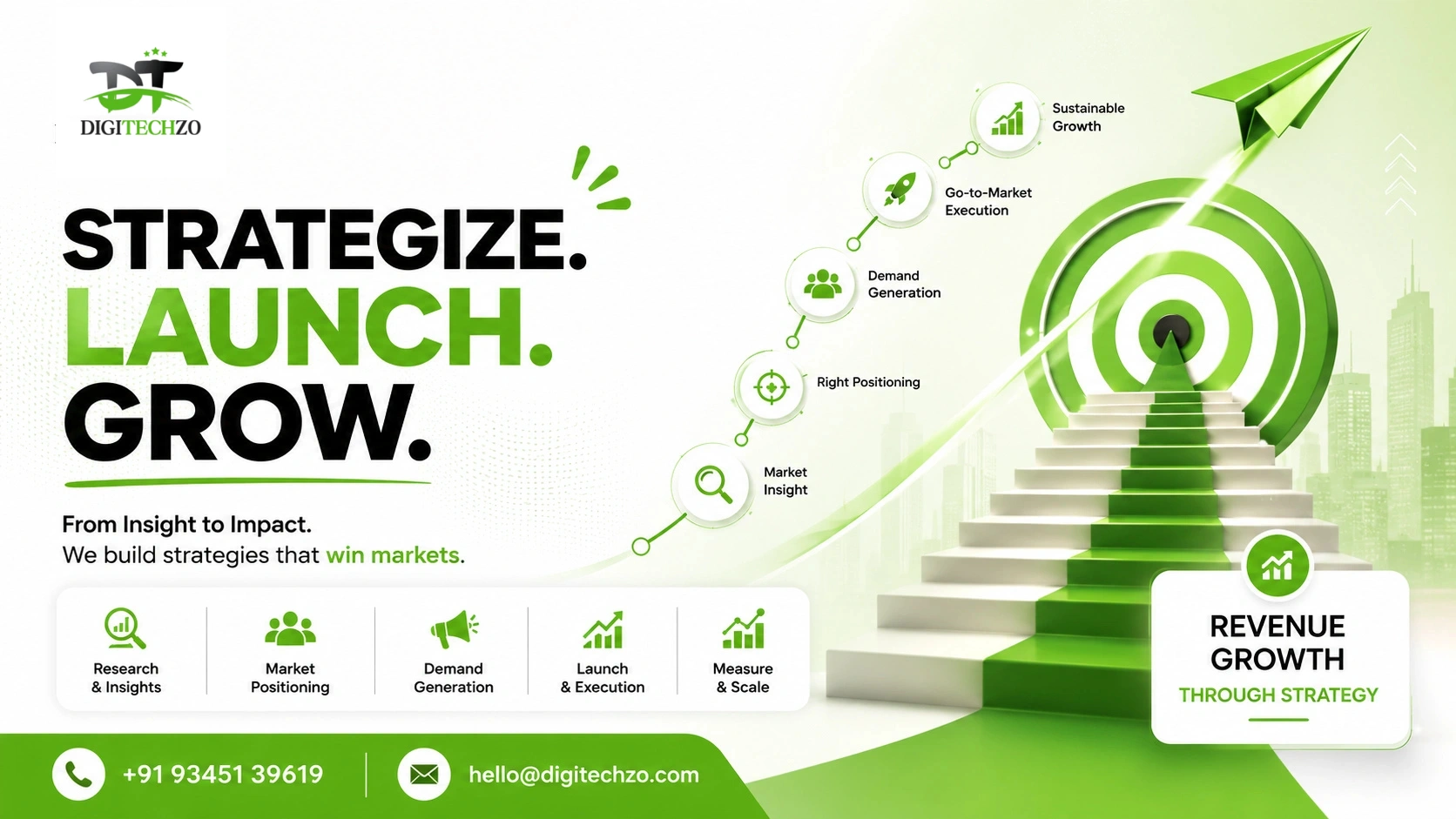
A GTM (go-to-market) strategy consultant helps you design and execute a launch or expansion plan that clearly positions your offering, targets the right customers, and aligns your sales, marketing, and product teams. The best GTM consultants combine market research with proven frameworks, bring cross-industry experience, and focus on measurable outcomes like customer acquisition cost (CAC), conversion rates, and product-market fit validation. Hiring one typically costs $5,000–$50,000+ depending on scope, but strong ROI comes from avoiding costly missteps and compressing your time-to-first-revenue by 30–60%.
What Is a GTM Strategy Consultant? (And Why It's Different from Marketing)
A GTM strategy consultant is a strategist who designs the complete pathway for bringing a product, service, or business expansion to market. Unlike a marketing consultant who focuses on campaigns and brand awareness, a GTM strategy consultant operates at a higher level—architecting the entire commercial strategy. Let's be clear: GTM strategy is not a marketing plan. It's the infrastructure that marketing operates within. A GTM strategy consultant defines:
Market positioning and messaging. How do you differentiate your offering? What problem do you solve better than competitors? What language resonates with your target buyer?
Target customer segmentation. Who is most likely to buy first? What company size, industry, or buyer persona has the highest propensity to convert? Which segments are most profitable?
Sales approach and pricing model. Will you go direct sales, inside sales, partner channels, or self-serve? What price point supports profitability while remaining competitive?
Customer acquisition channels. Which channels (cold outreach, content marketing, paid ads, partnerships, events) deliver the lowest CAC and highest lifetime value (LTV)?
Product positioning relative to competition. How do you compare to established players? Are you the cheaper alternative, the premium choice, or the innovative disrutor?
Launch timeline and success metrics. What does success look like? Revenue targets, customer acquisition numbers, conversion rate benchmarks, and key milestones? The best GTM strategy consultants operate like strategic architects. They ask hard questions, validate assumptions with data or customer conversations, and build a repeatable system that your entire team can execute against.
GTM Strategy vs. Marketing Strategy: Know the Difference
A marketing consultant optimizes within an existing strategy (email campaigns, content calendars, paid ad spend). A GTM strategy consultant defines the strategy itself. You could hire a great marketing consultant, but without a solid GTM foundation, you'll be optimizing the wrong channels or messaging the wrong benefits to the wrong people.
You're Launching a New product or Service If you're bringing something new to market—even a new feature set or vertical expansion—customers don't yet understand what you're selling or why they should care. A GTM strategy consultant helps you position the offering, identify early adopters, craft the launch narrative, and sequence your customer acquisition channels. The difference between a coordinated launch and a chaotic one is often 6–12 months of revenue acceleration.
Your Market Landscape Is Shifting Competitive entry, regulatory changes, or economic conditions can make your existing GTM strategy obsolete. A consultant provides fresh perspective on market dynamics, customer behavior changes, and emerging opportunities. For example, if you're in enterprise software and a competitor drops pricing 40%, you can't just match prices—you need a repositioning strategy that reinforces your differentiation.
You're Expanding into a New Segment or Geography Scaling into new customer segments or regions requires different messaging, sales approaches, and channel strategies. What worked for mid-market customers may not work for enterprise. What worked in the US may not work in Europe. A GTM consultant specializes in validating these assumptions and designing segment-specific strategies.
Your Customer Acquisition Costs Are Too High If your CAC is climbing while conversion rates fall, your GTM strategy is leaking value somewhere. It could be poor targeting, weak positioning, wrong sales approach, or misaligned messaging. A consultant conducts a GTM audit to identify where you're losing efficiency and restructures the system to lower costs while maintaining or increasing conversion.
Your Sales and Marketing Teams Are Misaligned Sales teams say marketing gives them bad leads. Marketing says sales doesn't follow up properly. Neither is wrong—they just lack a shared GTM strategy that aligns them. A consultant bridges this gap by defining what "qualified lead" means, what messaging resonates, and how handoff between departments should work.
You Want Predictable Revenue Growth Without a documented, repeatable GTM strategy, growth is random and dependent on individual salespeople or campaign creators. A GTM consultant builds a system that scales: consistent positioning, repeatable customer acquisition processes, defined success metrics, and accountability touchpoints.
The Core Components of Effective GTM Strategy
Before evaluating consultants, understand what an effective GTM strategy contains. These are the building blocks:
Component 1: Market and Competitive Analysis
A solid GTM strategy starts with deep understanding of your market. The consultant should research: Market size and growth rate. Is this market expanding, flat, or contracting? TAM (total addressable market) and SAM (serviceable addressable market) inform how aggressive your acquisition strategy can be. Competitive landscape. Who are direct and indirect competitors? What are their positioning, pricing, sales model, and customer base? What gaps exist that you can exploit? Customer pain points and buying behavior. What keeps your target customer up at night? When do they buy? How long is their sales cycle? What are the key decision criteria? A weak consultant skips this analysis or relies on outdated market research. Strong consultants conduct primary research—customer interviews, competitive testing, win/loss analysis—to ground strategy in reality.
Component 2: Ideal Customer Profile (ICP) and Buyer Personas
Who wins fastest and most profitably? Your ICP defines the target account characteristics (company size, industry, revenue, location, technology stack) where you have the highest conversion probability and best LTV. Buyer personas layer on the individual (job title, goals, pain points, objections, how they research, which channels they use). A strong GTM strategy doesn't try to sell to everyone—it doubles down on the segment where product-market fit is strongest and then expands. Example: A personal branding consultant might find that solo entrepreneurs with 6-12 months of coaching experience convert fastest, have the highest average deal value, and become best referral sources. This becomes the wedge—the initial segment where you win, prove success, and then expand to adjacent segments.
Component 3: Positioning and Messaging Architecture
Positioning is your strategic claim: "We help [ICP] achieve [outcome] by [differentiation]." It's NOT a tagline or mission statement—it's the foundation for all marketing and sales messaging. Strong positioning articulates: Your point of differentiation. Are you cheaper, faster, better, easier, or innovative? Most businesses claim all five—and that kills credibility. Pick your real advantage. The problem you solve. Not the feature benefit, but the business outcome (faster growth, lower risk, higher quality, better experience). Proof points. Customer testimonials, case studies, numbers, or third-party validation that reinforce your differentiation. Weak positioning sounds like every competitor. Strong positioning polarizes—it attracts your ideal customer and repels those who aren't it.
Component 4: Sales Model and Channel Strategy
How do customers buy from you? Direct sales. You hire a sales team, conduct discovery calls, create custom proposals. Inside sales. Smaller deal sizes, faster sales cycles, same-day discovery to close. Self-serve or freemium. Customers find you online, sign up, and use without human interaction (at first). Partnerships or channels. Resellers, affiliates, or strategic partners sell on your behalf. Hybrid. Combination of above (e.g., self-serve freemium model with a direct sales team for upmarket customers). Each model has different economics. Direct sales is expensive but high-touch and high-ACV. Self-serve is scalable but requires product-led growth. A good GTM consultant matches model to market and customer profile.
Component 5: Pricing Strategy and Value Communication
Pricing isn't random. It signals quality, targets specific customer segments, and impacts every other part of GTM strategy. A consultant should validate pricing through: Value-based pricing. What is the economic value to the customer? If you save them $100K annually, pricing at $15K annually is defensible. Competitive pricing analysis. What do competitors charge? Are you premium, value, or discount positioning? Pricing model validation. Is it per-seat, per-usage, per-outcome, or hybrid? What model aligns with customer buying behavior and your business model? Weak consultants suggest prices in a vacuum. Strong consultants tie pricing to positioning, customer value, and business model.
Component 6: Launch and Expansion Timeline
When do you launch? How do you sequence customer acquisition channels? When do you add new features or segments? A strong GTM strategy includes: Pre-launch phase. What validation and prep work happens before go-live? Who are your beta customers? What feedback do you need? Launch phase. Day one through month three. Do you launch quietly or with a bang? How do you generate initial traction? Growth phase. Months 3–12. Which channels are working? Where do you double down? What's your unit economics? Expansion phase. Year 1+. New segments, geographies, product lines. How do you scale without losing positioning or quality?
What to Look for When Hiring a GTM Strategy Consultant
Not all GTM consultants are created equal. Here's how to evaluate:
Red Flags to Avoid
One-size-fits-all frameworks. If a consultant says "all GTM strategies follow this template," run. Every market, business model, and customer profile is different. Templates are starting points, not destinations. No primary research. If they propose a GTM strategy without interviewing your customers, competitors, or sales team, they're guessing. Strong consultants invest time in discovery. Unclear pricing or vague deliverables. You should know exactly what you're paying for and what you'll receive (strategic plan, messaging guide, positioning document, sales playbook, channel strategy, etc.). No track record or case studies. Ask for references. Have they worked in your industry? With companies your size? What were the results? Selling their service, not solving your problem. Some consultants use GTM projects as a lead generation funnel for their own services (training, coaching, implementation). That's fine, but be aware of the incentive.
Green Flags to Look For
Deep industry and vertical expertise. Consultants who've worked extensively in your space understand buyer behavior, competitive dynamics, and unwritten rules. SaaS GTM is different from services GTM is different from physical products.
Intellectual honesty. They're willing to tell you hard truths (your positioning is weak, your ICP is too broad, your pricing is wrong). Yes-men consultants aren't valuable.
Quantitative and qualitative research. They interview customers, analyze competitive landscape, validate assumptions with data, and adjust based on evidence—not intuition alone.
Proven frameworks with flexibility. They have methodologies (like Strategyzer's Value Proposition Design or Reforge's GTM frameworks), but they adapt to your situation rather than forcing you into a template.
Cross-functional understanding. Great GTM consultants understand not just marketing, but product strategy, sales operations, pricing, customer success, and business development. GTM lives at the intersection of all teams.
Clear communication and actionability. The deliverable isn't a 100-page strategic manifesto that sits on a shelf. It's a clear, actionable guide your team can execute against immediately.
Questions to Ask Potential Consultants
"Walk me through a recent GTM strategy project. What was the situation? What did you recommend? What were the results?" "How would you approach our specific situation?" (See if they ask clarifying questions or jump to recommendations.) "What's your process for validating assumptions?" "How will we measure success? What metrics matter most?" "What happens after you deliver the strategy? Will you help us implement or train our team?" "Have you worked with companies our size? In our industry?"
The Core Components of Effective GTM Strategy
How to Structure Effective GTM Positioning
The strongest GTM strategies use positioning frameworks that cut through noise. Here's a simple one: For [target customer segment] who [key problem statement], our [product category] delivers [quantified value] by [key differentiator]." Example: "For solo entrepreneurs who struggle to establish credibility in their market, digitechzo's personal branding services deliver a 3x faster path to thought leadership status by combining AI-powered positioning strategy with authentic human coaching." Notice: specific ICP, clear problem, product category, quantified benefit, differentiator.
Competitive Positioning Map Exercise
A GTM consultant often builds a 2x2 matrix showing where you sit versus competitors:
- Axis 1: Price (low to high)
- Axis 2: Complexity/Enterprise readiness (simple to complex) You plot yourself and competitors. You may discover you're in a crowded quadrant (bad) or in a unique space (good). This visual clarifies where you can win without directly competing on price.
Common Mistakes Businesses Make with GTM Strategy
Mistake 1: Too Broad a Target Customer "We sell to anyone who has a business." That's not a GTM strategy—it's hope. Lack of focus means weak positioning, scattered marketing spend, confused sales messaging, and poor conversion. Start narrow. Win a segment. Expand.
Mistake 2: Building GTM Strategy in a Vacuum You build strategy internally without talking to customers, prospects, or competitive alternatives. Result: you're solving for problems customers don't have, missing their real pain points, and out-of-sync with market realities. Customer research isn't optional—it's foundational.
Mistake 3: Confusing GTM with Marketing You treat GTM strategy as a marketing initiative and ask your marketing team to "build the GTM strategy." Marketing should execute GTM strategy, not create it. GTM is bigger and requires leadership input from product, sales, and finance as well.
Mistake 4: Ignoring Sales Model Implications You design a positioning and messaging strategy without understanding how customers actually buy. Then you try to sell a self-serve offering using a direct sales team (expensive inefficiency) or a complex enterprise product using only content marketing (won't close). Sales model and GTM must align.
Mistake 5: Pricing Disconnected from Value Communication Your price doesn't reflect the value you're communicating, or your messaging doesn't justify the price. If you're charging $10K but talking about "minor efficiency gains," buyers will feel ripped off. Price and positioning must align.
Mistake 6: No Clear Success Metrics You launch a GTM strategy but don't define what success looks like. Is it customer count, revenue, market share, brand awareness, or conversion rate? Without clarity, you can't measure progress or adjust course. Strong GTM strategies define metrics upfront.
Mistake 7: Set and Forget You hire a consultant, they deliver a beautiful strategy document, and it sits on a shelf while everyone goes back to business as usual. GTM strategy only works if it's actively implemented, monitored, and adjusted. Expect the first 90 days post-strategy to be intensive execution.
Mistake 8: Misalignment Between Sales and Marketing Marketing generates leads using the GTM positioning and messaging, but sales team doesn't follow the playbook. Or sales wants to customize the message for every customer, making marketing's work ineffective. Sales and marketing must share the GTM strategy and commit to consistency with flexibility.
Expert Tips for Maximizing Your Consultant Partnership
Tip 1: Invest Time in Discovery The consultant's first 2-4 weeks should focus on discovery: customer interviews, competitive research, internal stakeholder alignment, and market validation. Don't rush this. The quality of strategy depends on the quality of discovery. Dedicate 3-5 hours per week to interviews and workshops.
Tip 2: Make It a Cross-Functional Project GTM strategy requires alignment from product, sales, marketing, and leadership. Create a working group that meets weekly with the consultant. Everyone contributes perspective, and everyone leaves aligned. This prevents later conflicts ("marketing didn't consult us") and accelerates buy-in.
Tip 3: Validate Assumptions Explicitly A strong consultant will lay out assumptions: "We believe your ICP is mid-market B2B SaaS companies with 50–500 employees. We believe they value ease-of-use over features. We believe the sales cycle is 60–90 days." These should be validated through customer interviews or data analysis before they become strategy pillars.
Tip 4: Demand Specificity "Improve brand positioning" is vague. "Position as the only GTM consulting firm that combines AI-powered market analysis with human strategic expertise for companies under $50M revenue" is specific. Specificity drives execution. Every recommendation should be testable and actionable.
Tip 5: Build in Quick Wins GTM strategy doesn't have to be perfect to start delivering value. Identify 2-3 quick wins during discovery: a messaging adjustment that could improve conversion, a customer segment to focus on, a sales process improvement. Implement these early to build momentum and prove the strategy works.
Tip 6: Plan for Implementation Ask the consultant how you'll implement the strategy. Will they provide training? Will they help craft sales playbooks? Will they support the first 90 days of execution? Some consultants deliver strategy and leave—you're responsible for execution. Others partner through implementation. Agree upfront on the scope.
Tip 7: Create Accountability Define a point person on your team who owns GTM strategy execution (often the CMO, VP Sales, or Chief Strategy Officer). This person is accountable for tracking progress against metrics, managing cross-functional alignment, and adjusting tactics as you learn. GTM strategy doesn't execute itself.
Why Choose DigiTechzo for GTM Consulting ?
A strong GTM strategy needs to connect market positioning, customer targeting, sales, marketing, and product priorities into one clear execution plan. For businesses entering a new market or refining an existing launch approach, choosing a partner that understands these interconnected requirements can help reduce inefficiencies and support more informed decisions.
DigiTechzo brings a technology-focused perspective to business growth, helping align strategic thinking with digital products, customer requirements, and market opportunities. This makes its approach relevant for businesses that need more than isolated marketing activities and instead require a coordinated view of positioning, audience targeting, and growth planning.
For B2B businesses seeking a structured approach to market entry and expansion, exploring DigiTechzo through its GTM AGENCY FOR B2B BUSSINES offering provides a relevant next step for understanding its GTM capabilities.
FAQs About GTM Strategy Consultants
How Much Does a GTM Strategy Consultant Cost?
Costs vary widely. Freelance consultants might charge $3K–$10K for a basic strategy. Boutique firms charge $15K–$50K+. Large consulting firms (McKinsey, BCG level) charge $50K–$250K+. Scope, consultant seniority, and research depth drive cost. Generally, expect to invest 2–4% of your first-year revenue target in GTM strategy if you're serious about getting it right. For a Series A startup planning to raise at $5M valuation, $20K–$30K for a consultant is a good investment if it improves your go-to-market by even 20%.
How Long Does a GTM Strategy Project Take?
Typically 6–12 weeks depending on complexity. A simple positioning refresh might take 4 weeks. A full GTM strategy for a new market entry might take 12 weeks. The timeline includes discovery (2–4 weeks), analysis and synthesis (2–3 weeks), strategy development (2–3 weeks), and presentation/refinement (1–2 weeks). Don't expect quality work in less than 4 weeks.
Should We Hire an Internal GTM Lead or a Consultant?
Both have merits. A consultant brings external perspective, proven frameworks, and doesn't cost ongoing salary. An internal hire owns GTM long-term and learns your business deeply. Consider: hire a consultant to build strategy (3 months), then hire an internal Head of GTM or Chief Strategy Officer to implement and evolve it (ongoing). Some businesses do both: consultant for strategic work, internal hire for execution.
How Do We Know If the GTM Strategy Is Working?
Define metrics upfront. Common ones include: customer acquisition cost, conversion rate, time-to-close, customer lifetime value, market share growth, or revenue growth vs. plan. Track these monthly. Most GTM strategies show results within 60–90 days of implementation. If a metric doesn't improve after 90 days, either the strategy wasn't implemented correctly, or it needs adjustment. Good consultants build in reflection points to validate and adjust.
Can We Work with a Consultant on a Part-Time or Retainer Basis?
Yes, many consultants offer retainer models where they dedicate 5–10 hours per week to GTM work. This works well if you need ongoing strategic support, market monitoring, or implementation help. Cost is typically lower than project-based work but spread over time. Retainer arrangements work best when the consultant is deeply familiar with your business (usually after an initial project phase).
What's the Difference Between a GTM Consultant and a Marketing Consultant?
A marketing consultant optimizes your go-to-market execution (campaigns, content, ads, SEO). A GTM consultant designs the strategy that marketing and sales execute against. Marketing consultant asks, "How do we improve email open rates?" GTM consultant asks, "Should we even be using email, and to which customer segment?" Both are valuable, but GTM consultant work should come first.
Can a Consultant Help With Implementation, Not Just Strategy?
Absolutely. Many consultants offer phased engagement: Phase 1 is strategy (6–8 weeks), Phase 2 is implementation support (ongoing). During implementation, they might help train your sales team, refine messaging, run competitive analysis, or monitor metrics. This is higher-touch and higher-cost, but results are often better because the consultant stays accountable to outcomes.