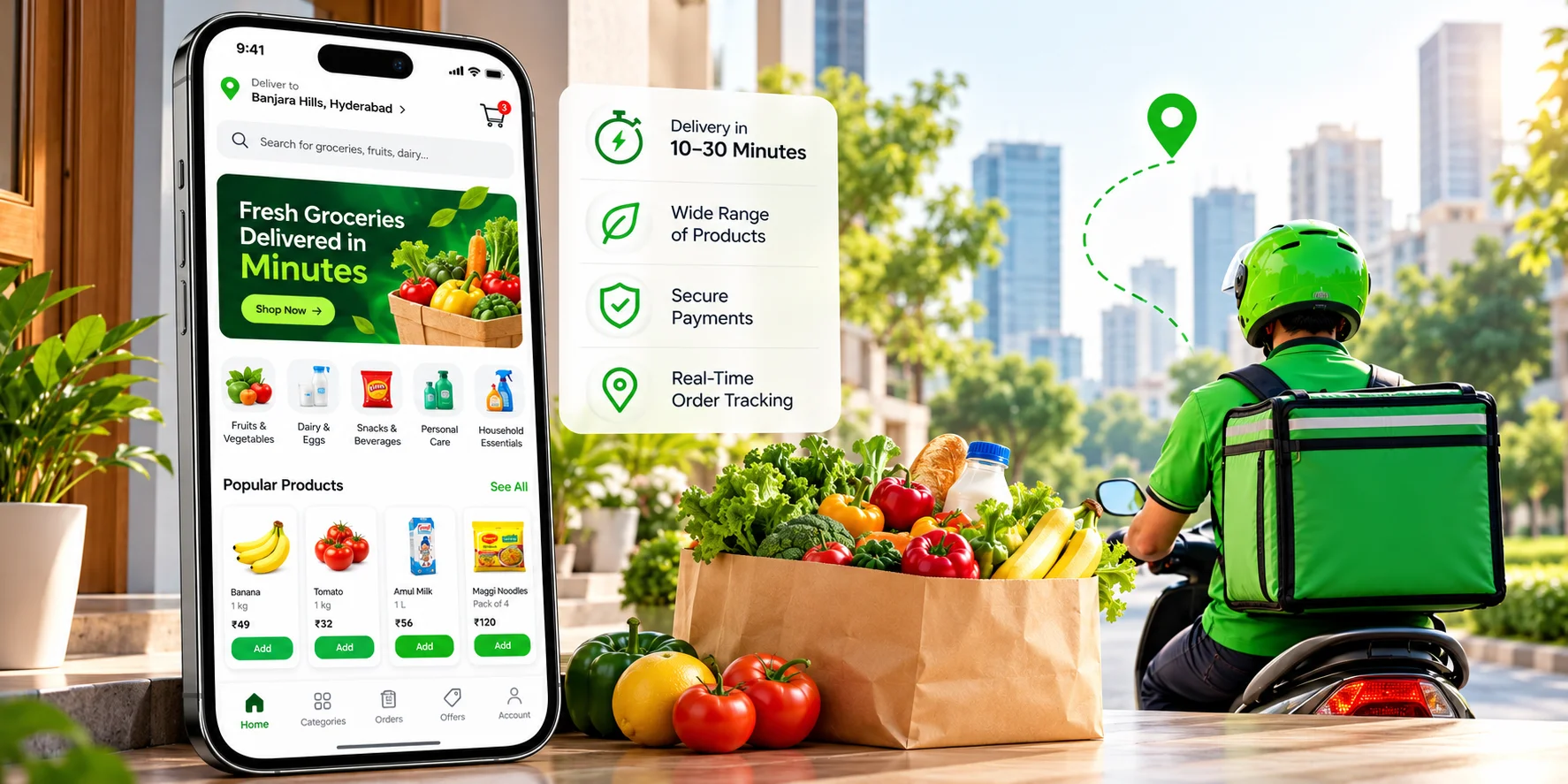
Most grocery apps do not fail because the catalog is missing or the buttons are the wrong color. They fail because the first order goes wrong. An item is out of stock with no sensible substitute, a delivery slot disappears at checkout, or a weighed item is charged at the wrong price. The customer leaves and the app gets deleted.
This guide explains what a grocery mobile app involves, which business model suits you, which features carry the most weight, what it realistically costs, and how to decide between building custom, using white-label software, or doing both. It is written for grocers, food entrepreneurs and retail leaders who need to make a budget decision, not for developers.
A grocery mobile app is software that lets customers browse products, place orders and receive groceries by delivery or pickup, backed by admin, inventory and delivery tools. Published 2026 cost estimates from development vendors range from roughly $10,000 for a basic MVP to $150,000 or more for a full platform, and the gap comes mainly from the number of user panels, inventory integration, delivery logic and the team's location. For most businesses, a focused MVP built around one store or one city is the safest starting point.
What a Grocery Mobile App Actually Includes
The apps behind one app
The customer-facing app is only one part of the product. A working grocery platform usually has four connected parts:
- Customer app for browsing, ordering, paying and tracking.
- Delivery partner app for accepting jobs, navigating and confirming handover.
- Admin dashboard for catalog, pricing, orders, offers and reports.
- Store or vendor panel for stock, order preparation and, in marketplaces, each seller's own catalog.
Cost estimates that talk about "an app" without saying which of these are included are hard to compare. Ask for the scope in terms of panels before you compare prices.
Why grocery is harder than generic e-commerce
A grocery basket behaves differently from a fashion or electronics order:
- Perishable, fast-changing stock. Availability can change between adding an item to the cart and checkout.
- Substitutions. When the first-choice item is unavailable, the app needs rules for what to offer and whether the customer approves it.
- Variable-weight items. Produce, meat and deli items are priced by weight, so the final charge may differ from the estimate.
- Time-sensitive delivery. Slots, cold-chain handling and delivery windows matter more than in standard parcel delivery.
- Repeat behavior. Customers reorder similar baskets weekly, so the reorder experience matters more than discovery.
At least one cost guide notes that grocery apps tend to cost more than generic food delivery apps because of inventory complexity, substitution logic and time-slot scheduling. If a quote looks like a generic marketplace template, check how it handles these.
Is a Grocery App Still Worth Building?
Yes, but the case depends on what you are competing on.
Online grocery is no longer a niche. Online's share of total U.S. grocery spending rose from under 15% at the end of Q3 2024 to more than 19% in Q1 2026. Consumer spending on online grocery grew 19% in Q1 2026, following a 20% rise in Q4 2025.
The harder part is who captures that growth. Walmart is approaching 40% of total U.S. e-grocery sales, and faster delivery is reducing the proximity advantage regional grocers have traditionally had. A new app that tries to beat Walmart or Amazon on speed and price is unlikely to work.
The more realistic opportunities are where large platforms are weak:
- Local trust and curation: neighborhood grocers, farm-to-home produce, regional specialties.
- Niche categories: halal, organic, ethnic or specialty foods, pet food, age-restricted products.
- Direct customer relationships: loyalty data and repeat-order control instead of paying marketplace commissions.
- Ownership of the experience: pickup, delivery slots and substitutions handled the way your customers expect.
India shows the same pattern at a different speed. India's quick-commerce platforms have crossed nine million daily orders, with Blinkit, Zepto and Swiggy Instamart accounting for nearly four-fifths of them. For independent retailers there, the practical question is usually not "can we out-deliver them?" but "which part of the customer relationship can we own?" newsbytesapp
Choosing the Right Business Model
Pick the model before you pick features. The model decides your panels, your logistics and your cost.
| Model | Best for | Main complexity | Typical starting scope |
|---|---|---|---|
| Single-store app | One supermarket or grocer going online | Inventory sync with in-store systems | Customer app + admin + simple delivery |
| Click-and-collect | Stores with strong foot traffic | Pick-and-pack workflow, pickup slots | Customer app + staff picking tool |
| Multi-vendor marketplace | Aggregators connecting many stores | Vendor onboarding, commissions, payouts | Four panels, vendor catalogs |
| Subscription or recurring-order app | Staples, produce boxes, dairy | Billing cycles, pause/skip, failed payments | Customer app + subscription engine |
| Quick-commerce with dark stores | Dense urban areas | Hyperlocal inventory, rider dispatch, very short delivery windows | Full platform with real-time logistics |
If you are unsure, a single-store or click-and-collect model is the lowest-risk way to test demand. You can add delivery partners or vendors once orders are stable.
Essential Features by User Type
Customer app
These are the features customers expect from any online grocery shopping app:
- Fast search with filters (category, brand, dietary needs) and barcode scan where relevant
- Real-time stock and price visibility
- Cart, checkout and multiple payment options
- Delivery slot or pickup slot selection
- Reorder from past orders and saved shopping lists
- Order tracking with notifications
- Substitution preferences per item
- Offers, coupons and loyalty
The ones that change retention are reorder, saved lists and substitution control. A shopper who can rebuild last week's basket in two taps is far more likely to return than one who must search again.
Delivery partner app
- Job acceptance and assignment
- Navigation and route support
- Proof of delivery (photo, OTP or signature)
- In-app contact with customer
- Earnings and shift visibility
Admin dashboard
- Catalog, pricing and offer management
- Order, refund and customer management
- Delivery zones and slot configuration
- Reports on sales, stock movement and repeat rate
- Role-based access for staff
Store or vendor panel
- Live stock updates
- Order acceptance and picking status
- Out-of-stock marking that updates the app immediately
- Settlement and payout summaries (for marketplaces)
Features worth adding after launch
Hold these until the core flow is stable: AI-based recommendations, recipe-linked baskets, subscription boxes, advanced routing, voice search, and dynamic pricing. Each adds cost and testing effort, and none replaces a reliable first order.
Technology Stack and Architecture
You do not need to choose every tool yourself, but you should understand the decisions a partner will ask you to make.
| Layer | Common options | What to weigh |
|---|---|---|
| Mobile front end | React Native, Flutter (cross-platform); Swift and Kotlin (native) | Cross-platform usually reduces cost and time; native may suit heavy device features |
| Backend | Node.js, Python/Django, Java, .NET | Team expertise, scalability, ecosystem |
| Database | PostgreSQL or MySQL, often with a cache such as Redis | Handling catalog, orders and stock updates reliably |
| Maps and location | Google Maps or alternatives | Address accuracy, delivery estimates, tracking |
| Payments | Gateway providers (card, wallet, UPI where relevant) | Local payment preferences, refund handling |
| Notifications | Push and SMS/WhatsApp services | Order updates, reorder nudges |
| Hosting | Major cloud providers | Peak-time scaling, uptime, cost |
Three architectural choices matter more than the brand names:
- Inventory source of truth. Decide whether the app or your existing POS/ERP owns stock. Poor sync is a leading cause of out-of-stock cancellations.
- Modular services. Keeping catalog, orders, payments and delivery as separate modules makes it easier to add a feature or vendor later.
- Peak load planning. Grocery demand spikes before weekends and festivals. Test for those peaks, not just average days.
Grocery App Development Cost
Why published estimates vary so widely
If you have searched for grocery app development cost, you have probably seen figures that do not agree. They are all vendor-published and directional, and they describe different things:
| Source (2026) | Scope described | Published range |
|---|---|---|
| Indian-team cost guide | Basic MVP to enterprise platform | About $10,000-$25,000 for an MVP with an experienced Indian team, and $60,000-$150,000 or more for an enterprise platform |
| Software-development vendor | Three-sided MVP (customer, shopper, retailer) | $65,000-$140,000, with an MVP in about 14-18 weeks |
| Development firm guide | MVP to enterprise tiers | MVP at $15,000-$20,000 in 2-3 months; enterprise at $27,500-$35,000+ |
| Cost estimator | Instacart-style app | Lean MVP $30,000-$60,000; full custom build $70,000-$170,000 |
| Cross-vendor overview | On-demand grocery app | $30,000-$400,000 depending on complexity, model and customer |
Treat these as a map of the market, not a quote. The same label ("MVP") can mean a single-store catalog with one payment gateway or a three-sided platform with a picker app, and "enterprise" is defined differently in each source.
What drives the number
- Number of panels. A customer-only app is a different project from customer + delivery + admin + vendor.
- Business model. Marketplaces and quick-commerce need vendor logic, payouts and real-time dispatch.
- Platforms. One cross-platform codebase usually costs less than separate native iOS and Android apps.
- Integrations. POS/ERP, payment gateways, maps, SMS/WhatsApp, loyalty and accounting systems each add scope.
- Design effort. Search, cart and checkout flows for large catalogs need careful UX work.
- Team location and model. Hourly rates differ by region, and fixed-price and dedicated-team contracts behave differently when scope changes.
- Testing depth. Payment, concurrency and stock-sync testing is worth the time.
Costs people forget
- App store developer accounts and review cycles
- Third-party fees: maps, SMS, payment gateway charges
- Cloud hosting that grows with order volume
- Maintenance, OS updates and bug fixes after launch
- Catalog onboarding and image preparation
- Customer support tools
- Delivery operations (riders, vehicles, packaging) if you run logistics yourself
A useful planning habit is to ask for the launch cost and the first-year running cost separately.
Timeline: A Realistic Phased Roadmap
Sources quote anything from two or three months for a lean MVP to over a year for a complex platform, so your timeline depends on scope. A phased plan keeps risk manageable:
| Phase | Focus | Outcome |
|---|---|---|
| 1. Discovery | Model, users, scope, integrations, success metrics | A scoped plan and clear MVP boundary |
| 2. UX and design | User flows, search, cart, checkout, delivery screens | Clickable prototype tested with real shoppers |
| 3. MVP build | Customer app, admin, basic delivery, one or two payment methods | Working product for a limited area |
| 4. Pilot | Real orders in one store or zone | Data on failed orders, substitutions, slot demand |
| 5. Improve | Fixes, reorder and loyalty features | Higher repeat rate |
| 6. Scale | More zones, vendors, integrations | Controlled expansion |
The pilot is the step most teams skip, and it usually costs the least relative to what it teaches.
Build Custom, Use White-Label, or Go Hybrid?
| Option | Advantages | Trade-offs | Often suits |
|---|---|---|---|
| Custom build | Full control, tailored workflows, unique features, ownership of data and code | Higher upfront cost, longer time to market | Businesses with differentiated operations or long-term plans |
| White-label / ready-made platform | Faster launch, lower initial cost | Limited customization, vendor dependency, recurring fees | Testing a concept quickly |
| Hybrid (ready-made base, customized) | Faster than custom, more flexible than pure white-label | Depends heavily on the quality of the base product | Growing grocers with specific needs |
Before choosing white-label, ask who owns the customer data, whether you receive source code, and what changes when you outgrow the base product. Those answers matter more than the launch date.
Security, Payments and Compliance Basics
This is technical guidance, not legal advice. Confirm obligations for your market with a qualified professional.
- Payments. Use established payment gateways so card data is handled by the provider rather than stored by your app. Check the gateway's compliance with card-industry security standards.
- Personal data. Grocery apps hold names, addresses, phone numbers and purchase history. Data-protection laws such as the GDPR in Europe and India's data-protection framework may apply depending on where your customers are. Collect only what you need, explain it clearly and secure it.
- Access control. Separate roles for admins, store staff and riders, and log sensitive actions.
- Age-restricted items. If you sell alcohol or tobacco, plan age verification at checkout and at delivery, and check local rules.
- Food labeling and safety. Product information, allergens and expiry handling may be subject to local food regulations.
- Reliability. Backups, monitoring and a tested recovery plan matter most when peak demand arrives.
Common Mistakes to Avoid
- Building every feature first. A bloated MVP delays learning.
- Ignoring substitutions. It is one of the most common causes of unhappy first orders.
- Weak inventory sync. Showing stock that does not exist creates cancellations.
- Copying a giant competitor. Instacart or Blinkit's model fits their scale, not a single neighborhood store.
- Underestimating delivery operations. The app is software; delivery is a business to run.
- Skipping a pilot. Real baskets reveal issues no test plan will.
- Treating launch as the finish line. Catalog quality, offers and search tuning are ongoing work.
- Comparing quotes without matching scope. A low price may exclude panels or integrations you assumed were included.
Metrics That Show Whether the App Is Working
Downloads are a vanity number. Track these instead:
- Order completion rate (carts that become paid orders)
- Repeat order rate within 30 and 90 days
- Average order value
- Substitution acceptance and refund rate
- On-time delivery rate
- Stock-out rate at the moment of picking
- Customer acquisition cost versus lifetime value
- Support contacts per 100 orders
If repeat rate and on-time delivery are healthy, growth spending makes sense. If not, fix operations before buying more traffic.
How to Evaluate a Grocery App Development Partner
Look for evidence, not slogans:
- Experience with commerce, logistics or on-demand apps, and willingness to walk through how they solved stock, slot or payment problems
- A clear discovery process that produces scope before a fixed quote
- Transparent breakdown of panels, integrations and exclusions
- Clarity on code ownership, hosting and handover
- Post-launch support and maintenance terms
- Security practices and testing approach
- References or verifiable work you can inspect
Choosing a Grocery App Development Partner: Why Businesses Consider DigiTechzo
Choosing who builds your grocery app affects the outcome as much as the feature list does. The same scope can produce a stable, easy-to-use product or a fragile one, depending on how the team plans, tests and supports it.
DigiTechzo is a technology company whose publicly listed capabilities include mobile app development, software, websites, AI development and growth marketing. For a grocery project, that combination is relevant because a grocery app is rarely only an app. It usually needs a backend, an admin system, integrations, and a plan for how customers will find and use it after launch.
A sensible conversation with DigiTechzo, as with any provider, would start with your business model, catalog size, delivery setup and budget, then define an MVP before discussing extras. If you are weighing options, ask for a scoped plan, a clear list of what is and is not included, and how post-launch support works. That gives you something concrete to compare against other proposals.
If you would like to talk through your grocery app idea, you can reach the DigiTechzo team through its website.
Frequently Asked Questions
What are the three essential applications in a grocery delivery platform?
A complete grocery delivery ecosystem consists of: (1) the Customer App for browsing catalogs, reordering, and payments; (2) the Store Picker/Merchant App for fulfilling orders and confirming stock; and (3) the Delivery Partner App for optimized route navigation and proof of delivery, all orchestrated by an Admin Web Dashboard.
How does a grocery app handle out-of-stock items and customer substitutions?
When a picked item is unavailable, the system either triggers automated substitute suggestions based on past preferences or notifies the customer in real time with an approval prompt. Customers can pre-set preferences at checkout, such as 'Substitute with similar brand' or 'Refund item'.
How are variable-weight products (such as fresh fruits, vegetables, and meat) billed accurately?
For variable-weight goods, the app places an authorized pre-authorization hold on the customer's card at checkout (usually 10%-15% above estimated weight). When the store picker weighs the item and enters the exact weight, the payment gateway captures the final amount and immediately releases the excess authorization hold.
What is the difference between an on-demand grocery aggregator and a single-store supermarket app?
An aggregator model (like Instacart) connects multiple local grocery retailers to nearby customers through a single multi-vendor marketplace with split commissions. A single-store or chain app serves one supermarket brand, integrating directly with that chain's centralized ERP and Point of Sale (POS) inventory.
What are the realistic development costs and timelines for a custom grocery app?
A single-store grocery MVP with essential catalog browsing, slot scheduling, and online payments typically costs $20,000 to $35,000 across 10 to 14 weeks. A full-scale multi-vendor marketplace with picker apps, driver routing, and live POS inventory sync ranges from $40,000 to $70,000+ across 16 to 22 weeks.