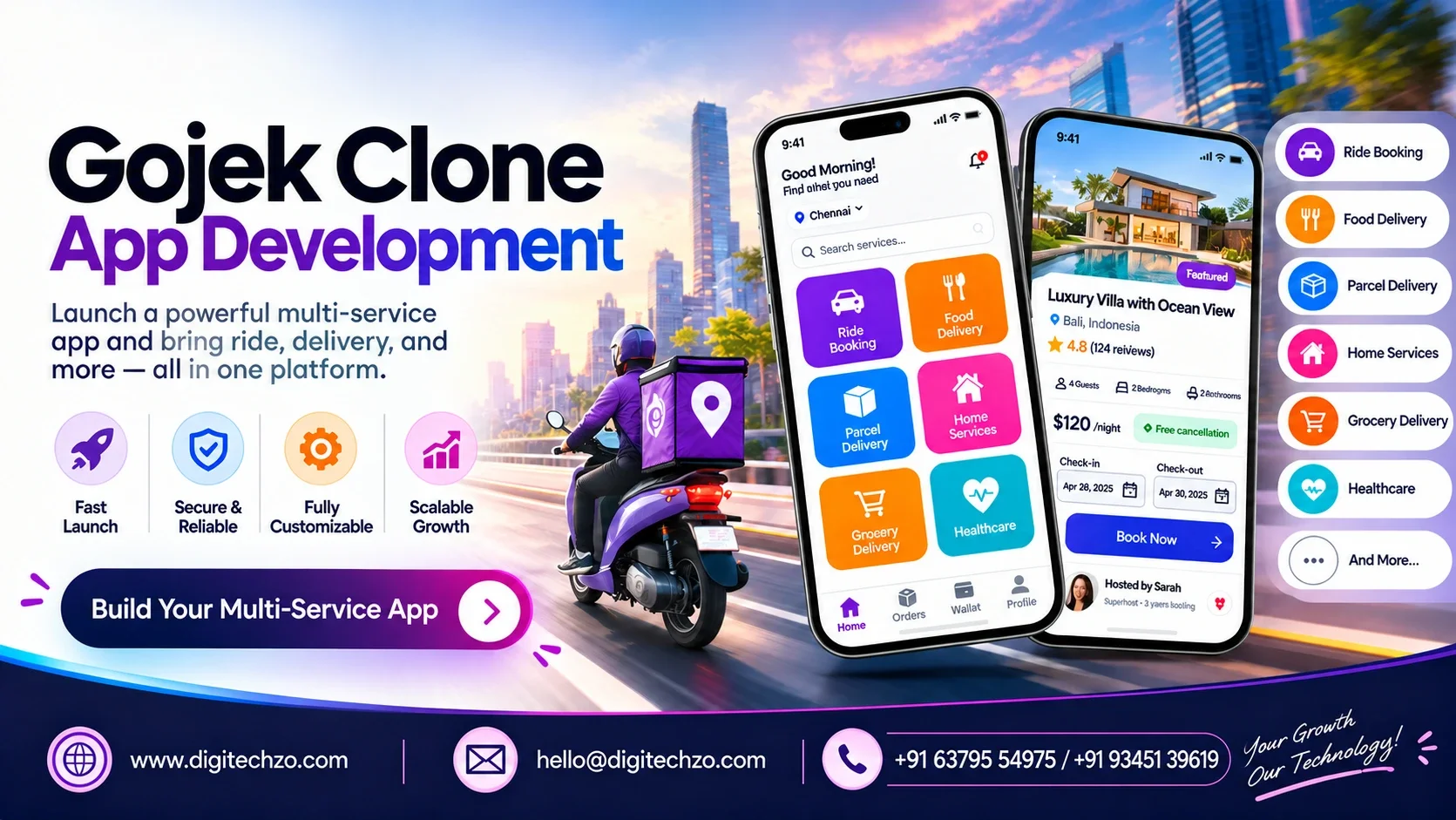
A single-service app competes on one thing: price. A multi-service app competes on convenience, and that is a much harder position for rivals to attack. That is the logic behind the Gojek model, and it is why so many founders search for a Gojek clone before they write a single line of requirements.
The problem is that most advice stops at "pick a script and launch." Real projects fail on different issues: the wrong services launched first, a rigid codebase that cannot add a vertical, no plan to attract providers, and compliance discovered too late. At Digitechzo, we see these as planning problems, not coding problems.
This guide explains what Gojek clone app development actually involves, which modules matter, how to decide between a ready-made script and a custom build, what drives cost and timeline, and how to launch without burning your budget.
A Gojek clone is a multi-service app that brings ride-hailing, food delivery, parcel delivery, home services and similar on-demand services into one platform with a shared user account, wallet and admin dashboard. You can launch it from a ready-made script (faster, less flexible) or build it custom (slower, fully ownable). For most serious businesses, the best path is a modular build that starts with two or three services and adds more as demand proves out.
What Is a Gojek Clone (and What It Is Not)?
Gojek is an Indonesian super app that grew from ride-hailing into a platform covering delivery, payments and everyday services. Its parent company, GoTo, was formed in 2021 through the merger of Gojek and the e-commerce platform Tokopedia. A Gojek clone is a platform built on the same business concept: many services, one app, one account.
It is important to be clear about what "clone" means. It means replicating the model and functional logic, not the brand, logo, source code or proprietary content of Gojek. A legitimate Gojek like app development project builds its own identity, its own design and its own code (or properly licensed code). Anyone planning to launch should confirm intellectual property and trademark questions with a qualified lawyer.
A Gojek clone is also not just a taxi app with extra buttons. The hard part is not showing multiple icons on a home screen. It is running several different marketplaces, each with its own supply, pricing, dispatch and support logic, on shared infrastructure.
Why the Multi-Service Model Works
The commercial case for a multi-service business app rests on four practical advantages.
Shared acquisition cost. Once a user installs the app for one service, offering a second or third service costs far less than acquiring a new customer for a new app.
Higher usage frequency. A cab app might be used a few times a week. Add food, groceries, parcels and home services, and the app becomes a daily habit.
Stronger provider retention. Drivers and delivery partners can earn across more than one service, which helps keep them active on your platform instead of switching to competitors.
Resilience. Demand for individual services rises and falls with season, weather and local conditions. A diversified platform smooths that out.
The trade-off is complexity. Every added service multiplies operational, support and quality-control requirements. That is why sequencing matters more than feature count.
Core Modules of a Gojek Clone Solution
A complete platform has three main surfaces, plus supporting services behind them.
Customer App
The customer app is the front door. It needs service discovery, location detection, booking and ordering flows, live tracking, in-app chat or calling, a unified wallet, multiple payment methods, ratings, order history and push notifications. Language support matters more than most teams expect, especially in India where regional languages affect adoption directly.
Service Provider App
Drivers, delivery partners and service professionals need a separate experience: onboarding with document upload, availability toggle, job requests, navigation, earnings dashboard, payout history and support. A weak provider app leads to churn on the supply side, and that is hard to recover from.
Admin Panel
The admin panel is where your business actually runs. It should handle provider verification, service and category management, dynamic pricing rules, commission settings, promo codes, dispute handling, payouts, analytics and content control. In a well-built system, adding a new service category is configuration, not a rewrite.
Service Verticals You Can Offer
You do not need all of these on day one. Pick based on local demand and your operational capacity.
| Vertical | Operational Complexity | Key Requirement |
|---|---|---|
| Bike, auto and cab rides | High | Real-time dispatch, driver compliance, safety features |
| Food delivery | High | Restaurant onboarding, order timing, delivery fleet |
| Grocery and parcel delivery | Medium | Inventory sync or pickup-and-drop logic |
| Home services (cleaning, repair, beauty) | Medium | Scheduling, skill verification, service-based pricing |
| Courier and logistics | Medium | Route handling, proof of delivery |
| Healthcare and wellness services | Medium to High | Provider credentials, privacy handling |
| Rentals and other bookings | Low to Medium | Availability calendar, deposits |
A practical rule: combine one high-frequency vertical (delivery or rides) with one or two lower-complexity verticals (home services, parcel) in your first release.
Features That Separate a Real Platform From a Template
Every vendor lists the basics: registration, booking, tracking, payments. These are the features that actually influence whether the platform succeeds.
- Unified wallet and payments: One balance across services, with refunds, cashbacks and provider payouts handled cleanly.
- Configurable dispatch engine: Matching logic that differs by service (nearest driver for rides, fastest preparation plus distance for food).
- Dynamic pricing controls: Base fares, surge multipliers, discounts and commissions that admins can adjust per service and per city.
- Provider verification workflow: Document checks, background verification where required and re-verification triggers.
- Safety tools: SOS button, trip sharing, masked calling and incident reporting.
- Dispute and support tooling: Order-level history, refund controls and ticketing, so support teams can resolve problems quickly.
- Analytics: Cohort retention, cancellation reasons, provider utilization and unit economics by service.
- Multi-language and multi-currency support: Essential for regional rollout.
These are the capabilities that make a Gojek clone solution operationally sustainable rather than just demo-ready.
Architecture and Tech Stack
The architectural decision that matters most is modularity. A single, tightly coupled codebase makes every new service a risky change. A modular architecture, with separate services for users, bookings, payments, dispatch, notifications and catalog, lets you add or modify one vertical without destabilizing the rest.
| Layer | Common Options | Why It Matters |
|---|---|---|
| Mobile apps | Flutter, React Native, or native Kotlin/Swift | Cross-platform reduces cost and time; native gives maximum performance |
| Backend | Node.js, Java, Go, or Python frameworks | Must handle concurrent real-time requests |
| Database | PostgreSQL or MySQL for transactions; Redis for caching | Reliable payments and fast lookups |
| Real-time layer | WebSockets, message queues | Live tracking and dispatch |
| Maps and location | Google Maps or alternative map providers | Routing, ETA, geofencing |
| Payments | Regional gateways and UPI integrations | Local payment preferences drive conversion |
| Cloud and DevOps | AWS, Google Cloud or Azure with containerization | Scalability, monitoring, uptime |
| Admin web | React or similar web framework | Operational control |
Stack choices should follow your team, market and scale expectations, not trends. Scalability planning, security reviews and API-first design should be built in from the start, since retrofitting them is costly.
How a Multi-Service Business App Makes Money
Most platforms combine several revenue streams:
- Commission per transaction from providers or merchants
- Delivery and service fees charged to customers
- Subscription plans for customers (free delivery, discounts) or providers (priority leads)
- Advertising and featured listings for merchants
- Surge or dynamic pricing, where permitted by regulation
- Wallet float and partnerships, subject to financial regulations
Commission rates should be set against local competitors and, for ride-hailing in India, against the applicable aggregator rules covered below.
Gojek Clone Script vs Custom Super App Development
This is the most important decision in the project, and the honest answer is that both options have a place.
| Factor | Ready-Made Gojek Clone Script | Custom Super App Development |
|---|---|---|
| Time to launch | Fastest | Longer |
| Upfront cost | Lower | Higher |
| Flexibility | Limited to existing structure | Full control |
| Differentiation | Low; many competitors use similar scripts | High |
| Scalability | Depends on the script's architecture | Designed for your growth plan |
| Code ownership | Often licensed, sometimes restricted | Typically full ownership |
| Integrations | Limited or paid customization | Built to your requirements |
| Long-term cost | Can rise with customization and upgrades | More predictable |
When a script makes sense: you are validating an idea in one city, have a tight budget and are comfortable with standard features.
When custom is the better call: you need unique workflows, local payment or compliance integrations, a distinctive brand experience, or you plan to scale across cities and verticals.
A middle path is common: start from a proven foundation, then customize and re-architect the parts that differentiate your business. Before committing, ask any vendor about source code access, upgrade policy, who owns the data and what happens when you outgrow the base product.
Cost and Timeline Factors
Anyone quoting a fixed price without understanding your requirements is guessing. These are the factors that actually move budget and schedule:
| Cost Driver | Effect |
|---|---|
| Number of services at launch | Each vertical adds workflows, testing and support tooling |
| Script vs custom approach | Custom increases upfront effort |
| Platforms | iOS, Android, web admin, merchant panel |
| Design depth | Custom UX and branding vs template |
| Third-party integrations | Payments, maps, SMS, KYC, accounting |
| Real-time complexity | Live tracking, dispatch logic, scale expectations |
| Compliance requirements | Licensing, data protection, safety features |
| Infrastructure | Cloud setup, monitoring, security testing |
| Post-launch support | Maintenance, updates, scaling |
Timeline: A script-based launch can be much faster than a custom build, while a custom multi-service platform is best planned in phases. A realistic structure is an MVP phase with two or three services, followed by iterative releases once real usage data arrives. Expect timelines to depend on scope and integration complexity, and treat any promise of a complete super app in a few weeks with caution.
Budget beyond development as well. Marketing, provider incentives, customer support and operations often cost as much as the app itself in the first year.
Step-by-Step Development Process
- Market and service validation: Study local demand, competitors and unit economics before choosing verticals.
- Requirement definition: Document user journeys for customers, providers and admins for each service.
- Architecture planning: Decide module boundaries, integrations, data model and scaling approach.
- UI/UX design: Design flows for first-time users, repeat users and providers; test with real people early.
- Development: Build backend services, apps and admin panel in iterative sprints.
- Integration: Connect payments, maps, notifications, KYC and communication tools.
- Testing: Functional, load, security and device testing, plus real-world field tests of dispatch and tracking.
- Pilot launch: Release in one city or zone with a controlled provider base.
- Measure and iterate: Track fulfillment rate, cancellations, provider earnings and retention, then expand.
Compliance and Regulatory Considerations (India)
This section is for general awareness and is not legal advice. Rules change, and states often differ, so confirm current requirements with a qualified advisor before launch.
For ride-hailing in India, the Ministry of Road Transport and Highways released revised Motor Vehicle Aggregator Guidelines in 2025. As reported, the guidelines allow surge pricing up to twice the base fare in peak periods and fares as low as half the base fare in off-peak periods, set a minimum share for drivers who bring their own vehicles (reported as 80 percent of the fare), introduce a capped cancellation penalty, and call for driver insurance and regional-language availability. States were given time to adopt the framework, and state-level rules and drafts have differed, so the rules that apply to you depend on where you operate.
Beyond transport rules, plan for:
- Data protection: Collecting location, payment and identity data creates obligations under India's data protection framework.
- Payments: Wallet, payout and payment-gateway rules depend on how you structure money flow. Working with licensed payment partners usually reduces risk.
- Provider verification and labor norms: Document checks, insurance and fair payout practices.
- Consumer protection and food safety: Relevant for delivery and grocery verticals.
Building compliance toggles (configurable fare caps, commission limits, document requirements per city) into the admin panel from day one is far cheaper than retrofitting later.
Launch Strategy: Solving the Two-Sided Cold Start
Every marketplace faces the same problem: customers will not stay without providers, and providers will not stay without customers. A few principles help:
- Launch narrow. One city or even a few neighborhoods, with two or three services. Density beats geography.
- Seed supply first. Onboard providers before aggressive customer marketing, and offer guaranteed earnings or onboarding incentives for the first weeks.
- Pick a hero service. Use your highest-frequency service to bring users in, then cross-promote others through bundles, wallet cashback and in-app prompts.
- Measure unit economics early. If each order loses money and there is no path to improvement, scaling only magnifies the loss.
- Build local partnerships. Restaurants, shops, housing societies and local associations can accelerate trust faster than paid ads.
Common Mistakes to Avoid
- Launching too many services at once. Operations, support and quality control spread thin.
- Choosing a script for its feature count. A long checklist says nothing about code quality, scalability or security.
- Ignoring the provider experience. Poor provider tools lead to poor service quality.
- Treating compliance as an afterthought. Licensing, data and payment rules affect architecture.
- No admin flexibility. If every pricing or commission change needs a developer, growth slows.
- Underbudgeting operations. Incentives, support and marketing decide survival after launch.
- Skipping load testing. Real-time systems fail at peak hours, exactly when it matters.
- Copying brand elements. Imitating the model is fine; imitating the identity creates legal and trust problems.
How to Choose a Gojek Clone App Development Company
Use this checklist when comparing vendors:
- Can they show working multi-service products or comparable platforms, and explain the architecture decisions behind them?
- Do you receive source code access and ownership terms in writing?
- Is the architecture modular and API-first, or a monolith that will be hard to extend?
- How do they handle security, data protection and load testing?
- What is included in post-launch support, and what costs extra?
- Can they integrate local payment, map, KYC and communication services you need?
- Do they give honest advice on scope and phasing, rather than agreeing to everything?
- Is the pricing breakdown transparent, covering customization, hosting, upgrades and support?
A good partner will challenge your scope. If every answer is "yes, no problem," that is a warning sign.
Why Choose DigiTechzo for Gojek Clone App Development?
Choosing a provider for a multi-service platform is a long-term decision, because the codebase, architecture and team you pick will shape how fast you can grow. DigiTechzo is a technology partner that works across mobile apps, software development, AI and blockchain, which matters for a platform like this because a super app touches all of these layers: apps, backend systems, integrations and increasingly intelligent automation. For businesses exploring Gojek clone app development, the useful questions are whether the partner will help you define the right first release, design a modular foundation, and support the platform as it scales, rather than simply deliver a template. If that is the kind of collaboration you are looking for, you can explore DigiTechzo's capabilities and start a conversation at DigiTechzo to discuss your service mix, market and timeline.
FAQs
What is a Gojek clone app?
A Gojek clone app is a multi-service platform modeled on the Gojek concept, combining services such as ride-hailing, food delivery, parcel delivery and home services in one app with a shared account, wallet and admin dashboard.
Is it legal to build a Gojek clone?
Building a platform based on the multi-service business model is generally acceptable, but copying Gojek's brand name, logo, design assets or source code is not. Use your own branding and code or properly licensed software, and confirm specifics with a qualified legal advisor.
How much does Gojek clone app development cost?
There is no single figure. Cost depends on the number of services, whether you use a script or custom build, platforms, integrations, design depth and compliance needs. A phased MVP is the most reliable way to control budget.
How long does it take to build a multi-service app?
A script-based launch is typically faster, while a custom platform takes longer and is best delivered in phases. Timelines depend on scope, integrations and testing requirements.
Should I choose a Gojek clone script or custom development?
Choose a script for fast validation in a single market with standard features. Choose custom development if you need differentiation, specific integrations, scalability across cities or full code ownership.
Which services should I launch first?
Start with one high-frequency service, such as delivery or rides, and add one or two lower-complexity services like home services or parcel pickup. Expand after you see consistent demand.
How does a Gojek-like app make money?
Through commissions, customer service fees, subscriptions, merchant advertising, dynamic pricing where allowed and partnership revenue.
Can a Gojek clone work outside Southeast Asia?
Yes, but it must be localized for payment methods, languages, regulations, service mix and local competitors. The model transfers; the operating details do not.
What technology is used to build a super app?
Typical stacks include Flutter or React Native (or native apps), a backend in Node.js, Java, Go or Python, PostgreSQL or MySQL with Redis, real-time messaging, map APIs and cloud infrastructure.
What is the biggest reason these platforms fail?
Usually operational and strategic issues rather than software: launching too broadly, weak provider supply, poor unit economics or ignoring compliance.