You've built a great product. Your team is talented. Your funding round closed. And yet — three months into launch — pipeline is thin, CAC is climbing, and nobody outside your existing network has heard of you.
This is the single most common failure point for B2B and B2C companies alike: not a product problem, but a go-to-market (GTM) execution problem. Research from CB Insights consistently lists "no market need" and "got outcompeted" among the top reasons startups fail — but dig deeper into most of those post-mortems, and the real issue is usually a GTM strategy that was rushed, generic, or built by people who'd never actually taken a product to market before.
This is exactly the gap a go to market agency is built to close. Instead of hiring a full internal GTM team (which takes 6–12 months and six figures before you see a single qualified lead), you bring in a specialized partner who has already run this playbook dozens of times, across dozens of markets, and can compress your time-to-revenue dramatically.
At Digitechzo, we've sat on both sides of this table — as an in-house growth team and as an external GTM partner — and we've watched the difference a structured, expert-led launch makes versus a scrappy, DIY one. This guide is everything we wish every founder and CMO knew before hiring (or building) a go-to-market function.
A go to market agency is a specialized partner that plans and executes the strategy, positioning, channels, and campaigns needed to launch a product or enter a new market successfully. The best agencies combine market research, messaging, demand generation, sales enablement, and performance tracking into one accountable engagement — helping you reach product-market fit and revenue faster, with less wasted spend, than building the function in-house from scratch.
What Is a Go-To-Market Agency?
A go to market agency is a strategic and execution partner that helps a business successfully introduce a product, service, or brand to a defined market. Unlike a general marketing agency that focuses primarily on campaigns, a GTM agency owns the full arc: market and buyer research, positioning and messaging, channel strategy, launch execution, sales enablement, and post-launch optimization.
Think of it less as "an agency that runs your ads" and more as "an outsourced GTM strategist and execution engine" — one that plugs directly into your product, sales, and marketing teams.
The Core Pillars of Go-To-Market Strategy
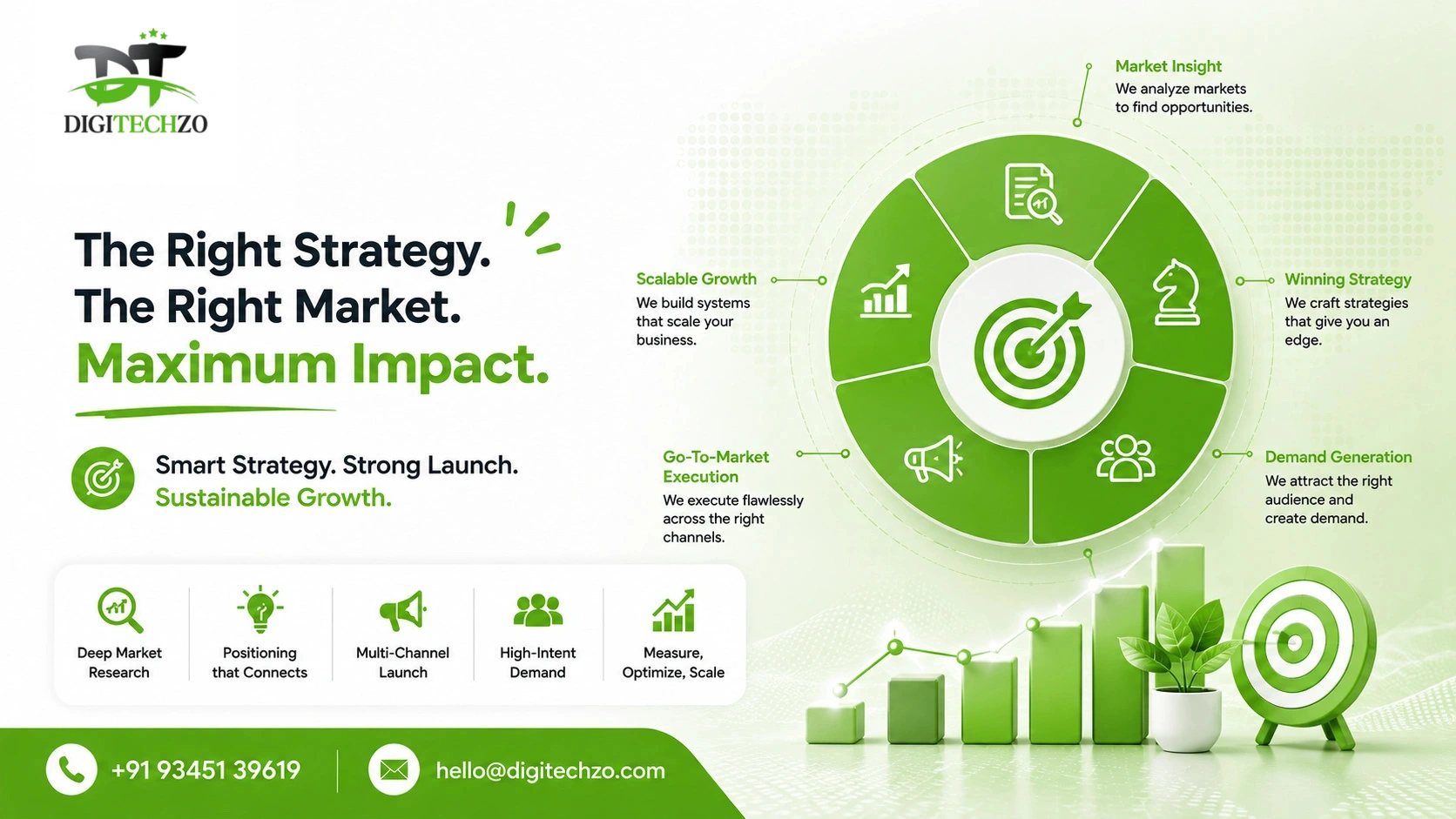
Every credible GTM engagement is built on four pillars:
- Market definition — Who exactly are you selling to, and what's their buying process?
- Positioning & messaging — Why should this specific buyer choose you over the alternative (including "do nothing")?
- Channel strategy — Where does your buyer actually make purchase decisions (SEO, paid, outbound, partnerships, marketplaces, events)?
- Motion & metrics — Is this product-led, sales-led, or a hybrid — and what does success look like at 30/60/90 days?
A go-to-market agency's job is to design and run all four in concert, rather than treating them as separate disconnected projects.
Why Companies Hire a GTM Agency Instead of Building In-House
There are three moments when companies typically reach for an external GTM partner:
- New product launch — An existing company entering a new category or vertical
- New market entry — Expanding into a new geography or customer segment
- Early-stage startup — Founders who need commercial execution but don't yet have (or want) a full internal team
The Real Reason: Speed and Pattern Recognition
The honest answer is simple: an experienced GTM agency has already seen your problem before — many times, across different industries. They've watched which messaging angles convert and which ones get ignored. They know which channels are oversaturated in your category and which are underused. That pattern recognition is nearly impossible to replicate with a first-time internal hire, no matter how talented.
According to Gartner's B2B Buying research, buying groups now typically involve 6–10 stakeholders, each independently gathering information before a purchase decision is made. Coordinating messaging, content, and sales enablement across that many touchpoints is a specialized skill — not a side project for an already-stretched marketing team.
What a Go-To-Market Agency Actually Does
Here's what a full-scope engagement typically includes, broken down by phase.
Phase 1: Discovery & Strategy (Weeks 1–3)
- Ideal Customer Profile (ICP) and buyer persona development
- Competitive and category analysis
- Win/loss interviews with existing customers or prospects
- Pricing and packaging review
- GTM motion decision: product-led growth (PLG), sales-led, or hybrid
Phase 2: Positioning & Messaging (Weeks 3–5)
- Core value proposition and differentiation narrative
- Messaging house (headline, sub-messages, proof points) by persona
- Sales narrative and objection-handling framework
- Website and landing page messaging alignment
Phase 3: Channel & Launch Planning (Weeks 4–8)
- Channel mix selection (SEO, paid search/social, outbound, content, partnerships, PR)
- Launch calendar and sequencing
- Content and creative production
- Sales enablement assets (battle cards, demo scripts, one-pagers)
Phase 4: Execution & Optimization (Ongoing)
- Campaign execution across chosen channels
- Pipeline and conversion tracking by stage
- Weekly/bi-weekly performance reviews
- Iteration on messaging and channels based on real data
In-House Team vs. GTM Agency: A Side-by-Side Comparison
| Factor | In-House GTM Team | Go-To-Market Agency |
|---|---|---|
| Time to first campaign live | 3–6 months (hiring + ramp-up) | 2–4 weeks |
| Upfront cost | High (salaries, benefits, tools) | Moderate (retainer or project fee) |
| Cross-industry pattern recognition | Limited to team's prior experience | Broad, across multiple clients/sectors |
| Long-term institutional knowledge | Strong, stays with the company | Requires deliberate knowledge transfer |
| Flexibility to scale up/down | Difficult (hiring/firing cycles) | Easy (adjust scope or retainer) |
| Day-to-day product intimacy | Very high | Requires ramp-up period |
Pros & Cons at a Glance
In-House Team
- Deep, permanent product and culture knowledge
- Full control over prioritization
- Slow to stand up, expensive to staff for every GTM discipline
- Risk of tunnel vision without external benchmarking
Go-To-Market Agency
- Faster time-to-market, broader experience base
- Access to a full team (strategist, content, paid, sales enablement) without full-time headcount
- Requires strong internal point of contact for alignment
- Quality varies significantly by agency — vetting matters
The strongest setups we've seen aren't "agency vs. in-house" — they're hybrid: a lean internal owner (often a founder, Head of Growth, or CMO) paired with an agency that runs the heavy strategic and execution lift. This is the model most experienced GTM agencies, including Digitechzo, are built around.
How to Choose the Right Go-To-Market Agency
Most comparison articles stop at "check their portfolio." That's not enough. Here's the deeper evaluation framework we recommend to every prospective client.
Ask for a Category-Specific Case Study, Not a Generic One
Any agency can show you a logo wall. Ask instead: "Show me a launch in a market similar to mine, and walk me through what didn't work before you found what did." Agencies confident in their process will happily show the messy middle, not just the polished result.
Understand Their Measurement Philosophy
A good agency will tell you exactly which metrics matter at each stage — pipeline velocity, CAC payback, activation rate, sales cycle length — and which ones are vanity metrics for your specific business model. If an agency leads with impressions or "engagement," be cautious.
Check Alignment on GTM Motion
A PLG SaaS company and an enterprise sales-led business need fundamentally different GTM approaches. Make sure the agency has demonstrated experience in your specific motion, not just your industry.
Clarify Ownership of Assets and Data
Who owns the messaging documents, ad accounts, CRM workflows, and creative once the engagement ends? This should be spelled out in the contract, not assumed.
Evaluate the Team, Not Just the Agency Brand
Ask who will actually be on your account day-to-day. Agency sales pitches are often delivered by senior partners; execution is sometimes handed to junior staff. Meet the actual team before signing.
Real-World GTM Scenarios and What Good Looks Like
Scenario 1: B2B SaaS Entering a New Vertical
A workflow automation company built for marketing teams wants to expand into HR. A strong GTM agency wouldn't just "run the same campaigns with different keywords." They'd rerun ICP research (HR buyers have different pain points and procurement processes), rebuild the messaging house around HR-specific outcomes, and select different channels (HR communities and analyst relationships often outperform paid social in this category).
Scenario 2: D2C Brand Launching a New Product Line
A skincare brand launching a men's line faces a positioning challenge, not just a channel challenge. The GTM work here is largely about differentiated messaging and creative testing across paid social and influencer channels — with rapid iteration cycles based on early conversion data, not a single "big bang" launch.
Scenario 3: Early-Stage Startup, First Commercial Hire
A pre-seed startup with a technical founding team needs commercial validation fast. Here, the agency's job is often to run structured customer discovery alongside light-touch outbound and content, to validate messaging before scaling spend — protecting limited runway.
Each of these requires a different sequencing of the same four pillars. This is why a templated, one-size-fits-all GTM package is usually a red flag.
Common Mistakes Companies Make with GTM Agencies
- Skipping the discovery phase to "move faster." This almost always backfires — campaigns launch on assumptions instead of validated insights, and get rebuilt (at extra cost) weeks later.
- Treating the agency as a vendor instead of a partner. GTM success requires tight collaboration with product and sales. Agencies kept at arm's length underperform.
- No single internal owner. When five internal stakeholders each have a different opinion on messaging, execution stalls. Assign one decision-maker.
- Judging success too early. Most GTM motions need 60–90 days of live data before conclusions are reliable. Pulling the plug at day 30 wastes the investment already made.
- Ignoring sales enablement. Even a brilliant campaign fails if the sales team can't articulate the new positioning on a call. GTM work has to reach the frontline, not just marketing channels.
- Choosing based on price alone. The cheapest proposal is rarely the cheapest outcome once you factor in a failed launch and the cost of relaunching.
Expert Tips for Getting the Most Out of Your GTM Partner
- Give the agency real customer access. The fastest way to derail a GTM engagement is limiting the agency to secondhand information. Let them sit in on sales calls and customer interviews directly.
- Set a 90-day review cadence, not a weekly panic cycle. Weekly check-ins are fine for reporting, but strategic pivots should be evaluated on a quarterly rhythm — GTM motions need time to show statistically meaningful signal.
- Insist on a documented messaging house before any channel spend begins. This single document should answer: who we sell to, what we solve, why us, and what proof we offer — and every piece of content should trace back to it.
- Track pipeline quality, not just volume. A spike in leads that don't convert is often worse than a smaller number of highly qualified ones — make sure your agency is optimizing for the right side of the funnel too.
- Build a shared dashboard from day one. Transparency on live numbers (not a monthly PDF) keeps both sides accountable and speeds up iteration.
Why Choose DigiTechzo for market agency?
A successful go-to-market strategy requires more than launching a product and running campaigns. Businesses need clear market positioning, effective channels, relevant messaging, demand generation, and performance tracking to turn market entry into sustainable growth. Choosing a partner that understands these connected requirements can make the process more structured and focused.
DigiTechzo brings a technology-focused perspective that can help businesses connect their market strategy with their actual products, digital capabilities, and customer requirements. This understanding supports a more practical approach to positioning, audience targeting, and growth planning rather than relying on generic marketing methods.
For B2B businesses seeking a structured approach to entering or expanding within a market, exploring DigiTechzo as a GTM AGENCY FOR B2B BUSSINES provides a relevant way to understand its go-to-market capabilities.
Frequently Asked Questions
What does a go-to-market agency cost?
Pricing typically ranges from project-based engagements (often starting around $10,000–$25,000 for a focused launch strategy) to ongoing monthly retainers (commonly $5,000–$25,000+ depending on scope, team size, and channel mix). Enterprise-level engagements with full execution support can run higher. Always ask what's included — strategy-only engagements cost less than strategy-plus-execution retainers.
How is a go-to-market agency different from a marketing agency?
A marketing agency typically focuses on specific channels or campaigns (SEO, paid ads, content). A go-to-market agency works upstream of that — defining who to target, how to position the product, and which channels and motions make sense — then often manages or coordinates execution across those channels as part of one cohesive strategy.
How long does a typical GTM engagement take to show results?
Most engagements need 60–90 days to move from strategy to live execution with meaningful data. Full GTM maturity — where channels are optimized and sales enablement is fully adopted — usually takes 4–6 months.
Can a go-to-market agency help a company that's already launched?
Yes. GTM agencies are frequently hired for relaunches, repositioning, and market expansion — not just first-time launches. If growth has plateaued or messaging isn't resonating, a structured GTM audit is often the fastest path to identifying the gap.
Do startups need a go-to-market agency, or can founders do it themselves?
Founders absolutely can run early GTM themselves, and many should for initial validation. An agency becomes valuable once a company needs to scale beyond founder-led sales — bringing structure, channel expertise, and execution capacity that's hard to build quickly in-house.