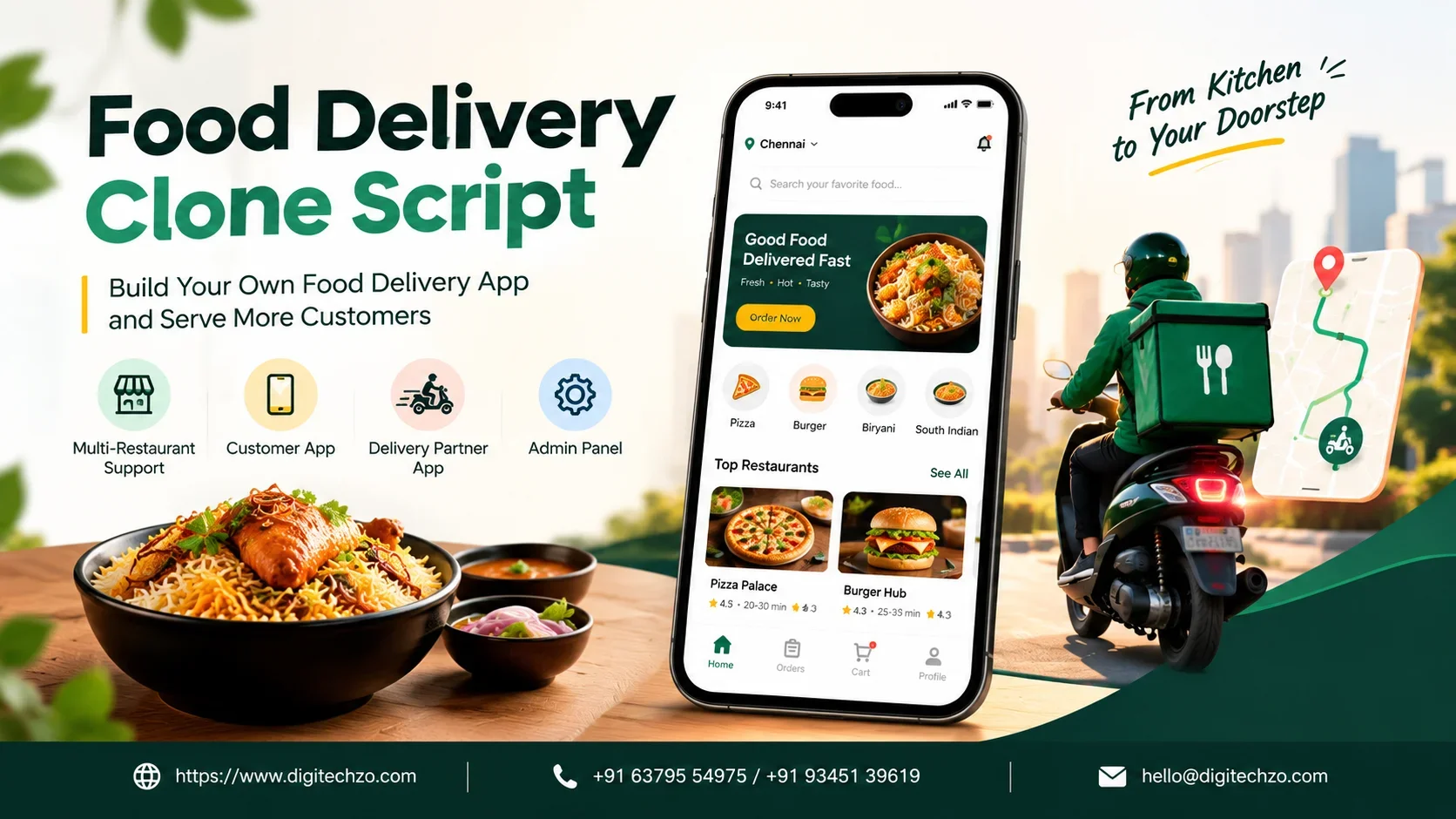
Most founders who search for a food delivery clone script are really asking one question: how do I launch a working food delivery business without spending a year building software from zero? It is the right question, but the honest answer has more layers than most vendor pages admit. The code is only one part. Choosing the right foundation, customizing it for your market, keeping it stable under real order volume, and staying compliant matter just as much.
This guide from DigiTechzo explains what a food delivery clone script includes, how it compares with white-label and custom development, which features matter at launch and which can wait, how to judge source code quality, and what drives cost and timeline. You will leave with a practical framework for deciding whether a clone script fits your plan, and how to avoid the problems that quietly sink first-time platforms.
A food delivery clone script is a pre-built software foundation that replicates the core workflow of platforms like Uber Eats, DoorDash, or Swiggy: a customer app, restaurant panel, delivery partner app, and admin dashboard. It shortens development time and upfront cost, but it is a starting point, not a finished business. The strongest results come from choosing a codebase you fully own, customizing it to your market, and planning payments, dispatch, compliance, and scaling before launch.
What Is a Food Delivery Clone Script?
A food delivery clone script is ready-made software that reproduces the proven functionality of a leading food delivery marketplace so you can launch your own platform without writing every module from scratch. "Clone" refers to the workflow and feature set, not to copying another company's brand, design assets, or proprietary code. A well-built script gives you the standard ordering, payment, tracking, and management modules, which you then adapt: your brand, your cuisine focus, your delivery zones, your commission model.
The four-part ecosystem
A food delivery platform is a multi-sided system. Every serious clone script covers four parts:
- Customer app (iOS, Android, web): browse restaurants, order, pay, and track.
- Restaurant panel: accept orders, manage menus, availability, and payouts.
- Delivery partner app: receive assignments, navigate, confirm pickup and delivery.
- Admin dashboard: control users, commissions, zones, promotions, disputes, and analytics.
If a script is missing any of these four, you are not buying a platform, you are buying a demo.
What a clone script is not
It is not a guarantee of customers, restaurant supply, or delivery capacity. It is not automatically scalable, secure, or compliant, because those depend on how it is built and hosted. And it is not a substitute for a business model. The software is the cheaper half of the problem; building a reliable network of restaurants and riders is the harder half.
Clone Script vs White-Label vs Custom Development
The terms are used loosely, which causes expensive misunderstandings. Here is a practical comparison.
| Factor | Clone script | White-label app | Custom development |
|---|---|---|---|
| Starting point | Pre-built codebase, you modify it | Finished product rebranded as yours | Built from scratch to your spec |
| Speed to launch | Fastest to moderate | Fast | Slowest |
| Upfront cost | Lower | Low to moderate (often plus recurring fees) | Highest |
| Source code access | Usually yes, but verify | Often no, vendor-hosted | Yes, by contract |
| Customization depth | High if you own the code | Limited to vendor options | Unlimited |
| Vendor dependence | Moderate | High | Low after handover |
| Best for | Founders needing speed plus flexibility | Testing a market quickly | Differentiated or large-scale products |
Vendors often advertise very aggressive numbers. One roundup, for example, claims launches in 3-4 working days at roughly $2,500-$3,500. Treat figures like these as the price of a basic installation, not of a production-ready, localized, integrated, tested platform. The gap between "script deployed" and "business running" is where most budgets are actually spent.
A simple decision rule: choose a clone script if speed matters and your model resembles a standard marketplace; choose white-label to validate demand with minimal commitment; choose custom development if your workflow, scale, or competitive edge depends on logic that off-the-shelf software cannot provide. Many successful teams start with a customized clone foundation and replace modules over time.
Choose the Business Model First
Software decisions follow business model decisions. Market research commonly segments food delivery into order-focused, logistics-focused, and full-service delivery systems. In practice:
- Order-focused (marketplace): you list restaurants and take orders; restaurants deliver themselves. Lower operational burden, lower control over experience.
- Logistics-focused: you provide delivery capacity for restaurants that manage their own ordering. Needs strong dispatch and rider management.
- Full-service: you handle ordering and delivery. Highest control and revenue per order, but also the highest operational cost and complexity.
This choice determines which features are essential. A full-service model, for instance, depends heavily on dispatch optimization and rider payouts, while an order-focused multi-vendor food ordering platform leans more on restaurant onboarding, menu tools, and commission handling.
Core Features Every Food Delivery Platform Needs
Feature lists on most pages are long and undifferentiated. Prioritize by who uses them and what breaks the experience if it is missing.
| User | Must-have features at launch |
|---|---|
| Customer | Registration and OTP login, location detection, restaurant and dish search with filters, menu with customization options, cart and promo codes, multiple payment methods, live order tracking, push/SMS notifications, order history and reorder, ratings and reviews |
| Restaurant | Order accept/reject with prep-time input, menu and inventory management, item-level availability toggle, working-hours control, earnings and payout reports, order history |
| Delivery partner | Online/offline status, order assignment with accept/reject, in-app navigation, pickup and delivery confirmation, earnings view, shift/zone management |
| Admin | User, restaurant, and rider management, zone and delivery-fee configuration, commission rules, promotion and coupon engine, refund and dispute handling, reporting and analytics |
Customer app
Speed and clarity decide retention. Reliable search, accurate delivery estimates, and trustworthy tracking matter more than visual extras. Online payment dominates the category, with over 79% of the global food delivery market paid online in 2024, so a smooth, secure checkout is not optional.
Restaurant management software panel
Restaurants judge your platform by how little friction it adds to a busy kitchen. A simple tablet-friendly panel, loud order alerts, and one-tap "out of stock" controls prevent the cancellations that damage your rating. Point-of-sale integration is valuable later, but a clean, fast panel comes first.
Delivery partner app
Riders need low battery drain, reliable GPS, and transparent earnings. Confusing payouts are a leading cause of rider churn, which directly hurts delivery times.
Admin dashboard
This is your control room. At minimum you need real-time order monitoring, configurable fees and commissions, and exportable financial reports. If the admin panel is weak, every operational problem becomes a developer ticket.
Advanced Features That Create an Edge
Once the basics are stable, these features differentiate an on-demand food delivery app from a generic copy:
- Tiered and category-based commissions per restaurant or cuisine.
- Dynamic delivery fees based on distance, time, demand, or weather.
- Order batching so one rider can collect compatible orders, lowering cost per delivery.
- Scheduled and group orders for offices and events.
- Subscription or loyalty programs that reward repeat ordering.
- Personalized recommendations based on order history and time of day.
- Wallet and refund automation to cut support workload.
- Analytics for restaurants, such as best-selling items and peak hours, which makes your platform stickier for supply.
Add these in phases. Teams that launch with every feature typically spend heavily on modules that real users never touch.
Architecture for a Scalable Platform
"Scalable" is the most overused word in clone script marketing. Here is what it should mean technically.
API-first, modular design. The customer, restaurant, rider, and admin apps should all talk to a shared backend through well-documented APIs. This lets you change one app, add a new channel, or integrate third-party tools without rewriting everything.
Real-time communication. Order status, rider location, and kitchen alerts need low-latency updates, typically via WebSockets or a managed real-time service, instead of constant polling that strains servers.
Geospatial engine. Search by distance, zone-based pricing, and rider matching all depend on efficient location queries and a reliable maps provider. Map API usage can become a significant recurring cost at volume, so budget for it.
Dispatch logic. Assignment can start simple (nearest available rider) and evolve toward batching and prediction. A script that hardcodes dispatch rules with no way to extend them will limit you later.
Cloud infrastructure and autoscaling. Dinner-hour demand is spiky. Cloud hosting with autoscaling, caching, and a managed database handles peaks without paying for peak capacity all day.
Payments and security. Use a certified payment gateway so card data never touches your servers, enforce encrypted connections, role-based admin access, and logging. Idempotent payment handling prevents duplicate charges when networks fail mid-order.
Observability. Monitoring, alerting, and error tracking let you catch an outage before customers post about it.
How to Evaluate Food Delivery App Source Code
This is the section most buyers wish they had read earlier. Before you pay for any food delivery app source code, check the following.
| Check | What to confirm | Red flag |
|---|---|---|
| Ownership and license | You receive full source code with clear rights to modify, host, and resell your own platform | Encrypted or obfuscated code, per-installation fees, or vague license terms |
| Code quality | Readable structure, consistent standards, documentation, and basic automated tests | No docs, copied libraries, no tests |
| Technology currency | Maintained framework versions and dependencies | Outdated or end-of-life frameworks |
| Security review | Input validation, secure authentication, protected admin routes, encrypted data | Hard-coded keys, weak password handling |
| Third-party dependencies | Which paid services (maps, SMS, payments) are required and their ongoing costs | Hidden mandatory subscriptions |
| Real demo vs staged demo | A live environment you can test with multiple roles and edge cases | Only screenshots or videos |
| Scalability evidence | How the platform behaves under concurrent orders | Claims without any test data |
| Support and updates | Written support scope, bug-fix terms, update policy | Support that ends after delivery |
| Customization terms | Who builds changes, at what rate, and who owns them | Customizations locked to the vendor |
Ask for a short technical walkthrough with an engineer, not a salesperson. How clearly a vendor answers these questions tells you a great deal about the code.
Cost and Timeline: What Actually Drives Them
Anyone quoting a single price without knowing your scope is guessing. These are the factors that move the number:
- Scope and number of apps: native iOS and Android, web, and four panels cost more than a single cross-platform app and a web admin.
- Customization depth: branding is cheap; new workflows, integrations, or a different business model are not.
- Third-party integrations: payment gateways, SMS, maps, POS, accounting, and tax tools each add integration and recurring cost.
- Localization: languages, currencies, tax rules, and local payment methods.
- Infrastructure: hosting, autoscaling, backups, and monitoring.
- Compliance setup: licensing support, data handling, and audit features.
- Testing and quality assurance: real-device testing and load testing are often under-budgeted.
- Post-launch maintenance: OS updates, bug fixes, and iterative improvements, commonly a meaningful share of the first year's spend.
Timeline follows the same logic. A basic deployment can be fast; a customized, tested, integrated launch usually runs through these stages: discovery and scoping, UI/UX adaptation, backend customization, integrations, testing, soft launch in one zone, and then expansion. Skipping the soft launch to hit a date is a common and costly shortcut.
Budget beyond software: restaurant onboarding, rider incentives, marketing, customer support, and discounts to build early demand often exceed the software cost. Plan the operating runway, not just the build.
Compliance and Regulatory Basics
This section is technical and general information, not legal advice. Requirements differ by country and sometimes by city, so confirm with a qualified local advisor.
Food safety licensing. In India, for example, the regulator has stated that no food business operator can operate on an e-commerce platform without a valid FSSAI license or registration. Guidance also expects platforms to prominently display sellers' licence or registration numbers and hygiene ratings, and to train last-mile delivery personnel in food safety. A platform that both lists restaurants and facilitates orders may itself need a central FSSAI licence. Practically, your onboarding flow should capture and verify restaurant licence details, and your admin panel should let you delist non-compliant outlets.
Payments. Use certified gateways and understand the rules on settlement, refunds, and holding funds on behalf of merchants. Marketplace payouts are regulated in many regions.
Data protection. Customer addresses, phone numbers, and order histories are personal data. Depending on where you operate, laws such as the GDPR or India's Digital Personal Data Protection Act, 2023 may apply, affecting consent, storage, and deletion.
Worker classification and local delivery rules. Rider contracts, insurance, and labor rules differ widely. Get local advice before you scale your fleet.
Intellectual property. Build your own brand, name, logo, and design. Using a leading brand's name or assets because your script mimics its workflow can create trademark problems.
Launching: Supply, Density, and Unit Economics
Food delivery is a local density business. A platform with 200 restaurants spread across a whole city usually performs worse than one with 40 restaurants in a few tight neighborhoods, because delivery times and rider utilization depend on density.
A practical launch sequence:
- Pick a narrow zone and a clear reason customers should choose you, such as local cuisine, a specific community, campus or office clusters, or lower commissions for restaurants.
- Secure supply first: restaurants and riders before heavy customer marketing.
- Soft launch with limited hours or areas, and fix issues before expanding.
- Track unit economics per order: average order value, commission, delivery fee, rider cost, payment fees, discounts, and support cost. If an order loses money, discounts will not fix it.
- Expand zone by zone once delivery times, ratings, and repeat rate are stable.
Market growth is real but should not replace this discipline. Forecasts vary a lot by definition: one analysis projects the global market reaching $1.79 trillion by 2030 at a 10.3% CAGR, while another with a narrower scope valued it at USD 165.11 billion in 2024. Whatever figure you use, your result will depend on local execution.
Common Mistakes to Avoid
- Buying on the demo alone, without checking source code, license, and real performance.
- Skipping business model decisions and then paying to rework dispatch and payouts.
- Launching broad instead of dense, which leads to slow deliveries and poor reviews.
- Underestimating third-party costs such as maps, SMS, and payment fees.
- Ignoring compliance until a restaurant or regulator raises the issue.
- Weak admin tooling, which turns routine tasks into developer work.
- No post-launch plan for updates, security patches, and support.
- Copying a giant's features instead of solving one specific local problem better.
Choosing the Right Food Delivery Platform Development Partner
The script matters, but the team behind the implementation often decides whether the platform survives its first six months. Provider selection should be a deliberate step, not an afterthought, because customization, integrations, security, and post-launch support all sit with whoever you choose.
When evaluating partners, look for clarity on source code ownership, a transparent scoping process, honest timelines, and a willingness to explain trade-offs instead of promising everything. You want a team that can talk about architecture, testing, and compliance as comfortably as design.
DigiTechzo is a technology partner offering AI development, websites, mobile apps, blockchain, software, and growth marketing. For a food delivery project, that mix is relevant: a platform needs strong app and backend engineering, and it also needs a plan for getting visible and acquiring customers once it is live. DigiTechzo's approach is to start from your business model and market rather than from a feature list, define what to customize and what to keep standard, and plan the launch in phases. If you want a second opinion on a script you are considering, or help scoping a food delivery platform solution from scratch, a short discovery conversation is a sensible next step. Bring your target zone, expected order volume, and any vendor quotes you have so the discussion can be specific.