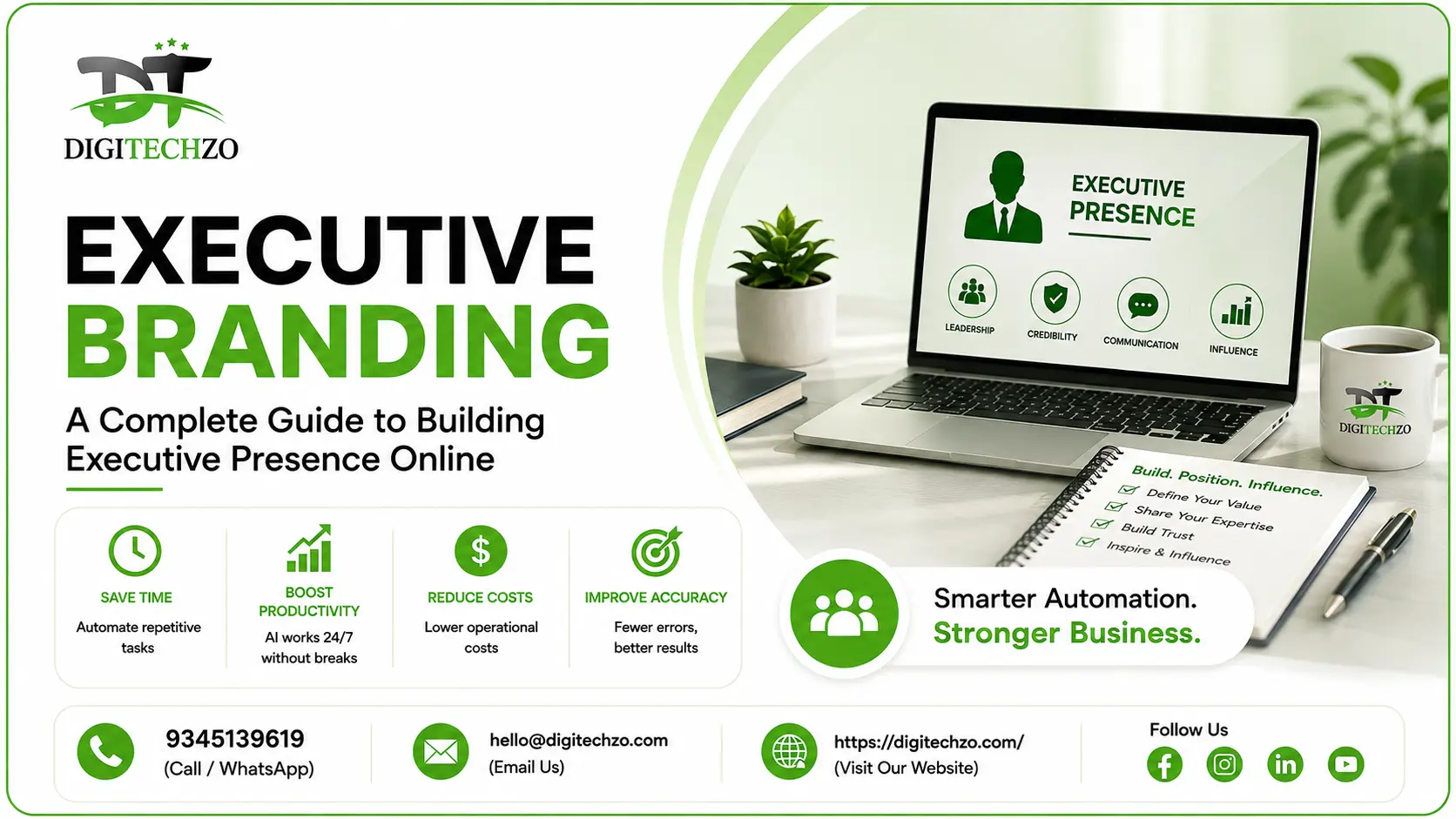
If you Google your own name right now, what shows up? For most senior leaders, the honest answer is: not much — maybe a LinkedIn profile, an old press mention, and a company bio page that hasn't been updated in three years. Meanwhile, your competitors, your prospective investors, and your next big client are all Googling you before they ever get on a call.
That gap between "how capable you actually are" and "what the internet says about you" is the entire problem executive branding solves.
At digitechzo, we work with founders, C-suite leaders, and senior executives who are exceptional at their jobs but invisible online — and we've seen firsthand how a deliberate executive branding strategy changes deal flow, hiring quality, and even valuation conversations. This guide distills that experience into a practical, no-fluff framework you can start using today, whether you're doing it yourself or bringing in a team to help.
Executive branding is the deliberate process of building a leader's public reputation, expertise, and visibility — primarily online — so it accurately reflects their value and earns trust before a conversation even starts. It combines personal brand strategy, content creation, digital PR, and platform optimization (especially LinkedIn) into a system that compounds over time. Done well, it turns an executive's name into a searchable, credible asset for the business, not just the individual.
What Is Executive Branding, Really?
Executive branding is often reduced to "post more on LinkedIn," but that's a symptom of the strategy, not the strategy itself. At its core, executive branding is reputation infrastructure — a system of content, credibility signals, and visibility that answers three questions for anyone who searches your name:
- What does this person actually know?
- Can I trust their judgment?
- Would working with them make my life easier?
A strong executive brand pre-answers these questions before a sales call, a board meeting, an interview, or a press interaction even happens. That's the practical difference between a leader who "has a LinkedIn" and one who has genuine executive presence online.
The Business Case, Not Just the Ego Case
Executive branding isn't vanity work. It has measurable downstream effects:
- Sales cycles shorten when prospects already trust the founder or sales leader they're talking to.
- Hiring improves because top candidates research leadership before accepting offers.
- Fundraising gets easier when investors can verify a founder's thinking pattern through public content.
- Crisis resilience increases because a well-documented track record is harder to distort.
Why Executive Branding Matters Now More Than Ever
Buyer and stakeholder behavior has shifted permanently toward research-before-contact. A few dynamics make this especially true for executives in 2026:
- B2B buying committees vet leadership, not just logos. Enterprise buyers increasingly look at who is running a vendor company, not just what the product page says.
- LinkedIn has become a search engine in its own right. Recruiters, journalists, and partners search LinkedIn directly, bypassing Google entirely.
- AI-generated search summaries pull from public content. When someone asks an AI assistant "who is [executive name]," the answer is built from whatever public content already exists — articles, interviews, LinkedIn posts, podcast transcripts. Silence gets interpreted as absence of authority.
- Talent wants to work for visible leaders. Especially at senior levels, candidates evaluate the leadership team's public thinking before committing.
The practical implication: executive branding is no longer optional positioning — it's a defensive and offensive business asset at the same time.
Executive Branding vs. Personal Branding vs. Corporate Branding
These three terms get used interchangeably, which causes real strategic confusion. Here's the distinction that matters:
| Type | Primary Owner | Primary Goal | Example |
|---|---|---|---|
| Corporate Branding | The company | Product/service trust, market positioning | A company's website, ad campaigns |
| Personal Branding | The individual | Career growth, general reputation, any audience | An influencer's content, a job-seeker's portfolio |
| Executive Branding | The leader, on behalf of the business | Business outcomes tied to leadership credibility | A CEO's LinkedIn thought leadership, founder-led sales content |
Executive branding sits at the intersection: it's personal in voice, but strategic in purpose. A good executive brand strategy always ties back to a business KPI — pipeline, hiring, retention, valuation, or crisis trust — not just follower count.
The Core Pillars of Online Executive Presence
Every strong executive brand rests on four pillars. Skipping any one of them creates a lopsided, less credible presence.
- Visibility
Being findable and consistently active where your audience actually looks — LinkedIn, industry publications, podcasts, panels, Google search results for your name.
- Expertise Signals
Content and credentials that prove depth: original frameworks, data-backed opinions, case studies, speaking engagements, published articles.
- Trust Signals
Third-party validation: press mentions, guest appearances, testimonials, awards, verifiable results — anything that isn't self-reported.
- Consistency
A recognizable point of view, tone, and set of themes repeated over months and years. Inconsistent posting or constantly shifting topics dilutes recall and authority.
How to Build Executive Presence Online: A Step-by-Step Framework
This is the sequence we use with executive clients at digitechzo, adapted for anyone building this independently.
Step 1: Audit Your Current Digital Footprint
Before creating anything new, search your own name in incognito mode, check Google Images, and review your LinkedIn "About" and featured sections as a stranger would. Note gaps: outdated titles, missing links, thin or contradictory information.
Step 2: Define Your Positioning Statement
Write one sentence that captures: who you help, what specific expertise you bring, and what makes your perspective different. Example: "I help SaaS founders scale from $1M to $10M ARR using founder-led sales, without hiring a big sales team too early."
This single sentence becomes the filter for every piece of content you create. If a post doesn't reinforce it, it's noise.
Step 3: Choose Your 3–4 Core Content Pillars
Pick a small number of themes you'll consistently talk about — for example: industry trends, contrarian opinions, behind-the-scenes decision-making, and team/culture lessons. Fewer, deeper pillars outperform scattered topics for recall and SEO.
Step 4: Optimize Owned Digital Assets
- Rewrite your LinkedIn headline to state value, not just title (e.g., "Helping fintech startups navigate compliance-first growth" beats "VP of Product at XYZ").
- Add a personal bio page or press page if you don't have one.
- Ensure your name, title, and photo are consistent across every platform.
Step 5: Publish Consistently, Not Constantly
Two to three high-quality, opinionated posts per week on LinkedIn will outperform daily generic updates. Depth and a distinct point of view earn more trust — and more algorithmic reach — than frequency alone.
Step 6: Pursue Earned Visibility
Pitch yourself for podcasts, panels, and guest columns in your industry's trade publications. Earned media carries more third-party credibility than owned content because it isn't self-published.
Step 7: Repurpose and Compound
Turn one strong LinkedIn post into a newsletter section, a slide for a talk, and a quote for a press pitch. Executive branding compounds when the same core insight shows up in multiple credible places over time.
Executive Branding on LinkedIn: Platform-Specific Tactics
LinkedIn deserves its own section because, for most executives, it's where 80% of the branding work should happen.
What Actually Works on LinkedIn Right Now
- Text-first posts with a strong opening line — the first two lines determine whether "see more" gets clicked.
- Personal stories tied to a business lesson — pure opinion posts perform, but stories with a concrete takeaway perform better and are more memorable.
- Native documents/carousels for frameworks — these tend to get saved, which signals value to the algorithm.
- Genuine comments on others' posts — an underused tactic that builds relationships and visibility in your niche faster than posting alone.
Pros & Cons of LinkedIn-First Executive Branding
Pros:
- Direct access to a professional, high-intent audience
- Content doubles as a searchable asset (LinkedIn posts are indexed by Google)
- Low cost to start compared to PR or paid media
Cons:
- Algorithm changes can affect reach unpredictably
- Requires consistency most executives underestimate
- Easy to sound generic without a distinct point of view
Common Mistakes in Executive Branding
- Outsourcing the voice entirely. Ghostwritten content that doesn't sound like the executive erodes trust the moment they speak differently in person than online.
- Posting without a point of view. Neutral, safe commentary gets ignored. Executive presence requires a defensible opinion, not just information-sharing.
- Treating it as a one-time project.A brand refresh with no ongoing content plan fades within a quarter.
- Ignoring the "About" section and bio pages.Most effort goes into posts while the static assets that convert profile visitors into leads stay outdated.
- Chasing virality over relevance. A viral post to the wrong audience does nothing for business outcomes — reach without relevance is vanity, not branding.
- No measurement.Without tracking inbound mentions, profile views, or pipeline influence, it's impossible to know if the effort is working.
Expert Tips for Long-Term Executive Presence
- Build a "content bank" from real work. Every client call, internal debate, or strategic decision is raw material. Executives who journal these moments never run out of content.
- Say the unpopular thing occasionally. A leader who only agrees with consensus is forgettable. Calculated, well-reasoned contrarian takes build stronger recall than safe agreement.
- Treat your bio like a landing page. It should answer "why should I trust this person" in under 10 seconds, with a clear next step (contact, newsletter, calendar link).
- Separate "brand voice" from "brand topics." Voice should stay consistent; topics can evolve as your role or industry shifts.
- Review and refresh quarterly. Titles change, achievements pile up, and old content ages — treat your digital footprint like a living asset, not a one-time setup.
How to Measure Executive Branding ROI
Executive branding is hard to tie to a single metric, but it's not immeasurable. Track a blend of:
- Leading indicators: profile views, follower growth in your target industry, engagement quality (comments from decision-makers, not just volume)
- Mid-funnel indicators: inbound DMs, meeting requests referencing content, podcast/speaking invitations
- Lagging indicators: sales cycle length for founder-influenced deals, candidate quality in hiring pipelines, press mentions per quarter
The mistake most leaders make is measuring only vanity metrics (likes, follower count) instead of connecting activity to these business-relevant signals.
Why Choose DigiTechzo for Executive Branding?
Executive branding requires a strategic approach that brings together personal positioning, content creation, digital visibility, and consistent communication. For leaders building authority online, the goal is not simply to increase visibility but to create a credible professional presence that strengthens trust and recognition over time.
Digitechzo can help align these elements into a focused digital branding strategy, connecting executive expertise with relevant content, platform optimization, and audience engagement. This approach supports a stronger online identity while ensuring the leader’s personal reputation contributes meaningfully to broader business objectives.
For executives seeking a structured approach to strengthening their visibility, authority, and professional identity across digital platforms, exploring PERSONAL BRANDING SERVICES provides a relevant path toward developing a consistent and recognizable personal brand.
FAQs
What is the difference between executive branding and personal branding?
Executive branding is personal branding applied specifically to business outcomes — it ties a leader's visibility and credibility directly to company goals like sales, hiring, or fundraising, rather than general career growth.
How long does it take to build executive presence online?
Most executives see meaningful traction (inbound messages, recognition in their industry) within 3–6 months of consistent effort, though deeper authority — being recognized as a go-to voice — typically takes 12–18 months of sustained, focused content.
Do I need to be on every social platform to build an executive brand?
No. Most B2B executives get the highest return from focusing deeply on one platform, usually LinkedIn, rather than spreading thin efforts across LinkedIn, X, Instagram, and YouTube simultaneously.
Should I hire a ghostwriter for executive branding content?
A ghostwriter can help with consistency and output, but the strategy, opinions, and core stories should still come from the executive directly — otherwise the content sounds hollow and the brand loses trust when the person speaks differently in real life.
Is executive branding only for CEOs and founders?
No. VPs, department heads, and senior individual contributors increasingly benefit from executive branding, especially in fields like sales, product, and engineering leadership where visibility directly affects hiring and partnership opportunities.