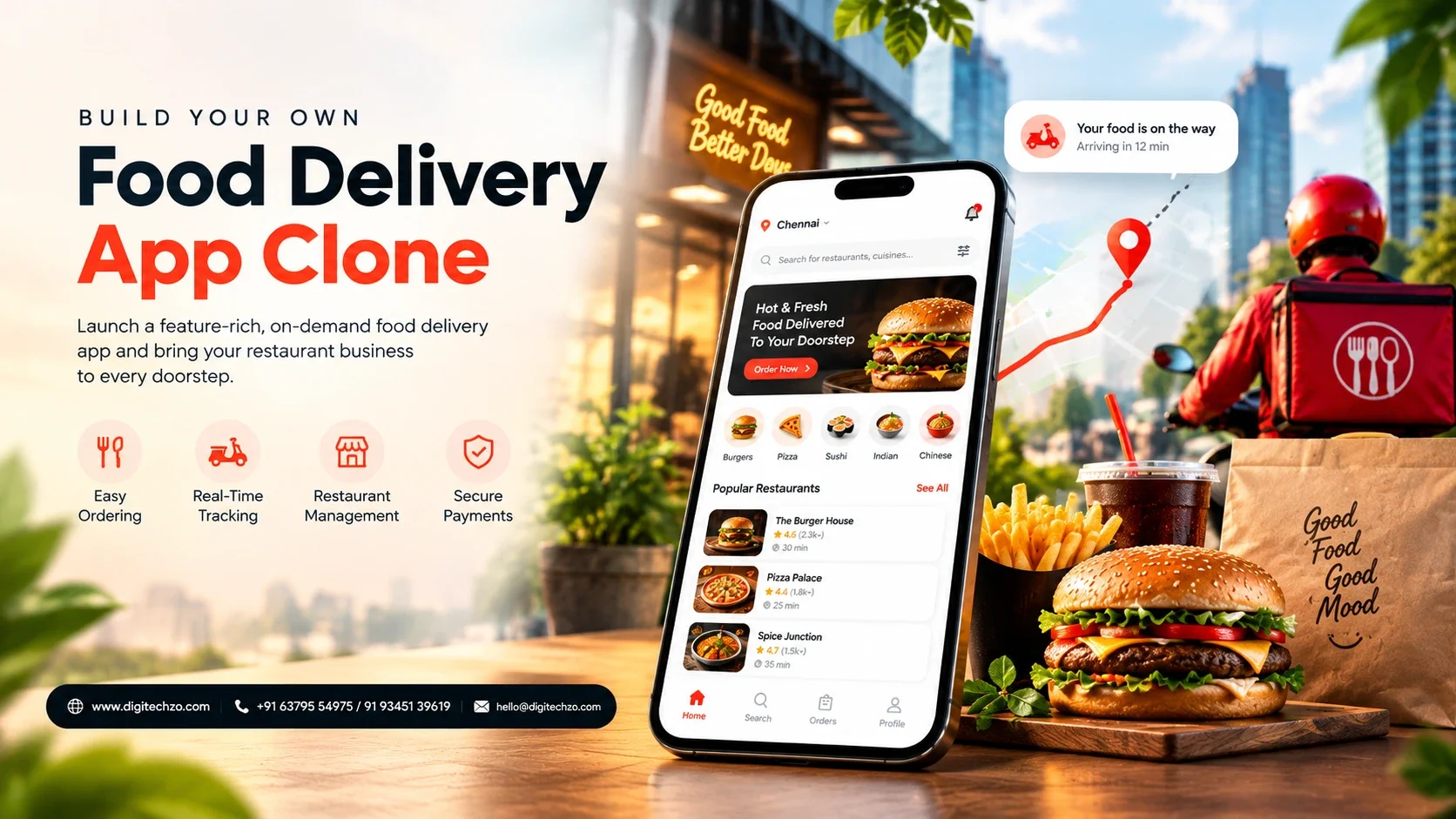
Most founders who search for a DoorDash clone are really asking one question: can I build a profitable food delivery marketplace without spending a fortune or getting the product wrong? The answer depends less on copying screens and more on understanding the three-sided marketplace underneath: customers, restaurants and delivery partners, all of whom must be served at the same time.
At Digitechzo, we see the same pattern in marketplace-style product requests. Founders focus on the app's look and feature count, then discover that dispatch logic, payment splitting, restaurant onboarding and unit economics decide whether the business survives. This guide covers all of it: what a DoorDash clone is, the features that matter, realistic cost ranges, the business model, the build-path options, and the mistakes that sink new platforms.
A DoorDash clone is a food delivery marketplace app inspired by DoorDash's model, with a customer app, a restaurant dashboard, a delivery partner app and an admin panel, launched under your own brand. A realistic budget runs from roughly $20,000 to $40,000 for a lean MVP, $40,000 to $80,000 for a mid-level product, and $80,000 to $150,000 or more for a fully custom, scalable platform. Timelines typically run from about three to eight months, depending on scope. Revenue comes mainly from restaurant commissions, customer fees, delivery fees, subscriptions and advertising.
What Is a DoorDash Clone?
A DoorDash clone is an on-demand food delivery platform that replicates the core workflow made popular by DoorDash. A customer browses nearby restaurants, places an order and pays online. The restaurant accepts and prepares it, a delivery partner picks it up, and the customer tracks it to the doorstep. The platform earns money on each transaction.
What "clone" should and should not mean
"Clone" refers to the business model and feature set, not to copying another company's brand, code, logo, interface assets or trademarks. A legitimate DoorDash clone is built with its own name, identity, design and codebase. Copying protected assets exposes you to legal risk and gives customers no reason to choose you. Your differentiation, whether a niche cuisine, a city, a vertical like groceries or a better restaurant deal, is what actually builds a business.
Why this model attracts entrepreneurs
Food delivery demand is large and recurring, restaurants want incremental orders without building their own tech, and a marketplace can start in a single city and expand zone by zone. The model also layers in extra revenue over time: subscriptions, advertising, grocery and retail delivery, and white-label delivery for restaurants.
How the DoorDash Business Model Works
The three-sided marketplace
DoorDash connects three groups, and each needs a reason to stay:
- Customers want a wide selection, fair prices, accurate delivery times and reliable support.
- Restaurants want orders that are profitable after commission, clear payouts and simple tools.
- Delivery partners want steady, fairly paid work and efficient routing.
If any one side is weak, the other two suffer. Too few drivers means late deliveries, which means unhappy customers, which means fewer orders for restaurants.
Revenue streams
DoorDash's marketplace earns from several sources:
- Merchant commissions. In the US, delivery orders carry tiered commissions: 15% (Basic), 25% (Plus) and 30% (Premier). Pickup orders carry a much lower commission.
- Customer fees. Delivery fees, service fees and membership fees such as DashPass.
- Advertising. Restaurants and consumer packaged goods brands pay for visibility inside the app.
- Commerce platform services. Tools for merchants who run their own online ordering.
For a new platform, the useful lesson is the tiered structure: lower commission for basic visibility, higher commission for greater reach and promotion. It lets you serve small restaurants and ambitious ones with the same product.
Current scale (FY2025)
DoorDash's own annual report shows how large the model can get. In 2025 it completed about 3.2 billion orders, with Marketplace gross order value of roughly $102 billion and revenue of about $13.7 billion. That equals a net revenue margin of roughly 13.4% of order value. It also reported over 56 million monthly active users and more than 35 million members across its subscription programs.
That 13.4% figure matters more than the headline revenue. It shows that even at massive scale, the platform keeps only a small slice of each order after courier costs, promotions and incentives. A new entrant must plan its economics with the same realism.
Essential Features of a DoorDash Clone App
A complete food delivery marketplace is really four products working together.
Customer app
- Quick registration (phone, email, social login)
- Location-based restaurant discovery with search and filters (cuisine, rating, price, delivery time)
- Menu browsing with customizations, add-ons and special instructions
- Cart, promo codes and multiple payment methods
- Real-time order tracking with live map
- Ratings, reviews and reorder
- Order history, saved addresses and push notifications
- Subscription or loyalty program (growth phase)
- Scheduled orders and group ordering (growth phase)
Restaurant app / dashboard
- Menu and pricing management, including item availability toggles
- Order acceptance, rejection and preparation-time updates
- Order notifications that cannot be missed in a busy kitchen
- Earnings, payout reports and sales analytics
- Operating hours, holiday settings and promotions
- POS integration (growth phase)
Delivery partner app
- Onboarding with document verification
- Online / offline availability toggle
- Order requests with pickup and drop details
- In-app navigation and proof of delivery
- Earnings, incentives and payout history
- Performance and ratings dashboard
Admin panel
This is the control room, and it is often under-built.
- User, restaurant and delivery partner management
- Commission, fee and zone configuration
- Dispatch monitoring and manual assignment
- Refund, dispute and support management
- Promotions, banners and push campaigns
- Analytics: order volume, delivery time, acceptance rate, cancellation rate, repeat rate
- Content and policy management
Features by phase
| Phase | Focus | Features |
|---|---|---|
| MVP | Prove demand in one zone | Core ordering, payments, live tracking, basic dispatch, restaurant dashboard, essential admin |
| Growth | Improve retention and margin | Subscriptions, advanced promotions, scheduled orders, ratings-based ranking, multi-language, analytics |
| Scale | Optimize operations | Smart batching, demand heat maps, dynamic delivery fees, ad platform, API integrations, multi-city management |
Launching with the full scale-phase list is one of the most common budget mistakes. Start narrow and expand from live data.
Technology Stack and Architecture
There is no single correct stack, but a typical modern setup looks like this:
- Mobile apps: React Native or Flutter for cross-platform speed, or native Swift / Kotlin for maximum performance
- Backend: Node.js, Python or Java services behind REST or GraphQL APIs
- Database: PostgreSQL or MySQL for transactions, with Redis for caching and real-time state
- Real-time layer: WebSockets or a managed real-time service for tracking and order updates
- Maps and routing: Google Maps Platform or Mapbox for geocoding, routing and ETAs
- Payments: A gateway that supports marketplace split payments and tokenized card storage, such as Stripe Connect or Razorpay Route depending on your market
- Notifications: Firebase Cloud Messaging, Apple Push Notification service and SMS or WhatsApp providers
- Cloud and DevOps: AWS, Google Cloud or Azure with auto-scaling, monitoring and CI/CD
Two architectural decisions deserve early attention. First, design the dispatch engine so it can start simple (nearest available partner) and later support batching and load balancing. Second, keep payments, orders and dispatch as separate services or modules, so a spike in one does not bring down the others.
DoorDash Clone Cost: What You Will Actually Pay
Cost ranges
Published estimates for DoorDash-like apps vary enormously, from under $15,000 to well over $150,000. The spread is large because providers are often pricing very different things. Based on typical market scope, the ranges below are indicative, not quotations:
| Build Level | What's Included | Indicative Cost | Typical Timeline |
|---|---|---|---|
| Lean MVP | Customer app, restaurant dashboard, partner app and admin on a standard architecture, one region | $20,000 - $40,000 | 3 - 4 months |
| Mid-level product | Richer UX, advanced promotions, subscriptions, analytics, third-party integrations | $40,000 - $80,000 | 4 - 6 months |
| Advanced custom platform | Custom dispatch logic, scalable architecture, ads, multi-city, deep integrations | $80,000 - $150,000+ | 6 - 8+ months |
Script-based or white-label solutions sit below these ranges upfront, but they come with trade-offs covered later in this guide. Final cost depends on scope, team location, design depth and integrations.
What drives the cost
- Number of user roles and apps. Four panels cost more than two.
- Platform choice. iOS plus Android plus web costs more than a single platform.
- Dispatch complexity. Manual assignment is cheap; automated, batched, ETA-aware dispatch is not.
- Payment structure. Split payouts, wallets, tips and refunds add backend work.
- UI/UX depth. Custom design and animation cost more than template-based design.
- Integrations. POS systems, SMS, maps, analytics, CRM and accounting tools.
- Compliance needs. Data protection, payment security and local licensing support.
- Team model. Regional rates, agency vs. freelancers, and in-house vs. outsourced.
Ongoing costs founders forget
The build is only part of the investment. Plan for:
- Cloud hosting, which scales with order volume
- Maps, SMS and push notification usage fees
- Payment gateway fees on every transaction
- App store developer accounts
- Maintenance, bug fixes and OS updates (often budgeted at 15 to 20% of build cost per year)
- Customer support operations
- Marketing and driver and restaurant acquisition, which usually exceeds the tech spend
Illustrative Unit Economics
Before choosing features, test whether a single order can make money. The numbers below are a simplified example for understanding the logic, not a forecast.
| Per-Order Item | Illustrative Amount |
|---|---|
| Food order value | $30.00 |
| Restaurant commission (20%) | +$6.00 |
| Customer delivery + service fees | +$4.50 |
| Gross platform revenue | $10.50 |
| Delivery partner payout | -$5.50 |
| Payment processing (~3%) | -$1.00 |
| Maps, SMS, hosting (per order) | -$0.40 |
| Average promotions and refunds | -$1.50 |
| Contribution per order | ≈ $2.10 |
At about $2 per order, fixed costs such as support, marketing and salaries have to be covered by volume. This is why order density, meaning many orders in a small area, matters so much. Dense zones shorten delivery times, allow batching and lower the courier cost per order. Scattering a launch across a whole city usually does the opposite.
Script vs White Label vs Custom Development
This decision shapes your cost, speed and long-term flexibility.
| Factor | DoorDash Clone Script | White Label Food Delivery App | Custom Development |
|---|---|---|---|
| Upfront cost | Lowest | Low to moderate | Highest |
| Launch speed | Fastest | Fast | Slowest |
| Customization | Limited | Moderate (branding, some features) | Full control |
| Code ownership | Often limited or licensed | Usually vendor-owned | Typically yours |
| Scalability | Depends on script quality | Depends on vendor | Designed for your growth |
| Best for | Testing an idea cheaply | Fast branded launch | Differentiated, long-term platforms |
A ready-made script suits a pilot in one neighborhood. If you plan to differentiate through unique workflows, proprietary dispatch, integrations or a new vertical, custom food delivery app development avoids the painful rebuild that often follows a script-based launch. Whichever route you choose, ask who owns the source code, how updates are delivered, and what happens when your order volume grows tenfold.
Development Process and Timeline
- Discovery and market research (1 - 3 weeks). Define your city, niche, delivery model (order-only or order-and-delivery), monetization and success metrics.
- Product planning and wireframes (2 - 3 weeks). Map user journeys for all four roles and prioritize the MVP.
- UI/UX design (3 - 4 weeks). Design for speed and clarity. Restaurant and driver apps must work under pressure.
- Backend and API development (6 - 10 weeks). Orders, dispatch, payments, notifications and admin logic.
- App development (6 - 10 weeks, parallel). Customer, restaurant and partner apps.
- Testing (3 - 4 weeks). Functional, load, payment, GPS accuracy, device and security testing.
- Pilot launch. Start with a limited zone and a curated set of restaurants and drivers.
- Iteration and scale. Use real order data to improve dispatch, fees and retention before expanding.
Common Mistakes to Avoid
- Copying features instead of solving a local problem. Know why customers in your market would switch.
- Launching in too many areas. Thin supply creates bad experiences that are hard to recover from.
- Underbuilding the admin panel. Without good tools, operations teams drown in manual work.
- Ignoring restaurant-side usability. If the kitchen workflow is clumsy, order acceptance drops.
- Skipping unit economics. Fixing a loss-making model after launch is harder than testing it beforehand.
- Weak payment architecture. Poor split-payment or refund logic creates reconciliation nightmares.
- Overlooking compliance. Data protection, payment security, food licensing and courier classification rules vary by country and region. Consult qualified legal advisors for your market.
- Choosing a vendor on price alone. The cheapest quote often excludes dispatch, security, testing or post-launch support.
How to Choose a Food Delivery App Development Company
Use these criteria to evaluate any partner:
- Marketplace experience. Have they built multi-role, real-time products, not just single-user apps?
- Clear scope and pricing. Itemized estimates that explain what is and is not included.
- Architecture thinking. Can they explain how the system scales and how dispatch will evolve?
- Security practices. Tokenized payments, encrypted data, role-based access and secure APIs.
- Source code ownership and documentation. You should know exactly what you own at handover.
- Post-launch support. Monitoring, updates and a plan for growth-phase features.
- Communication. Regular demos, transparent progress tracking and honest answers about risk.
Why Choose Digitechzo for DoorDash Clone App Development?
Choosing the right development partner affects your budget, timeline and long-term product quality more than any single feature decision. A food delivery platform has to work for customers, restaurants and delivery partners at once, and that takes planning beyond screens.
Digitechzo is a technology company working across mobile apps, websites, software development, AI, blockchain and growth marketing. That mix matters for a marketplace launch: the product has to be built well, and it also has to be found and adopted. For businesses planning DoorDash clone app development, we approach the project the way this guide recommends: start with your market and unit economics, define a focused MVP, build on an architecture that can grow, and keep scope and costs transparent. If you want to discuss your idea with a team that can cover both the build and the go-to-market side, you can explore Digitechzo's app and software development capabilities and share your requirements for a scoped recommendation.
FAQs
What is a DoorDash clone?
A DoorDash clone is a food delivery marketplace app that follows DoorDash's core model of connecting customers, restaurants and delivery partners through one platform. It is built with your own brand, design and code rather than copying another company's assets.
How much does it cost to build a DoorDash clone?
Typical budgets range from about $20,000 to $40,000 for a lean MVP, $40,000 to $80,000 for a mid-level product, and $80,000 to $150,000 or more for a fully custom platform. Features, platforms, integrations and the development team's location drive the final figure.
How long does DoorDash clone app development take?
Most projects take roughly three to eight months. A lean MVP can launch in three to four months, while advanced platforms with custom dispatch and multi-city support take longer.
How does DoorDash make money?
DoorDash earns from merchant commissions on orders, customer delivery and service fees, membership subscriptions and advertising from restaurants and consumer brands. Its net revenue margin was about 13.4% of order value in 2025.
Should I use a DoorDash clone script or custom development?
A script suits quick, low-cost testing in a small area. Custom development suits businesses that want differentiation, full code ownership and a platform designed to scale. White-label solutions sit in between.
Which features are essential for a food delivery app like DoorDash?
At minimum: customer ordering and tracking, a restaurant dashboard, a delivery partner app, secure payments, real-time dispatch and an admin panel to manage operations, fees and disputes.
Can I build a multi-vendor food delivery app for a single city?
Yes, and it is usually the smartest way to start. Concentrating restaurants and drivers in one zone improves delivery times and order density, which strengthens your economics before you expand.
Is it legal to build a DoorDash clone?
Building a food delivery marketplace is a common, legitimate business model. What is not acceptable is copying another company's trademarks, logos, code or protected design. Regulations on payments, data protection, food licensing and courier engagement vary by location, so seek local legal advice.