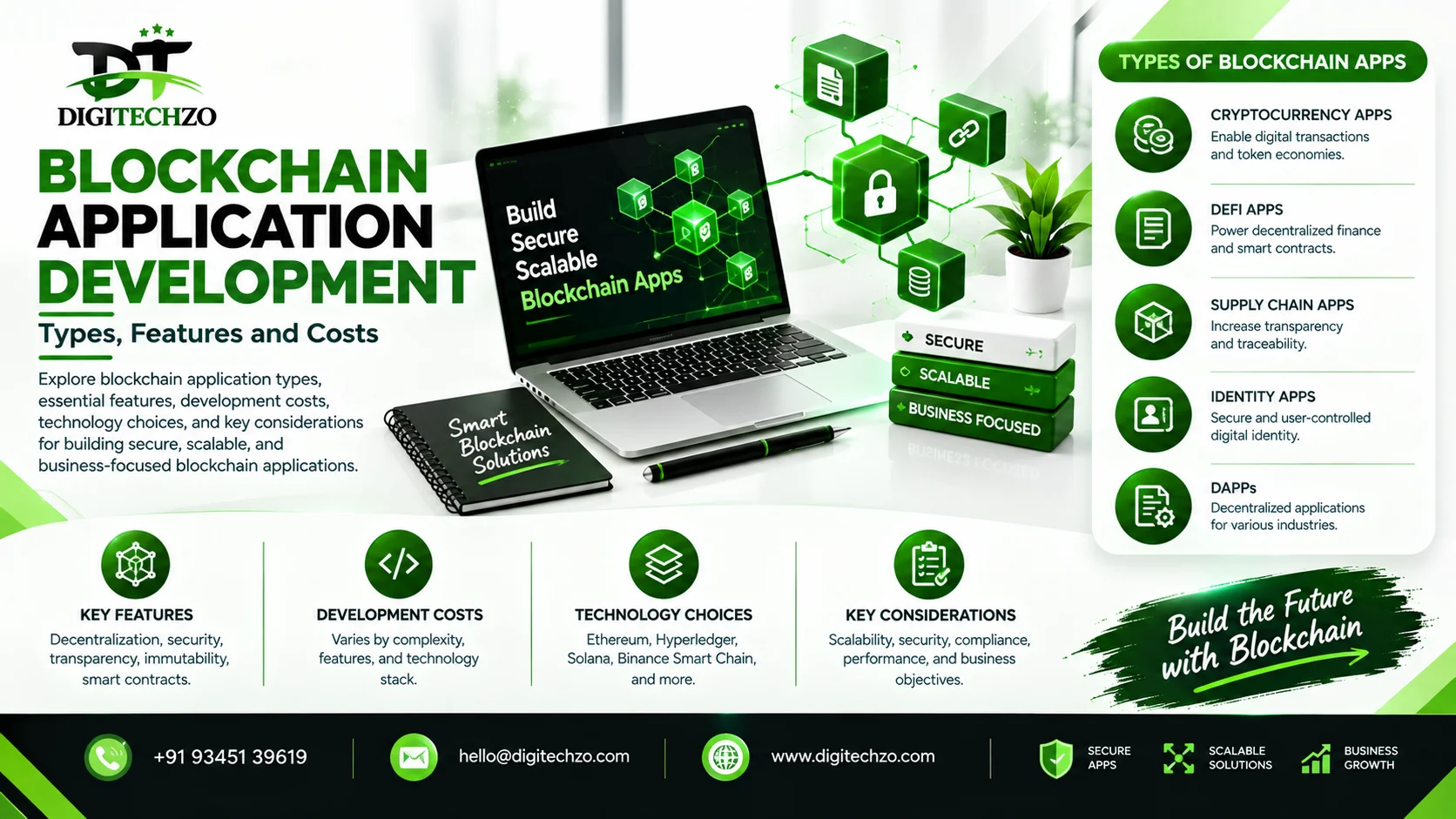
"Blockchain application development" isn't one service - it's at least eight different ones wearing the same name. A DeFi lending protocol, an NFT marketplace, and a permissioned supply-chain tracker all fall under that label, but they share almost nothing in architecture, feature set, or cost.
That mismatch is the most common reason founders get wildly different quotes for "the same" project: two vendors are often scoping two different types of blockchain applications without realizing it. At digitechzo, the first thing we do in any blockchain application development services conversation is nail down exactly which type of application we're actually building - because that one decision determines almost everything downstream.
This guide breaks down the main types of blockchain applications, the features that actually drive their cost, and realistic pricing for each - so you can scope your project accurately before you ever request a quote.
Blockchain application development services span eight main application types - dApps, DeFi platforms, NFT/digital asset platforms, supply chain trackers, identity systems, blockchain games, DAOs, and enterprise/permissioned applications - each with a different feature set and cost profile. Costs range from $20,000 for a simple dApp to $750,000+ for a compliance-heavy enterprise platform, with compliance, interoperability, and governance features driving the largest cost increases.
What Blockchain Application Development Services Actually Cover
Full-scope blockchain application development services typically include six components: discovery and architecture, smart contract development, frontend/backend integration, security auditing, deployment, and post-launch maintenance. A vendor quoting only "development" is usually quoting one of six pieces - which is why comparing quotes without knowing what's included is close to meaningless.
The 8 Main Types of Blockchain Applications
Every blockchain application falls into one (or a combination) of these categories:
Decentralized Applications (dApps)
General-purpose applications where core logic runs on-chain via smart contracts, with a standard frontend layered on top. This is the broadest category and the usual starting point for most projects.
DeFi Applications
Lending platforms, decentralized exchanges (DEXs), and staking protocols. These carry the highest security stakes of any category, since they hold and move real user funds directly.
NFT & Digital Asset Platforms
Marketplaces, minting platforms, and royalty systems for unique digital (or tokenized physical) assets.
Supply Chain & Traceability Applications
Track goods, materials, or documents across multiple parties who don't fully trust each other's internal systems - a common enterprise use case.
Identity & Credentialing Applications
Verifiable credentials, decentralized identity (DID), and academic or professional certification systems that need to be provable without a central authority vouching for them.
Blockchain Gaming Applications
Play-to-earn mechanics, in-game asset ownership, and on-chain economies - technically demanding due to the need for high transaction throughput.
DAOs & Governance Platforms
On-chain voting, treasury management, and proposal execution systems for decentralized organizations.
Enterprise / Permissioned Blockchain Applications
Private or consortium networks where participants are known and vetted, prioritizing controlled access over public trustlessness.
Core Features Every Blockchain Application Needs
Regardless of type, most blockchain applications share a common feature backbone:
- Wallet & identity integration - how users connect and authenticate (MetaMask, Phantom, or enterprise SSO for permissioned networks)
- Smart contract layer - the on-chain business logic
- Consensus & network choice - which blockchain and why
- Security & audit trail - logging, monitoring, and a completed independent audit
- Interoperability - cross-chain bridges or multi-chain support, where relevant
- Governance & access control - who can upgrade, pause, or modify the system
- Tokenomics - for any application involving a native token or reward system
Not every application needs all seven - a simple NFT minting site doesn't need cross-chain interoperability, and a basic identity app doesn't need tokenomics. Scoping which features you actually need (not which ones sound impressive) is where blockchain application cost is won or lost.
What Actually Drives Up Blockchain Application Cost
This is the part most competitor guides skip: not all features cost the same, and the difference isn't intuitive.
| Feature | Cost Impact |
|---|---|
| Basic on-chain data storage/transfer | Low |
| Standard smart contract logic | Low-Medium |
| Wallet integration | Low |
| Oracle integration (external data feeds) | Medium |
| Governance/voting modules | Medium-High |
| Cross-chain interoperability | High |
| Compliance/KYC integration | High |
| Custom tokenomics with complex incentive design | High |
The pattern: anything that requires your application to coordinate trust across multiple systems - other chains, external data sources, or regulatory frameworks - costs disproportionately more than anything that just runs logic within a single chain. This is the single most useful mental model for scoping a realistic budget before you talk to a vendor.
Blockchain Development Cost by Application Type
| Application Type | Typical Cost Range |
|---|---|
| Simple dApp | $20,000 - $80,000 |
| NFT marketplace | $50,000 - $180,000 |
| Identity/credentialing app | $40,000 - $150,000 |
| Supply chain application | $60,000 - $250,000 |
| DAO/governance platform | $35,000 - $200,000+ |
| DeFi application | $100,000 - $350,000 |
| Blockchain game | $150,000 - $550,000+ |
| Enterprise/permissioned application | $150,000 - $750,000+ |
These ranges assume a complete, audited product. For a full breakdown of what makes up those numbers stage by stage, see our detailed blockchain development cost guide.
Custom Blockchain Application Development vs. Off-the-Shelf Solutions
| Approach | Pros | Cons |
|---|---|---|
| Custom blockchain application development | Built exactly to your use case, full ownership of architecture | Higher upfront cost, longer timeline |
| Off-the-shelf / white-label | Fast to launch, lower initial cost | Limited customization, you don't own the core code, harder to differentiate |
Practical rule: white-label works well for validating demand quickly (a basic NFT drop, a simple token launch). Anything meant to be your core product long-term - especially DeFi or enterprise applications - is worth building custom, because the limitations of white-label platforms tend to surface right as you're trying to scale.
Enterprise Blockchain Application Development: What's Different
Enterprise blockchain applications solve organizational problems, not consumer ones - which changes the feature priorities:
- Legacy system integration (ERP, CRM, existing databases) usually takes longer than the blockchain layer itself
- Permissioned networks are far more common than public chains, since participants are known businesses, not anonymous users
- Governance replaces a single admin key with multi-party approval and dispute resolution
- Compliance and audit trails are core requirements, not optional add-ons
If you're scoping an enterprise blockchain application, budget more time for integration and governance design than for the smart contract layer - that's consistently where enterprise timelines slip.
Decentralized Application Development: The Most Common Starting Point
Most companies enter blockchain application development services through a standard dApp - a smart contract layer with a conventional frontend. It's the right starting point for a reason: it's the cheapest way to validate that your use case genuinely benefits from blockchain (see our full guide on how to build a blockchain application for the step-by-step process) before committing to the added complexity of DeFi, cross-chain, or enterprise features.
Common Mistakes
- Scoping "a blockchain app" without specifying the type, leading to wildly inconsistent quotes
- Adding cross-chain or compliance features "just in case" without a concrete near-term need, inflating cost for no real benefit
- Assuming all blockchain application types cost roughly the same to build and maintain
- Choosing white-label for a product meant to be a long-term core asset, then hitting a customization wall at scale
- Underestimating enterprise integration time relative to smart contract development time
Expert Tips
- Name your application type explicitly before requesting quotes - "DeFi lending app" gets a far more accurate estimate than "blockchain app"
- Map your required features against the cost-impact table above before finalizing scope
- Start with the narrowest version of your application type that proves the concept, then add cross-chain or compliance features once demand is validated
- For enterprise applications, scope the integration work first - it usually determines the real timeline more than the blockchain layer does
- Ask any vendor which of the eight application types they have the deepest track record in - expertise doesn't transfer evenly across DeFi, gaming, and enterprise builds
Why Turn Your Blockchain Vision Into Reality With Digitechzo?
Choosing the right development partner matters when blockchain applications range from dApps and DeFi platforms to NFT ecosystems, identity solutions, DAOs, and enterprise applications. Each type requires a different approach to architecture, features, security, scalability, and cost.
Digitechzo brings relevant expertise across blockchain architecture, smart contract development, Web3 applications, DeFi, tokenization, DApps, crypto platforms, security, scalability, and blockchain integrations. This technical breadth helps businesses evaluate the right technology approach based on their application requirements rather than following a one-size-fits-all model.
Whether the goal is a focused dApp or a more complex enterprise blockchain platform, understanding the development capabilities behind the project is essential. Businesses can explore Digitechzo's capabilities as a BLOCKCHAIN DEVELOPMENT COMPANY to better understand how blockchain requirements can be translated into practical applications.
FAQs
What are the main types of blockchain applications?
The eight main types are decentralized applications (dApps), DeFi platforms, NFT/digital asset platforms, supply chain applications, identity systems, blockchain games, DAOs, and enterprise/permissioned applications.
What features should every blockchain application have?
At minimum: wallet/identity integration, a smart contract layer, a defined consensus/network choice, and a completed security audit. Interoperability, governance modules, and tokenomics are added based on the specific application type.
How much does blockchain application development cost?
Costs range from $20,000 for a simple dApp to $750,000+ for a compliance-heavy enterprise platform. The application type and feature set - particularly compliance, cross-chain support, and governance - are the biggest cost drivers.
What's the difference between a dApp and a regular blockchain application?
A dApp is the general-purpose baseline: core logic on-chain, standard frontend. Other blockchain application types (DeFi, DAOs, enterprise systems) are more specialized versions built on the same underlying principles, with additional features layered on top.
Should I build a custom blockchain application or use a white-label solution?
White-label works well for quickly validating demand on a simple use case. Custom development is worth the higher upfront cost for anything meant to be a long-term core product, especially DeFi or enterprise applications, since white-label platforms tend to hit customization limits right as you try to scale.