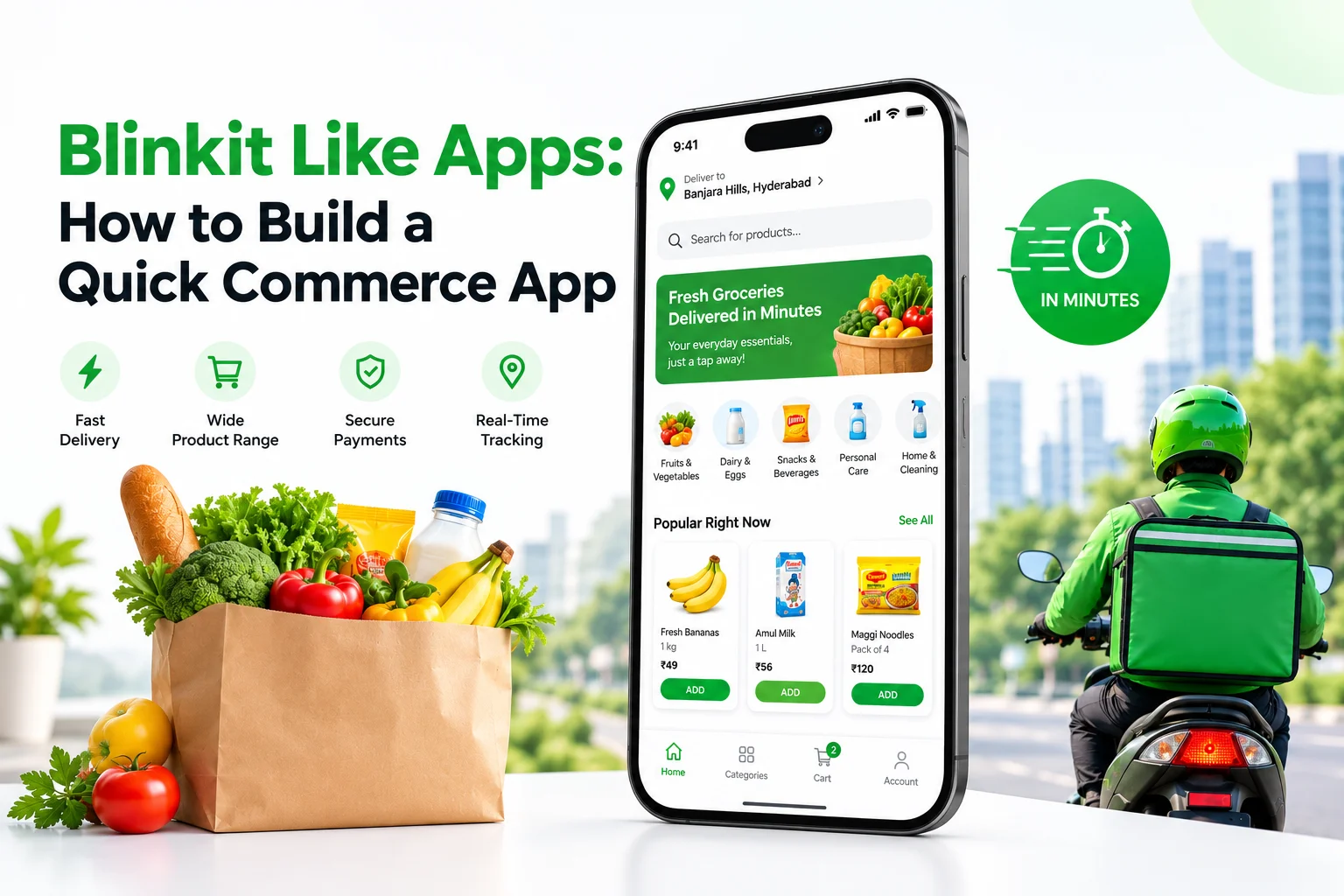
Plenty of founders look at Blinkit and see an app. They think about the product grid, the cart and the countdown timer. What actually delivers a bag of groceries in minutes is a tightly run network of dark stores, inventory accuracy and rider dispatch logic, with the app on top. A Blinkit-like app that copies the screens and skips the operations will look right and still perform badly.
This guide covers what a Blinkit-style quick commerce platform really involves, which features matter, how the technology fits together, what drives cost and timeline, where builds commonly fail, and how to judge whether this model suits your business.
A Blinkit-like app is a hyperlocal quick commerce platform that connects customers to nearby dark stores and delivers essentials in roughly 10 to 30 minutes. It needs four connected products: a customer app, a rider app, a dark store picking app and an admin dashboard. They are backed by real-time inventory, dispatch and payment systems. The app is the visible part. Delivery speed and margins depend mostly on inventory accuracy, store location and operations design.
Why Quick Commerce Became a Serious Business Model
Quick commerce in India has moved from experiment to a major retail segment. According to an Equirus report, the segment is projected to reach about Rs 1.08 lakh crore in 2026, growing around 40% year on year, roughly double the pace of overall digital commerce. The same report puts the combined dark store network of Blinkit, Swiggy Instamart and Zepto at 5,026 locations in May 2026, up from 3,405 a year earlier.
Company-level numbers show how concentrated the market is. Based on FY26 figures reported in an investor comparison, Blinkit handled about 916.6 million orders, ahead of Zepto at 640.2 million and Swiggy Instamart at 412.2 million. Flipkart Minutes, BigBasket, Amazon and JioMart are also competing hard for the same customers.
Two points matter if you plan to build. Dark store counts and market-share figures vary by source, date and city coverage, so treat any single number as a snapshot. And quick commerce is still a small slice of overall retail, which means large neighborhood-store networks remain the default for most households. That leaves room for regional and category-focused players who serve a specific area well, rather than trying to beat national platforms everywhere.
How Blinkit Like Apps Actually Work
The dark store model
A dark store is a small fulfillment center that works like a retail store but is closed to walk-in customers. It stocks a curated range of fast-moving items, usually groceries, household goods, personal care and snacks, and its layout is built for speed of picking rather than browsing.
The model works because of proximity. Each store serves a small delivery radius, so a rider's trip is short. The software has to keep the customer's view of stock aligned with what is physically on the shelf. If the app shows an item that is actually out of stock, you get a cancelled order or a substitution, and both hurt trust and margin.
Where the 10 minutes go
"10-minute delivery" is a budget, and it helps to break it into stages:
| Stage | What happens | What the software must do |
|---|---|---|
| Order confirmation | Payment, address and stock check | Fast checkout, reliable stock validation |
| Order assignment | Order routed to the nearest serviceable store | Geofencing, store-level catalog |
| Picking | Staff collect items from shelves | Optimized pick lists, barcode scanning |
| Packing | Items bagged and checked | Order verification, handover trigger |
| Rider assignment | Nearest available rider is matched | Real-time dispatch, load balancing |
| Last-mile ride | Rider travels to customer | Routing, live tracking, ETA updates |
| Handover | Order delivered | Delivery confirmation, feedback |
Treat this as a planning framework, not an official breakdown from any platform. Its value is diagnostic. Whenever delivery times slip, the delay can usually be traced to one stage. For example, slow picking points to store layout or pick-list logic, while slow assignment points to dispatch rules. The best systems measure each stage separately so teams know where to act.
Core Features Every Quick Commerce App Needs
Customer app
The customer experience has to be fast and low-friction. Key capabilities include:
- Phone-number or OTP-based login and saved addresses
- Location detection with serviceability checks
- Store-specific catalog showing only what is available nearby
- Search with typo tolerance, plus category browsing
- Cart, coupons and multiple payment options, including UPI, cards and wallets
- Real-time order tracking with live ETA
- Substitution preferences and refund handling
- Reorder shortcuts, since repeat purchases drive most grocery volume
Rider app
Riders need simplicity and reliability. Typical features include shift management, order acceptance, turn-by-turn navigation, customer contact through masked calling, proof of delivery, earnings view and issue reporting. Battery use and network tolerance matter more here than visual polish.
Dark store / picker app
This is the most overlooked product. It should provide guided pick lists sorted by shelf location, barcode scanning, stock-in and stock-out entry, expiry tracking, cycle counts and packing checks. Inventory accuracy in the store depends on this app being quick enough that staff actually use it.
Admin and operations dashboard
Operators need catalog and pricing management per store, order monitoring, rider and store performance reports, refund and complaint handling, promotion controls and delivery-time analytics by stage. Without this, you cannot find problems or improve the operation.
Technology Architecture Behind Instant Delivery
Backend and real-time systems
Quick commerce relies on real-time updates: live stock, rider location, order status. Most builds use a modular or microservices-style backend, with event-driven communication for orders and dispatch, caching for catalog reads, and WebSockets or push-based updates for tracking. A common starting point is a well-structured modular backend that can be split into services as volume grows. Splitting too early adds complexity without benefit.
Inventory and catalog
Each dark store needs its own inventory view. Sound design includes store-level stock records, reserved-stock logic during checkout, low-stock alerts, batch and expiry handling for perishables, and integration paths for supplier or ERP data. If your business already uses a billing or ERP system, plan the integration early, since it often decides whether inventory stays accurate.
Dispatch and routing
Dispatch decides which rider takes which order. Basic systems assign the nearest free rider. Stronger ones consider rider load, batching of nearby orders, predicted preparation time and traffic. Maps and routing services are usually integrated from established providers rather than built from scratch.
Payments and security
Plan for UPI and card payments through a compliant payment gateway, along with refunds, wallets and cash-on-delivery handling where relevant. Security basics include encrypted data in transit and at rest, role-based access for staff, rate limiting, and fraud checks for coupon abuse and fake orders. If you store or process personal data, review applicable data protection requirements with a qualified advisor. This article offers technical information, not legal advice.
AI and data capabilities
AI is useful where it solves a specific problem, and it should not be added for its own sake. Practical uses include demand forecasting to guide store stocking, search ranking and personalization, ETA prediction, and fraud detection. Most of these work better after you have a few months of real order data, so they are typically phase-two investments.
Clone, White-Label or Custom Build?
"Blinkit clone" is a common search term, but the right approach depends on your goals.
| Approach | Best for | Advantages | Trade-offs |
|---|---|---|---|
| Ready-made clone / white-label | Fast market testing, small budgets | Quick launch, lower upfront cost | Limited flexibility, shared code patterns, harder to differentiate |
| Custom build | Businesses with a defined model and growth plans | Control over features, architecture and data; easier integration | Higher cost and longer timeline |
| Hybrid | Teams wanting speed without full lock-in | Start from proven modules, customize key flows | Needs careful code and ownership review |
A useful question to ask: what will make customers choose your app over the dozen already on their phone? If the answer is a niche (organic produce, pharmacy, regional specialties, a specific city or housing community), custom flows and integrations usually justify a custom or hybrid build. If you simply want to test demand in one neighborhood, a leaner starting point may be reasonable. Whichever route you choose, confirm who owns the source code, what the licence terms are, and how scalable the architecture is.
MVP vs Full Platform: Scoping Your Build
Not every business needs every feature on day one.
| Scope | Typically includes | Suitable when |
|---|---|---|
| MVP | Customer app, basic rider app, simple admin panel, one or a few stores, core payments | Testing one locality or category |
| Growth platform | Picker app, advanced inventory, dispatch rules, promotions, analytics, multi-store management | Operations are proven and expanding |
| Scale platform | Demand forecasting, dynamic routing, advanced fraud tools, deep ERP integrations, multi-city support | Order volume justifies deeper automation |
A phased path keeps early spending proportionate and lets real operating data shape later investment. The exception is the store-side system. Even an MVP should include basic inventory tracking, because stock errors damage the customer experience quickly.
Cost and Timeline Factors
No honest article can give one price for a Blinkit-like app, because the range is wide. These factors move cost and timeline the most:
- Scope: Number of apps (customer, rider, picker, admin) and platforms (Android, iOS, web)
- Inventory complexity: Single store vs many, perishables, ERP integration
- Dispatch sophistication: Simple nearest-rider assignment vs batching and predictive routing
- Third-party services: Maps, payment gateway, SMS/OTP, notifications and cloud hosting, which are usually recurring costs
- Design effort: Custom UX vs a standard template
- Security and compliance work: Data handling, payment requirements, audit needs
- Testing and launch: Load testing, pilot rollout, store-staff training
- Ongoing costs: Maintenance, monitoring, feature updates and support after launch
As a general planning guide, a focused MVP is commonly measured in a few months, while a multi-app platform with advanced inventory and dispatch typically takes longer. Ask any provider for an itemized estimate that separates build cost from recurring costs, and treat vague single-number quotes with caution.
Remember that software is only part of the investment. Dark store leasing, inventory, staffing, riders and marketing often outweigh development spend. Model these alongside the app budget.
Common Mistakes When Building a Blinkit-Style App
Copying the interface and ignoring operations. The app is the smallest part of the system. Delivery performance comes from store design, stocking and dispatch.
Weak inventory accuracy. If the catalog shows items that aren't on the shelf, cancellations and refunds climb. Build stock reconciliation into the workflow from the start.
Launching too broad. Starting in many areas with a large catalog spreads inventory thin and raises wastage. A dense launch in one locality often teaches more.
Ignoring unit economics. Delivery costs, discounts and small basket sizes can erase margin. Track contribution margin per order early, and set minimum order values or delivery fees deliberately.
Skipping the picker and admin tools. Teams often fund the customer app first and discover too late that operations cannot run without store-side software.
Over-engineering early. Complex microservices and AI features before you have real traffic add cost without proven benefit.
Underestimating retention. Acquiring customers with discounts is easy. Retaining them through reliability, range and repeat-order convenience is what builds a business.
Is a Blinkit Like App Right for Your Business?
Quick commerce favors dense urban areas with high order frequency. It tends to suit:
- Regional grocery and supermarket chains that already hold inventory and supplier relationships
- Specialty retailers (organic, pet, pharmacy, gourmet) serving a defined audience
- Residential communities, campuses or townships with concentrated demand
- Brands extending an existing customer base into fast delivery
It is harder for businesses without a clear catchment area, without supply relationships, or without capital for store and rider operations. A hyperlocal model with a smaller radius, a narrower catalog or scheduled delivery can be a sensible alternative where full 10-minute service is not realistic. The goal is to match the service promise to what your operations can actually deliver.
Why Choose DigiTechzo for Quick Commerce App Development
Choosing a development partner for a quick commerce platform is a bigger decision than choosing a generic app builder. The project spans several connected apps, real-time systems and operational workflows, so mistakes in architecture or scoping are costly to fix later. The questions worth asking any provider are these:
- Do they start with your operating model, or with a feature list?
- Can they explain how inventory, dispatch and picking tie together?
- Will you own the source code and data?
- Do they offer phased delivery, and do they provide post-launch support?
- Are cost estimates itemized and realistic?
DigiTechzo is a technology company whose public positioning covers mobile app development, AI development, software development and growth marketing. For businesses planning a Blinkit-style platform, that combination is relevant because the project needs app engineering, data capabilities and a go-to-market plan together. A sensible first step is a scoping conversation that defines your catchment area, catalog, store model and MVP boundaries before any code is written. You can explore DigiTechzo's mobile app development services at digitechzo.com to see how they approach projects like this.
If you want a realistic view of scope, phasing and budget for your own quick commerce idea, a short discovery call with DigiTechzo is a practical way to start.
Frequently Asked Questions
How does the dark store network model work in quick commerce apps?
Dark stores are localized micro-fulfillment hubs strategically placed in high-density urban areas. Unlike standard retail supermarkets, dark stores are optimized strictly for fast picking and packing by dedicated warehouse staff, typically operating within a 2 to 3-kilometer radius to guarantee sub-15-minute deliveries.
What is the estimated cost and timeline to build an app like Blinkit?
Building a functional quick commerce MVP generally ranges from $25,000 to $45,000 and takes around 12 to 16 weeks. A fully customized, enterprise-grade ecosystem with advanced batch dispatch algorithms, dark store ERP, and multi-city scaling typically ranges from $50,000 to $90,000+ across 5 to 7 months.
What core technology stack is recommended for real-time dispatch and tracking?
A reliable quick commerce architecture relies on Node.js or Go for microservices, Redis for real-time caching and geofencing, PostgreSQL for transaction management, and WebSockets/MQTT for live delivery partner telemetry. Frontend client apps are commonly built using React Native or Flutter.
Why do generic e-commerce platforms fail at quick commerce?
Standard e-commerce platforms are built around warehouse shipping with daily inventory updates. Quick commerce requires millisecond-level stock synchronization, geofenced dark store mapping, batch order routing, and immediate driver dispatch. Selling an out-of-stock item breaks the instant delivery promise immediately.
Should I build a custom quick commerce app or use a white-label solution?
If you are validating customer demand in a single geographic pocket, a white-label solution offers a faster, low-risk test. However, if you plan to scale across multiple micro-warehouses with proprietary routing algorithms and custom vendor integrations, a tailored custom architecture prevents platform bottlenecks and high recurring license fees.